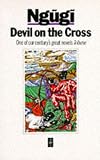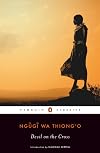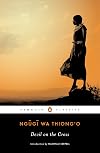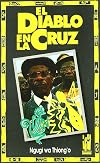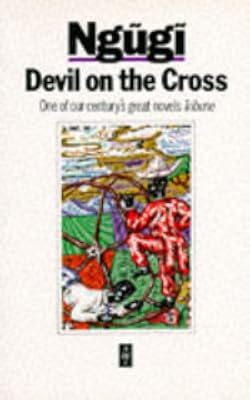
Devil on the Cross
by Ngũgĩ wa Thiong'o
On This Page
Description
"The great Kenyan writer and Nobel Prize nominee Ng?g? wa Thiong?o's powerful fictional critique of capitalism One of the cornerstones of Ng?g? wa Thiong?o's fame, Devil on the Cross was written in secret, on toilet paper, while Ng?g? wa Thiong?o was in prison. It tells the tragic story of Wariinga, a young woman who moves from a rural Kenyan town to the capital, Nairobi, only to be exploited by her boss and later by a corrupt businessman. As she struggles to survive, Wariinga begins to show more realize that her problems are only symptoms of a larger societal malaise and that much of the misfortune stems from the Western, capitalist influences on her country. An impassioned cry for a Kenya free of dictatorship and for African writers to work in their own local dialects, Devil on the Cross has had a profound influence on Africa and on post-colonial African literature"-- show lessTags
Recommendations






Member Reviews
Thiong'o paints a dark, but hopeful picture of post-colonial Kenya. Here is a Kenya where westernized Kenyans profit off of the misery and desperation of their countrymen by emulating and subjugating themselves to western business. Thiong'o's handling of the subject matter is both incredibly personal and comicly satirized. In some ways his choices have a kinship with magical realism. There is a playfulness to his depiction of the the Devil's feast and the frenzied competition amongst the modern thieves and robbers to prove their skill in fleecing their countrymen for their own ends and those of their Western masters.
The book was a much needed counter balance after reading the painfully biased Dead Man Do Tell Tales. But even without my show more need to hear a native African voice this makes for a rousing and passionate read. It offers a revolutionary call not just against the destructive consequences of colonialism, but also an unfliching indictment of globalism and the promotion of profit over people.
Most tellingly one of Thiong'o hyperbolic schemes suggested by one of the theives and robbers is a real thing. They do sell dirt to people by the potful to people too poor to own any land of their own. An idea Thiong'o clearly thought as shameful and ludicrous as selling air. And yet... show less
The book was a much needed counter balance after reading the painfully biased Dead Man Do Tell Tales. But even without my show more need to hear a native African voice this makes for a rousing and passionate read. It offers a revolutionary call not just against the destructive consequences of colonialism, but also an unfliching indictment of globalism and the promotion of profit over people.
Most tellingly one of Thiong'o hyperbolic schemes suggested by one of the theives and robbers is a real thing. They do sell dirt to people by the potful to people too poor to own any land of their own. An idea Thiong'o clearly thought as shameful and ludicrous as selling air. And yet... show less
By far the weakest Ngugi I've read. While it still has some of the same great characterisation and pissed-off political analysis as Petals Of Blood and Wizard Of The Crow, it far too often turns into something that reads more like a play than a novel, where characters representing various factions simply recite long monologues of Post-Colonial Marxism 101 at each other. The fact that he wrote it while imprisoned for political crimes (supposedly, the chapters are of varying length because he wrote it on whatever paper he managed to get a hold of - including toilet paper) probably explains that, the novel is more a call to action than a subtle allegory, but it doesn't necessarily make it a better book. The ending packs one hell of a show more punch, though. show less
Strong and memorable book on post-colonial Kenya, but with dimensions familiar across the modern world and particularly in the former Soviet republics. It is an account of how capitalist drive and individual greed drowned earlier cultural traditions and collective goals. The allegory is in-your-face and didactic, and the magical realism isn't a style that I would normally read, but Ngugi's novels are always powerful.
A book about the devil and his followers on Earth: the capitalists who oppress and exploit the workers.
"The Beautitudes of the rich and the imperialist go like this:
Blessed is he who bites and soothes, because he will never be found out.
Blessed is the man who burns down another man's house and in the morning joins him in grief, for he shall be called merciful.
Blessed is the man who robs another of five shillings and then gives him back half a shilling for salt, for he shall be called generous. As for the man who bites and doesn't know how to soothe,
And the one who steals from the masses and does not attempt to deceive them with honeyed words,
Woe unto him!
For should the masses ever awaken,
Such people will see through their arses, show more
And may even pass on their disease to us,
Who have been able to disguise our wicked deeds
With the religious robes of hypocrisy."
Page 238 show less
"The Beautitudes of the rich and the imperialist go like this:
Blessed is he who bites and soothes, because he will never be found out.
Blessed is the man who burns down another man's house and in the morning joins him in grief, for he shall be called merciful.
Blessed is the man who robs another of five shillings and then gives him back half a shilling for salt, for he shall be called generous. As for the man who bites and doesn't know how to soothe,
And the one who steals from the masses and does not attempt to deceive them with honeyed words,
Woe unto him!
For should the masses ever awaken,
Such people will see through their arses, show more
And may even pass on their disease to us,
Who have been able to disguise our wicked deeds
With the religious robes of hypocrisy."
Page 238 show less
Ngũgĩ was imprisoned by the post-independence government of Kenya when he wrote this satirical and allegorical indictment of the rulers of that government and the business leaders in cahoots with them and US and European corporations. (He wrote it on the only medium available to him, toilet paper.) He also explores the exploitation of women by men. A young woman, Warĩĩnga, who had dreamed of a career as an engineer but has fallen on hard times, thanks to that exploitation, is preparing to journey to her family home when she receives a mysterious card from a mysterious man, advertising a Devil's Feast and competition to select the seven cleverest thieves and robbers -- and it will be held the next day in the very town she is headed show more for. Along the way she meets several other people, and the bulk of the novel concerns them and their interactions with the thieves and robbers, who turn out to be businessmen competing to steal the most from the people and enter the good graces of the foreign corporations. After a dramatic ending, we see Warĩĩnga creating a new life for herself.
This is an angry novel, illustrating the bitterness and frustration of the Kenyan people who saw their hopes of independence dashed as the new leaders of the country concentrated on getting rich and collaborating with foreign corporations to exploit the people. The story is mixed with African poetry and songs, and with a lot of Christian symbolism that I couldn't completely understand. In places, it is perhaps a little didactic, but overall it is impassioned, brave, and important. show less
This is an angry novel, illustrating the bitterness and frustration of the Kenyan people who saw their hopes of independence dashed as the new leaders of the country concentrated on getting rich and collaborating with foreign corporations to exploit the people. The story is mixed with African poetry and songs, and with a lot of Christian symbolism that I couldn't completely understand. In places, it is perhaps a little didactic, but overall it is impassioned, brave, and important. show less
Witty, sarcastic take on corruption, tyranny, and the aftermath of colonialism.
Did it for Sixth Form, I believe.
Was a difficult book to read, because of the bloody, violent imagery to describe Western capitalism's impact on Africa. But the metaphors are accurate, a cautionary tale too many are ignoring.
Was a difficult book to read, because of the bloody, violent imagery to describe Western capitalism's impact on Africa. But the metaphors are accurate, a cautionary tale too many are ignoring.
Members
- Recently Added By
Lists

Best African Books
126 works; 46 members

1980s
356 works; 23 members

Top Five Books of 2015
811 works; 241 members

Read These Too
458 works; 9 members

Writers at Risk
106 works; 17 members

Schomburg Centennial Reading List
100 works; 4 members
Talk Discussions
Past Discussions
Devil on the Cross by Ngũgĩ wa Thiong'o in Author Theme Reads (November 2011)
Author Information

71+ Works 7,499 Members
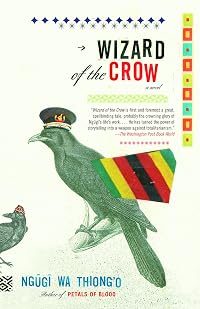
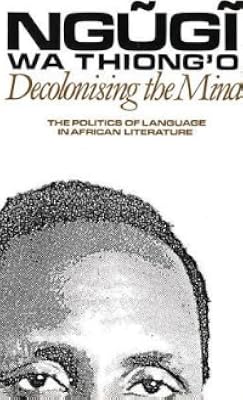
Novelist, playwright, and essayist, Ngugi wa Thiong'o was born in Kenya on January 5, 1938. He received a B.A. in English from Makerere University College in Kampala, Uganda in 1963. He is Kenya's best-known writer and one of East Africa's most outspoken social critics. His first novel, Weep Not, Child (1964), was a penetrating account of the Mau show more Mau uprising (a tribal revolt that occurred in colonial Kenya) and was the first English-language novel by an East African. Two subsequent works, The River Between (1965) and A Grain of Wheat (1967), are sensitive novels about the Kikuyu people caught between the old and the new Africa. One of his major concerns has been the lack of reading materials in native African languages. In an attempt to bring literature to African peasants and workers, he wrote and produced the play I Will Marry When I Want (1977) in his native Kikuyu language. The play, which shows the exploitation of Kikuyu workers and peasants, attracted a large audience of poor Kenyans. It also led to Ngugi's arrest and imprisonment. After his release from prison, he went into exile and is currently living in the United States. His other works include Detained (1981); Decolonising the Mind: The Politics of Language in African Literature (1986); and Matigari (1987). He received the 2001 Nonino International Prize for Literature. In 2006, Random House published his first new novel in nearly two decades, Wizard of the Crow. (Bowker Author Biography) show less
Some Editions
Awards and Honors
Series
Belongs to Publisher Series
Common Knowledge
- Canonical title
- Devil on the Cross
- Original title
- Caitaani mũtharaba-inĩ
- Original publication date
- 1980
- Dedication
- To all Kenyans struggling against the neocolonial stage of imperialism
Classifications
- Genres
- Fiction and Literature, General Fiction
- DDC/MDS
- 896.39 — Literature & rhetoric Literatures of other languages African literatures Niger-Congo languages Bantu languages
- LCC
- PL8379.9 .N4 .C313 — Language and Literature Languages and literatures of Eastern Asia, Africa, Oceania Languages of Eastern Asia, Africa, Oceania African languages and literature Special languages (alphabetically)
- BISAC
Statistics
- Members
- 460
- Popularity
- 66,690
- Reviews
- 7
- Rating
- (3.76)
- Languages
- 9 — Catalan, English, Finnish, German, Kikuyu, Norwegian (Bokmål), Spanish, Swahili, Swedish
- Media
- Paper, Ebook
- ISBNs
- 17
- ASINs
- 5