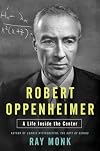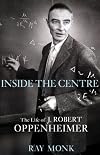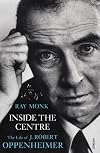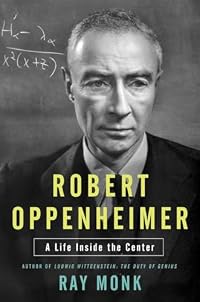
Robert Oppenheimer: Inside the Centre
by Ray Monk
On This Page
Description
"Revered biographer Ray Monk solves the enigma of Robert Oppenheimer's life and personality and brilliantly illuminates his contribution to the revolution in twentieth-century physics. In Robert Oppenheimer, Ray Monk delves into the rich and complex intellectual life of America's most fascinating and elusive scientist, the father of the atomic bomb. As a young professor at Berkeley, the wealthy, cultured Oppenheimer finally came into his own as a physicist and also began a period of support show more for Communist activities. At the high point of his life, he was chosen to lead the Manhattan Project and develop the deadliest weapon on earth: the atomic bomb. Upon its creation, Oppenheimer feared he had brought mankind to the precipice of self-annihilation and refused to help create the far more powerful hydrogen bomb, bringing the wrath of McCarthyite suspicion upon him. In the course of famously dramatic public hearings, he was stripped of his security clearance. Drawing on original research and interviews, Monk traces the wide range of influences on Oppenheimer's development--his Jewishness, his social isolation at Harvard, his love of Sanskrit, his radical politics. This definitive portrait finally solves the enigma of the extraordinary, charming, tortured man whose beautiful mind fundamentally reshaped the world"-- show lessTags
Recommendations
























Member Reviews
From the author's preface:
In this fascinating and engaging biography, I feel the author succeeded to "describe and explain his contributions to physics and to place them in their historical context." Oppenheimer contributed to particle physics and quantum mechanics and the other end of the scale with collapsed stars and black holes. This shows how he ambitiously 'punched above his weight', basically working along Nobel prize winners as an undergrad. The details on the work of Freeman Dyson and Richard Feynman feels like it goes too far from the subject of the biography while helping complete a picture of American physics up to the atom bomb and beyond. His "important role in the history and politics of the twentieth century" seems to revolve around the early development of atomic weaponry and then into a decade plus of questioning him on possible Communist connections. Apparently, and not unusually for the time, he had friends in family that were at least "fellow travelers". This was much smoke with little fire for a man that developed an almost jingoistic enthusiasm for expanding an A-bomb stockpile and developing tactical nukes. With the H-bomb he turned against to internationalist, anti-proliferation attitudes which only increased the heat on him. He made all this worse by fumbling lies to protect friend (Haakon Chevalier) and his brother Frank Oppenheimer. Now for "the singularity of his mind, to the depth and diversity of his intellectual interests" there is a lot about his passion for poetry and literature and languages in much detail. This includes sourcing his famous ""Now I am become Death, the destroyer of worlds" quip and the connection to his Sanskrit teacher.
Overall, this really raised the profile of Oppenheimer in my mind from glorified bureaucrat to original, innovative thinker and master of several, diverse areas of thought. show less
...I was surprised to discover that no full and complete biography of him had, at that point, been written. There was, I said in my review, a really great biography waiting to be written about Oppenheimer, a biography that would attempt to do justice both to his important role in the history and politics of the twentieth century and to the singularity of his mind, to the depth and diversity of his intellectual interests. Such a book would need to describe and explain his contributions to physics and to place them in their historical context. It would need to do the same with regard to his other intellectual interests and to his participation in public life. It would not be an easy book to write. In fact, itshow more
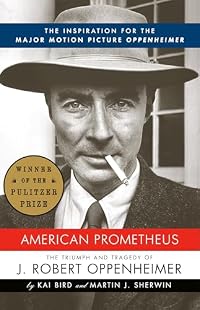
seemed perfectly possible that it would never be written. Since I wrote that review, several books about Oppenheimer have been written and published, which attempt to rise to at least some of the challenges I described. Chief among these is American Prometheus: The Triumph and Tragedy of J. Robert Oppenheimer by Kai Bird and Martin J. Sherwin, a book that was a long time in the making and the result of a staggering amount of research. American Prometheus is a very fine book indeed, a monumental piece of scholarship that I have had at my side ever since it was published. However (partly to my relief, since I was, by the time this book appeared, engaged on my own book), it is not the book I envisaged when I reviewed Smith and Weiner. Though Bird and Sherwin describe in exhaustive detail Oppenheimer’s personal life and his political activities, they either ignore altogether or summarise very briefly his contributions to physics.
In this fascinating and engaging biography, I feel the author succeeded to "describe and explain his contributions to physics and to place them in their historical context." Oppenheimer contributed to particle physics and quantum mechanics and the other end of the scale with collapsed stars and black holes. This shows how he ambitiously 'punched above his weight', basically working along Nobel prize winners as an undergrad. The details on the work of Freeman Dyson and Richard Feynman feels like it goes too far from the subject of the biography while helping complete a picture of American physics up to the atom bomb and beyond. His "important role in the history and politics of the twentieth century" seems to revolve around the early development of atomic weaponry and then into a decade plus of questioning him on possible Communist connections. Apparently, and not unusually for the time, he had friends in family that were at least "fellow travelers". This was much smoke with little fire for a man that developed an almost jingoistic enthusiasm for expanding an A-bomb stockpile and developing tactical nukes. With the H-bomb he turned against to internationalist, anti-proliferation attitudes which only increased the heat on him. He made all this worse by fumbling lies to protect friend (Haakon Chevalier) and his brother Frank Oppenheimer. Now for "the singularity of his mind, to the depth and diversity of his intellectual interests" there is a lot about his passion for poetry and literature and languages in much detail. This includes sourcing his famous ""Now I am become Death, the destroyer of worlds" quip and the connection to his Sanskrit teacher.
Overall, this really raised the profile of Oppenheimer in my mind from glorified bureaucrat to original, innovative thinker and master of several, diverse areas of thought. show less
An interesting read but not as good as [b:American Prometheus: The Triumph and Tragedy of J. Robert Oppenheimer|80571|American Prometheus The Triumph and Tragedy of J. Robert Oppenheimer|Kai Bird|http://d.gr-assets.com/books/1348493895s/80571.jpg|1932215] by Kai Bird and Martin J. Sherwin
The biography to read if you want to understand Oppenheimer as a
scientist. Excellent background on how he was shaped by the events
and people around him.
scientist. Excellent background on how he was shaped by the events
and people around him.
Ratings
Members
- Recently Added By
Published Reviews
ThingScore 50
Oppenheimer was above all a good soldier. That is why he worked so well with General Groves, and that is why Groves trusted him. I have a vivid memory of the ice-cold February day in 1967 when we held a memorial service for Oppenheimer at Princeton. Because of the extreme cold, attendance at the service was sparse. But General Groves, old and frail, came all the way from his home to pay his show more respects to his friend. show less
added by vy0123
Author Information

15+ Works 2,994 Members
Awards and Honors
Awards
Distinctions
Notable Lists
Common Knowledge
- Canonical title
- Robert Oppenheimer: Inside the Centre
- Original title
- Robert Oppenheimer: Inside the Centre
- Alternate titles
- Robert Oppenheimer: His Life and Mind (A Life Inside the Center) (A Life Inside the Center); Inside the Centre: The Life of J. Robert Oppenheimer
- Original publication date
- 2012
- People/Characters
- Robert Oppenheimer
- First words
- J. Robert Oppenheimer, his friend Isidor Rabi once remarked, was 'a man who was put together of many bright shining splinters', who 'never got to be an integrated personality'.
- Last words
- (Click to show. Warning: May contain spoilers.)But it also, Rabi perceptively suggests, was what made him so fascinating and therefore enabled Oppenheimer to become the great man he showed himself to be.
Classifications
Statistics
- Members
- 314
- Popularity
- 101,148
- Reviews
- 3
- Rating
- (4.22)
- Languages
- English, German, Italian
- Media
- Paper, Audiobook, Ebook
- ISBNs
- 11
- ASINs
- 4