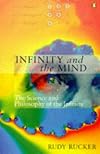
Infinity and the Mind: The Science and Philosophy of the Infinite
by Rudy Rucker
On This Page
Description
A dynamic exploration of infinityIn Infinity and the Mind, Rudy Rucker leads an excursion to that stretch of the universe he calls the "Mindscape," where he explores infinity in all its forms: potential and actual, mathematical and physical, theological and mundane. Using cartoons, puzzles, and "ations to enliven his text, Rucker acquaints us with staggeringly advanced levels of infinity, delves into the depths beneath daily awareness, and explains Kurt Gödel's belief in the possibility of show more robot consciousness. In the realm of infinity, mathematics, science, and logic merge with the fantastic. By closely examining the paradoxes that arise, we gain profound insights into the human mind, its powers, and its limitations. This Princeton Science Library edition includes a new preface by the author. show lessTags
Recommendations















Member Reviews
In the 1981 preface Rucker writes, “This book discusses every kind of infinity: potential and actual, mathematical and physical, the ontological and the mundane.” The main line of argument is mathematical. Rucker uses physics, philosophy and theology as illustrations and examples of mathematical concepts. He also uses mathematical formulas, diagrams and cartoon to illustrate concepts in other disciplines. The five chapters all conclude with a collection of puzzles and paradoxes. This assumes that if the reader has followed and understood the concepts so far you have another chance to exhaust your reasoning powers on these, because with infinities there are things that cannot be logically, mathematically or scientifically described show more fully. Rucker argues that many of the ideas about infinity are not rationally and deductive, but mystical an intuitive. This makes a book that is an active and entertaining mental wrestling match. It also makes it a stimulating, thought provoking, and potentially mind expanding read. show less
I read this book over a longish evening. At the end my mind was so expanded I had difficulty in going to bed! if you are at all curious about infinity, the concept, which, according to Borges "Contaminates and destroys all others", then a look at this book wil satisfy you. Some concepts still elude me, but if Rucker can't make them plain, then probably no-one else can. Perhaps I might suggest a book on flower arranging?
To Rucker I owe the following proof of the falsity of the statement "in an infinite universe, anything is possible". Ti disprove this, we only have to show that something is impossible in our (imaginary) infinite universe. Let's say a planet where everyone has green hair. Now imagine a guide to the planets in the show more universe. This book has an infinite number of pages. Now imagine that we put green-haired planets every other page, with noral planets in between. We can remove the GHP from our guidebook, and it is still infinite. So now we can imagine an infinite universe with no GHPs. So many things are not possible in our infinite universe. This proof is oddly satisfying. Thank you Mr. Rucker. show less
To Rucker I owe the following proof of the falsity of the statement "in an infinite universe, anything is possible". Ti disprove this, we only have to show that something is impossible in our (imaginary) infinite universe. Let's say a planet where everyone has green hair. Now imagine a guide to the planets in the show more universe. This book has an infinite number of pages. Now imagine that we put green-haired planets every other page, with noral planets in between. We can remove the GHP from our guidebook, and it is still infinite. So now we can imagine an infinite universe with no GHPs. So many things are not possible in our infinite universe. This proof is oddly satisfying. Thank you Mr. Rucker. show less
The concept of infinity is one that many people banter around without really grasping its meaning. People use the word almost blithely, but few realize what an astounding, frightening idea it really is. Imagine the largest number you can. Add one to it. Think of the smallest unit imaginable. Cut it in half. Try to grasp your insignificance based on a universe that simply never ends. It's a little scary. In this book, Rucker (best known for his science fiction writing) attempts to explain infinity in terms that laymen can understand. While he often gets bogged down in complex mathematics and occasionally drifts in to New Age territory, there are enough interesting ideas and concepts presented here to make the book a must read for those show more interest in the idea of infinity. Rucker occasionally has a way of explaining this that makes them just click. Despite its flaws, an interesting read.
(This review originally appeared on zombieunderground.net) show less
(This review originally appeared on zombieunderground.net) show less
The contents of this book is best used in 50 lb bags, available at most lawn & garden stores. You would get a better grasp of infinity by overdosing on dextromethorphan than by reading this tripe. The basic concept of a true infinity escapes Mr. Rucker throughout the whole book.
Dive into the concept of infinite sets. How is it the materially finite beings can grasp the varieties of the infinite!
molto disuguale
Devo dire che sono stato piuttosto deluso da questo libro, che pure pare essere un long seller (per quanto possano esserlo i libri di saggistica). Mi pare che Rucker abbia fatto un mischione, tra capitoli matematici molto tecnici - persino io ho avuto qualche difficoltà a seguirli, e il testo dovrebbe essere a livello divulgativo - e capitoli pseudofilosofici, con una contrapposizione tra Uno e Molti che a me sa più che altro di New Age. Diciamo che non penso lo rileggerò mai.
Devo dire che sono stato piuttosto deluso da questo libro, che pure pare essere un long seller (per quanto possano esserlo i libri di saggistica). Mi pare che Rucker abbia fatto un mischione, tra capitoli matematici molto tecnici - persino io ho avuto qualche difficoltà a seguirli, e il testo dovrebbe essere a livello divulgativo - e capitoli pseudofilosofici, con una contrapposizione tra Uno e Molti che a me sa più che altro di New Age. Diciamo che non penso lo rileggerò mai.
Sep 17, 2023Italian
Ratings
Members
- Recently Added By
Published Reviews
Wellicht naar aanleiding van het succes van "De vierde dimensie" (a.i. 86-18-262) is nu ook Ruckers oudere boek "Oneindigheid" (uit 1982) in Nederlandse vertaling op de markt gebracht. Met dezelfde briljante gedrevenheid behandelt Rucker de paradoxale wereld van het oneindig grote en het oneindig kleine, zoals we die in de filosofie en vooral in de moderne wiskunde tegenkomen. Daarbij komen de show more transfiniete getallen, de stelling van Godel, de kunstmatige intelligentie, en zelfs een vleugje oosterse mystiek aan de orde. In tegenstelling tot "De vierde dimensie" is dit boek echter didactisch vrij zwak. De opbouw is rommelig, de uitleg vaak niet helder, en de gemiddelde leek waar het voor geschreven is heeft aardig wat wiskundekennis van universitair niveau nodig om het te kunnen volgen. Bevat puzzels met oplossingen, en een uitvoerige literatuurlijst.
(NBD|Biblion recensie, Drs. D.G. van der Steen.) show less
(NBD|Biblion recensie, Drs. D.G. van der Steen.) show less
added by karnoefel
Author Information

158+ Works 10,537 Members
Rudy Rucker is a mathematician, computer scientist, professor, and writer who has twice won the Philip K. Dick Award for best SF paperback original, and has published a number of successful popular books on mathematical subjects, including The Fourth Dimension and Infinity and the Mind. He lives in Los Gatos, California.
Series
Belongs to Publisher Series
Work Relationships
Has as a commentary on the text
Common Knowledge
- Canonical title
- Infinity and the Mind: The Science and Philosophy of the Infinite
- Original publication date
- 1982
- First words
- The symbol for infinity that one sees most often is the lazy eight curve, technically called the lemniscate.
- Blurbers
- Gardner, Martin
- Original language
- english
Classifications
Statistics
- Members
- 928
- Popularity
- 28,730
- Reviews
- 6
- Rating
- (3.71)
- Languages
- 6 — Dutch, English, Finnish, German, Greek, Italian
- Media
- Paper, Ebook
- ISBNs
- 17
- ASINs
- 8