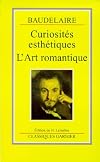
Curiosités esthétiques
by Charles Baudelaire
36 Members (4.00)
On This Page
Tags
Recommendations























Member Recommendations


Member Reviews
Members
- Recently Added By
Author Information

759+ Works 19,270 Members
Charles Baudelaire, 1821 - 1867 Charles Baudelaire had perhaps had an immeasurable impact on modern poetry. He was born on April 9, 1821, to Joseph-Francois Baudelaire and Caroline Archimbaut Dufays in Paris. He was educated first at a military boarding school and then the College Louis-le-Grand, where he was later expelled in 1839. Baudelaire show more then began to study law, at the Ecole de Droit in Paris, but devoted most of his time to debauchery. After an abortive trip to the East, he settled in Paris and lived on an inheritance from his much despised step father, while he wrote poetry. During this period he met Jeanne Duval, a mulatto with whom he fell in love with and who became the "Black Venus," the muse behind some of his most powerful erotic verse. Baudelaire strove to portray sensual experiences and moods through complex imagery and classical form, avoiding sentimentality and objective description. Thus he profoundly influenced the later French symbolist writers, including Mallarme and Rimbaud, and such English-language poets as Yeats, Eliot, and Stevens. With much of his inheritance squandered, Baudelaire turned to journalism, especially art and literary criticism, the first of which were "Les Salons". Here he discovered the work of Edgar Allan Poe, which became an influence on his own poetry. While continuing to write unpublished verse, Baudelaire became famous as critic and translator of Poe. This reputation enabled Baudelaire to publish his most famous collection of poetry, "Les Fleurs du Mal" (The Flowers of Evil) in 1857. The result was an obscenity trial and the banning of six of the poems. Though he continued to write journalism with some success, he became increasingly depressed and pessimistic. Baudelaire attempted suicide in 1845, an attempt to get attention, and became minorly involved in the French Revolution. Today Baudelaire's work is considered the "last brilliant summation of romanticism, precursor of symbolism and the first expression of modern techniques". It was his originality that set him apart and ultimately proved to be his end. Baudelaire died, apparently from complications of syphilis, on August 31, 1867, in Paris. (Bowker Author Biography) show less
Classifications
- Genres
- Nonfiction, Literature Studies and Criticism, History
- DDC/MDS
- 700 — Arts & recreation Arts Arts & Recreation
- LCC
- N6847 — Fine Arts Visual arts History
- BISAC
Statistics
- Members
- 36
- Popularity
- 796,258
- Rating
- (4.00)
- Languages
- English, French, Spanish
- Media
- Paper
- ISBNs
- 8
- ASINs
- 4