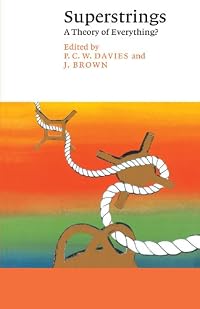
Superstrings: A Theory of Everything?
by P. C. W. Davies (Editor), Julian Brown (Editor)
259 Members (3.19)
On This Page
Description
Superstring theory is one of the most exciting and actively pursued branches of physics today. The far-reaching claims made for this theory would, if correct, provide the much sought-after Theory of Everything, the unification of physics. It would enable the fundamental building blocks of matter to be identified and amalgamated in a common description, with a unified theory of all the forces of nature. This book explains the theory for laymen, in an introduction to the subject which show more originated in the BBC Radio programme, Desperately Seeking Superstrings. A clear, concise, non-mathematical explanation of the theory and its profound implications is followed by transcripts of interviews with all the most important physicists involved in its development. Superstrings makes a fascinating topic at the forefront of modern scientific research accessible to physicists, philosophers and general readers alike. show lessTags
Recommendations
















Member Reviews
Members
- Recently Added By
Author Information

All Editions
Common Knowledge
- Canonical title
- Superstrings: A Theory of Everything?
- Original publication date
- 1988
- First words
- In the last few years a remarkable new theory has captured the imagination of physicists. • • Preface
What is a Theory of Everything? — No science is more pretentious than physics, for the physicis... (show all)t claims to the whole universe his subject matter. • • Introduction
The idea of using strings to model fundamental particles is one that goes back quite a way. • • John Schwarz - Quotations
- "God was invented to explain mystery. God is always invented to explain those things that you do not understand. Now, when you finally discover how something works, you get some laws which you're taking away from God; you don... (show all)'t need him anymore. But you need him for the other mysteries. So therefore you leave him to create the universe because we haven't figured that out yet; you need him for understanding those things which you don't believe the laws will explain, such as consciousness, or why you only live to a certain length of time — life and death — stuff like that. God is always associated with those things that you do not understand. Therefore I don't think that the laws can be considered to be like God because they have been figured out. ~ Richard P. Feynman
- Last words
- (Click to show. Warning: May contain spoilers.)One thing is agreed: the stakes have never been higher for any scientific enterprise. • • Introduction
(Click to show. Warning: May contain spoilers.)Now it's developing so rapidly that it's impossible to keep up with the literature — I get a pile of new papers every day — and one can easily spend one's time just reading them and not doing anything else at all! • • John Schwarz - Original language
- English
Classifications
Statistics
- Members
- 259
- Popularity
- 123,965
- Rating
- (3.19)
- Languages
- 5 — Chinese, English, German, Greek, Spanish
- Media
- Paper
- ISBNs
- 8
- ASINs
- 1