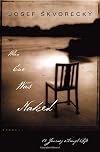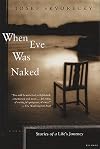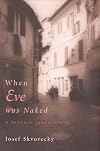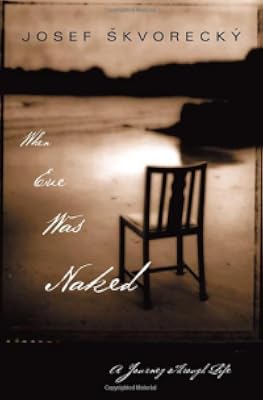
When Eve Was Naked: Stories of a Life's Journey
by Josef Škvorecký
On This Page
Description
This autobiography in stories, When Eve Was Naked, takes us through a most remarkable life, from the innocence of prewar Prague through the horrors of the Nazi occupation and World War II. In the title story, narrated by Skvorecky's alter-ego Danny Smiricky, seven-year-old Danny falls in love for the first time; at sixteen he hides in a railway station and watches as his Jewish teacher is herded onto a train and taken away; and in 1968, as Russian tanks rolled into Prague, Skvorecky flees show more Czechoslovakia, taking Danny with him. In the collection's final stories, Danny begins his tenure as Professor Smiricky at a Canadian university and attempts to come to terms with the politically innocent and self-centered youth that flock to his courses. show lessTags
Recommendations



















Member Reviews
This collection of short stories spans fifty years of Skvorecky's life, from his childhood in Nachod to a university in Toronto. Many are related by Skvorecky's fictional counterpart, Danny Smiricky.
Danny traces the destruction of Jewish life in Koslovo, the fictional Nachod. He sees his primary school teacher taken to the camps; a once-respected doctor is unable to practise medicine or even to speak to his former patients; people return from the camps to find that their neighbours deny all knowledge of the valuables left with them for safe keeping; Czech children abuse the Jewish schoolmates who were once their closest friends. Through the years, Danny remembers the Jewish people he once knew.
In "Spectator on a February Night," show more written in 1948, Danny witnesses the Communist coup. Life under Communism is bleak: intellectuals and liberals like Danny are exiled to remote cities; jazz is banned; Czech patriots are executed; people live sad lives without hope. This is a different Danny Smiricky from the ebullient, sardonic narrator of The Cowards. show less
Danny traces the destruction of Jewish life in Koslovo, the fictional Nachod. He sees his primary school teacher taken to the camps; a once-respected doctor is unable to practise medicine or even to speak to his former patients; people return from the camps to find that their neighbours deny all knowledge of the valuables left with them for safe keeping; Czech children abuse the Jewish schoolmates who were once their closest friends. Through the years, Danny remembers the Jewish people he once knew.
In "Spectator on a February Night," show more written in 1948, Danny witnesses the Communist coup. Life under Communism is bleak: intellectuals and liberals like Danny are exiled to remote cities; jazz is banned; Czech patriots are executed; people live sad lives without hope. This is a different Danny Smiricky from the ebullient, sardonic narrator of The Cowards. show less
The book, like many of his, is semi-autobiographical, with the inimitable Danny Smirecky, jazz-loving cynic and lothario, standing in for Skvorecky. The stories in the book are written over a period of 40 years, and are arranged to reflect the major periods in Skvorecky's life (childhood, Nazi occupation, communist rule, emigration to Canada). Although the stories are not linked by common narrative threads, when put together they clearly read as a sort of autobiography.
There is a huge range of quality to the stories. The ones written about his youth left me worried that Skvorecky was a writer who, while excelling in long prose, hadn't mastered the shorter form. However, as I read on, I was blown away by some of his pieces. The strange show more juxtaposition of frail, self-interested humanity with earth-shattering events is something he has done brilliantly in novels such as The Cowards. He does this in his short stories with equal deftness. In particular, Smiricky's search for love and sex in an imploding Czechoslavakia, and the Canadian professor's wry observations of his callow students (and himself) were every bit as well done as in his novels. Everything is shot through with a beautifully pitched sense of humour. This was another big plus in Skvorecky's win column for me, and a spur to read even more of his books. show less
There is a huge range of quality to the stories. The ones written about his youth left me worried that Skvorecky was a writer who, while excelling in long prose, hadn't mastered the shorter form. However, as I read on, I was blown away by some of his pieces. The strange show more juxtaposition of frail, self-interested humanity with earth-shattering events is something he has done brilliantly in novels such as The Cowards. He does this in his short stories with equal deftness. In particular, Smiricky's search for love and sex in an imploding Czechoslavakia, and the Canadian professor's wry observations of his callow students (and himself) were every bit as well done as in his novels. Everything is shot through with a beautifully pitched sense of humour. This was another big plus in Skvorecky's win column for me, and a spur to read even more of his books. show less
Ratings
Members
- Recently Added By
Author Information

87+ Works 3,315 Members
Josef Skvorecky was born in Nachod, Czechoslovakia on September 27, 1924. Under Nazi occupation, he was forced to work in an aircraft factory. He later read Philosophy at Charles University in Prague. He worked for the state publishing house, helping to translate books by Ernest Hemingway, William Faulkner and Raymond Chandler. He began to write show more detective stories featuring Lieutenant Boruvka, which became popular with Czech readers. In 1958, his novel The Cowards was published and then banned on the grounds that it was "Titoist and Zionist." He and his wife moved to Canada after the 1968 Soviet-led invasion of Czechoslovakia that crushed the liberal reforms known as the Prague Spring. They founded 68 Publishers in 1971, which released more than 200 books by exiled Czech authors and those banned by the communists. Skvorecky's other written works include Miss Silver's Past, The Engineer of Human Souls, and The Miracle Game. In 1980, he received the Neustadt International Prize for Literature. He taught at the University of Toronto. He died on January 3, 2012 at the age of 87. (Bowker Author Biography) show less
Classifications
- Genres
- Fiction and Literature, General Fiction
- DDC/MDS
- 891.8 — Literature & rhetoric Literatures of other languages East Indo-European and Celtic literatures West and South Slavic languages (Bulgarian, Slovene, Polish, Czech, Slovak, Serbo-Croatian, and Macedonian)
- LCC
- PG5038 .S527 .A2 — Language and Literature Slavic languages and literatures. Baltic languages. Albanian language Slavic. Baltic. Albanian Slavic Czech
- BISAC
Statistics
- Members
- 69
- Popularity
- 450,427
- Reviews
- 2
- Rating
- (3.75)
- Languages
- English
- Media
- Paper, Ebook
- ISBNs
- 5
- ASINs
- 3