On This Page
Description
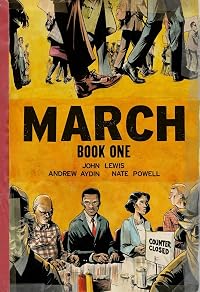
Congressman John Lewis (GA-5) is an American icon, one of the key figures of the civil rights movement. His commitment to justice and nonviolence has taken him from an Alabama sharecropper's farm to the halls of Congress, from a segregated schoolroom to the 1963 March on Washington, and from receiving beatings from state troopers to receiving the Medal of Freedom from the first African-American president.Now, to share his remarkable story with new generations, Lewis presents March, a graphic show more novel trilogy, in collaboration with co-writer Andrew Aydin and New York Times best-selling artist Nate Powell (winner of the Eisner Award and LA Times Book Prize finalist for Swallow Me Whole).March is a vivid first-hand account of John Lewis' lifelong struggle for civil and human rights, meditating in the modern age on the distance traveled since the days of Jim Crow and segregation. Rooted in Lewis' personal story, it also reflects on the highs and lows of the broader civil rights movement.Book One spans John Lewis' youth in rural Alabama, his life-changing meeting with Martin Luther King, Jr., the birth of the Nashville Student Movement, and their battle to tear down segregation through nonviolent lunch counter sit-ins, building to a stunning climax on the steps of City Hall.Many years ago, John Lewis and other student activists drew inspiration from the 1958 comic book Martin Luther King and the Montgomery Story. Now, his own comics bring those days to life for a new audience, testifying to a movement whose echoes will be heard for generations.. show less
Tags
Recommendations


Member Reviews
In March: Book One John Lewis, Andrew Aydin, and Nate Powell tell the story of John Lewis' youth in Alabama, how he developed his sense of justice, and his early work to help desegregate lunch counters. Visiting with his Uncle Otis in Buffalo, NY helped open Lewis' eyes to a world in which blacks and white lived side-by-side in a major city and could shop and eat together. The trip North also showed him how inhospitable parts of the racist South were as his Uncle had to plan his trip based on where they could and could not stop for fear of violence. Lewis uses the inauguration of President Barack Obama in 2009 as a framing device, perhaps to create a sense of how the historic inauguration of America's first African American president show more was but one instant in a long line of historic feats. Lewis refers to the "spirit of history taking hold of [his] life" (pg. 73) and his use of the inauguration as a framing device serves to link all the struggles of the past with the successes of the present. It also cautions that the successes are not a foregone conclusion. This book brilliantly tells its narrative and Powell's art conveys the emotions Lewis experienced in his youth and the horrors he witnessed far better than simple prose could. In this, the book works as a teaching tool, much like the Martin Luther King and the Montgomery Story comic from 1956 that Lewis read in his youth. show less
John Lewis, noted Civil Rights Activist and Georgia Congressman, can now add another fabulous moniker to his name: National Book Award Winner. On November 16th, 2016, he won the National Book Award (in the Young Readers category) for his book “March: Book 3”, the conclusion to his autobiographical graphic novel series about his time during the Civil Rights Movement. I caught his acceptance speech, and like many other people, cried deeply because I was so happy for him, and it clearly meant so so much on so many levels. By total coincidence, I had just read “March: Book 2” that morning. It had been awhile since I read “Book 1”, and was playing catch up. So then all I had to do was wait for “Book 3” to come in, vowing that show more once it did I was going to review the entire work as a whole. Because that’s what the “March” Trilogy is: it’s one large story about a remarkable man during a tumultuous time, a story about a movement that changed the nation and a movement that seems all the more relevant today. So I waited. And “Book 3” finally came in for me. So now, let me tell you about this fabulous series.
“March: Book 1” starts with Lewis’s childhood as the son of a sharecropper in rural Alabama and goes through the Lunch Counter Protests in Nashville. From a young age Lewis had a drive and a passion to lead and learn, his early aspirations of being a preacher evolving into the leadership and commitment that he put forth while in the Nashville Student Movement, and then into the broader Civil Rights Movement as a whole. “March: Book 2” talks about his time with the Freedom Riders and the violence they faced during their non violent protests and demonstrations, all leading up to the March on Washington and Martin Luther King Jr.’s “I Have A Dream” speech. This book deals more with the growing aggression of the white citizens and government, as well as the Federal Government starting to waffle and teeter and struggle with the role that it should be playing. It’s also the book that shows Lewis and his own inner struggles, as while non violence is always the mission and the goal, his resentment and anger threatens to boil over. “March: Book 3” is the conclusion, and addresses Freedom Summer, Voting Rights, and Selma. And this story is told all within the frame of the Inauguration of President Barack Obama. Stunning framework, absolutely beautiful. There are multiple parallels between things in “Book 1” that come up again in “Book 3”, and there are themes that link all of them together not just with Lewis, but with other prominent figures as well. Lewis sets out to tell all of their stories as best he can, and the result is one of the best damn graphic novel series I have ever read.
This series is so powerful and personal, and it goes to show just how remarkable John Lewis is. He’s one of the ‘Big Six’, aka one of the most influential members of the Civil Rights Movement, and one of the only ones left, as he reminds us in “Book 1”. These books are very straight forward and simple, but they are so honest and personal that the power they have is immense. I found myself crying many times during my reads of all these books, but also laughing, and cheering, and seething. Lewis brought out so many emotions in me with his story, and his immense talent as a storyteller comes through, just as his charisma does. We get to see the story of the Civil Rights Movement through his eyes, and he tells us the stories of those involved within the movement and those who influenced it from the outside as well. Yes, at times these books are violent, and upsetting, but they need to be, because the horrors that fell upon many people during their non violent protests must never be forgotten. I think that the entirety is an accomplishment, but I understand why they gave the National Book Award to “Book 3”. After all, while it is probably symbolic of awarding the whole darn thing, I think that “Book 3” was the most powerful in terms of emotion being served, be it pride, fear, rage, or determination. It certainly was the one that had me weeping from the get go, as the very first moment was the bombing of the 16th Baptist Church that killed four little girls. The violence is absolutely horrifying, but it cannot be forgotten or glossed over. It absolutely cannot. “March: Book 3” also was the one to really address the differences of ideologies within the movement as a whole, not just between King and X, but Lewis and SNCC as well. And Lewis also has no qualms addressing the fact that LBJ, while he did ultimately get things going on a Federal level, was incredibly reluctant to do much in terms of help until he absolutely HAD to. I think that realities get lost in the historical narratives that come in our educations, and that is absolutely why the “March” Trilogy is fundamental reading when it comes to the Civil Rights Movement in this country.
And, like other graphic novels before it, I want to address the artwork in this series. Because it is beautiful in it’s simplicity, and yet powerful in it’s design. It’s all black and white, and stark and striking on every page. Nate Powell brings the story to life on the page, and he did it both with bits of humor to go along with the hope, horror, and courage. There were bits of realism to accompany the distinct style, but it always felt very tangible and very authentic. As I mentioned before, the illustrations do not gloss over the violence that was prevalent during the time, and while it certainly is disturbing, it’s done in a way that could never be dismissed as exploitative or ‘over the top’. It is incredibly honest and upsetting, but it needs to be. The reader needs to be upset and outraged by it. Because it IS upsetting, and it is outrageous.
I cannot stress enough how important the “March”Trilogy is in these uncertain and scary times. John Lewis is a treasure and an inspiration, and I feel that this is required reading. Get this in schools, get this in curriculums, get this in peoples hands. And you, you should likewise go out and get your hands on this series. You will not regret it. You will learn something. And you will be moved. Thank you, John Lewis. Thank you for so much. show less
“March: Book 1” starts with Lewis’s childhood as the son of a sharecropper in rural Alabama and goes through the Lunch Counter Protests in Nashville. From a young age Lewis had a drive and a passion to lead and learn, his early aspirations of being a preacher evolving into the leadership and commitment that he put forth while in the Nashville Student Movement, and then into the broader Civil Rights Movement as a whole. “March: Book 2” talks about his time with the Freedom Riders and the violence they faced during their non violent protests and demonstrations, all leading up to the March on Washington and Martin Luther King Jr.’s “I Have A Dream” speech. This book deals more with the growing aggression of the white citizens and government, as well as the Federal Government starting to waffle and teeter and struggle with the role that it should be playing. It’s also the book that shows Lewis and his own inner struggles, as while non violence is always the mission and the goal, his resentment and anger threatens to boil over. “March: Book 3” is the conclusion, and addresses Freedom Summer, Voting Rights, and Selma. And this story is told all within the frame of the Inauguration of President Barack Obama. Stunning framework, absolutely beautiful. There are multiple parallels between things in “Book 1” that come up again in “Book 3”, and there are themes that link all of them together not just with Lewis, but with other prominent figures as well. Lewis sets out to tell all of their stories as best he can, and the result is one of the best damn graphic novel series I have ever read.
This series is so powerful and personal, and it goes to show just how remarkable John Lewis is. He’s one of the ‘Big Six’, aka one of the most influential members of the Civil Rights Movement, and one of the only ones left, as he reminds us in “Book 1”. These books are very straight forward and simple, but they are so honest and personal that the power they have is immense. I found myself crying many times during my reads of all these books, but also laughing, and cheering, and seething. Lewis brought out so many emotions in me with his story, and his immense talent as a storyteller comes through, just as his charisma does. We get to see the story of the Civil Rights Movement through his eyes, and he tells us the stories of those involved within the movement and those who influenced it from the outside as well. Yes, at times these books are violent, and upsetting, but they need to be, because the horrors that fell upon many people during their non violent protests must never be forgotten. I think that the entirety is an accomplishment, but I understand why they gave the National Book Award to “Book 3”. After all, while it is probably symbolic of awarding the whole darn thing, I think that “Book 3” was the most powerful in terms of emotion being served, be it pride, fear, rage, or determination. It certainly was the one that had me weeping from the get go, as the very first moment was the bombing of the 16th Baptist Church that killed four little girls. The violence is absolutely horrifying, but it cannot be forgotten or glossed over. It absolutely cannot. “March: Book 3” also was the one to really address the differences of ideologies within the movement as a whole, not just between King and X, but Lewis and SNCC as well. And Lewis also has no qualms addressing the fact that LBJ, while he did ultimately get things going on a Federal level, was incredibly reluctant to do much in terms of help until he absolutely HAD to. I think that realities get lost in the historical narratives that come in our educations, and that is absolutely why the “March” Trilogy is fundamental reading when it comes to the Civil Rights Movement in this country.
And, like other graphic novels before it, I want to address the artwork in this series. Because it is beautiful in it’s simplicity, and yet powerful in it’s design. It’s all black and white, and stark and striking on every page. Nate Powell brings the story to life on the page, and he did it both with bits of humor to go along with the hope, horror, and courage. There were bits of realism to accompany the distinct style, but it always felt very tangible and very authentic. As I mentioned before, the illustrations do not gloss over the violence that was prevalent during the time, and while it certainly is disturbing, it’s done in a way that could never be dismissed as exploitative or ‘over the top’. It is incredibly honest and upsetting, but it needs to be. The reader needs to be upset and outraged by it. Because it IS upsetting, and it is outrageous.
I cannot stress enough how important the “March”Trilogy is in these uncertain and scary times. John Lewis is a treasure and an inspiration, and I feel that this is required reading. Get this in schools, get this in curriculums, get this in peoples hands. And you, you should likewise go out and get your hands on this series. You will not regret it. You will learn something. And you will be moved. Thank you, John Lewis. Thank you for so much. show less
Summary: A graphic non-fiction biography of John Lewis. Book One focuses on his youth, the contact with Martin Luther King, Jr. that changed the course of his life, and his early efforts in the desegregation of lunch counters in Nashville.
We lost one of the last great civil rights leaders of the 1950’s and 1960’s with the death of Congressman John Lewis this past July. Jon Meacham recently published His Truth is Marching On on the life of John Lewis. In this graphic non-fiction set of three books, we hear from John Lewis himself.
Book One begins, after the scene of the confrontation on the Edmund Pettus Bridge and the brutal beating of Lewis, on January 20, 2009, the morning of the inauguration of Barack Obama. Lewis makes his way to show more his congressional office, preparing for his procession and seating to witness the swearing in of the first Black president. A family from Atlanta stops into his office to see the office of this famous civil rights pioneer. They receive far more, as they meet John Lewis, who narrates the course of his life.
He begins with life on his parent’s farm in Pike County Alabama, his early religious awakening and his “ministry” with his chickens. He describes the trip north with his Uncle Otis, and his discovery that racial segregation wasn’t the same in the north. He describes his passion for education, first encounters with the preaching of Martin Luther King, Jr on the radio, his opportunity to go to seminary, and discovery of the social gospel. This led to his decision to transfer to Troy State and his first meeting with Dr. King.
The next stage in his development was his training with James Lawson in the practice of non-violent resistance. He describes the workshops and the verbal and physical assaults to see if any would break under the stress. The graphic depiction of this training, and the supplement practice of that discipline helps one grasp in a new way the costliness and courage of the non-violent way. Be sure to read the instructions given every volunteer on page 97.
The beginning of their activism was to press for the desegregation of Nashville’s lunch counters. The refusals, the abuse, the beatings, and the refusal of the police to intervene are all shown. Then the arrests are followed by jail, court hearings, refusals to pay fine, and more jail. The book ends with the confrontation at city hall and the mayor’s agreement to allow the lunch counters to integrate.
Lewis represented the daring edge of the civil rights movement, refusing to heed older leading lights like Thurgood Marshall, being willing to risk life and limb to continue to non-violently protest segregation. This leads to formation of the Student Nonviolent Coordinating Committee (SNCC or “Snick”) with Lewis in leadership.
One comes away from reading this appreciating the deep spirituality, discipline, resolve and courage of Lewis and so many of those who marched, sat at counters, and shared beatings and jail cells with him. One also grasps the power of their courage and nonviolent resistance to unmask the dehumanizing character of racism-a story Lewis wants to pass to the next generation listening in his office. show less
We lost one of the last great civil rights leaders of the 1950’s and 1960’s with the death of Congressman John Lewis this past July. Jon Meacham recently published His Truth is Marching On on the life of John Lewis. In this graphic non-fiction set of three books, we hear from John Lewis himself.
Book One begins, after the scene of the confrontation on the Edmund Pettus Bridge and the brutal beating of Lewis, on January 20, 2009, the morning of the inauguration of Barack Obama. Lewis makes his way to show more his congressional office, preparing for his procession and seating to witness the swearing in of the first Black president. A family from Atlanta stops into his office to see the office of this famous civil rights pioneer. They receive far more, as they meet John Lewis, who narrates the course of his life.
He begins with life on his parent’s farm in Pike County Alabama, his early religious awakening and his “ministry” with his chickens. He describes the trip north with his Uncle Otis, and his discovery that racial segregation wasn’t the same in the north. He describes his passion for education, first encounters with the preaching of Martin Luther King, Jr on the radio, his opportunity to go to seminary, and discovery of the social gospel. This led to his decision to transfer to Troy State and his first meeting with Dr. King.
The next stage in his development was his training with James Lawson in the practice of non-violent resistance. He describes the workshops and the verbal and physical assaults to see if any would break under the stress. The graphic depiction of this training, and the supplement practice of that discipline helps one grasp in a new way the costliness and courage of the non-violent way. Be sure to read the instructions given every volunteer on page 97.
The beginning of their activism was to press for the desegregation of Nashville’s lunch counters. The refusals, the abuse, the beatings, and the refusal of the police to intervene are all shown. Then the arrests are followed by jail, court hearings, refusals to pay fine, and more jail. The book ends with the confrontation at city hall and the mayor’s agreement to allow the lunch counters to integrate.
Lewis represented the daring edge of the civil rights movement, refusing to heed older leading lights like Thurgood Marshall, being willing to risk life and limb to continue to non-violently protest segregation. This leads to formation of the Student Nonviolent Coordinating Committee (SNCC or “Snick”) with Lewis in leadership.
One comes away from reading this appreciating the deep spirituality, discipline, resolve and courage of Lewis and so many of those who marched, sat at counters, and shared beatings and jail cells with him. One also grasps the power of their courage and nonviolent resistance to unmask the dehumanizing character of racism-a story Lewis wants to pass to the next generation listening in his office. show less
This powerful graphic narrative (the first of three volumes) tells the story of John Lewis’ youth and the beginning of his involvement in the Civil Rights movement. As a college student, Lewis began protesting the unequal treatment of black people in Tennessee—where they were permitted to shop in stores but were refused service at lunch counters. By adopting the philosophy of nonviolent resistance—like Martin Luther King, whom Lewis soon joined—he helped galvanize thousands of college students to peacefully protest injustice.
A deceptively quick read, this book uses gritty images and dialogue to recreate a somber time in US history as experienced by a man who has dedicated his life to the fight for social justice.
A deceptively quick read, this book uses gritty images and dialogue to recreate a somber time in US history as experienced by a man who has dedicated his life to the fight for social justice.
The art in this book is perfect. Easy to read and highly evocative.
The story is angering and inspiring at the same time, as many civil rights stories tend to be. John Lewis and his contemporaries are/were amazing people, full of courage and love and justice. Reading this, I can't help but question myself - would I have been able to do the same as them? As a white person benefiting from the system, would I have been able to risk that, risk life and limb and safety and freedom to support what's right? I don't know. I am enraged that, 55 years later, desegregation is still seen as a victory while the system that is meant to keep us all safe is still only doing that for white folks, while still criminalizing black skin and still killing show more black people for one reason only. Juxtaposing this book and its inspirational tone with current events is incredibly depressing. show less
The story is angering and inspiring at the same time, as many civil rights stories tend to be. John Lewis and his contemporaries are/were amazing people, full of courage and love and justice. Reading this, I can't help but question myself - would I have been able to do the same as them? As a white person benefiting from the system, would I have been able to risk that, risk life and limb and safety and freedom to support what's right? I don't know. I am enraged that, 55 years later, desegregation is still seen as a victory while the system that is meant to keep us all safe is still only doing that for white folks, while still criminalizing black skin and still killing show more black people for one reason only. Juxtaposing this book and its inspirational tone with current events is incredibly depressing. show less
This is another graphic novel that showed me how powerful the format can be. It is told simply. But the pictures and the first person narrative make it hit home. I know it's obvious, but this book made me actually feel that no progress has ever been made in this country without fighting for it. The people, races, genders, and classes in positions of privilege and power never graciously grant those in lower positions their basic rights. People in disadvantaged positions always have to make it too inconvenient, embarrassing, or dangerous for people in power in order for them to make changes. The book was published in 2013, and has an optimistic tone because it was still during Barak Obama's presidency. Reading it in 2023 highlights how show more far we still have to go. show less
I'm sad to say that my school really didn't spend as much time on the American Civil Rights movement as it did on things British, so for me this was not only a very moving personal memoir, but also a harrowing encounter with my country's history. It is incredibly well done -- well paced, good imagery, good story. A lot of very complicated parts of the story are carefully navigated so that it is easy to follow. My respect for Congressman Lewis and nonviolent protest only continues to grow. At the same time, it is completely devastating that things haven't changed more, given that strong seed.
Members
- Recently Added By
Lists

Recommended Comics / Graphic Novels
595 works; 122 members

Mensa for Kids Excellence in Reading Award Program (Nonfiction)
54 works; 4 members

Books Set in Washington DC
34 works; 7 members
Club Read's Graphic Stories Recommendations
127 works; 2 members

Top Five Books of 2020
982 works; 350 members

Youth: BLM
265 works; 1 member

Reading Glasses Podcast
410 works; 3 members

Top-Rated Books on LibraryThing
272 works; 117 members

Best Biographies, Autobiographies and Memoirs
465 works; 160 members

Top Five Books of 2022
736 works; 272 members

Red Dot 2014-2015 - Mature Readers - Longlist
36 works; 5 members

Five star books
1,767 works; 110 members

Books Read in 2014
2,343 works; 89 members

Pierce County READS
17 works; 1 member

Books Read in 2018
4,360 works; 110 members

Top Five Books of 2017
757 works; 231 members

Phi Beta Kappa reading list
260 works; 8 members

Books Read in 2017
4,249 works; 130 members

Top Five Books of 2016
795 works; 229 members

Books Read in 2016
4,666 works; 197 members

Books by Black Men
49 works; 2 members
Author Information

16+ Works 10,081 Members
John Lewis is the U.S. Representative for Georgia's 5th district, a position he has held since 1987. Michael Droso is the author of sixteen books, which include Oceana, Plundering Paradise, and The Cost of Courage. His work has been featured or reviewed in The New Yorker, Time, Newsweek, and Sports Illustrated, among other publications.

14+ Works 8,775 Members

All Editions
Some Editions
Awards and Honors
Awards
Distinctions
Notable Lists
Series

Work Relationships
Is contained in
Common Knowledge
- Canonical title
- March: Book One
- Original title
- March: Book One
- Original publication date
- 2013-08-13
- People/Characters
- John Lewis (John Robert Lewis); Otis Carter; Coreen Harvey; Martin Luther King, Jr.; Emmett Till; Rosa Parks (show all 19); Ralph Abernathy; Fred Gray; Jim Lawson; Diane Nash; Bernard Lafayette; James Bevel; Douglas Moore; Will Campbell; Steven J. Wright; Z. Alexander Looby; Ben West; Buford Ellington; Thurgood Marshall
- Important places
- Pike County, Alabama, USA; Nashville, Tennessee, USA; Washington, D.C., USA
- Important events
- African-American Civil Rights Movement; March on Washington for Jobs and Freedom
- Dedication
- To the past and future children of the movement.
- First words
- Can you swim? John?
- Last words
- (Click to show. Warning: May contain spoilers.)Don't get weary.
- Publisher's editor
- Staros, Chris; Walton, Leigh
- Blurbers
- Clinton, Bill
- Original language
- English
- Canonical DDC/MDS
- 741.5
- Canonical LCC
- E840.8.L43
Classifications
Statistics
- Members
- 3,777
- Popularity
- 4,210
- Reviews
- 168
- Rating
- (4.46)
- Languages
- English, Italian, Portuguese (Portugal)
- Media
- Paper, Ebook
- ISBNs
- 13
- ASINs
- 1