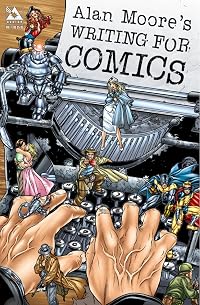
Alan Moore's Writing for Comics, Volume 1
by Alan Moore, Jacen Burrows (Illustrator)
On This Page
Description
Alan Moore, the creator, of Watchmen, Miracleman, and more shares his thoughts on the craft of writing comics! The main essay was originally written in 1985 for an obscure British fanzine, just as Moore was reshaping the landscape of modern comics. Now Avatar brings it back in print, collected for the first time as one graphic novel, and heavily illustrated by Jacen Burrows. Alan Moore also provides a brand new essay on how his thoughts on writing have changed in the two decades since he show more first wrote it. show lessTags
Recommendations


Member Reviews
In Alan Moore’s Writing for Comics, Moore outlines his philosophy for comic book writing based upon his years of experience in the medium. He cautions that he does not intend to teach readers how to write like him, but rather to offer some general advice that may be useful. As Avatar Press originally published this as a book in 2003, it’s interesting to see how a decade-and-a-half have borne out his musings.
Moore writes, “In the end, it is effect which governs the success of an individual piece of artwork or a whole artform, and while abstract critical considerations concerning the inherent quality of a work might give us a few useful handles with which to grasp and appreciate a work more fully, art still succeeds or fails in show more terms of the actual effect it has upon the individual members of its audience. If it stimulates or excites them, they will respond to it. If it doesn’t, they’ll go and look for something that does. Comics have a capacity for effect that they haven’t begun to take advantage of, and are held back by narrow and increasingly obsolete notions of what constitutes a comic story. In order for comics to move forward as a medium, these notions must change” (pgs. 5-6). In this, Moore’s comments seem particularly prescient given Marvel and DC’s struggles to break out of the usual pattern of large events, reboots, and nostalgia that dominate a great deal of their storytelling. That said, many of the smaller and independent comics have succeeded in finding new types of stories to tell and new ways to tell them, generating greater effect.
Discussing comic book history, Moore summarizes the approach to characterization from the Golden Age of the 1940s and 50s to the Silver Age of the 1960s and 70s, writing, “The earliest approach found in comics was that of simple one-dimensional characterization, usually consisting of ‘This person is good’ or ‘This person is bad.’ For the comics of the time and the comparatively simple world that they were attempting to entertain, this was perfectly adequate. By the early 1960s, however, times had changed and a new approach was needed. Thus, Stan Lee invented two-dimensional characterization: ‘This person is good but has bad luck with girlfriends,’ and ‘This person is bad but might just reform and join the Avengers if enough readers write in asking for it’” (pg. 23). Moore concludes, however, that progress has been minimal since that point with characters remaining two-dimensional.
Arguing that plot should enhance character and theme, Moore writes, “Pick up an average current comic and put it to your ear and you can almost hear the process at work: Plot, plot, plot, plot, plot, plot…it sounds like someone wading through mud and it very often reads like it, too. An obsession with the demands of a concrete and linear plotline is often one of the most dependable ways to crush all the life and energy from your story and make it simply an exercise in mechanical narration” (pg. 29, ellipses in original).
Finally, in his conclusion, Moore argues that the advice may have been good for those starting out, but that readers should ignore things like his promotion of a certain panel structure as, in hindsight, that was on its way out even as he wrote. Further, he offers advice for those who are already writing, urging them to take risks, avoid cliché, and, above all else, work on being good human beings because then they’ll leave the kind of work that will be impactful. Though the book has passed its 15th anniversary and Avatar Press has it in its 9th printing, it remains valuable for those seeking to break into the popular culture industry. The majority of the book also serves as a time capsule for those studying comics of the late 1980s and early 1990s. show less
Moore writes, “In the end, it is effect which governs the success of an individual piece of artwork or a whole artform, and while abstract critical considerations concerning the inherent quality of a work might give us a few useful handles with which to grasp and appreciate a work more fully, art still succeeds or fails in show more terms of the actual effect it has upon the individual members of its audience. If it stimulates or excites them, they will respond to it. If it doesn’t, they’ll go and look for something that does. Comics have a capacity for effect that they haven’t begun to take advantage of, and are held back by narrow and increasingly obsolete notions of what constitutes a comic story. In order for comics to move forward as a medium, these notions must change” (pgs. 5-6). In this, Moore’s comments seem particularly prescient given Marvel and DC’s struggles to break out of the usual pattern of large events, reboots, and nostalgia that dominate a great deal of their storytelling. That said, many of the smaller and independent comics have succeeded in finding new types of stories to tell and new ways to tell them, generating greater effect.
Discussing comic book history, Moore summarizes the approach to characterization from the Golden Age of the 1940s and 50s to the Silver Age of the 1960s and 70s, writing, “The earliest approach found in comics was that of simple one-dimensional characterization, usually consisting of ‘This person is good’ or ‘This person is bad.’ For the comics of the time and the comparatively simple world that they were attempting to entertain, this was perfectly adequate. By the early 1960s, however, times had changed and a new approach was needed. Thus, Stan Lee invented two-dimensional characterization: ‘This person is good but has bad luck with girlfriends,’ and ‘This person is bad but might just reform and join the Avengers if enough readers write in asking for it’” (pg. 23). Moore concludes, however, that progress has been minimal since that point with characters remaining two-dimensional.
Arguing that plot should enhance character and theme, Moore writes, “Pick up an average current comic and put it to your ear and you can almost hear the process at work: Plot, plot, plot, plot, plot, plot…it sounds like someone wading through mud and it very often reads like it, too. An obsession with the demands of a concrete and linear plotline is often one of the most dependable ways to crush all the life and energy from your story and make it simply an exercise in mechanical narration” (pg. 29, ellipses in original).
Finally, in his conclusion, Moore argues that the advice may have been good for those starting out, but that readers should ignore things like his promotion of a certain panel structure as, in hindsight, that was on its way out even as he wrote. Further, he offers advice for those who are already writing, urging them to take risks, avoid cliché, and, above all else, work on being good human beings because then they’ll leave the kind of work that will be impactful. Though the book has passed its 15th anniversary and Avatar Press has it in its 9th printing, it remains valuable for those seeking to break into the popular culture industry. The majority of the book also serves as a time capsule for those studying comics of the late 1980s and early 1990s. show less
Fabulous. Moore gives some solid bullet points on writing (and thinking about writing) but what's more helpful are the details between the bullets; digressions and quotes and examples which will provide food for lengthy thought long after the basic, explicit messages have been understood.
One of the most imaginative and creative writers of the last two decades show us how he thinks his art. An excellent book for any one who wants to understand about writing, but not just comics but any kind of writing. Alan Moore is both practical and insightful in his explanations and draws examples from both comics and literatura, showing that the line between is more imaginary than had been thought.
Like most real writers writing about their craft, Alan Moore doesn't beat around the bush. It's certainly impossible to teach someone how to write. Ask any creative writing professor. Alan Moore simply gave us the tools to make decisions about our writing, not attempting to teach us how to write like him, or like the next Stan Lee. He doesn't give us the conventional wisdom of comic books that have padded out childhood, but to learn how to grow within our own realm.
Writing for Comics isn't only "the rules" for storytelling in the graphic novel world, but storytelling in general. Even if you're not attempting to be the next Frank Miller or Alan Moore, the book will help you out with literary pieces - meaning prose. Highly suggest all show more writers and would be writers to pick up a copy. It isn't expensive and you'll impress your audience. show less
Writing for Comics isn't only "the rules" for storytelling in the graphic novel world, but storytelling in general. Even if you're not attempting to be the next Frank Miller or Alan Moore, the book will help you out with literary pieces - meaning prose. Highly suggest all show more writers and would be writers to pick up a copy. It isn't expensive and you'll impress your audience. show less
This slender volume reprints an extended essay from 1985 along with a short follow-up from 2003. The main piece consists of Alan Moore's thoughts on the mechanics and thought processes behind the writing of a comic strip and is illustrated with discussions of examples from his own work and that of other artists (from comics and other art forms). The follow-up essay, in much condensed form, explores some of these same topics from the perspective of a now established, and experienced writer. Most interesting for me is the way Alan Moore describes different aspects of the creative process and some mechanisms he has used or uses to generate "ideas". (I found myself thinking of the BBC Radio programme 'Chain Reaction' where he discusses this show more in an interview with Brian Eno.) show less
A dense booklet, perhaps a bit on the "ramblings and musings" side. In any case, here's someone with very strong opinions about comics, and not afraid to express them.
Really just a longish article on the craft of writing, not a book per se, but for what it is, I enjoyed it.
Members
- Recently Added By
Author Information

1,124+ Works 96,689 Members
Multiple award-winning author Alan Moore is universally considered the best writer of graphic novels in the medium's history. Among his many awards are the Hugo Award, the Bram Stoker Award, the Eisner Award, and the International Horror Guild Award

Common Knowledge
- Canonical title
- Alan Moore's Writing for Comics, Volume 1
- Original publication date
- 2003
- First words
- Y'know, it's a funny old world.
- Last words
- (Click to show. Warning: May contain spoilers.)Beyond that, you're on your own, pal.
Classifications
Statistics
- Members
- 501
- Popularity
- 60,112
- Reviews
- 9
- Rating
- (3.62)
- Languages
- English, Italian
- Media
- Paper
- ISBNs
- 3