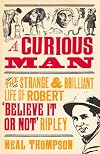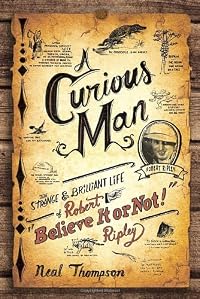
A Curious Man: The Strange and Brilliant Life of Robert "Believe It or Not!" Ripley
by Neal Thompson
On This Page
Description
A Curious Man is the marvelously compelling biography of Robert “Believe It or Not” Ripley, the enigmatic cartoonist turned globetrotting millionaire who won international fame by celebrating the world's strangest oddities, and whose outrageous showmanship taught us to believe in the unbelievable.As portrayed by acclaimed biographer Neal Thompson, Ripley’s life is the stuff of a classic American fairy tale. Buck-toothed and cursed by shyness, Ripley turned his sense of being an show more outsider into an appreciation for the strangeness of the world. After selling his first cartoon to Time magazine at age eighteen, more cartooning triumphs followed, but it was his “Believe It or Not” conceit and the wildly popular radio shows it birthed that would make him one of the most successful entertainment figures of his time and spur him to search the globe’s farthest corners for bizarre facts, exotic human curiosities, and shocking phenomena.
Ripley delighted in making outrageous declarations that somehow always turned out to be true—such as that Charles Lindbergh was only the sixty-seventh man to fly across the Atlantic or that “The Star Spangled Banner” was not the national anthem. Assisted by an exotic harem of female admirers and by ex-banker Norbert Pearlroth, a devoted researcher who spoke eleven languages, Ripley simultaneously embodied the spirit of Peter Pan, the fearlessness of Marco Polo and the marketing savvy of P. T. Barnum.
In a very real sense, Ripley sought to remake the world’s aesthetic. He demanded respect for those who were labeled “eccentrics” or “freaks”—whether it be E. L. Blystone, who wrote 1,615 alphabet letters on a grain of rice, or the man who could swallow his own nose.
By the 1930s Ripley possessed a vast fortune, a private yacht, and a twenty-eight room mansion stocked with such “oddities” as shrunken heads and medieval torture devices, and his pioneering firsts in print, radio, and television were tapping into something deep in the American consciousness—a taste for the titillating and exotic, and a fascination with the fastest, biggest, dumbest and most weird. Today, that legacy continues and can be seen in reality TV, YouTube, America’s Funniest Home Videos, Jackass, MythBusters and a host of other pop-culture phenomena.
In the end Robert L. Ripley changed everything. The supreme irony of his life, which was dedicated to exalting the strange and unusual, is that he may have been the most amazing oddity of all.
. show less
Tags
Recommendations

















Member Reviews
This book raised some questions about what we should expect from biographers. Are they merely relating details of the life of a person, or should they provide more of a commentary on that life as well? Is what we might consider to be ‘neutral’ reporting actually just reinforcing the status quo? By not dwelling on the more questionable parts of a subject’s personality, is the biographer acting in an appropriate manner, or are they implicitly giving their approval by not spending more time examining those characteristics?
Robert Ripley is the subject of this biography. You’re likely familiar with the “Believe It Or Not!” brand; there was a TV show about it in the 80s, and there are Ripley’s museums in San Francisco and NYC. show more Mr. Ripley started as a cartoonist in the early 1900s, eventually travelling the world to visit over 200 countries, collecting information about parts of the world that were extremely foreign to people in the U.S., especially before the frequent use of photography or radio programming. This straightforward biography follows Mr. Ripley from his birth in Santa Rosa, California through to his death in New York nearly 60 years later.
The author, Mr. Thompson, is a fine writer. I hesitated a bit in the beginning, distracted by other books I received as gifts for Christmas. However, I sped through the second half of the book today, finishing it up as the Texans got destroyed by Kansas City in the playoffs. It’s written well, and I think maybe five or ten years ago I would have strongly recommended it for anyone interested in learning more about this particular figure in U.S. history.
But these days, I have more questions. For example, Mr. Ripley clearly had some misogynistic tendencies, and while Mr. Thompson does mention this (which a lesser author might gloss over even further), he doesn’t examine it in a thoughtful way. The larger issue, however, that I just don’t think received enough attention in this biography, is the ethics of the entire basis for the Believe It Or Not concept: how “weird” the world is outside of the U.S. I get the sense from this biography that Mr. Ripley felt that he respected other cultures, but I’m not entirely sure that he did. He was certainly well-traveled, and developed strong affinities for certain cultures (especially China), but his cartoons at times dipped into racist territory, and his collections of curios and oddities really just seems like a whole lot of ‘othering’ of non-U.S. cultures.
And this is where those questions I posed at the start of this review come up. What duty – if any – does the biographer have to the audience to delve deeper into the subject’s actions? Is a biographer merely a stenographer, pulling together clippings and filling in the blanks, or is he or she an investigative reporter, looking deeper into the subject and placing at least some level of judgment on the actions the subject has taken throughout his or her life? I think it’s more of the latter, or at least that’s my feeling after reading this book. Mr. Thompson spends really no ink exploring whether it was ethical or appropriate for a white man to travel to Africa and bring back and display (out of context) parts of the cultures on that continent. I don’t think it’s necessarily cut and dried; Mr. Ripley’s work did expose many in the U.S. to parts of the world they knew nothing about. But I don’t think the default should be that whatever Mr. Ripley did was value-neutral, which is what this book presents. show less
Robert Ripley is the subject of this biography. You’re likely familiar with the “Believe It Or Not!” brand; there was a TV show about it in the 80s, and there are Ripley’s museums in San Francisco and NYC. show more Mr. Ripley started as a cartoonist in the early 1900s, eventually travelling the world to visit over 200 countries, collecting information about parts of the world that were extremely foreign to people in the U.S., especially before the frequent use of photography or radio programming. This straightforward biography follows Mr. Ripley from his birth in Santa Rosa, California through to his death in New York nearly 60 years later.
The author, Mr. Thompson, is a fine writer. I hesitated a bit in the beginning, distracted by other books I received as gifts for Christmas. However, I sped through the second half of the book today, finishing it up as the Texans got destroyed by Kansas City in the playoffs. It’s written well, and I think maybe five or ten years ago I would have strongly recommended it for anyone interested in learning more about this particular figure in U.S. history.
But these days, I have more questions. For example, Mr. Ripley clearly had some misogynistic tendencies, and while Mr. Thompson does mention this (which a lesser author might gloss over even further), he doesn’t examine it in a thoughtful way. The larger issue, however, that I just don’t think received enough attention in this biography, is the ethics of the entire basis for the Believe It Or Not concept: how “weird” the world is outside of the U.S. I get the sense from this biography that Mr. Ripley felt that he respected other cultures, but I’m not entirely sure that he did. He was certainly well-traveled, and developed strong affinities for certain cultures (especially China), but his cartoons at times dipped into racist territory, and his collections of curios and oddities really just seems like a whole lot of ‘othering’ of non-U.S. cultures.
And this is where those questions I posed at the start of this review come up. What duty – if any – does the biographer have to the audience to delve deeper into the subject’s actions? Is a biographer merely a stenographer, pulling together clippings and filling in the blanks, or is he or she an investigative reporter, looking deeper into the subject and placing at least some level of judgment on the actions the subject has taken throughout his or her life? I think it’s more of the latter, or at least that’s my feeling after reading this book. Mr. Thompson spends really no ink exploring whether it was ethical or appropriate for a white man to travel to Africa and bring back and display (out of context) parts of the cultures on that continent. I don’t think it’s necessarily cut and dried; Mr. Ripley’s work did expose many in the U.S. to parts of the world they knew nothing about. But I don’t think the default should be that whatever Mr. Ripley did was value-neutral, which is what this book presents. show less
Although I've decided I don't very much like the man Robert Ripley became, I must give this four stars for an excellent and engaging biography. Ripley seems to me to have been a very selfish man---the epitome of a man ruined by fame and fortune. The last 30-40 pages bummed me out as he declined and died as most men like him do---unhappy and alone.
There is a Ripley's Believe It or Not! museum in Newport, Oregon that I've visited a couple times. It's spooky---but not scary. I never really understood why I felt so weirded out there, but after reading this, I sorta get it. There were so many interesting parts to his life and story that I can't do them all justice in a short review. As a blogger, I thought it was fun how the author compared show more Ripley's travel narratives to blogging. I'd always wondered about shrunken heads and how that was even possible---now I'm thinking these heads were without skulls. I did feel like too much was made of his buckteeth; calling them a handicap, even, at one point. Surely someone with a real handicap might beg to differ---or maybe this straight-toothed girl just can't sympathize.
Definitely a good read---but don't expect to think highly of Ripley when you're through. show less
There is a Ripley's Believe It or Not! museum in Newport, Oregon that I've visited a couple times. It's spooky---but not scary. I never really understood why I felt so weirded out there, but after reading this, I sorta get it. There were so many interesting parts to his life and story that I can't do them all justice in a short review. As a blogger, I thought it was fun how the author compared show more Ripley's travel narratives to blogging. I'd always wondered about shrunken heads and how that was even possible---now I'm thinking these heads were without skulls. I did feel like too much was made of his buckteeth; calling them a handicap, even, at one point. Surely someone with a real handicap might beg to differ---or maybe this straight-toothed girl just can't sympathize.
Definitely a good read---but don't expect to think highly of Ripley when you're through. show less
A Curious Man: The Strange and Brilliant Life of Robert "Believe It or Not!" Ripley
By Neal Thompson
Three Rivers Press
Review by Karl Wolff
The phrase "Believe it or not!" is something nearly everybody knows, but its history has been long forgotten. "Believe It or Not!" (with capital letters) was the brainchild of Robert L. Ripley, a California native who came from a hardscrabble background. He took a winning gimmick and ran with it. Before the concept of omni-media empire was a thing, Ripley had created a personal empire that included a regular newspaper cartoon, a museum of sort (the Odditorium), a radio show, movie newsreels, and a TV show (in multiple incarnations). Before there were the omni-media empires of Martha Stewart, George show more Lucas, and Walt Disney, there was Robert L. Ripley (1890 - 1949). When I was growing up in Wisconsin, my family would take the occasional trip to the Wisconsin Dells. One of the main attractions was the Ripley's Believe It or Not Museum. I may or may not have gone through it. I was a kid, my memories are pretty fuzzy. (Although I do remember going through another monument to American Odd-ness, The House on the Rock.) "Believe It or Not!" is iconic American Odd. Even those unfamiliar with the biography of Robert L. Ripley, know where the phrase comes from. It is akin to knowing Pulp Fiction references without having seen the Tarantino film. I was one of those people, until I read A Curious Man: The Strange and Brilliant Life of Robert "Believe It or Not!" Ripley, by Neal Thompson.
A Curious Man offers a breezy, breathless, and fascinating biography of Robert L. Ripley, the man behind the brand. "Believe It or Not!" has become so iconic, it is a challenge to realize that it almost never came to be. As with many rags to riches stories, Ripley's life is an accumulation of chance, circumstance, guile, market- and media-savvy, and both successes and failures. Anyone who became wealthy without enduring failure and making mistakes is either lying to you or the wealth was inherited. (Cue inevitable election season joke.)
Robert L. Ripley (born LeRoy Robert Ripley) was born in Santa Rosa, California, a shy, bucktoothed bookish kid who spent his spare hours sketching. Through the help of his high school teacher he was able to land a cartooning job in San Francisco. He was shortly fired. After a few professional hiccups, he landed a job as a sports cartoonist for San Francisco paper. He eventually moved to work as a cartoonist for a New York City paper. During this time, photography was still a slow and expensive process. Cartoonists provided newspapers with a cheap means of communicating the story. Ripley's contemporaries included Rube Goldberg, another cartoonists whose gimmick turned his name into a descriptor.
"Believe It or Not!" was originally named "Champs and Chumps," showcasing record-breaking sports achievements. With the help of William Randolph Hearst, the cartoon received syndication, and with the help of his polymath assistant, Norbert Pearlroth, the cartoon became immensely popular. The cartoon still runs today ... "Believe It or Not!" The cartoon allowed Ripley to travel the world, collecting odd facts and odd souvenirs. The souvenirs accumulated so fast he needed a place to put them all. He filled a New York City apartment and Believe It or Not! Island, his private mansion. One of his favorite destinations was China. This stemmed from his visits to San Francisco's Chinatown when he was a young cartoonist. He found the culture fascinating.
During the Depression, "Believe It or Not" provided entertainment to those hard on their luck. They read Ripley's travel columns, his cartoons, and visited the Odditorium. The Odditorium made Ripley an inheritor of the freak show tradition began by P.T. Barnum. Ripley tried to legitimize the Odditorium by distancing himself from Barnum, but the American public came for the same reason. Americans love to gawk at freaky stuff. Why do we still watch Jerry Springer, Honey Boo Boo, and the insatiable maw of "reality television"? Ripley capitalized on this, making his interests the interests of America at large, and rode this to the bank.
A Curious Man offers a comprehensive biography of Robert L. Ripley and his omni-media juggernaut. He made the American cultural landscape richer, weirder, and stranger. He was an instrumental pioneer of the American Odd.
http://www.cclapcenter.com/2015/04/american_odd_a_curious_man_by_.html show less
By Neal Thompson
Three Rivers Press
Review by Karl Wolff
The phrase "Believe it or not!" is something nearly everybody knows, but its history has been long forgotten. "Believe It or Not!" (with capital letters) was the brainchild of Robert L. Ripley, a California native who came from a hardscrabble background. He took a winning gimmick and ran with it. Before the concept of omni-media empire was a thing, Ripley had created a personal empire that included a regular newspaper cartoon, a museum of sort (the Odditorium), a radio show, movie newsreels, and a TV show (in multiple incarnations). Before there were the omni-media empires of Martha Stewart, George show more Lucas, and Walt Disney, there was Robert L. Ripley (1890 - 1949). When I was growing up in Wisconsin, my family would take the occasional trip to the Wisconsin Dells. One of the main attractions was the Ripley's Believe It or Not Museum. I may or may not have gone through it. I was a kid, my memories are pretty fuzzy. (Although I do remember going through another monument to American Odd-ness, The House on the Rock.) "Believe It or Not!" is iconic American Odd. Even those unfamiliar with the biography of Robert L. Ripley, know where the phrase comes from. It is akin to knowing Pulp Fiction references without having seen the Tarantino film. I was one of those people, until I read A Curious Man: The Strange and Brilliant Life of Robert "Believe It or Not!" Ripley, by Neal Thompson.
A Curious Man offers a breezy, breathless, and fascinating biography of Robert L. Ripley, the man behind the brand. "Believe It or Not!" has become so iconic, it is a challenge to realize that it almost never came to be. As with many rags to riches stories, Ripley's life is an accumulation of chance, circumstance, guile, market- and media-savvy, and both successes and failures. Anyone who became wealthy without enduring failure and making mistakes is either lying to you or the wealth was inherited. (Cue inevitable election season joke.)
Robert L. Ripley (born LeRoy Robert Ripley) was born in Santa Rosa, California, a shy, bucktoothed bookish kid who spent his spare hours sketching. Through the help of his high school teacher he was able to land a cartooning job in San Francisco. He was shortly fired. After a few professional hiccups, he landed a job as a sports cartoonist for San Francisco paper. He eventually moved to work as a cartoonist for a New York City paper. During this time, photography was still a slow and expensive process. Cartoonists provided newspapers with a cheap means of communicating the story. Ripley's contemporaries included Rube Goldberg, another cartoonists whose gimmick turned his name into a descriptor.
"Believe It or Not!" was originally named "Champs and Chumps," showcasing record-breaking sports achievements. With the help of William Randolph Hearst, the cartoon received syndication, and with the help of his polymath assistant, Norbert Pearlroth, the cartoon became immensely popular. The cartoon still runs today ... "Believe It or Not!" The cartoon allowed Ripley to travel the world, collecting odd facts and odd souvenirs. The souvenirs accumulated so fast he needed a place to put them all. He filled a New York City apartment and Believe It or Not! Island, his private mansion. One of his favorite destinations was China. This stemmed from his visits to San Francisco's Chinatown when he was a young cartoonist. He found the culture fascinating.
During the Depression, "Believe It or Not" provided entertainment to those hard on their luck. They read Ripley's travel columns, his cartoons, and visited the Odditorium. The Odditorium made Ripley an inheritor of the freak show tradition began by P.T. Barnum. Ripley tried to legitimize the Odditorium by distancing himself from Barnum, but the American public came for the same reason. Americans love to gawk at freaky stuff. Why do we still watch Jerry Springer, Honey Boo Boo, and the insatiable maw of "reality television"? Ripley capitalized on this, making his interests the interests of America at large, and rode this to the bank.
A Curious Man offers a comprehensive biography of Robert L. Ripley and his omni-media juggernaut. He made the American cultural landscape richer, weirder, and stranger. He was an instrumental pioneer of the American Odd.
http://www.cclapcenter.com/2015/04/american_odd_a_curious_man_by_.html show less
For cartoonists, as with those in so many other fields, it takes more than talent to be successful. It also takes a big idea. For Charles Schulz, that idea took the form of Charlie Brown and Snoopy. For Jim Davis, it was a cat who prefers lasagna to mice. And for Robert Ripley, who began his career in San Francisco as a sports cartoonist, the big idea was a cartoon showing some of the strange-but-true oddities to be found in the world.
Within a very few years, the success of Ripley's "Believe It or Not!" turned this shy, buck-toothed young man into a wealthy, world-famous celebrity who lived a playboy lifestyle while Hugh Hefner was still a toddler. Besides his newspaper cartoon, Ripley also starred in radio and television programs, show more wrote books and sanctioned exhibits of the strange people and objects he had discovered. Neal Thompson tells all about this amazing life in "A Curious Man: The Strange and Brilliant Life of Robert 'Believe It or Not!' " (2013). Ripley, it turns out, was the kind of man who might have appeared in one of his own cartoons.
Among the oddities one learns about his life: Ripley traveled often to faraway places, but he was afraid of flying. As a young man, he was a handball champion. He also tried out for a major league baseball team. He played a key role in the adoption of "The Star-Spangled Banner" as the national anthem. Barry Goldwater, who later ran for president, as a young man took Ripley down into the Grand Canyon for a radio broadcast. And a dog belonging to the aforementioned Charles Schulz, then 14 years old, once appeared in one of Ripley's cartoons. The dog ate pins, tacks, screws and razor blades.
One of the curious things about his life that Ripley kept secret was that while he was making as much as $350,000 a year during the Depression for drawing his cartoons, he paid a man named Norbert Pearlroth just $75 a week to dig out most of the oddities that appeared in those cartoons. Pearlroth didn't seem to mind, for he loved spending long hours in the library looking through books.
Ripley drank too much, and although an athlete as a young man, he turned fat and flabby in middle age. He died at 59.
Thompson's fine biography turns this "curious man" into someone who was flesh and blood, and even believable. show less
Within a very few years, the success of Ripley's "Believe It or Not!" turned this shy, buck-toothed young man into a wealthy, world-famous celebrity who lived a playboy lifestyle while Hugh Hefner was still a toddler. Besides his newspaper cartoon, Ripley also starred in radio and television programs, show more wrote books and sanctioned exhibits of the strange people and objects he had discovered. Neal Thompson tells all about this amazing life in "A Curious Man: The Strange and Brilliant Life of Robert 'Believe It or Not!' " (2013). Ripley, it turns out, was the kind of man who might have appeared in one of his own cartoons.
Among the oddities one learns about his life: Ripley traveled often to faraway places, but he was afraid of flying. As a young man, he was a handball champion. He also tried out for a major league baseball team. He played a key role in the adoption of "The Star-Spangled Banner" as the national anthem. Barry Goldwater, who later ran for president, as a young man took Ripley down into the Grand Canyon for a radio broadcast. And a dog belonging to the aforementioned Charles Schulz, then 14 years old, once appeared in one of Ripley's cartoons. The dog ate pins, tacks, screws and razor blades.
One of the curious things about his life that Ripley kept secret was that while he was making as much as $350,000 a year during the Depression for drawing his cartoons, he paid a man named Norbert Pearlroth just $75 a week to dig out most of the oddities that appeared in those cartoons. Pearlroth didn't seem to mind, for he loved spending long hours in the library looking through books.
Ripley drank too much, and although an athlete as a young man, he turned fat and flabby in middle age. He died at 59.
Thompson's fine biography turns this "curious man" into someone who was flesh and blood, and even believable. show less
Strange and brilliant doesn't even begin to cover it. Robert Ripley was the true "believe it or not." Since I was a child I had always been enamored with the believe it or not franchise. I had some of the books and even visited one of the odditoriums when I was a kid. Not until I picked up this book though, did I know a thing about the founder of this bizarre empire. Neal Thompson lovingly puts together Ripley's life starting from a young boy up until his premature death at 59. Ripley started off a shy, gawky, artist and quickly turned into one of the most influential and wealthy men of his era. His rise to fame began small and then skyrocketed. He exposed the oddest people, facts, and feats and people loved him for it. His cartoons, show more radio and tv shows, books, and side shows became the most unusual and beloved in America. Unfortunately, it started to go to his head and although he was generous and fun, he could have a temper. He kept a fast paced schedule and worked non-stop and it eventually took a toll on his health. Author Neal Thompson does a great job chronicling the rise and fall of Ripley as well as outlining the lasting impact of his empire.
For fans of the odd and biographies.
I received this book for free from Blogging for Books in return for my honest, unbiased opinion. show less
For fans of the odd and biographies.
I received this book for free from Blogging for Books in return for my honest, unbiased opinion. show less
A Curious Man: The Strange and Brilliant Life of Robert “Believe It or Not!” Ripley by Neal Thompson
421 pages
★★★★
I have to admit that Robert “Believe it or Not!” Ripley was not a very likable guy. He was a boozer, racist, a womanizer, and a jerk but one must also needs to remember in part of that that he was a product of his time. So while I didn’t particularly like the man, I did like the book.
The author, Neal Thompson, does a great job in researching and writing about Ripley. He kept my attention from the beginning. Ripley lived a fascinating life and he definitely had one of those rags-to-riches stories that people love so much. Ripley was talented and well travels. He discovered many things in a time where many show more believed nothing else could be discovered. He was a man obsessed with finding the “weird” and he would travel the world to find it. I don’t have too many complaints on the writing of this biography. At no point did I find myself bored. My one complaint is that the author seems to have some kind of obsession with Ripley’s teeth! Seriously, Ripley was born with a severe jutting of the teeth and it seems like in almost every chapter the author is back on “overcoming appearance his teeth gave him”, you’d think Ripley made it so far only by his ability to “overcome” his teeth (while I understand it gave him a speech impediment, I think one or two mentions would have been plenty). I was actually excited when it was mentioned that he had major reconstructive surgery on his mouth because it meant I no longer had to read about them. This was a fun, random biography I picked up. Well done. show less
421 pages
★★★★
I have to admit that Robert “Believe it or Not!” Ripley was not a very likable guy. He was a boozer, racist, a womanizer, and a jerk but one must also needs to remember in part of that that he was a product of his time. So while I didn’t particularly like the man, I did like the book.
The author, Neal Thompson, does a great job in researching and writing about Ripley. He kept my attention from the beginning. Ripley lived a fascinating life and he definitely had one of those rags-to-riches stories that people love so much. Ripley was talented and well travels. He discovered many things in a time where many show more believed nothing else could be discovered. He was a man obsessed with finding the “weird” and he would travel the world to find it. I don’t have too many complaints on the writing of this biography. At no point did I find myself bored. My one complaint is that the author seems to have some kind of obsession with Ripley’s teeth! Seriously, Ripley was born with a severe jutting of the teeth and it seems like in almost every chapter the author is back on “overcoming appearance his teeth gave him”, you’d think Ripley made it so far only by his ability to “overcome” his teeth (while I understand it gave him a speech impediment, I think one or two mentions would have been plenty). I was actually excited when it was mentioned that he had major reconstructive surgery on his mouth because it meant I no longer had to read about them. This was a fun, random biography I picked up. Well done. show less
LeRoy Ripley is the embodiment of the American dream: a poor, bucktoothed, stuttering kid who cartooned his way to fame and fortune, was surrounded by beautiful women and traveled the globe. Thompson shows that behind the public persona Ripley lived a very lonely life, cut himself off from the support of family and friends, and was an alcoholic. This Ripley seemed to never achieve emotional maturity or find happiness no matter how much he achieved - in fact it’s amazing how much he accomplished, being perpetually drunk or hung over.
Although it was interesting, I thought this book overly long and found myself skimming the last couple of hundred pages. Also, I had an ARC and was disappointed that there were no pictures.
Although it was interesting, I thought this book overly long and found myself skimming the last couple of hundred pages. Also, I had an ARC and was disappointed that there were no pictures.
Members
- Recently Added By
Author Information

8 Works 729 Members
Awards and Honors
Common Knowledge
- Dedication
- For Mary, always
For Sean and Leo - First words
- In the middle of the Syrian Desert, halfway between Damascus and Baghdad, the half-breed vehicle with twelve sand-surfing balloon tires came to a stop at an indistinct pile of rocks bordered by a scrawny stand of palm trees.
- Last words
- (Click to show. Warning: May contain spoilers.)LeRoy Ripley, it turns out, may have been the most unbelievable oddity of all.
Classifications
- Genres
- Reference, Biography & Memoir, Nonfiction, General Nonfiction
- DDC/MDS
- 031.092 — Computer science, information & general works Encyclopedias & books of facts Guiness Records, Ripley's Believe It or Not
- LCC
- PN4874 .R53 .T57 — Language and Literature Literature (General) Literature (General) Journalism. The periodical press, etc. By region or country
- BISAC
Statistics
- Members
- 328
- Popularity
- 95,903
- Reviews
- 25
- Rating
- (3.69)
- Languages
- English
- Media
- Paper, Audiobook, Ebook
- ISBNs
- 7
- ASINs
- 1