On This Page
Description
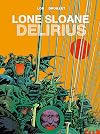
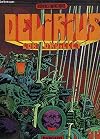
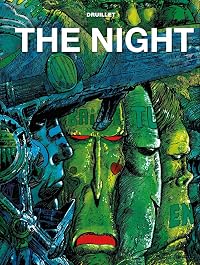
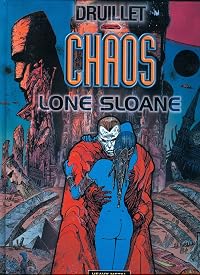
Lone Sloane is still stuck on the planet aptly named Delirius, one of the strangest places in the galaxy. The lonely traveler is in trouble: he was struck by an erasure arrow by the fanatical monks of the Red Redemption. He is accompanied by Mali, the daughter of his friend Yearl Martian, first in his travels to the destitute underground world of Delirius then to find Yearl and Lance, Mali's lover and then in the mission to save the inhabitants of Delirius from the spreading madness!Tags
Recommendations




















Member Reviews
This volume collects some of the earliest comics by Métal Hurlant co-founder Phillipe Druillet. There is not much depth to the neo-human protagonist Lone Sloane, even if he is "partly a god." He is a thorn in the side of every society and authority that he interacts with, and his stigma of blazing red eyes seems to be a heritage from Moorcock's Elric, whom Druillet had earlier adapted to comics.
The basic genre of these stories is psychedelic space opera, and the first half of the book is made up of distinct adventures. The first of these has Sloane encountering the Throne of the Black God (another Elric motif?), which becomes his interdimensional conveyance until he is reunited with his spaceship the O Sidarta. Other episodes show more introduce villains like the savage ruler Shonga and the sorcerer Torquedara Varenkor, who suppose they can use Sloane in their plans. Rose, the "rocket brain" (ships's computer?) that serves Sloane, becomes a woman who aids him. And the end of this sequence is a visit to a post-human Earth, populated by "horned dwarfs ... tattooed women ... masked priests" who have "fled the universe of Elric the Necromancer."
The second half of the book has a more coherent and continuous narrative set on the anarchic pleasure world Delirius. It culminates in a heist that triggers "a revolutionary farce on an artificial and decadent planet." In this tale, there is a cult called the Red Redemption that seeks to use Sloane as a pawn in their schemes under the power of an interstellar empire. I seem to perceive some influence on Star Wars here, although both could just be drawing on a common heritage of planetary romance.
The page compositions throughout--frequently two-page spreads and sometimes rotated ninety degrees--are consistently striking, and the illustrations are a riot of detail and op-art colors. Sequential panels are often used, but they are never conventional rectangles, and they are sometimes so exotically shaped and arranged that it is necessary for the artist to supply little traffic-directing arrows to guide the reader.
No credit is given in the 1973 Dragon's Dream/Heavy Metal US edition for either translation or lettering work. The hand lettering uses a fantasy-inflected style, and it varies greatly in size. (I was unsure whether that resulted from differing scaling of the original art, translation demands altering the quantity of text, or both.) Sometimes it is so tiny that I had to resort to a magnifying glass! That tool, along with bright overhead lighting, was also helpful when text was given in black ink on dark-colored text boxes.
Admittedly, the text is almost superfluous in this book, where the exotic and elaborate images are the real prize, and the stories are mostly piles of tropes. show less
The basic genre of these stories is psychedelic space opera, and the first half of the book is made up of distinct adventures. The first of these has Sloane encountering the Throne of the Black God (another Elric motif?), which becomes his interdimensional conveyance until he is reunited with his spaceship the O Sidarta. Other episodes show more introduce villains like the savage ruler Shonga and the sorcerer Torquedara Varenkor, who suppose they can use Sloane in their plans. Rose, the "rocket brain" (ships's computer?) that serves Sloane, becomes a woman who aids him. And the end of this sequence is a visit to a post-human Earth, populated by "horned dwarfs ... tattooed women ... masked priests" who have "fled the universe of Elric the Necromancer."
The second half of the book has a more coherent and continuous narrative set on the anarchic pleasure world Delirius. It culminates in a heist that triggers "a revolutionary farce on an artificial and decadent planet." In this tale, there is a cult called the Red Redemption that seeks to use Sloane as a pawn in their schemes under the power of an interstellar empire. I seem to perceive some influence on Star Wars here, although both could just be drawing on a common heritage of planetary romance.
The page compositions throughout--frequently two-page spreads and sometimes rotated ninety degrees--are consistently striking, and the illustrations are a riot of detail and op-art colors. Sequential panels are often used, but they are never conventional rectangles, and they are sometimes so exotically shaped and arranged that it is necessary for the artist to supply little traffic-directing arrows to guide the reader.
No credit is given in the 1973 Dragon's Dream/Heavy Metal US edition for either translation or lettering work. The hand lettering uses a fantasy-inflected style, and it varies greatly in size. (I was unsure whether that resulted from differing scaling of the original art, translation demands altering the quantity of text, or both.) Sometimes it is so tiny that I had to resort to a magnifying glass! That tool, along with bright overhead lighting, was also helpful when text was given in black ink on dark-colored text boxes.
Admittedly, the text is almost superfluous in this book, where the exotic and elaborate images are the real prize, and the stories are mostly piles of tropes. show less
Ratings
Members
- Recently Added By
Lists

Best Science Fiction Comics and Graphic Novels
144 works; 11 members
Author Information

Awards and Honors
Notable Lists
Series

Belongs to Publisher Series
Work Relationships
Is contained in
Common Knowledge
- Original publication date
- 1972
- Disambiguation notice
- This book collects the first two adventures of Lone Sloane: (1) The 6 Voyages of Lone Sloan & (2) Delirius. Do not combine with editions that contain only one or the other.
Classifications
Statistics
- Members
- 139
- Popularity
- 236,290
- Reviews
- 1
- Rating
- (3.94)
- Languages
- Dutch, English, French, German
- Media
- Paper
- ISBNs
- 7
- ASINs
- 2