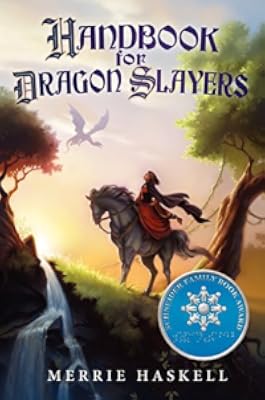
Handbook for Dragon Slayers
by Merrie Haskell
On This Page
Description
Yearning for life in a cloistered scriptorium, thirteen-year-old Princess Matilda, whose lame foot brings fear of the evil eye, escapes her scheming cousin Ivo and joins her servant Judith and an old friend, Parz, in hunting dragons and writing about them.Tags
Recommendations



Member Reviews
Trying to get out this horrible reading slump I'm in... I grabbed this book because it's short, required minimal brain power, I liked the author's previous book, and hey - dragons!
It was a super fast read, and while it had unexpected complexity to the plot (which honestly I should have expected given that Haskell's first book was also like that), I wished it was longer/deeper/more. The story ended and I wanted to scream in frustration because really, there was so much more that the author left unresolved. Yes, the main plot was resolved but I had just gotten to like the characters, and I definitely wanted to see more of Curschin.
I loved the subtle weaving of the Bluebeard story into the plot
It was a super fast read, and while it had unexpected complexity to the plot (which honestly I should have expected given that Haskell's first book was also like that), I wished it was longer/deeper/more. The story ended and I wanted to scream in frustration because really, there was so much more that the author left unresolved. Yes, the main plot was resolved but I had just gotten to like the characters, and I definitely wanted to see more of Curschin.
I loved the subtle weaving of the Bluebeard story into the plot
Matilda may be a princess, but she feels anything but in control of her life. Since she is lame in one foot, her days are spent doing scribe's work related to the running of her small country, which she will rule when she comes of age. Enjoying a few days of freedom while her mother is away on a visit, Tilda and her maidservant Judith travel to a neighboring knight's home to help set his accounts in order, and to visit her friend Parzifal who is a squire there. While there, Tilda is captured by her evil Cousin Ivo, who has designs on her land and plans to step into her place as ruler. Tilda, who dreams of retiring to a quiet convent where she could spend her days in a scriptorium writing her own book, tells Ivo he can have her country, show more though of course he doesn't believe her. That night, Parz and Judith rescue Tilda, and the three go on the run. Parz and Judith plan to become dragon slayers, and Tilda will finally get to write her own book, a handbook for dragon slayers. There's a little problem, of course: none of them really know anything about dragons or dragon-slaying. And is running away from her responsibilities truly the solution to Tilda's problems?
This story has plenty of action, and a plot that is fairly unpredictable -- I thought I knew where the story was going, and then it would shift and surprise me, which was refreshing (though occasionally disorienting). Tilda and her friends experience a lot of character development as they learn about what it will take to pursue their ambitions. Minor characters are likewise rendered in shades of gray, rarely all good or all bad (though there is one bad guy who is pretty much evil all the way through). Though the setting is medieval, the language is modern, with no thees or thous in sight. I thought this was a fun read with a surprising amount of depth, and I will recommend it to kids and adults who enjoy this sort of fantasy story. show less
This story has plenty of action, and a plot that is fairly unpredictable -- I thought I knew where the story was going, and then it would shift and surprise me, which was refreshing (though occasionally disorienting). Tilda and her friends experience a lot of character development as they learn about what it will take to pursue their ambitions. Minor characters are likewise rendered in shades of gray, rarely all good or all bad (though there is one bad guy who is pretty much evil all the way through). Though the setting is medieval, the language is modern, with no thees or thous in sight. I thought this was a fun read with a surprising amount of depth, and I will recommend it to kids and adults who enjoy this sort of fantasy story. show less
I received a review copy of this book from the author, but am completely honest in my opinion.
Every so often, I read a middle grade book that completely reawakens my inner 10-year-old. This is one of those books--the sort I would have read repeatedly until I memorized it, drawn fan art of, and likely daydreamed myself into. I approached the book thinking that it looked good, but I didn't expect to like it quite so much.
What makes this book stand out?
Foremost is the main character, Tilda. She's a princess, but not in a glamorous Disney kind of way. She's been raised to take care of her holdings, to listen to her people's grievances, and write manuscripts--and that's her greatest love. Tilda was born with a twisted foot and has show more difficulty moving, and feels shunned by many people because of it. She's learned to be rather cold, and somewhat selfish, just to avoid the emotional pain. Only her handmaiden Judith, friend Parz, and a few adults see her as she really is.
Something that surprised me from the start was the amount of tension. A lot of bad things happen. The kids make bad choices, as do the adults around them. As an adult, I struggle with some kids' books because I find them too predictable. Handbook surprised me at every turn, and that compelled me to keep turning pages so I could find out what happened next. I also loved historical fiction as a child, and this book blends fantasy and European history in a very appealing way.
Ah, and then there was the biggest surprise of all, the one that made my inner 10-year-old squeal with delight: the magical horses. I won't say any more, as I don't want to delve into spoiler territory, but I could have so seen myself as a kid in a mad scramble for my colored pencils so I could draw these magnificent characters. I'm smiling now to even think of it.
Really, I think that's the grandest praise I can foist upon this book: it made me feel like a kid again. show less
Every so often, I read a middle grade book that completely reawakens my inner 10-year-old. This is one of those books--the sort I would have read repeatedly until I memorized it, drawn fan art of, and likely daydreamed myself into. I approached the book thinking that it looked good, but I didn't expect to like it quite so much.
What makes this book stand out?
Foremost is the main character, Tilda. She's a princess, but not in a glamorous Disney kind of way. She's been raised to take care of her holdings, to listen to her people's grievances, and write manuscripts--and that's her greatest love. Tilda was born with a twisted foot and has show more difficulty moving, and feels shunned by many people because of it. She's learned to be rather cold, and somewhat selfish, just to avoid the emotional pain. Only her handmaiden Judith, friend Parz, and a few adults see her as she really is.
Something that surprised me from the start was the amount of tension. A lot of bad things happen. The kids make bad choices, as do the adults around them. As an adult, I struggle with some kids' books because I find them too predictable. Handbook surprised me at every turn, and that compelled me to keep turning pages so I could find out what happened next. I also loved historical fiction as a child, and this book blends fantasy and European history in a very appealing way.
Ah, and then there was the biggest surprise of all, the one that made my inner 10-year-old squeal with delight: the magical horses. I won't say any more, as I don't want to delve into spoiler territory, but I could have so seen myself as a kid in a mad scramble for my colored pencils so I could draw these magnificent characters. I'm smiling now to even think of it.
Really, I think that's the grandest praise I can foist upon this book: it made me feel like a kid again. show less
Mathilda wants only to be left alone so she can write her book. She is a princess, but who needs that responsibility? Her people ward against the evil eye when they see her lame foot. Who needs them? So when cousin Ivo kidnaps Mathilda and intends to claim her lands, Tilda is all for it. She escapes from Ivo with the help of her independent handmaiden, Judith, and her knight-in-training friend, Parz. Parz wants to slay a dragon to prove himself, Judith wants to slay a dragon to prove her strength and independence, and Tilda wants to write a book. They agree to research dragon slaying, slay a dragon, and write the Handbook for Dragon Slayers. Things don't go quite as easily as they'd hoped. Injuries, the Wild Hunt, magical horses, and an show more evil suitor all conspire to thwart the trio.
Haskell's fairy tale incorporates mythology, history, magic, and dragon lore into a fast-paced, roaring good read. Haskell's Wild Hunt departs from ancient Celtic myth by featuring a female hunt leader and metal horses imprisoned by magical bridles. Sister Hildegard, a healer, is most reminiscent of Saint Hildegard of Bingen, famous for her healing prayer, music, and visonary wisdom. The dragons breathe flame, hoard treasure, and fight knights, but Haskell imbues them with her own imaginary traits as well. Tilda, Judith, and Parz leap and fall from one disaster to another, but it is Tilda's leadership, Judith's loyalty, and Parz's resilience that give depth to the story. Readers who like their adventures sprinkled with magic, but rooted in character and plot will surely enjoy Handbook for Dragon Slayers. show less
Haskell's fairy tale incorporates mythology, history, magic, and dragon lore into a fast-paced, roaring good read. Haskell's Wild Hunt departs from ancient Celtic myth by featuring a female hunt leader and metal horses imprisoned by magical bridles. Sister Hildegard, a healer, is most reminiscent of Saint Hildegard of Bingen, famous for her healing prayer, music, and visonary wisdom. The dragons breathe flame, hoard treasure, and fight knights, but Haskell imbues them with her own imaginary traits as well. Tilda, Judith, and Parz leap and fall from one disaster to another, but it is Tilda's leadership, Judith's loyalty, and Parz's resilience that give depth to the story. Readers who like their adventures sprinkled with magic, but rooted in character and plot will surely enjoy Handbook for Dragon Slayers. show less
Handbook for Dragon Slayers is an engaging fantasy story featuring a disabled heroine who is completely awesome. Matilda, or Tilda, a girl who only wants to be alone with her beloved books, is constantly interrupted by her responsibilities as manager of the estate while her mother is away. When her treacherous cousin succeeds in deposing her and she is forced to go on the run, she views it as a relief. She can finally escape the people who, due to her clubfoot, view her as bad luck and unfit to be a ruler. Rather than plan a way to retake her estate, Matilda embarks on a dragon-slaying adventure with her friends in order to get material to write a book of her own.
Tilda is a complex heroine who is smart and brave while having some very show more human flaws. Her clubfoot is painful and often forces her to rely on her companions for assistance, and the poor way some of her superstitious subjects treat her has shaped her insecurities. However, she is a character who can think her way out of most tricky situations and whose kindness and compassion serve her well on her journey. Judith, her maid and best friend, is a character who is great in her own right. Far from being the stereotypical obedient servant, Judith is not afraid to tell Tilda harsh truths and it is she who has the initial yearning for adventure. Rounding out the team is Parz, the knight in training Tilda has a crush on and whom Judith relies on for dragon-slaying instruction. Refreshingly, a love triangle between the trio never materializes.
The story itself is a blend of fairytales elements with historical details including the role of noblewomen as administrators, convents as stand-ins for places of learning, etc. One classic fairytale in particular is used, and I will not spoil the surprise but I did enjoy how it was handled. Through these various adventures Tilda and her friends come to realize that dragon slaying is very different from what they imagined and learn you cannot escape your responsibilities. In a way that is not at all overtly preachy or didactic, Tilda comes to reconcile her own wishes with her responsibilities and accepts her duty to her people. All in all, this is a great read for anyone who loves fairytales, historical fantasy, and dynamic characters. show less
Tilda is a complex heroine who is smart and brave while having some very show more human flaws. Her clubfoot is painful and often forces her to rely on her companions for assistance, and the poor way some of her superstitious subjects treat her has shaped her insecurities. However, she is a character who can think her way out of most tricky situations and whose kindness and compassion serve her well on her journey. Judith, her maid and best friend, is a character who is great in her own right. Far from being the stereotypical obedient servant, Judith is not afraid to tell Tilda harsh truths and it is she who has the initial yearning for adventure. Rounding out the team is Parz, the knight in training Tilda has a crush on and whom Judith relies on for dragon-slaying instruction. Refreshingly, a love triangle between the trio never materializes.
The story itself is a blend of fairytales elements with historical details including the role of noblewomen as administrators, convents as stand-ins for places of learning, etc. One classic fairytale in particular is used, and I will not spoil the surprise but I did enjoy how it was handled. Through these various adventures Tilda and her friends come to realize that dragon slaying is very different from what they imagined and learn you cannot escape your responsibilities. In a way that is not at all overtly preachy or didactic, Tilda comes to reconcile her own wishes with her responsibilities and accepts her duty to her people. All in all, this is a great read for anyone who loves fairytales, historical fantasy, and dynamic characters. show less
This is a fun read, with plenty of action and a feisty heroine. I particularly loved the horses, and I think it's a great choice if you're a horse fan too.
Tilda is the princess of a tiny kingdom in Germany that is short of money. Being a princess means a list of duties that take up her entire day and pretending not to notice when people make fun of her lame foot. What Tilda most wants is to live alone far away from other people and pursue her scribe work.
When her cousin Ivo steals her castle, Tilda is rather relieved and she runs off with a couple of dragon slayers. With Ivo in charge of her kingdom, Tilda thinks that all her responsibilities are over. Now, she can spend her days adventuring and gathering research material for the book she intends to write, a handbook for dragon slayers. Tilda and her friends encounter dragons, meet the Wild Hunt, befriend magical horses, and get show more imprisoned in the castle of a man who has already buried six wives and is looking for a seventh.
This is a fantastic book. It takes place in an alternate Germany during the 12th century with dragons and magical horses wandering around the countryside. I love Tilda and all the other main characters. show less
When her cousin Ivo steals her castle, Tilda is rather relieved and she runs off with a couple of dragon slayers. With Ivo in charge of her kingdom, Tilda thinks that all her responsibilities are over. Now, she can spend her days adventuring and gathering research material for the book she intends to write, a handbook for dragon slayers. Tilda and her friends encounter dragons, meet the Wild Hunt, befriend magical horses, and get show more imprisoned in the castle of a man who has already buried six wives and is looking for a seventh.
This is a fantastic book. It takes place in an alternate Germany during the 12th century with dragons and magical horses wandering around the countryside. I love Tilda and all the other main characters. show less
Members
- Recently Added By
Author Information

13+ Works 757 Members
Awards and Honors
Awards
Notable Lists
Common Knowledge
- Original publication date
- 2013-05-28
- People/Characters
- Mathilda (Tilda); Judith; Parzival (Parz); Joyeuse
- Dedication
- For my mother, Beverly Cook, who taught me the keywords for this book: RESILIENCE and TRANSFORMATION and LOVE (and many other words besides, as well as how to spell them)
- First words
- "That's the sixth knock this morning. I wish I lived in a cave!"
- Quotations
- Whosoever steals this book shall BURN in the fiery Conflagration of a Dragon's Breath and will also Lose Their Nose to Putrefaction. It is advised, therefore, that you take your nose home intact, and leave this HANDBOOK for t... (show all)he study of proper Dragon Slayers.
- Last words
- (Click to show. Warning: May contain spoilers.)If you can overcome your fear and show these trapped creatures kindness and love, you may just discover the truth inside them.
Classifications
Statistics
- Members
- 214
- Popularity
- 152,573
- Reviews
- 14
- Rating
- (3.62)
- Languages
- English
- Media
- Paper, Ebook
- ISBNs
- 6
- ASINs
- 1