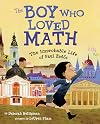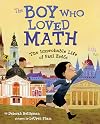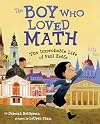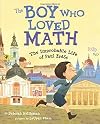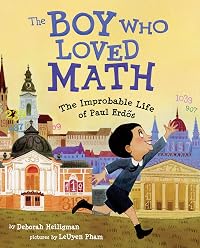
The Boy Who Loved Math: The Improbable Life of Paul Erdos
by Deborah Heiligman
On This Page
Description
Growing up in Hungary during WWI, Erdos tried school but chafed at the rules and convinced his mother that he should study at home. He was fascinated by numbers from an early age, and by the time he was 20, he was known as The Magician from Budapest. Unable to do common tasks such as cooking, laundry, or driving, he spent his adult life flying around the world, staying with other mathematicians, and working collaboratively on challenging math problems.Tags
Recommendations






Member Reviews
Math genius Paul Erdos was born in Budapest, Hungary in 1913. He left for the United States in 1938 to escape the Nazis; most of his relatives, who were Jewish, were murdered by them. He lived until 1996, dying at a math meeting in Poland, but, as the author writes in her note, he is still inspiring mathematicians to this day.
The story in the book focuses on Paul’s love of numbers, on his eccentricities, and on the many people who loved him, calling him “Uncle Paul” and assigning an “Erdos number” to their friendship with him. I.e., if you did math with him, you got an Erdos number of 1, if you worked with someone who worked with him, your number was 2, and so on.
Readers of the book, recommended for ages 3 and up, will be show more charmed by the text, the illustrations, and perhaps become fascinated by the interesting facts about math included, especially about prime numbers.
Illustrator Leuyen Pham writes in a note in the back matter that she had “a great amount of fun trying to incorporate the world of math with the world of art in this book.” She includes a very detailed and helpful guide to the math she used in some of the images. show less
The story in the book focuses on Paul’s love of numbers, on his eccentricities, and on the many people who loved him, calling him “Uncle Paul” and assigning an “Erdos number” to their friendship with him. I.e., if you did math with him, you got an Erdos number of 1, if you worked with someone who worked with him, your number was 2, and so on.
Readers of the book, recommended for ages 3 and up, will be show more charmed by the text, the illustrations, and perhaps become fascinated by the interesting facts about math included, especially about prime numbers.
Illustrator Leuyen Pham writes in a note in the back matter that she had “a great amount of fun trying to incorporate the world of math with the world of art in this book.” She includes a very detailed and helpful guide to the math she used in some of the images. show less
This delightful picture book biography tells the story of a genius who at the age of 4 could tell people how many seconds they’d been alive if he knew the year and time they were born, who knew his calling as a child when he found out about negative numbers, who fell in love with prime numbers at age 10. Not a rule follower in life (he was homeschooled as a child because he couldn’t function in school), he loved the rules of mathematics. Never functioning well or fitting in with society, he invented his own way of life, travelling the world, meeting with mathematicians, and doing math. He referred to children as epsilons “because an epsilon is a very small amount in math” (p. 22). The text is filled with mathematical language show more such as “Mama loved him to infinity” (p.3) and the illustrations are laced with numbers and expertly researched mathematical references which LeUyen Pham explains in an illustrator’s note. A tour de force, this book could be shared with k-12 students who could be introduced to and appreciate Paul Erdos at appropriate levels. Heiligman acknowledges valuable print sources and also a documentary about Erdos N is a Number, which is well worth watching. show less
Most people think of mathematicians as solitary, working away in isolation. And, it's true, many of them do. But Paul Erdos never followed the usual path. At the age of four, he could ask you when you were born and then calculate the number of seconds you had been alive in his head. But he didn't learn to butter his own bread until he turned twenty. Instead, he traveled around the world, from one mathematician to the next, collaborating on an astonishing number of publications. With a simple, lyrical text and richly layered illustrations, this is a beautiful introduction to the world of math and a fascinating look at the unique character traits that made "Uncle Paul" a great man.
This book tells about the life of mathematician Paul Erdos. He hated following rules, except when it came to mathematics. When Paul was grown, he realized that he did not fit into the world the way other people did. He decided that he was meant for a different type of life so he traveled the world, exchanging mathematics for a place to stay. He spent his entire life dedicating his time to his study of mathematics.
This book would make a great addition to a mathematics classroom because it shows that a passion for mathematics is not an unusual thing. It also shows that not everyone fits into the world in the way that society tells us is "normal" and that is okay!
This book would make a great addition to a mathematics classroom because it shows that a passion for mathematics is not an unusual thing. It also shows that not everyone fits into the world in the way that society tells us is "normal" and that is okay!
It is thought that Paul Erdos may have been Autistic which although he was a genius, made some life skills very difficult for him to master. Themes in this book are inclusion, intelligence, math, kindness, sharing, self acceptance and friendship.
The Boy Who Loved Math: The Improbable Life of Paul Erdős tells the story of Paul Erdős, a Hungarian boy whose lifelong fascination with numbers led him to become one of the most influential mathematicians of the 20th century. The book follows him from his childhood in Budapest, where he preferred thinking about numbers instead of everyday routines, to his adult life traveling the world to collaborate with other mathematicians. The intended audience is upper elementary and middle school students. The book includes academic vocabulary such as combinatorics, equations, and patterns. It focuses on the joy of problem-solving, making it an excellent resource for introducing students to mathematical inquiry. This story would be a meaningful show more addition to a classroom library because it celebrates intellectual curiosity and diverse thinking. show less
The Boy Who Loved Math tells the story of a famous mathematician named Paul Erdos. As a child, Paul loved the concept of infinity and often explored how mathematics interacted with everyday life. Paul had trouble following the rules in school, so his mother decided to let him stay home and complete his studies. After high school, Paul decided to travel the world to do math with his colleagues, which led to the discovery and evolution of number theory. The story of Paul Erdos’s life is a great inspiration for children who may struggle with rules and learn in unconventional ways. Heiligman does a fantastic job of integrating math concepts in a fun and intriguing way!
Members
- Recently Added By
Lists

Children's Books About Science and Math
461 works; 12 members

My Wishlist - Children's
185 works; 4 members

Favorite Kids Science Books
129 works; 1 member
Author Information

39+ Works 10,382 Members
All Editions
Awards and Honors
Awards
Distinctions
Notable Lists
Common Knowledge
- Original publication date
- 2013
- People/Characters
- Paul Erdős
- Important places
- Budapest, Hungary
- Dedication
- For Zachary Weiner, who is inventing his own special way to live --- D. H.
This book is most humbly dedicated to Anne Diebel. --- L. P. - First words
- There once was a boy who loved math. He grew up to be 1 of the greatest mathematicians who ever lived.
- Quotations
- Everyone else talked and ate, but Paul stared at his bread. He stared at his butter. He didn't know how to butter his bread.
Finally he took his knife, put some butter on it, and spread it on his bread. &nb... (show all)sp;Phew. He did it! "It wasn't so hard," he said. ( Erdős was about 20)
Uncle Paul was generous with his brain -- and his money, too. Whatever money he had he gave away. He gave money to poor people and he offered prize money for unsolved math problems.
All over the world mathmaticians still talk about and love Uncle Paul. Even people who never met him. They talk about their "Erdős number." If you did math with Paul you get an Erdős number of 1. If you worked with ... (show all)someone who worked with Paul, your Erdős number is 2. People are so proud of their Erdős number. (pp.31-32) - Last words
- (Click to show. Warning: May contain spoilers.)Numbers and people were his best friends. Paul Erdős Had no problem with that.
Classifications
Statistics
- Members
- 985
- Popularity
- 26,725
- Reviews
- 149
- Rating
- (4.37)
- Languages
- Chinese, English, Estonian
- Media
- Paper, Ebook
- ISBNs
- 8
- ASINs
- 3