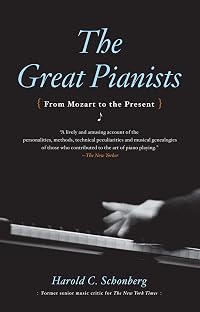
The Great Pianists: From Mozart to the Present
by Harold C. Schonberg
On This Page
Description
From Mozart's fabulous legato that "flowed like oil" to Beethoven's oceanlike surge, from Clara Schumann's touch "sharp as a pencil sketch" to Rubinstein's volcanic and sensual playing, The Great Pianists brings to life the brilliant, stylish, and sometimes eccentric personalities, methods, and technical peculiarities of history's greatest pianists. Pulitzer Prize-winning critic and author Harold C. Schonberg presents vivid accounts of the artists' performances, styles, and even their show more personal lives and quirky characteristics-- such as Mozart's intense competition with Clementi, Lizst's magnetic effect on women (when he played, ladies flung their jewels on stage), and Gottschalk's persistent nailbiting, which left the keys covered with blood. Including profiles of Horowitz and Van Cliburn, among others, and chapters detailing the playing and careers of such modern pianists as de Larrocha, Ashkenazy, Gilels, Gould, Brendel, Bolet, Gutierrez, and Watts, The Great Pianists is a comprehensive and fascinating look at legendary performers past and present. show lessTags
Recommendations















Member Reviews
I found this book fascinating. It doesn't concentrate on biographical details of the great pianists, but rather on their personalities, idiosyncracies and their piano playing style as described by those who heard (and saw) them.
There's some delightful titbits in there, such as the fact that Liszt was a handsome man with long hair, who would throw his hands around, and toss his hair over his face, make dramatic gestures and fierce grimaces while playing. Ladies would swoon and scream and throw their jewellery on the stage while he played. The first rock star?
As well as anecdotes like that, the book is also a history of piano playing, from the piano's invention in Bach's day, until the time of writing, which was the 1980s. It gives a show more clear picture of the changes from baroque to classical to romantic to modernist. As a piano player, I found some fascinating insights there too, such as that it's a relatively new idea that the performer should slavishly adhere to what's written on the score - it was the norm for over a century to embellish and enforce one's own personality onto the music.
My only complaint is that the book finishes too soon - reading it now, I feel like I'm missing out on the rest of the story - it was written squarely in the modernist period, which I'm sure is over now. What are we at now? Post-modernist? Neo-romantic? Eclectic? I'd love someone to tell me. show less
There's some delightful titbits in there, such as the fact that Liszt was a handsome man with long hair, who would throw his hands around, and toss his hair over his face, make dramatic gestures and fierce grimaces while playing. Ladies would swoon and scream and throw their jewellery on the stage while he played. The first rock star?
As well as anecdotes like that, the book is also a history of piano playing, from the piano's invention in Bach's day, until the time of writing, which was the 1980s. It gives a show more clear picture of the changes from baroque to classical to romantic to modernist. As a piano player, I found some fascinating insights there too, such as that it's a relatively new idea that the performer should slavishly adhere to what's written on the score - it was the norm for over a century to embellish and enforce one's own personality onto the music.
My only complaint is that the book finishes too soon - reading it now, I feel like I'm missing out on the rest of the story - it was written squarely in the modernist period, which I'm sure is over now. What are we at now? Post-modernist? Neo-romantic? Eclectic? I'd love someone to tell me. show less
Another indispensable work by Schonberg. Really gives you some idea of how the great pianists of the past (and a few of the present) approached their work and what the pre-recording era ones probably sounded like. This was especially interesting to me since my daughter is studying the piano, and though not a musician myself, I was fascinated by Schonberg's narrative, which includes lots of memorable anecdotes. Doesn't require a music degree to appreciate, and anyone with a hankering for some fine writing needs to discover Schonberg.
this book is absolutely FANTASTIC. I found it really readable and also incredibly informative. It's full of interesting anecdotes which I'm sure I'll never forget, as well as heaps of background on the development of pianos and piano technique from...well, Mozart to the present.
All pianists should read this! It's so much fun to read, and that really makes everything you read about stick.
When you read about Evgeny Kissin having 'potential' and the 'recent' winners of the Chopin competition not seeming to have much 'promise' you realise how long ago this was written, though!
All pianists should read this! It's so much fun to read, and that really makes everything you read about stick.
When you read about Evgeny Kissin having 'potential' and the 'recent' winners of the Chopin competition not seeming to have much 'promise' you realise how long ago this was written, though!
Ratings
Members
- Recently Added By
Lists

Piano and Pianists
17 works; 3 members

Works concerning Franz Liszt
30 works; 1 member
Author Information

27+ Works 1,642 Members
Common Knowledge
- Canonical title
- The Great Pianists: From Mozart to the Present
- Original title
- The Great Pianists: From Mozart to the Present
- Original publication date
- 1963; 1987, revised and updated edition
- People/Characters
- Wolfgang Amadeus Mozart; Ludwig van Beethoven; Franz Liszt; Frédéric Chopin; Robert Schumann; Muzio Clementi (show all 40); Louis Gotschalk; Ignacy Jan Paderewsky; Sergei Rachmaninoff; Josef Hofmann; Ferruccio Busoni; Artur Schnabel; Artur Rubinstein; Vladimir Horowitz; Glenn Gould; Karl Czerny; Carl Maria von Weber; John Field; Johann Nepomuk Hummel; Friedrich Kalkbrener; Ignaz Moscheles; Karl Tausig; Richard Dreyschock; Sigismund Thalberg; Adolf Henselt; Louis Valentine Alkan; Sophie Menter; Anton Rubinstein; Camille Saint-Saëns; Theodore Leschetizky; Vladimir de Pachmann; Leopold Godowsky; Josef Lhevinne; Alfred Cortot; Walter Gieseking; Jorge Bolet; Rudolf Serkin; Claudio Arrau; Alfred Brendel; Maurizio Pollini
- First words*
- Dieses Buch handelt vom Klavierspiel, und die Geschichte des Klavierspiels beginnt mit Mozart und Clementi.
- Original language
- English
*Some information comes from Common Knowledge in other languages. Click "Edit" for more information.
Classifications
- Genres
- Music, Nonfiction, General Nonfiction, Biography & Memoir, History
- DDC/MDS
- 786.10922 — Arts & recreation Music Keyboard, mechanical, electrophonic, percussion instruments General principles, musical forms, instruments
- LCC
- ML397 .S3 — Music Literature on music Literature on music History and criticism Biography
- BISAC
Statistics
- Members
- 398
- Popularity
- 78,640
- Reviews
- 3
- Rating
- (4.38)
- Languages
- English, German, Spanish
- Media
- Paper
- ISBNs
- 7
- ASINs
- 6