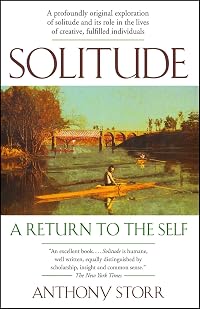
Solitude: A Return to the Self
by Anthony Storr
On This Page
Description
Originally published in 1988, Anthony Storr's bestselling meditation on the creative individual's need for solitude has become a classic. A pre-eminent work in self-help and popular psychology literature, Solitude was seminal in challenging the psychological paradigm that "interpersonal relationships of an intimate kind are the chief, if not the only, source of human happiness." Indeed, most self-help literature still places relationships at the center of human existence. Lucid and lyrical, show more Storr's book argues that solitude ranks alongside relationships in its impact on an individual's well-being and productivity, as well as on society's progress and health. Citing numerous examples of brilliant scholars and artists--from Beethoven and Kant to Anne Sexton and Beatrix Potter--he argues that solitary activity is essential not only for geniuses, but often for the average person as well. For nearly three decades, readers have found inspiration and renewal in Storr's erudite, compassionate vision of the human experience--and the benefits and joy of solitude. show lessTags
Recommendations







Member Reviews
In this acclaimed book, the eminent psychiatrist Dr. Anthony Storr challenges the widely held view that success in personal relationships is the only key to happiness. He argues persuasively that we pay far too little attention to some of the other great satisfactions of life - work and creativity. In a series of skillful biographical sketches, among them Beethoven, Henry James, Goya, Wittgenstein, Kipling, and Beatrix Potter, he demonstrates how many of the creative geniuses of our civilization have been solitary, by temperament or circumstance, and how the capacity to be alone is, even for those who are not creative, a sign of maturity.
His argument is that Solitude can be and often is a positive force in one's life, and offers rewards at least as satisfying as finding a mate. It resonated with me as a single man in my 30s--I'm now a 60-year-old bachelor, and I find it to be on the money.
Anthony Storr contrasts the significance of human relationships with the power of solitude in this engaging look at the nature of solitude. The importance of the impersonal part of the human condition and its value for creativity and life is the message of Storr's thoughtful meditation and exegesis. On a voyage consisting of twelve chapters or excursions into the variety of solitude and its meaning the author considers aspects from the "hunger of the imagination" to the "search for coherence" in one's life with digressions into depression and its counterparts. Containing a wealth of references to writers from Plato to Freud (plus artists and other creative types) the book uses examples of creativity and healthy living that have show more flourished in solitude. While the creative among us have contributed to the benefit of all, Storr suggests that everyone can benefit from some moments of solitude, if not a life based upon it. The desire for human companionship is important, but it should not exclude a realization and participation in moments of solitude. This book expands the possibility for human flourishing by considering the impersonal side of our human nature. show less
British psychiatrist challenges established belief (in 1988 when pub.) that interpersonal relationships are the chief if not the only source of happiness. Makes the case for solitary activity as indispensible in living a full creative life.
Some people can spend days, weeks, months in thier imagination without needing human interaction. Storr looks at this phenomenon. I found it to be very reassuring as I can be by myself for weeks before I need to interact with people.
pretty good book.
If you would like to share your joy in this book, please Click here
Members
- Recently Added By
Lists

Tom's Bookstore
346 works; 2 members

In Our Time books
4,934 works; 2 members
Author Information

22+ Works 4,242 Members
Charles Anthony Storr, May 18, 1920 - March 17, 2001 Charles Anthony Storr was born on May 18, 1920 in London to a Reverend of Westminster Abbey and his wife. The two were first cousins, which may have lead to his poor health and depression. At the age of eight, he attended public school at Winchester and was very unhappy. He graduated from show more Winchester College and proceeded to Christ's Church in Cambridge where he met C. P. Snow who encouraged him to be moral and compassionate. Storr continued his medical studies at Westminster Hospital from 1941 to 1944, and then became a house physician at various hospitals. He is best known for his books on Freud and Jung. After completing his education, Storr practiced psychotherapy privately, but combined his private practice with hospitals as a consultant. In 1974, he retired from private practice to teach post graduate doctors at Oxford where he received dining rights at Wadham College and became a fellow at Green College. After his first attempt at writing proved fruitful, Storr continued his career as a writer, producing 11 books in the next 26 years. Storr's books were very popular in the U. S. and following his literary fame, he became a frequent book reviewer and commentator on British television. He wrote on different themes, but his favorites were gurus, as evidenced in his book, "Feet of Clay, solitude as a helpful tool in recovery, "Solitude: A Return to Self", and the theories of Freud and Jung. Storr died on March 17 in Oxford after having a heart attack during a speech at Wadham College. He was 80 years old. show less
Work Relationships
Inspired
Common Knowledge
- Original title
- The School of Genius
Classifications
- Genres
- Nonfiction, General Nonfiction, Philosophy, Religion & Spirituality
- DDC/MDS
- 155.92 — Philosophy & psychology Psychology Differential and developmental psychology Environmental psychology Social Influences
- LCC
- BF637 .S64 .S65 — Philosophy, Psychology and Religion Psychology Psychology Applied psychology
- BISAC
Statistics
- Members
- 1,191
- Popularity
- 21,051
- Reviews
- 7
- Rating
- (3.76)
- Languages
- 7 — Chinese, Dutch, English, French, Italian, Portuguese, Swedish
- Media
- Paper, Ebook
- ISBNs
- 21
- ASINs
- 15