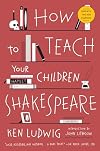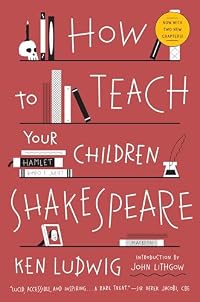
How to teach your children Shakespeare
by Ken Ludwig
On This Page
Description
Outlines an engaging way to instill an understanding and appreciation of Shakespeare's classic works in children, outlining a family-friendly method that incorporates the history of Shakespearean theater and society.Tags
Recommendations








Member Reviews
I had so much fun reading this book. If you always have loved the writing of Shakespeare, or, better yet, wanted to love it but just didn’t get it, this is the book for you!
How To Teach Your Children Shakespeare is by an acclaimed playwright who hopes to provide you with the tools to help you and your children make Shakespeare a part of your lives. He shows you how to make Shakespeare both informative and fun. He writes:
"Shakespeare should not be an occasional visitor. He should be a permanent houseguest, living in that spare room down the hall, ready to join you for a meal or an evening whenever you crave his company. Better yet, he should feel like a part of your family...”
With passion and enthusiasm, he sets out to convince you show more how to do just that, providing plenty of guidance.
I don’t know how well this book would work on kids, but it certainly helped me to understand Shakespeare better than I ever did, and I studied Shakespeare extensively in college.
He goes through many passages adding “translations,” as in this example:
"I have of late [recently],
but wherefore [why] I know not,
lost all my mirth [cheerfulness]”
If the speech might be particularly abstruse for modern audiences, he uses two columns, with Shakespeare’s words on the left, and a summary of their meaning on the right. He also explains the imagery and importance of the passages, and why they are considered so masterful. For instance, in discussing Hamlet, he observes:
"The Ghost fills Hamlet’s ear with the details of his own murder the way Claudius filled King Hamlet’s ear with poison. This paradox underscores an important question: Is the Ghost lying or telling the truth? Are his words reliable or poisonous? This is something that Hamlet will spend the next two acts of the play trying to find out.”
I loved too how he demonstrates the way in which Shakespeare manipulated word length and alliteration to slow down or speed up delivery of lines for dramatic effect.
He even provides ideas for entertaining ways to encourage your children to incorporate some of Shakespeare’s bot mots into your own lives. For example, here is how the author's daughter echoes Falstaff from Henry IV, Part I:
"Our daughter, Olivia, stays up past her bedtime and her mother catches her in bed with her computer.
Mom
Olivia, what do you think you’re doing?
Olivia
Why, Mom, ‘tis my vocation, Mom. ‘Tis no sin for a girl to labor in her vocation.’”
As he explains at the outset, in answer to the question “Why Shakespeare?”:
"...Shakespeare isn’t just one of the many great authors in the English language; Shakespeare is, indisputably, one of the two great bedrocks of Western civilization in English. (The other is the King James translation of the Bible.) Not only do Shakespeare’s plays themselves contain the finest writing of the past 450 years, but most of the best novels, plays, poetry, and films in the English language produced since Shakespeare’s death in 1616 - from Jane Austen to Charles Dickens, from Ulysses to The Godfather - are heavily influenced by Shakespeare’s stories, characters, language, and themes.”
Evaluation: I truly enjoyed this book; it gave me so many new insights into the wonderful world of Shakespeare, and allowed me to enjoy his work in an entirely new way. Highly recommended even without any potential pupils besides yourself! show less
How To Teach Your Children Shakespeare is by an acclaimed playwright who hopes to provide you with the tools to help you and your children make Shakespeare a part of your lives. He shows you how to make Shakespeare both informative and fun. He writes:
"Shakespeare should not be an occasional visitor. He should be a permanent houseguest, living in that spare room down the hall, ready to join you for a meal or an evening whenever you crave his company. Better yet, he should feel like a part of your family...”
With passion and enthusiasm, he sets out to convince you show more how to do just that, providing plenty of guidance.
I don’t know how well this book would work on kids, but it certainly helped me to understand Shakespeare better than I ever did, and I studied Shakespeare extensively in college.
He goes through many passages adding “translations,” as in this example:
"I have of late [recently],
but wherefore [why] I know not,
lost all my mirth [cheerfulness]”
If the speech might be particularly abstruse for modern audiences, he uses two columns, with Shakespeare’s words on the left, and a summary of their meaning on the right. He also explains the imagery and importance of the passages, and why they are considered so masterful. For instance, in discussing Hamlet, he observes:
"The Ghost fills Hamlet’s ear with the details of his own murder the way Claudius filled King Hamlet’s ear with poison. This paradox underscores an important question: Is the Ghost lying or telling the truth? Are his words reliable or poisonous? This is something that Hamlet will spend the next two acts of the play trying to find out.”
I loved too how he demonstrates the way in which Shakespeare manipulated word length and alliteration to slow down or speed up delivery of lines for dramatic effect.
He even provides ideas for entertaining ways to encourage your children to incorporate some of Shakespeare’s bot mots into your own lives. For example, here is how the author's daughter echoes Falstaff from Henry IV, Part I:
"Our daughter, Olivia, stays up past her bedtime and her mother catches her in bed with her computer.
Mom
Olivia, what do you think you’re doing?
Olivia
Why, Mom, ‘tis my vocation, Mom. ‘Tis no sin for a girl to labor in her vocation.’”
As he explains at the outset, in answer to the question “Why Shakespeare?”:
"...Shakespeare isn’t just one of the many great authors in the English language; Shakespeare is, indisputably, one of the two great bedrocks of Western civilization in English. (The other is the King James translation of the Bible.) Not only do Shakespeare’s plays themselves contain the finest writing of the past 450 years, but most of the best novels, plays, poetry, and films in the English language produced since Shakespeare’s death in 1616 - from Jane Austen to Charles Dickens, from Ulysses to The Godfather - are heavily influenced by Shakespeare’s stories, characters, language, and themes.”
Evaluation: I truly enjoyed this book; it gave me so many new insights into the wonderful world of Shakespeare, and allowed me to enjoy his work in an entirely new way. Highly recommended even without any potential pupils besides yourself! show less
I don't have kids, but I love Shakespeare and I teach high school English, and I thoroughly enjoyed reading this book. Ludwig's passion for Shakespeare is infectious, and his commentary on the passages he selects is insightful but accessible. Even as someone who has read and reread and studied each of the plays he explores in this book, I found myself learning new things, seeing passages in a new light or from a fascinating new perspective -- which probably speaks to the richness of Shakespeare as much as to Ludwig's talents as an author and a guide. Ultimately, when I put the book down, I wanted nothing so much as to pick up Hamlet or MacBeth and reread them for the nth time... which I think speaks very strongly to the success of this show more book. show less
 This review was written for LibraryThing Early Reviewers.
This gem is a book built to help introduce your children to Shakespeare, but it would work as an introduction for adults as well. It’s also a great way to dive deeper into the world of Shakespeare even if you’re already a fan. I felt like I learned quite a bit while reading it, because it isn’t dumbed down for kids, it’s just simplified.
Ludwig's passion for Shakespeare is infectious. He finds joy in the work and beautifully explains how to make that joy accessible to anyone who reads the Bard. He makes you appreciate each lovely line while giving an overview of the plays, Shakespeare's life and the depth of his work.
“… Shakespeare was fearlessly true to life. Throughout his plays we see not only comedy and not only tragedy show more but also, always, the truth.”
Ludwig breaks down some of Shakespeare’s most famous plays to make them accessible. He focuses quite a bit on memorization, but that’s just one aspect of the book. He explains plots and language, the difference between prose and poetry, provides character break downs, and walks us through beautiful speeches and what they mean. He explains the way Shakespeare used the cadence of the language to help the actors pace their performances.
He takes some of the famous soliloquies, especially from Hamlet, and breaks them down in a side-by-side comparison. He gives the reader Shakespeare’s words next to his own paraphrase in modern language. It’s incredibly helpful for adults as well as kids. It helps readers understand the full meaning behind some of well-known lines.
One of my favorite things Ludwig does in the book is offer a context for Shakespeare’s work. He looks at the author’s life, England during that time period and the order in which the plays were written. Understanding that The Tempest was written later in life and The Taming of the Shrew was an early work helps readers understand the increased tone of gravitas n even his comedies.
At the end of the book he also includes an extensive bibliography of both books and films to further your children’s or your exploration of Shakespeare. I love that in addition to listing the books and movies he gives some background and his opinion of them.
BOTTOM LINE: Beautifully written and incredibly accessible, this book is sure to ignite a love of Shakespeare in anyone who is interested!
*The book covers the following plays: Midsummer Night’s Dream, Twelfth Night, Hamlet, Romeo and Juliet, Macbeth, Henry IV, As You Like It, Henry V, and The Tempest.
“Shakespeare’s plays, like all great works of art, are open to interpretation. That is the hallmark of art that has real value. If a work is static and never changes, then it can never tell us very much about how we change over our lifetimes, and how mankind changes over centuries. As Hamlet says, it is the artist’s job to hold the mirror up to nature.”
“Toward the end of his life, Rossini said of Mozart: ‘He was the inspiration of my youth, the despair of my middle years and the consolation of my old age.’ We want Shakespeare to be all those things for your children.” show less
Ludwig's passion for Shakespeare is infectious. He finds joy in the work and beautifully explains how to make that joy accessible to anyone who reads the Bard. He makes you appreciate each lovely line while giving an overview of the plays, Shakespeare's life and the depth of his work.
“… Shakespeare was fearlessly true to life. Throughout his plays we see not only comedy and not only tragedy show more but also, always, the truth.”
Ludwig breaks down some of Shakespeare’s most famous plays to make them accessible. He focuses quite a bit on memorization, but that’s just one aspect of the book. He explains plots and language, the difference between prose and poetry, provides character break downs, and walks us through beautiful speeches and what they mean. He explains the way Shakespeare used the cadence of the language to help the actors pace their performances.
He takes some of the famous soliloquies, especially from Hamlet, and breaks them down in a side-by-side comparison. He gives the reader Shakespeare’s words next to his own paraphrase in modern language. It’s incredibly helpful for adults as well as kids. It helps readers understand the full meaning behind some of well-known lines.
One of my favorite things Ludwig does in the book is offer a context for Shakespeare’s work. He looks at the author’s life, England during that time period and the order in which the plays were written. Understanding that The Tempest was written later in life and The Taming of the Shrew was an early work helps readers understand the increased tone of gravitas n even his comedies.
At the end of the book he also includes an extensive bibliography of both books and films to further your children’s or your exploration of Shakespeare. I love that in addition to listing the books and movies he gives some background and his opinion of them.
BOTTOM LINE: Beautifully written and incredibly accessible, this book is sure to ignite a love of Shakespeare in anyone who is interested!
*The book covers the following plays: Midsummer Night’s Dream, Twelfth Night, Hamlet, Romeo and Juliet, Macbeth, Henry IV, As You Like It, Henry V, and The Tempest.
“Shakespeare’s plays, like all great works of art, are open to interpretation. That is the hallmark of art that has real value. If a work is static and never changes, then it can never tell us very much about how we change over our lifetimes, and how mankind changes over centuries. As Hamlet says, it is the artist’s job to hold the mirror up to nature.”
“Toward the end of his life, Rossini said of Mozart: ‘He was the inspiration of my youth, the despair of my middle years and the consolation of my old age.’ We want Shakespeare to be all those things for your children.” show less
This review was written for LibraryThing Early Reviewers.Though this book is aptly named, it might also be titled "How to Teach Yourself Shakespeare" or "You are Literally Holding in Your Hands a Script Sufficient to Introduce Your Children to Shakespeare." I thoroughly enjoyed reading it, and I can see how it would be extremely useful in introducing the various plots and writing styles associated with Shakespeare. Writing in a very conversational style, Ludwig alternates instructive prose with personal anecdotes: it is clear indeed that he has codified a system that worked well for his own children, and we are all the better for it. With the dialogue provided -- even printing out repetitions where suggested -- and access to large-scale memory aids online, this is a very thorough and show more accessible start. I was also thinking about how it might be adapted outward: the memorization techniques are universal, and might be applied with the same attention to detail and meaning to other poetry, scripture, "non-fiction" speeches, etc. I learned a lot already, and I would recommend it to anyone who, like myself, wishes to teach Shakespeare but lacks the confidence to design their own approach. show less
This review was written for LibraryThing Early Reviewers.I requested an early reviewer edition of this book because I anticipated it would be useful down the line in homeschooling. But when I began reading it, I got excited about it right away, and when I read that he began teaching his children Shakespeare at age 6, I thought why not just give it a try with my (well-read) four-year-old? Over lunch with other children in my early childhood program, I asked if anyone would like to memorize something. All enthusiastically agreed (ages 2, 2, 3, and 4). By the end of lunch, we were reciting "I know a bank where the wild thyme blows." Over the next few days, my daughter learned to say all 10 lines of the selected passage flawlessly, and understood what it meant, and its context within the play. show more She was begging me for more. I don't intend to follow the whole book with her at such an early age, but it was a kick to see how well it worked! I look forward to pursuing the rest of it with her when she's a bit older, and I'm thrilled to have this resource. show less
This review was written for LibraryThing Early Reviewers.When I first received Ken Ludwig’s “How to Teach Your Children Shakespeare,” I was intrigued but also a little skeptical. It seemed like something idealistic to strive towards, but I was convinced that there would be a catch involved. After reading the book, I am happy to report that my concerns did not come to fruition. Instead of offering an overly complicated system or providing a model that seems too good to be true, Ludwig provides a straightforward method for helping children (or anyone) learn and appreciate Shakespeare. At the core of Ludwig’s suggestion is memorization, a pedagogical technique that has fallen out of favor because of fears of children simply parroting back ideas without comprehending them. However, Ludwig show more eschews rote learning by also emphasizing that the participants should also understand what they are saying and why the language is so important and effective in Shakespeare. To aid with this, he offers quotation pages that make the passages less foreboding. Additionally, after the first few chapters in which he outlines his suggested method, the rest of the book is dedicated to deconstructing, explaining, and exploring the selected passages (which include selections from Henry IV, The Tempest, and Macbeth). All in all, the result of Ludwig’s work is a system that champions the importance of Shakespeare and the idea that children will not only be able to understand the Bard’s work but also revel in it. show less
This review was written for LibraryThing Early Reviewers."How to Teach Your Children Shakespeare" by Ken Ludwig is must reading for anyone who teaches Shakespeare. The book is recommended reading for everyone else. It does not matter if you do not have children to teach or if you don’t even have an interest in Shakespeare. You are likely to develop an interest in Shakespeare after reading this book and want to share your new interest with others. Reading this book is like sitting with an enthusiastic mentor. Ludwig’s love for Shakespeare is contagious. His writing is a joy to read. For those who want to teach others Shakespeare, Ludwig offers a method for helping children and adults memorize key Shakespearean passages. Each chapter is a lesson. Ludwig includes numerous tips for making the show more lessons fun. If you do not want to teach others, use the book to teach yourself. Ludwig’s approach makes Shakespeare relevant and alive. The book’s bibliography provides a wealth of follow-up resources and the author’s enthusiastic explanation of each resource will have you wanting to become a Shakespearean authority. In summary, this book is practical, enlightening, and fun. show less
This review was written for LibraryThing Early Reviewers.Members
- Recently Added By
Author Information
29+ Works 1,398 Members
Ken Ludwig is an internationally acclaimed playwright who has had numerous hits on Broadway, in London, and throughout the world. His plays and musicals include Lend Me a 'Tenor, which won two Tony Awards, and Crazy for You. which won the Tom Award for Best Musical. He has also won two Laurence Olivier Awards and the Edgar Award from the Mystery show more Writers of America. His work has been commissioned by the Royal Shakespeare Company, and his plays have been performed in over thirty countries in more than twenty languages. show less
Common Knowledge
- Canonical title
- How to teach your children Shakespeare
- Original publication date
- 2013-06-11
- Dedication
- This book is dedicated to my children, Olivia and Jack Ludwig, who inspired it.
It is also dedicated to Barbara Mowat, great Shakespearean, for her friendship and advice. - Blurbers
- Shapiro, James; McClatchy, J.D.; Jacobi, Derek; Holbrook, Hal; Landesman, Rocco
Classifications
Statistics
- Members
- 876
- Popularity
- 30,815
- Reviews
- 30
- Rating
- (4.47)
- Languages
- Chinese, English
- Media
- Paper, Ebook
- ISBNs
- 4
- ASINs
- 2