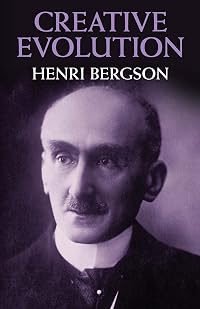
Creative Evolution
by Henri Bergson
On This Page
Description
French philosopher Henri Bergson's Creative Evolution was published in 1907 and translated into English in 1911. Very popular at the time, it gives an alternate mechanism for evolution - that it is motivated by an "élan vital" a vital impetus, also graspable as our natural creative urge. It also looks at Bergson's conception of time, a subjective "duration" (rather than the quantifiable time of a clock) that is best understood not through the intellect but through our creative intuition, an show more idea that influenced Marcel Proust and other modernist thinkers.. show less
Tags
Recommendations



Member Reviews
Questo libro apparso oltre un secolo fa, nel 1907, solo in apparenza sembra un trattato di filosofia per i suoi lineamenti sistematici e universali. Si tratta, in realtà, di un libro fatto di semplici e solenni meditazioni che si collegano a due o tre intuizioni di grande ed affascinante profondità. Di fatto, ognuno che legge questo libro, e anche chi non lo legge, puoi rendersi conto quanto sia faticoso capire la natura degli uomini e delle loro cose.
E' il cervello a dircelo, con le difficoltà che tutti conosciamo, a farlo funzionare nel modo migliore. Che cos'è la vita è il problema che Bergson affronta a viso aperto, con tranquilla disinvoltura: la vita, o forse meglio dire, la materia vivente, contrapposta alla fissità show more immobile, meccanica della materia inerte. Continuità di mutamento, attività incessante ed imprevedibile, conservazione del passato nel presente, durata del tempo. La materia vivente condivide per Bergson tutti i suoi attributi con la coscienza. Lui sostiene che soltanto per la materia vivente esiste il tempo, per questa ragione la vita è un continuo divenire, flusso ininterrotto, libera e perpetua creazione, corrente di coscienza che si insinua nella materia asservendola a sè ma anche rimandone limitata e condizionata.
Gli scontri con la vita con la materia segnano la grande strada su cui cammina l'evoluzione dell'universo. L'intelligenza umana, capace di rappresentare a se stessa soltanto ciò che è immobile e quindi soltanto la morte, potrà forse capire le leggi della materia, potrà matematizzare e fisicizzare il mondo, ma non potrà mai capire la vita. "Vi sono cose, lui dice, che solo l'intelligenza può cercare, ma che per suo conto non potrà mai trovare. Queste cose, solo l'istinto sarebbe capace di trovarle, ma l'istinto non le cercherà mai". show less
E' il cervello a dircelo, con le difficoltà che tutti conosciamo, a farlo funzionare nel modo migliore. Che cos'è la vita è il problema che Bergson affronta a viso aperto, con tranquilla disinvoltura: la vita, o forse meglio dire, la materia vivente, contrapposta alla fissità show more immobile, meccanica della materia inerte. Continuità di mutamento, attività incessante ed imprevedibile, conservazione del passato nel presente, durata del tempo. La materia vivente condivide per Bergson tutti i suoi attributi con la coscienza. Lui sostiene che soltanto per la materia vivente esiste il tempo, per questa ragione la vita è un continuo divenire, flusso ininterrotto, libera e perpetua creazione, corrente di coscienza che si insinua nella materia asservendola a sè ma anche rimandone limitata e condizionata.
Gli scontri con la vita con la materia segnano la grande strada su cui cammina l'evoluzione dell'universo. L'intelligenza umana, capace di rappresentare a se stessa soltanto ciò che è immobile e quindi soltanto la morte, potrà forse capire le leggi della materia, potrà matematizzare e fisicizzare il mondo, ma non potrà mai capire la vita. "Vi sono cose, lui dice, che solo l'intelligenza può cercare, ma che per suo conto non potrà mai trovare. Queste cose, solo l'istinto sarebbe capace di trovarle, ma l'istinto non le cercherà mai". show less
Radically pioneering & influential in its early 20th Century day, & now attracting fresh interest, this philosophical masterwork is a map of life itself - of its interlocking, continuously forward-thrusting nature.
I appreciate Bergson as someone who sits somewhere between Lucretius and Descartes. His ideas are interesting, especially when applied by Deleuze.
This book's main content consists of a de-anthropomorphized and secularized watchmaker's argument. I could take or leave this, I guess. I found the long passages on biology and different evolutionary theories to be a slog at best and made me worry that I was being duped at worst.
I kind of felt going into this one that it wouldn't really be the Bergson book for me. I'll be looking to read Matter and Memory or The Two Sources at some point.
This book's main content consists of a de-anthropomorphized and secularized watchmaker's argument. I could take or leave this, I guess. I found the long passages on biology and different evolutionary theories to be a slog at best and made me worry that I was being duped at worst.
I kind of felt going into this one that it wouldn't really be the Bergson book for me. I'll be looking to read Matter and Memory or The Two Sources at some point.
POINTS OF INTEREST
In reality, consciousness does not spring from the brain; but brain and consciousness correspond because equally they measure, the one by the complexity of its structure and the other by the intensity of the awareness, the quantity of choice that the living being has at its disposal. Consciousness corresponds exactly to the living beings power of choice; it is coextensive with the fringe of possible action that surrounds the real action. Consciousness is essentially free; it is freedom itself; but it cannot pass through matter without settling on it, without adapting itself to it: this adaptation we call intellectuality.
Prior to the science of geometry, there is a natural geometry whose clearness and evidence surpass show more the clearness and evidence of the other deductions – this latent geometry, is the main spring of our intellect and the cause of its workings. The consciousness of a living being may be defined as an arithmetical difference between potential and real activity. It measures the interval between representation and action. Inadequacy of act to representation is precisely what we call consciousness. Consciousness is the light that plays around the zone of possible actions or potential activity which surrounds the action really performed by living being. It signifies hesitation or choice. Where many equally possible actions are indicated without there being any real action (as in a deliberation that has not come to end), consciousness is intense. Where the action performed is the only action possible (as in activity of the somnambulistic or more generally automatic kind), consciousness is reduced to nothing.
Consciousness, in man, is pre-eminently intellect. The human intellect feels at home among inanimate objects, more especially among solids, where our action finds its fulcrum and out industry its tools; our concepts have been formed on the model of solids; out logic is, pre-eminently, the logic of solids; consequently, our intellect triumphs in geometry, wherein is revealed the kinship of logical thought with unorganized matter, and where the intellect has only to follow its natural movement, in order to go from discover to discover, sure that experience is following behind it and will justify it invariably. The more consciousness is intellectualized, the more is matter spatialized. Deduction requires there be spatial intuition behind it. Induction implies first that world of the physicist as in that of the geometrician, time does not count. But it implies also that qualities can be superposed on each other like magnitudes. It implies that reality is decomposable into groups, which can be practically regarded as isolated and independent. It rests on the belief that there are causes and effects; and that the same effects follow the same causes.
Intelligence, in so far as it is innate, is the knowledge of a form; instinct implies the knowledge of matter. Whatever, in instinct and intelligence, that is innate knowledge, bears in the first case on thing and in the second on relations. Intelligence and instinct represent two divergent solutions, equally fitting, of one and the same problem; they are opposite and complementary; they are tendencies and not things. A tendency achieves all that it aims at only if its not thwarted by another tendency.
Instinct perfected is a faculty of using and even constructing organized instruments; intelligence perfected is the faculty of making and using unorganized instruments. Instinct is sympathy – the artist tries to regain, in placing himself back within the object by a kind of sympathy, in breaking down, by an effort of intuition, the barrier that space put up between him and his model. Intelligence, for every need that it satisfies, it creates a new need; and so, instead of closing, like instinct, the round of action within which the animal tends to move automatically, it lays open to activity an unlimited field into which it is driven further and further, and made more and more free. The entirely formal knowledge of intelligence has an immense advantage over the material knowledge of instinct. A form, just because it is empty, may be filled at will with any number of things in turn, even with those that are of no use. But, on the other hand, intelligence has even more need of instinct then instinct has of intelligence; for the power to give shape to crude matter involves already a superior degree of organization, a degree to which the animal could not have risen, save in the wings of instinct.
Of immobility and the discontinuous does the intellect form a clear idea: when it tries to form an idea of movement, it does so by constructing movement out of immobility put together. The more complexity the intellect puts into its object by analyzing it, the more complex is the order it finds there. And this complexity necessarily appear to the intellect as a positive reality, since reality and intellectually are turned in the same direction. Yet this complexity and extension represent nothing positive; they express a deficiency of will. The more we perceive, symbolically, parts in an indivisible whole, the more the number of relations that the parts have between themselves necessarily increases, since the same undividedness of the real whole continues to hover over the growing multiplicity of the symbolic elements into with the scattering of the attention has decomposed it.
Intuition and intellect represent two opposite directions of the work of consciousness; intuition goes in the very direction of life, intellect goes in the inverse direction, and thus finds itself naturally in accordance with the movement of matter. By intuition I mean instinct that has become disinterested, self-conscious, capable of reflecting upon its object and of enlarging it indefinitely. A complete and perfect humanity would be that in which the two forms of conscious activity should attain their full development, in any number of possible stages, corresponding to all the degrees imaginable of intelligence and of intuition.
[In the history of philosophy] there is no durable system that is not, at least in some of its parts, vivified by intuition. Dialectic is what ensures the agreement of our thought with itself. But by dialectic – which is only a relaxation of intuition – many different agreements are possible, while there is only one truth. Intuition, if it could be prolonged beyond a few instants, would not only make the philosopher agree with his own thought, but also all philosophers with each other. Such as it is, fugitive and incomplete, it is, in each system, what is worth more than the system and survives it. The impetus of life consists in a need of creation; it cannot create absolutely, because it is confronted with matter, that is to say with the movement that is inverse of its own. But it seizes upon this matter, which is necessity itself, and strives to introduce into it the largest possible amount of indetermination and liberty.
We are not the vital current itself; we are this current already loaded with matter, that is, with congealed parts of its own substance which it carries along its course. Matter, at first, aided mind to run down its own incline; it gave the impulsion. But, the impulsion once received, mind continues its course. The idea that it forms of pure space is only the schema of the limit at which this movement would end. Once in possession of the form of space, mind uses it like a net with meshes that can be made and unmade at will, which, thrown over matter, divides it as the needs of our action demand. Thus, the space of our geometry and the spatiality of things are mutually engendered by the reciprocal action and reaction of two terms which are essentially the same, but which move each in the direction inverse of the other. Neither is space so foreign to our nature as we imagine, nor is matter as completely extended in space as our senses and intellect represent it.
Life transcends finality; it is essentially a current sent through matter, drawing from it what it can. There has not, therefore, properly speaking, been any project or plan. If the current of life had been otherwise divided, we should have been, physically and morally, far different from what we are. The part played by contingency in evolution is therefore great. Contingent, generally, are the forms adopted, or rather invented. Contingent, relative to the obstacles encountered in a given place and at a given moment, is the dissociation of the primordial tendency into such and such complementary tendencies which create divergent lines of evolution.
To represent the object X non-existent can only consist in adding something to the idea of this object: we add to it, in fact, the idea of an exclusion of this particular object by actual reality in general. To think of object X as non-existent is first to think the object and consequently to think it existent; it is then that another reality, with which it is incompatible, supplants it. In other words, and however strange our assertion may seem, there is more, and not less, in the idea of an object conceived as “not existing” than the idea of this same object conceived as “existing.” Every human action has its starting-point in a dissatisfaction, and thereby in a feeling of absence. We should not act if we did not set before ourselves an end, and we seek a thing only because we feel the lack of it. Our action proceeds this from “nothing” to “something”, and its very essence is to embroider “something” on the canvas of “nothing”. The truth is that the “nothing” concerned here is the absence no so much of a thing as of a utility. In a general way, human work consists in creating utility; and, as long as the work is not done, there is “nothing” – nothing that we want. Our life is thus spent in filling voids, which our intellect conceives under the influence, by no means intellectual, of desire and of regret, under the pressure of vital necessities; and if we mean by void as absence of utility and not of things, we may say, in this quite relative sense, that we are constantly going from the void to the full.
[THE UNDERSTATING:] Must we keep the mechanistic idea of its which the understanding will always give us – an idea necessarily artificial and symbolical, since it makes the total activity of life shrink to the form of a certain human activity which is only a partial and local manifestation of life, a result or by-product of the vital process? In theory, there is a kind of absurdity in trying to know otherwise than by intelligence; but if the risk be frankly accepted, action will perhaps cut the knot that reasoning has tied and will not unloose. He who throws himself into the water, having known only the resistance of solid earth, will immediately be drowned if he does not struggle against the fluidity of the new environment: he must perforce still cling to that solidity, so to speak, which even water presents. Only on this condition can he get used to the fluids fluidity. So of our thought, when it has decided to make the leap. So you may speculate as intelligently as you will on the mechanism of intelligence; you will never, by this method, succeed in going beyond it; you may get something more complex, but not something higher nor even something different. You must take things buy storm: you must thrust intelligence outside itself by an act of will.
For a scientific theory to be final, the mind {or computer} would have to embrace the totality of things in block and place each thing in its exact relation to every other thing; but in reality we are obliged to consider problems one by one, in terms which are, for that very reason, provisional, so that the solution of each problem will have to be corrected indefinitely by the solution that will be given to the problems that will follow: thus, science as a whole is relative to the particular order in which the problems happen to have been put. Therein reside certain powers that are complementary to the understanding, powers of which we have only an indistinct feeling when we remain shut up in ourselves, but which will become clear and distinct when they perceive themselves at work, so to speak, in the evolution of nature. [This power to perceive other forms of consciousness] brought together and amalgamated with intellect provides a brief, fleeting glimpse of life complete. Our thought, in its purely logical form, is incapable of presenting the true nature of life, the full meaning of the evolutionary movement
That new things can join things already existing is absurd since the thing results from a solidification performed by our understanding, and there are never any things other than those that the understanding has thus constituted - things are constituted by the instantaneous cut which the understanding practices, at a given moment, on a flux of this kind, and what is mysterious when we compare the cuts together becomes clear when we relate them to the flux. Life is a movement, materiality is the inverse movement; there results between them a modus vivendi which is organization. The Understanding has the choice either to regard the infinitely complex organization as a fortuitous concatenation or atoms, or to relate it to the incomprehensible influence of an external force that has grouped its elements together. Things and states are only views, taken by our mind, of becoming. There are no things, there are only actions. Our intellect, whose function is essentially practical, presents to us things and states rather than changes and actions; [to think of things which are created and a thing which creates leads to illusion].
Life is of the psychological order, and it is of the essence of the psychical to enfold a confused plurality of interpenetrating terms. Is my own person, at a given moment, one or manifold? If I declare it one, inner voices arise and protest – those of the sensations, feelings, ideas, among which my individuality is distributed. But, if I make it distinctly manifold, my consciousness rebels quite as strongly; it affirms that my sensations, my feelings, my thoughts are abstractions which I effect on myself, and that each of my states implies all the others. I am then a unity that is multiple and multiplicity that is one; a mutual encroachment of numerous tendencies which nevertheless are numerous only when specialized – that is, regarded as outside of each other.
[DURATION:] The world the mathematician deals with is a world that dies and is reborn every instant – the world which Descartes was thinking of when he spoke of continued creation. We persuade ourselves that the duration to come admits the same treatment as past duration, that it is, even now, unrollable, that the future is there, rolled up, already painted on the canvas. An illusion, no doubt; the flux of time is the reality itself, and the things which we study are the things which flow. It is true that of this flowing reality we are limited to taking instantaneous views [– there is] a progressive growth of the absolute, and in the evolution of things a continual invention of forms ever new.
The more we succeed in making ourselves conscious of our progress in pure duration, the more we feel the different parts of our being enter into each other, and our whole personality concentrate itself in a point, or rather a sharp edge, pressed against the future and cutting into it unceasingly. It is in this that life and action are free. But suppose we let ourselves go and, instead of acting, dream. At once the self is scattered; out past, which till then was gathered together into the indivisible impulsion it communicated to us, is broken into a thousand recollections made external to one another. They give up interpenetrating in the degree that they have become fixed. Out personality thus descends in the direction of space. It coasts around it continually in sensation.
If everything is in time, everything changes inwardly, and the same concrete reality never recurs. Repetition is therefore possible only in the abstract: what is repeated is some aspect that our senses, and especially our intellect, have singled out from reality, just because our action, upon which all the effort of our intellect is directed, can move only among repetitions. The intellect turns away from the vision of time. It dislikes what is fluid, and solidifies everything it touches. We do not think real time. But we live it, because life transcends intellect. The evolution of the living being implies a continual recording of duration, a persistence of the past in the present, and so an appearance, at least, of organic memory.
Each of us, glancing back over his history, will find that his child-personality, though indivisible, united in itself divers persons, which could remain blended just because they were in their nascent state: this indecision, so charged with promise, is on of the greatest charms of childhood. But these interwoven personalities become incompatible in course of growth, and, as each of us can live but one life, a choice must perforce be made. We choose in reality without ceasing; without ceasing, also, we abandon many things. The route we pursue in time is strewn with the remains of all that we began to be, of all that we might have become. But nature, which has at command an incalculable number of lives, is in no wise bound to make such sacrifices. She preserves the different tendencies that have bifurcated with their growth. She creates with them divering series of species that will evolve separately. Evolution is a creation increasingly renewed, it creates, as it goes on, not only the forms of life, but the ideas that will enable the intellect to understand it, the terms which will serve to express it. That is to say that its future overflows its present, and can not be sketched out therein in an idea.
What are we, in fact, what is our character, if not the condensation of the history that we have lived from our birth – nay, even before our birth, since we bring with us prenatal disposition? Doubtless we think with only a small part of our past, but it is with our entire past, including the original bent of our soul, that we desire, will and act. Our past, then, as a whole, is made manifest to us in its impulse, it is felt in the form of tendency, although a small part of it is only known in the form of idea. From this survival of the past it follows that consciousness cannot go through the same state twice. The circumstances may still be the same, but they will act no longer on the same person, since they find him at a new moment in history. Our personality which is being built up each instant with its accumulated experience, changes without ceasing. That is why our duration is irreversible. We could not live over again a single moment, for we should have to begin by effacing the memory of all that had followed. Even could we erase this memory from our intellect, we could not from our will. Thus our personality shoots, grows and ripens without ceasing. Each of its moments something new added to what was before. We may go further: it is not only something new, but something unforeseeable. So each of our states, at the moment of its issue, modifies our personality, being indeed the new form that we are just assuming. It is the right to say that what we do depends on what we are; but it is necessary to add also that we are, to a certain extent, what we do, and that we are creating ourselves continually. This creation of self by self is the more complete, the more on reasons on what one does. For reason does not proceed in such matters as in geometry, where impersonal conclusions must perforce be drawn. Here, on the contrary, the same reasons may dictate to different persons, or to the same person at different moments, acts profoundly different, although equally reasonable. The truth is that they are not quite the same reasons, since they are not those of the same person, nor of the same moment. That is why we cannot deal with them in the abstract, from outside, as in geometry, nor solve for another the problems by which he is faced in life. Each must solve them from within, on his own account. show less
In reality, consciousness does not spring from the brain; but brain and consciousness correspond because equally they measure, the one by the complexity of its structure and the other by the intensity of the awareness, the quantity of choice that the living being has at its disposal. Consciousness corresponds exactly to the living beings power of choice; it is coextensive with the fringe of possible action that surrounds the real action. Consciousness is essentially free; it is freedom itself; but it cannot pass through matter without settling on it, without adapting itself to it: this adaptation we call intellectuality.
Prior to the science of geometry, there is a natural geometry whose clearness and evidence surpass show more the clearness and evidence of the other deductions – this latent geometry, is the main spring of our intellect and the cause of its workings. The consciousness of a living being may be defined as an arithmetical difference between potential and real activity. It measures the interval between representation and action. Inadequacy of act to representation is precisely what we call consciousness. Consciousness is the light that plays around the zone of possible actions or potential activity which surrounds the action really performed by living being. It signifies hesitation or choice. Where many equally possible actions are indicated without there being any real action (as in a deliberation that has not come to end), consciousness is intense. Where the action performed is the only action possible (as in activity of the somnambulistic or more generally automatic kind), consciousness is reduced to nothing.
Consciousness, in man, is pre-eminently intellect. The human intellect feels at home among inanimate objects, more especially among solids, where our action finds its fulcrum and out industry its tools; our concepts have been formed on the model of solids; out logic is, pre-eminently, the logic of solids; consequently, our intellect triumphs in geometry, wherein is revealed the kinship of logical thought with unorganized matter, and where the intellect has only to follow its natural movement, in order to go from discover to discover, sure that experience is following behind it and will justify it invariably. The more consciousness is intellectualized, the more is matter spatialized. Deduction requires there be spatial intuition behind it. Induction implies first that world of the physicist as in that of the geometrician, time does not count. But it implies also that qualities can be superposed on each other like magnitudes. It implies that reality is decomposable into groups, which can be practically regarded as isolated and independent. It rests on the belief that there are causes and effects; and that the same effects follow the same causes.
Intelligence, in so far as it is innate, is the knowledge of a form; instinct implies the knowledge of matter. Whatever, in instinct and intelligence, that is innate knowledge, bears in the first case on thing and in the second on relations. Intelligence and instinct represent two divergent solutions, equally fitting, of one and the same problem; they are opposite and complementary; they are tendencies and not things. A tendency achieves all that it aims at only if its not thwarted by another tendency.
Instinct perfected is a faculty of using and even constructing organized instruments; intelligence perfected is the faculty of making and using unorganized instruments. Instinct is sympathy – the artist tries to regain, in placing himself back within the object by a kind of sympathy, in breaking down, by an effort of intuition, the barrier that space put up between him and his model. Intelligence, for every need that it satisfies, it creates a new need; and so, instead of closing, like instinct, the round of action within which the animal tends to move automatically, it lays open to activity an unlimited field into which it is driven further and further, and made more and more free. The entirely formal knowledge of intelligence has an immense advantage over the material knowledge of instinct. A form, just because it is empty, may be filled at will with any number of things in turn, even with those that are of no use. But, on the other hand, intelligence has even more need of instinct then instinct has of intelligence; for the power to give shape to crude matter involves already a superior degree of organization, a degree to which the animal could not have risen, save in the wings of instinct.
Of immobility and the discontinuous does the intellect form a clear idea: when it tries to form an idea of movement, it does so by constructing movement out of immobility put together. The more complexity the intellect puts into its object by analyzing it, the more complex is the order it finds there. And this complexity necessarily appear to the intellect as a positive reality, since reality and intellectually are turned in the same direction. Yet this complexity and extension represent nothing positive; they express a deficiency of will. The more we perceive, symbolically, parts in an indivisible whole, the more the number of relations that the parts have between themselves necessarily increases, since the same undividedness of the real whole continues to hover over the growing multiplicity of the symbolic elements into with the scattering of the attention has decomposed it.
Intuition and intellect represent two opposite directions of the work of consciousness; intuition goes in the very direction of life, intellect goes in the inverse direction, and thus finds itself naturally in accordance with the movement of matter. By intuition I mean instinct that has become disinterested, self-conscious, capable of reflecting upon its object and of enlarging it indefinitely. A complete and perfect humanity would be that in which the two forms of conscious activity should attain their full development, in any number of possible stages, corresponding to all the degrees imaginable of intelligence and of intuition.
[In the history of philosophy] there is no durable system that is not, at least in some of its parts, vivified by intuition. Dialectic is what ensures the agreement of our thought with itself. But by dialectic – which is only a relaxation of intuition – many different agreements are possible, while there is only one truth. Intuition, if it could be prolonged beyond a few instants, would not only make the philosopher agree with his own thought, but also all philosophers with each other. Such as it is, fugitive and incomplete, it is, in each system, what is worth more than the system and survives it. The impetus of life consists in a need of creation; it cannot create absolutely, because it is confronted with matter, that is to say with the movement that is inverse of its own. But it seizes upon this matter, which is necessity itself, and strives to introduce into it the largest possible amount of indetermination and liberty.
We are not the vital current itself; we are this current already loaded with matter, that is, with congealed parts of its own substance which it carries along its course. Matter, at first, aided mind to run down its own incline; it gave the impulsion. But, the impulsion once received, mind continues its course. The idea that it forms of pure space is only the schema of the limit at which this movement would end. Once in possession of the form of space, mind uses it like a net with meshes that can be made and unmade at will, which, thrown over matter, divides it as the needs of our action demand. Thus, the space of our geometry and the spatiality of things are mutually engendered by the reciprocal action and reaction of two terms which are essentially the same, but which move each in the direction inverse of the other. Neither is space so foreign to our nature as we imagine, nor is matter as completely extended in space as our senses and intellect represent it.
Life transcends finality; it is essentially a current sent through matter, drawing from it what it can. There has not, therefore, properly speaking, been any project or plan. If the current of life had been otherwise divided, we should have been, physically and morally, far different from what we are. The part played by contingency in evolution is therefore great. Contingent, generally, are the forms adopted, or rather invented. Contingent, relative to the obstacles encountered in a given place and at a given moment, is the dissociation of the primordial tendency into such and such complementary tendencies which create divergent lines of evolution.
To represent the object X non-existent can only consist in adding something to the idea of this object: we add to it, in fact, the idea of an exclusion of this particular object by actual reality in general. To think of object X as non-existent is first to think the object and consequently to think it existent; it is then that another reality, with which it is incompatible, supplants it. In other words, and however strange our assertion may seem, there is more, and not less, in the idea of an object conceived as “not existing” than the idea of this same object conceived as “existing.” Every human action has its starting-point in a dissatisfaction, and thereby in a feeling of absence. We should not act if we did not set before ourselves an end, and we seek a thing only because we feel the lack of it. Our action proceeds this from “nothing” to “something”, and its very essence is to embroider “something” on the canvas of “nothing”. The truth is that the “nothing” concerned here is the absence no so much of a thing as of a utility. In a general way, human work consists in creating utility; and, as long as the work is not done, there is “nothing” – nothing that we want. Our life is thus spent in filling voids, which our intellect conceives under the influence, by no means intellectual, of desire and of regret, under the pressure of vital necessities; and if we mean by void as absence of utility and not of things, we may say, in this quite relative sense, that we are constantly going from the void to the full.
[THE UNDERSTATING:] Must we keep the mechanistic idea of its which the understanding will always give us – an idea necessarily artificial and symbolical, since it makes the total activity of life shrink to the form of a certain human activity which is only a partial and local manifestation of life, a result or by-product of the vital process? In theory, there is a kind of absurdity in trying to know otherwise than by intelligence; but if the risk be frankly accepted, action will perhaps cut the knot that reasoning has tied and will not unloose. He who throws himself into the water, having known only the resistance of solid earth, will immediately be drowned if he does not struggle against the fluidity of the new environment: he must perforce still cling to that solidity, so to speak, which even water presents. Only on this condition can he get used to the fluids fluidity. So of our thought, when it has decided to make the leap. So you may speculate as intelligently as you will on the mechanism of intelligence; you will never, by this method, succeed in going beyond it; you may get something more complex, but not something higher nor even something different. You must take things buy storm: you must thrust intelligence outside itself by an act of will.
For a scientific theory to be final, the mind {or computer} would have to embrace the totality of things in block and place each thing in its exact relation to every other thing; but in reality we are obliged to consider problems one by one, in terms which are, for that very reason, provisional, so that the solution of each problem will have to be corrected indefinitely by the solution that will be given to the problems that will follow: thus, science as a whole is relative to the particular order in which the problems happen to have been put. Therein reside certain powers that are complementary to the understanding, powers of which we have only an indistinct feeling when we remain shut up in ourselves, but which will become clear and distinct when they perceive themselves at work, so to speak, in the evolution of nature. [This power to perceive other forms of consciousness] brought together and amalgamated with intellect provides a brief, fleeting glimpse of life complete. Our thought, in its purely logical form, is incapable of presenting the true nature of life, the full meaning of the evolutionary movement
That new things can join things already existing is absurd since the thing results from a solidification performed by our understanding, and there are never any things other than those that the understanding has thus constituted - things are constituted by the instantaneous cut which the understanding practices, at a given moment, on a flux of this kind, and what is mysterious when we compare the cuts together becomes clear when we relate them to the flux. Life is a movement, materiality is the inverse movement; there results between them a modus vivendi which is organization. The Understanding has the choice either to regard the infinitely complex organization as a fortuitous concatenation or atoms, or to relate it to the incomprehensible influence of an external force that has grouped its elements together. Things and states are only views, taken by our mind, of becoming. There are no things, there are only actions. Our intellect, whose function is essentially practical, presents to us things and states rather than changes and actions; [to think of things which are created and a thing which creates leads to illusion].
Life is of the psychological order, and it is of the essence of the psychical to enfold a confused plurality of interpenetrating terms. Is my own person, at a given moment, one or manifold? If I declare it one, inner voices arise and protest – those of the sensations, feelings, ideas, among which my individuality is distributed. But, if I make it distinctly manifold, my consciousness rebels quite as strongly; it affirms that my sensations, my feelings, my thoughts are abstractions which I effect on myself, and that each of my states implies all the others. I am then a unity that is multiple and multiplicity that is one; a mutual encroachment of numerous tendencies which nevertheless are numerous only when specialized – that is, regarded as outside of each other.
[DURATION:] The world the mathematician deals with is a world that dies and is reborn every instant – the world which Descartes was thinking of when he spoke of continued creation. We persuade ourselves that the duration to come admits the same treatment as past duration, that it is, even now, unrollable, that the future is there, rolled up, already painted on the canvas. An illusion, no doubt; the flux of time is the reality itself, and the things which we study are the things which flow. It is true that of this flowing reality we are limited to taking instantaneous views [– there is] a progressive growth of the absolute, and in the evolution of things a continual invention of forms ever new.
The more we succeed in making ourselves conscious of our progress in pure duration, the more we feel the different parts of our being enter into each other, and our whole personality concentrate itself in a point, or rather a sharp edge, pressed against the future and cutting into it unceasingly. It is in this that life and action are free. But suppose we let ourselves go and, instead of acting, dream. At once the self is scattered; out past, which till then was gathered together into the indivisible impulsion it communicated to us, is broken into a thousand recollections made external to one another. They give up interpenetrating in the degree that they have become fixed. Out personality thus descends in the direction of space. It coasts around it continually in sensation.
If everything is in time, everything changes inwardly, and the same concrete reality never recurs. Repetition is therefore possible only in the abstract: what is repeated is some aspect that our senses, and especially our intellect, have singled out from reality, just because our action, upon which all the effort of our intellect is directed, can move only among repetitions. The intellect turns away from the vision of time. It dislikes what is fluid, and solidifies everything it touches. We do not think real time. But we live it, because life transcends intellect. The evolution of the living being implies a continual recording of duration, a persistence of the past in the present, and so an appearance, at least, of organic memory.
Each of us, glancing back over his history, will find that his child-personality, though indivisible, united in itself divers persons, which could remain blended just because they were in their nascent state: this indecision, so charged with promise, is on of the greatest charms of childhood. But these interwoven personalities become incompatible in course of growth, and, as each of us can live but one life, a choice must perforce be made. We choose in reality without ceasing; without ceasing, also, we abandon many things. The route we pursue in time is strewn with the remains of all that we began to be, of all that we might have become. But nature, which has at command an incalculable number of lives, is in no wise bound to make such sacrifices. She preserves the different tendencies that have bifurcated with their growth. She creates with them divering series of species that will evolve separately. Evolution is a creation increasingly renewed, it creates, as it goes on, not only the forms of life, but the ideas that will enable the intellect to understand it, the terms which will serve to express it. That is to say that its future overflows its present, and can not be sketched out therein in an idea.
What are we, in fact, what is our character, if not the condensation of the history that we have lived from our birth – nay, even before our birth, since we bring with us prenatal disposition? Doubtless we think with only a small part of our past, but it is with our entire past, including the original bent of our soul, that we desire, will and act. Our past, then, as a whole, is made manifest to us in its impulse, it is felt in the form of tendency, although a small part of it is only known in the form of idea. From this survival of the past it follows that consciousness cannot go through the same state twice. The circumstances may still be the same, but they will act no longer on the same person, since they find him at a new moment in history. Our personality which is being built up each instant with its accumulated experience, changes without ceasing. That is why our duration is irreversible. We could not live over again a single moment, for we should have to begin by effacing the memory of all that had followed. Even could we erase this memory from our intellect, we could not from our will. Thus our personality shoots, grows and ripens without ceasing. Each of its moments something new added to what was before. We may go further: it is not only something new, but something unforeseeable. So each of our states, at the moment of its issue, modifies our personality, being indeed the new form that we are just assuming. It is the right to say that what we do depends on what we are; but it is necessary to add also that we are, to a certain extent, what we do, and that we are creating ourselves continually. This creation of self by self is the more complete, the more on reasons on what one does. For reason does not proceed in such matters as in geometry, where impersonal conclusions must perforce be drawn. Here, on the contrary, the same reasons may dictate to different persons, or to the same person at different moments, acts profoundly different, although equally reasonable. The truth is that they are not quite the same reasons, since they are not those of the same person, nor of the same moment. That is why we cannot deal with them in the abstract, from outside, as in geometry, nor solve for another the problems by which he is faced in life. Each must solve them from within, on his own account. show less
Proust's philosophical mentor and inspiration - finally had to make the attempt!
100 BERG 1
Members
- Recently Added By
Lists

The Road to Freedom (Will Durant's 100 Best Books for an Education)
100 works; 8 members

Filosofía - Clásicos
217 works; 1 member

Books referenced in Jim Holt's Why Does the World Exist?
119 works; 1 member

Nobel Price Winners
222 works; 19 members

How to Read a Book's Recommended Reading List
309 works; 10 members

Publisher's Weekly NON-Fiction list - 1912 - 1975
486 works; 4 members

Books Referenced by Izetbegovic's Islam Between East and West
233 works; 2 members

Books Read in 2025
4,128 works; 98 members

In Our Time books
4,934 works; 2 members
Author Information

132+ Works 5,429 Members
Born in Paris in 1859 of Jewish parents, Henri Bergson received his education there and subsequently taught at Angers and Clermont-Ferraud before returning to Paris. He was appointed professor of philosophy at the College de France in 1900 and elected a member of the French Academy in 1914. Bergson developed his philosophy by stressing the show more biological and evolutionary elements involved in thinking, reasoning, and creating. He saw the vitalistic dimension of the human species as being of the greatest importance. Bergson's writings were acclaimed not only in France and throughout the learned world. In 1927 he was awarded the Nobel Prize for literature. In defiance of the Nazis after their conquest of France, Bergson insisted on wearing a yellow star to show his solidarity with other French Jews. Shortly before his death in 1941, Bergson gave up all his positions and renounced his many honors in protest against the discrimination against Jews by the Nazis and the Vichy French regime. (Bowker Author Biography) show less
Some Editions
Awards and Honors
Awards
Distinctions
Series
Belongs to Publisher Series
Work Relationships
Common Knowledge
- Canonical title*
- De scheppende evolutie
- Original title
- L'évolution créatrice
- Original publication date
- 1907
- First words
- The existence of which we are most assured and which we know best is unquestionably our own, for of every other object we have notions which may be considered external and superficial, whereas, of ourselves, our perception is... (show all) internal and profound.
- Last words
- (Click to show. Warning: May contain spoilers.)So understood, philosophy is not only the turning of the mind homeward, the coincidence of human consciousness with the living principle whence it emanates, a contact with the creative effort: it is the study of becoming in general, it is true evolutionism and consequently the true continuation of science—provided that we understand by this word a set of truths either experienced or demonstrated, and not a certain new scholasticism that has grown up during the latter half of the nineteenth century around the physics of Galileo, as the old scholasticism grew up around Aristotle.
- Original language
- French
*Some information comes from Common Knowledge in other languages. Click "Edit" for more information.
Classifications
- Genres
- Philosophy, Science & Nature, Nonfiction, General Nonfiction
- DDC/MDS
- 113.8 — Philosophy & psychology Metaphysics (existence, purpose, and the nature of reality) Cosmology (Philosophy of nature) Philosophy of life
- LCC
- B2430 .B4 .E72 — Philosophy, Psychology and Religion Philosophy (General) By period Modern By region or country
- BISAC
Statistics
- Members
- 1,043
- Popularity
- 24,889
- Reviews
- 14
- Rating
- (3.80)
- Languages
- 15 — Dutch, English, Estonian, Finnish, French, German, Greek, Italian, Japanese, Polish, Romanian, Spanish, Swedish, Turkish, Portuguese (Portugal)
- Media
- Paper, Audiobook, Ebook
- ISBNs
- 97
- UPCs
- 1
- ASINs
- 44