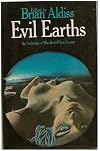
Evil Earths
by Brian Aldiss
On This Page
Tags
Recommendations











Member Reviews
I don't know how much actual evil there is in this anthology; it's a little hard to discern much of a theme at all, beyond a sort of bleakness. There are fourteen stories here, with original publication dates between 1935 and 1970, and I wouldn't say that any of them are enduring classics.
A few of them aren't bad, though. "Film of Death" by J. S. Campbell presents an ecological disaster that foreshadows "ice-nine" from Vonnegut's Cat's Cradle; Allen K. Lang's "Guest Expert" is a three-page joke about overpopulation with a crisply brutal punchline; and Howard Fast's "The Wound" is written with enough skill to get away with a concept that teeters on sappy sentiment.
The main reason I picked up the book was for its longest story, Henry show more Kuttner's Hugo-nominated novella "The Time Trap." It's from the late 1930s, and very much of its era. It's a good example of an early SF subgenre known as the "scientific romance," in which a brave hero faces an episodic series of creatures, disasters, and perils; this one is long enough that you can imagine it as an old-fashioned movie serial, leaving the hero in danger at every cliffhanger ending. Not a genre that holds up well today, though Kuttner certainly does offer breatless excitement and a sense of awe that transcend the limits of his story. show less
A few of them aren't bad, though. "Film of Death" by J. S. Campbell presents an ecological disaster that foreshadows "ice-nine" from Vonnegut's Cat's Cradle; Allen K. Lang's "Guest Expert" is a three-page joke about overpopulation with a crisply brutal punchline; and Howard Fast's "The Wound" is written with enough skill to get away with a concept that teeters on sappy sentiment.
The main reason I picked up the book was for its longest story, Henry show more Kuttner's Hugo-nominated novella "The Time Trap." It's from the late 1930s, and very much of its era. It's a good example of an early SF subgenre known as the "scientific romance," in which a brave hero faces an episodic series of creatures, disasters, and perils; this one is long enough that you can imagine it as an old-fashioned movie serial, leaving the hero in danger at every cliffhanger ending. Not a genre that holds up well today, though Kuttner certainly does offer breatless excitement and a sense of awe that transcend the limits of his story. show less
A very good collection of early SF short stories with a theme of SF here on Earth. To quote from the editor's introduction, "Earth was the first planet discovered by homo sapiens. It still holds magic and excitement for us." I have learned to trust Aldiss as one of the best editors of SF collections. He picks good material and he writes great introductions. He is also a very good writer.
Some of the stories are very short. One is a Novella. The newest one was published in 1970. The earliest was from 1935. I liked almost all 14 stories. The Novella is an early work by Henry Kuttner. This, of course, means it was likely written by Kuttner and his author wife C.L. Moore. If you like Indiana Jones with time travel it's an above average show more adventure from the 1930s. show less
Some of the stories are very short. One is a Novella. The newest one was published in 1970. The earliest was from 1935. I liked almost all 14 stories. The Novella is an early work by Henry Kuttner. This, of course, means it was likely written by Kuttner and his author wife C.L. Moore. If you like Indiana Jones with time travel it's an above average show more adventure from the 1930s. show less
This book, like Perilous Planets, and the Galactic Empires set is a theme based anthology edited by Brian Aldiss. Oddly, although Aldiss is regarded as one of the "new wave" science fiction authors who rejected the Campbellian motifs that had come to dominate the field, in this series, Aldiss shows great love for tales of that style.
The stories are organized into sections, each with its own overarching theme, and each has an introduction by Aldiss. Although the title of this compilation is Evil Earths, only a few of the stories in here (notably, Aldiss' own Heresies of the Huge God) actually depict an Earth that one would consider to be "evil". Some, like Dick's The Golden Man merely depict a situation in which man will likely become an show more endangered species, others, would best be described as simply being "stories set on Earth".
The stories are all average to excellent with no real clunkers in the line-up, but I found this to be weaker than Perilous Planets and Galactic Empires. Whether that is because the scope of the stories was limited to Earth, or the fact that the stories defied my expectations because they weren't really all that "evil" is an open question. show less
The stories are organized into sections, each with its own overarching theme, and each has an introduction by Aldiss. Although the title of this compilation is Evil Earths, only a few of the stories in here (notably, Aldiss' own Heresies of the Huge God) actually depict an Earth that one would consider to be "evil". Some, like Dick's The Golden Man merely depict a situation in which man will likely become an show more endangered species, others, would best be described as simply being "stories set on Earth".
The stories are all average to excellent with no real clunkers in the line-up, but I found this to be weaker than Perilous Planets and Galactic Empires. Whether that is because the scope of the stories was limited to Earth, or the fact that the stories defied my expectations because they weren't really all that "evil" is an open question. show less
Ratings
Members
- Recently Added By
Author Information

565+ Works 27,510 Members
Brian W. Aldiss was born in Dereham, United Kingdom on August 18, 1925. In 1943, he joined the Royal Signals regiment, and saw action in Burma. After World War II, he worked as a bookseller at Oxford University. His first book, The Brightfount Diaries, was published in 1955. His first science fiction novel, Non-Stop (Starship in the United show more States), was published in 1958. He wrote more than 80 books including Hothouse, Greybeard, The Helliconia Trilogy, The Squire Quartet, Frankenstein Unbound, The Malacia Tapestry, Walcot, and Mortal Morning. His short story Super-Toys Last All Summer Long was the basis for the film A.I. Artificial Intelligence. He has received numerous awards for his work including two Hugo Awards, the Nebula Award, the John W. Campbell Memorial Award, and an OBE for services to literature. He was also an anthologist and an artist. He was the editor of 40 anthologies including Introducing SF, The Penguin Science Fiction Omnibus, Space Opera, Space Odysseys, Galactic Empires, Evil Earths, and Perilous Planets. He was an abstract artist and his first solo exhibition, The Other Hemisphere, was held in Oxford in August-September 2010. He died on August 19, 2017 at the age of 92. (Bowker Author Biography) show less
Work Relationships
Common Knowledge
- Original publication date
- 1976
Classifications
- Genres
- Fiction and Literature, Science Fiction
- DDC/MDS
- 813.0876 — Literature & rhetoric American literature in English American fiction in English By type Genre fiction Adventure fiction Speculative fiction
- LCC
- PZ1 — Language and Literature Fiction and juvenile belles lettres Fiction and juvenile belles lettres Fiction in English
Statistics
- Members
- 140
- Popularity
- 231,369
- Reviews
- 3
- Rating
- (3.31)
- Languages
- English
- Media
- Paper
- ISBNs
- 3
- ASINs
- 2