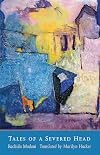
Tales of a Severed Head
by Rachida Madani
On This Page
Description
A brilliant retelling of the classic Arab tale of Scheherazade, set in the present day This volume brings Moroccan poet Rachida Madani's remarkable poems to English-language readers for the first time. In Tales of a Severed Head, Madani addresses present-day issues surrounding the role of women in society--issues not unlike those explored a thousand years ago in the enduring collection of Arab tales known as The Thousand and One Nights. In the ancient tales, the insanely distrustful King show more Shehriyar vows to marry a new wife each night and have her beheaded the next morning, thus eliminating the risk of being cuckolded. Through the courage and wit of young Scheherazade, who volunteers to be the king's bride and then invents the legendary tales that go on for a thousand and one nights, Shehriyar is healed of his obsession and the kingdom's virgins are saved. Like her brave-hearted predecessor, Madani's modern-day Scheherazade is fighting for her own life as well as the lives of her fellow sufferers. But in today's world, the threat comes as much from poverty, official corruption, the abuse of human rights, and the lingering effects of colonialism as from the power wielded by individual men. Madani weaves a tale of contemporary resistance, and once again language provides a potent weapon. show lessTags
Recommendations









































Member Reviews
Divided into three 'Tales', I wasn't sure that I'd get through the first one, simply because of my own incomprehension. The remaining 2/3s of the poem drew me on, though, and this is a solid 4⭐
Using the story of Scheherazade, Madani reflects on the position of women in patriarchal societies (so, everywhere!) In the context of the oppression of King Hassan II of Morocco, known as the Years of Lead. The preface quotes Hassan's view on freedom of independent thought: "There is no danger greater for the State than that of self-styled intellectuals. You would have been better off remaining illiterate." Better off, as under his regime you'd be tortured, imprisoned or disappeared for expressing any criticism, opposition or dissenting show more thought.
Madani's poem is by turns beautiful and terrifying. show less
Using the story of Scheherazade, Madani reflects on the position of women in patriarchal societies (so, everywhere!) In the context of the oppression of King Hassan II of Morocco, known as the Years of Lead. The preface quotes Hassan's view on freedom of independent thought: "There is no danger greater for the State than that of self-styled intellectuals. You would have been better off remaining illiterate." Better off, as under his regime you'd be tortured, imprisoned or disappeared for expressing any criticism, opposition or dissenting show more thought.
Madani's poem is by turns beautiful and terrifying. show less
“She speaks of all nights
and all women
she speaks of the sea
of waves which carry everything away
as if everything could be carried away
of waves which begin the sea again
there where the sea stopped.
She goes through the city
she walks with death
hand in hand
and her hand does not tremble…”
This slim volume of poetry is a modern-day One Thousand and One Nights set in Morocco describing the position of women within that country. It tells of the repression of people, not just women, who are poor, hungry, have little recourse as freedom of expression has been taken from them. It is about history repeating itself time and time again. Madani argues that not much has changed since the days when One Thousand and One Nights was written. In One show more Thousand and One Nights, the profoundly distrustful King Shehriyar vows to marry a new virginal bride each day only to behead her come morning. This continues until Scheherazade volunteers to be a bride. Her trick, however, is to start to tell the King a story and not finish. He wants to know the ending so does not behead her in the morning. The next night she finishes the story, but begins another… so this continues saving many maidens in the process.
The author, Rachida Madani, wrote this in French and it was translated to English by Marilyn Hacker. Hacker’s introduction to the poem is incredibly helpful in framing a reference for it. Rachida Madani, an activist, began writing poetry during Morocco’s leaden years. During this time, under King Hassan II’s rule, there was much political unrest and the government was brutal in it’s response to criticism and opposition. Madani’s writing, though strongly feminist evaluating the role of women in the hierarchy, is more powerfully about the corruption in the society as a whole and the repression and abuses of the government towards it’s people. Within this poem of three parts, Madani encourages a palace rebellion. She is encouraging people to protest, speak out, share their voices.
I read this as part of Book Riot’s Read Harder Challenge and am happy I did. It satisfied the following requirement: read a collection of poetry in translation on a theme other than love. I’m glad I read it and feel that I learned more about Morocco and this time period as a result. show less
and all women
she speaks of the sea
of waves which carry everything away
as if everything could be carried away
of waves which begin the sea again
there where the sea stopped.
She goes through the city
she walks with death
hand in hand
and her hand does not tremble…”
This slim volume of poetry is a modern-day One Thousand and One Nights set in Morocco describing the position of women within that country. It tells of the repression of people, not just women, who are poor, hungry, have little recourse as freedom of expression has been taken from them. It is about history repeating itself time and time again. Madani argues that not much has changed since the days when One Thousand and One Nights was written. In One show more Thousand and One Nights, the profoundly distrustful King Shehriyar vows to marry a new virginal bride each day only to behead her come morning. This continues until Scheherazade volunteers to be a bride. Her trick, however, is to start to tell the King a story and not finish. He wants to know the ending so does not behead her in the morning. The next night she finishes the story, but begins another… so this continues saving many maidens in the process.
The author, Rachida Madani, wrote this in French and it was translated to English by Marilyn Hacker. Hacker’s introduction to the poem is incredibly helpful in framing a reference for it. Rachida Madani, an activist, began writing poetry during Morocco’s leaden years. During this time, under King Hassan II’s rule, there was much political unrest and the government was brutal in it’s response to criticism and opposition. Madani’s writing, though strongly feminist evaluating the role of women in the hierarchy, is more powerfully about the corruption in the society as a whole and the repression and abuses of the government towards it’s people. Within this poem of three parts, Madani encourages a palace rebellion. She is encouraging people to protest, speak out, share their voices.
I read this as part of Book Riot’s Read Harder Challenge and am happy I did. It satisfied the following requirement: read a collection of poetry in translation on a theme other than love. I’m glad I read it and feel that I learned more about Morocco and this time period as a result. show less
Ratings
Members
- Recently Added By
Lists

Books Read in 2022
5,226 works; 115 members

Books With the Most Memorable Titles
478 works; 158 members

Arab and Arab Diaspora Literature We Recommend
112 works; 53 members
Author Information

1+ Work 24 Members
Some Editions
Awards and Honors
Awards
Series
Belongs to Publisher Series
Common Knowledge
- Canonical title
- Tales of a Severed Head
- Original title
- Contes d’une tête tranchée
- Original publication date
- 2005
- People/Characters
- Scheherazade; Shahrayar (Shehriyar); Dinazarde
- Important places
- Morocco
- Important events
- Years of Lead (Morocco)
- Blurbers
- Caws, Mary Ann; Rogers, Hoyt
- Original language
- French
Classifications
Statistics
- Members
- 24
- Popularity
- 1,112,494
- Reviews
- 2
- Rating
- (3.00)
- Languages
- English
- Media
- Paper
- ISBNs
- 1
- ASINs
- 1