Fiasco
by Stanisław Lem
On This Page
Description
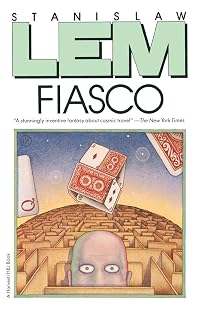
The planet Quinta is pocked by ugly mounds and covered by a spiderweb-like network. It is a kingdom of phantoms and of a beauty afflicted by madness. In stark contrast, the crew of the spaceship Hermes represents a knowledge-seeking Earth. As they approach Quinta, a dark poetry takes over and leads them into a nightmare of misunderstanding.Tags
Recommendations































Member Reviews
A chilling, disturbing dissection of humanity's inability to escape its club-wieldind, genocidal roots, even and moreover when they think they are at the peak of their climb to God-like serene rationality.
Also, an eulogy to our bold anthropocenthrism.
Finally, buyer beware: this is not your classic, action packed sci-fi. Lem was a physics PhD, and a philosopher. Most of the book develops as a reflection, which may be puzzling when unexpected, but believe me, action and suspense are embedded in the long reflections and asides, all coming to a synthesis more and more apparent as the events slowly develop, while the reader helplessly witnesses the ethical horror unfold, endowed by those long musings with an understanding of further ethical show more horrors to come, yet unable to prevent them. This is sci-fi that changes your assumption on humanity. Straight to my "to be read in schools" shelf.
(This is the same review I left on Audible. Call me lazy. I am.)
EDIT: I have never, ever encountered such a quotable author as Stanisław Lem. His writing is so consequential, deep, competent, humane, and packed with memorable synthetic sentences, that one gives up the task of selection and ends up transcribing none, through sheer choicevoverload. show less
Also, an eulogy to our bold anthropocenthrism.
Finally, buyer beware: this is not your classic, action packed sci-fi. Lem was a physics PhD, and a philosopher. Most of the book develops as a reflection, which may be puzzling when unexpected, but believe me, action and suspense are embedded in the long reflections and asides, all coming to a synthesis more and more apparent as the events slowly develop, while the reader helplessly witnesses the ethical horror unfold, endowed by those long musings with an understanding of further ethical show more horrors to come, yet unable to prevent them. This is sci-fi that changes your assumption on humanity. Straight to my "to be read in schools" shelf.
(This is the same review I left on Audible. Call me lazy. I am.)
EDIT: I have never, ever encountered such a quotable author as Stanisław Lem. His writing is so consequential, deep, competent, humane, and packed with memorable synthetic sentences, that one gives up the task of selection and ends up transcribing none, through sheer choicevoverload. show less
Makes the previous books by Lem seem childish, reading this was a step from teen fiction to adult fiction. Lem uses a superb mixture of real science, real astronomy, real robotics, real computer technology, to inventive, imaginative, logical progression of the fictional. Overall the plot describes a scenario where humans attempt contact with extra-terrestrial intelligent life. This is Lem's idea of the future of SETI and CETI, via Titan, robotics, astronautics, exploration, cryogenics, embryonics, eschatology, psychology, philosophy, rocket science, and computer technology.
The long descriptions, of course including Lem's own neologisms for places and things, make the book a challenging read, but following it to the end is show more worthwhile.
Woven into the story are many unanswered questions: what is the identity of Mark Tempe? How much human influence on DEUS, and DEUS' influence on the humans affected the decisions for their mission? The questions of the sanity of the crew cast doubt onto the outcome of the mission. Were the Quintians even there, or were they a projection of the desire in the human mind? "You now have what you wanted." Perhaps the whole story from the resurrected mystery man was simply an experience of his own afterlife?
Along with the Lemisms, I particularly loved the concept of sidereal engineering, like quantum physics it works although we cannot understand how. I wonder why Lem didn't utilise a quantum computer too.
Lem's own background in medical science was employed describing how cryogenics was superseded by embryonics for the suspended animation of astronauts having to wait out years for their scout ship to return. They are revived like foetuses from the womb, in one instance he described "an old-fashioned method" whereby the doctor gently pushes a finger into the jaw of the patient and pushes up on the palate.
There was so much to explore outside reading this book: psychological bicameralism, development of civilizations, diadochokinesia, the Coriolis force, the Schwarzschild radius, to accentuate just a few. I would have liked it if the IAU had utilised Lem's terminology for the place-names and geological features on Titan, (these would have been more appropriate than Middle-earth).
Top notch creative, speculative science fiction. show less
The long descriptions, of course including Lem's own neologisms for places and things, make the book a challenging read, but following it to the end is show more worthwhile.
Woven into the story are many unanswered questions: what is the identity of Mark Tempe? How much human influence on DEUS, and DEUS' influence on the humans affected the decisions for their mission? The questions of the sanity of the crew cast doubt onto the outcome of the mission. Were the Quintians even there, or were they a projection of the desire in the human mind? "You now have what you wanted." Perhaps the whole story from the resurrected mystery man was simply an experience of his own afterlife?
Along with the Lemisms, I particularly loved the concept of sidereal engineering, like quantum physics it works although we cannot understand how. I wonder why Lem didn't utilise a quantum computer too.
Lem's own background in medical science was employed describing how cryogenics was superseded by embryonics for the suspended animation of astronauts having to wait out years for their scout ship to return. They are revived like foetuses from the womb, in one instance he described "an old-fashioned method" whereby the doctor gently pushes a finger into the jaw of the patient and pushes up on the palate.
There was so much to explore outside reading this book: psychological bicameralism, development of civilizations, diadochokinesia, the Coriolis force, the Schwarzschild radius, to accentuate just a few. I would have liked it if the IAU had utilised Lem's terminology for the place-names and geological features on Titan, (these would have been more appropriate than Middle-earth).
Top notch creative, speculative science fiction. show less
I have to admit, the sole reason I took this novel off the shelf was love for the word ‘fiasco’. (There’s something so satisfying about it!) It then joined my library book pile because I know Stanislaw Lem to be an author of high quality science fiction weirdness (cf [b:Memoirs Found in a Bathtub|497121|Memoirs Found in a Bathtub|Stanisław Lem|https://images.gr-assets.com/books/1348416568s/497121.jpg|485271]). On the back cover, a puff quote describes ‘Fiasco’ as ‘Brilliant and challenging’. Although my reflex was to scoff at the latter term, I am now inclined to agree with it. This is a dense, complicated book that isn't particularly easy to read. Lem spends a great deal of time on the technical aspects of the show more interstellar space travel scenario that is being recounted, including a lot about collapsars that I didn’t really understand. The plot is essentially concerned with first contact between humans and aliens. The first half sets this up, the second plays it out. I found the former hard work and the latter extremely compelling. Unless I’m missing something, the first fifty pages were wholly unnecessary.
By contrast, the second half included some extraordinary and fascinating conversations on AI, game theory, and political philosophy. Lem advances many thought-provoking ideas, which by turns I both disagreed with (‘...technology, once it gained momentum, became a variable independent of the civilisational substructure’) and agreed with (‘...if technologies for saving or replacing the biosphere did not come to the rescue of technologies of expansion, the given civilisation would enter a crisis to end all crises, ie extinction’). The progression of events once the mission arrives in the alien solar system is inexorable and brilliantly handled. It forms a pretty spectacular critique of the Cold War, unsurprising given the publication date of 1986. Nonetheless, I can only award three stars as it takes quite a lot of patience to reach the excellent chapters. I think the level of technobabble was somewhat excessive, even for a story set largely in space. The title is extremely apposite, though. show less
By contrast, the second half included some extraordinary and fascinating conversations on AI, game theory, and political philosophy. Lem advances many thought-provoking ideas, which by turns I both disagreed with (‘...technology, once it gained momentum, became a variable independent of the civilisational substructure’) and agreed with (‘...if technologies for saving or replacing the biosphere did not come to the rescue of technologies of expansion, the given civilisation would enter a crisis to end all crises, ie extinction’). The progression of events once the mission arrives in the alien solar system is inexorable and brilliantly handled. It forms a pretty spectacular critique of the Cold War, unsurprising given the publication date of 1986. Nonetheless, I can only award three stars as it takes quite a lot of patience to reach the excellent chapters. I think the level of technobabble was somewhat excessive, even for a story set largely in space. The title is extremely apposite, though. show less
Lem has been one of my favorite science fiction authors for a long time. I almost think of him as anti-science fiction, though, because many of the best of his books are dedicated to undermining the naive dreams of the techno-utopians (i.e. Star Trek writers) and remorselessly showing what happens when humanity's flaws get translated to the stars. As the title shows, this story of first contact doesn't go well, but what makes it so compelling is his trademark way of showing the consequences of our limited rationality and our ultimate smallness in a baffling and possibly unknowable universe.
Starts out great, but after its initial third Lem spends too much time on fake science and has characters behave too stupidly to be believable. Despite the themes skillfully weaved into the early parts of this book, the rest fails to capitalize on this, and so Fiasco falls far short of one of Lem's other novels about attempted contact, Solaris. I'll be comparing Fiasco to Solaris frequently throughout this review, so if you've haven't read the latter consider yourself warned- and also, go read Solaris, it's excellent.
The opening chapter recounts a pilot using a giant walking robot to attempt to rescue people lost on Jupiter's moon Titan. While it might seem strangely divorced from the rest of the text, instead it skillfully establishes show more many of the themes and ideas that will be explored throughout the rest of Fiasco. While walking through the frozen structures of Titan the pilot is repeatedly reminded of natural phenomena, highlighting how human beings have a natural inclination to draw connections between things, to see the familiar even where there is nothing but the alien. At one point the pilot is led astray, it turns out by his own reflection. After an accident the pilot resorts to a cryogenic freezing option only slightly better than suicide, his rescue mission a failure.
Fast-forward hundreds of years later and several cryogenically frozen people have been brought aboard a huge space ship that will use a black hole to travel to a distant solar system in an attempt to contact intelligent life. Not all of the frozen people can be unfrozen, however, in fact only one can. The scientists have two candidates that have an exactly equal chance of being revived successfully, and so the scientists in charge of the resurrection agree that they will invent a lie about why one candidate is superior, while in fact the one they choose to resurrect will be selected at random. Again, while this section might seem unrelated to the main contact story, it establishes the idea that human kind needs to master his surroundings through reason, and is even willing to make up a reason where none exists, a falsehood being better than nothing.
While traveling aboard the space ship the resurrected man can't remember who he was before, not that he is much troubled by this, though he lives his old life in his dreams and does not reveal this to the doctors who treat him. He spends some time reading a piece of a story about an explorer who finds a vast colony of ants and wages a campaign to get at the heart of the place, where he finds a mysterious sphere that seems to attract insects no matter where he goes. Not only is it a great story in its own right (one I'd be happy to read more of), it also raises the idea of insane quests focused on things beyond our understanding that, even when successful, still ends with a result that's incomprehensible.
All of this is the prologue to the main contact story, and in my opinion it's by far the best part of the book. It establishes the characters, themes, and tone of the book in an entertaining way and without beating you over the head. Unfortunately, the rest of the book doesn't live up to the foundation this prologue establishes.
After this point Lem dives heavily into the fake science of interstellar travel, giving us pages and pages of explanation for how the journey is being made and why it will only take a certain amount of time. In Solaris, the scientific theories and reports Lem has the characters read all serve a specific purpose: to show that mankind has spent a huge amount of effort trying to understand Solaris, and also that so far mankind has learned absolutely nothing definite about it. In Fiasco, the fake science of interstellar travel serves no such similar purpose, since in the world of this story the fake science discussed is actually the truth- at least it works for the characters here. Thus you have to read about the rationale for the temporal effects of black holes for a significant amount of time when the story could have just had the characters use the black hole, with some perfectly reasonable trepidation, and gotten on with the story from there. The fake science about interstellar travel adds nothing to the book.
Not that the fake science ends when the characters get to the inhabited alien world, but after the journey the fake science switches from fake physics to fake alien sociology. This at least serves a purpose, pretty much the same one the reports served in Solaris: to emphasize that we don't really know anything about what an alien might be like or how they might behave, despite piles and piles of theories that sound logical and scientific on paper. What undercuts this section is that the characters performing this first contact don't behave in reasonable ways. Their first actions are to snatch alien objects orbiting the atmosphere and cut them open, an act that is hard not to interpret as hostile. What is it with first contact stories where the humans' first course of action is to cut into the alien thing and see what happens? They do the same thing in Peter Watts' Blindsight.
The attempts at contact just get more absurd from there. They beam radio signals and lasers onto the planet, ignoring the fact that if an alien did the same thing to them while they were on earth they'd almost certainly not realize it. Eventually they stumble upon the better, although acknowledged as still subpar, idea of projecting images down to the planet. This is after the crew enacts certain measures that are stunningly stupid, including blowing up the moon, possibly the stupidest way to make an alien open up the channels of communication ever conceived, though nearly matched later on in the novel when they start laser-beaming the planet. None of the attempts at contact make much sense, a fact at one point acknowledged by the resurrected character, not that it makes the fact any better. The behavior of the crew paints them all as idiots at best, and homicidal maniacs at worst, nothing like how they were characterized earlier. It's a baffling turn for the narrative to take, made even more confusing by Lem proving in Solaris that he can write a far better contact story than this.
The ending does nothing to mitigate these problems- the resurrected character lands on the planet, and through his scan of the mock ship they sent down we're led to believe that at least some of the crew's conjecture about these aliens was correct. The conjecture all seemed more like projection of the human characters, though, so the reveal that they might actually have been correct was a surprise to me, and not a very satisfying one. Still, the wanderings and observations of the character make it clear that he and the other humans still have no idea what's going on in the planet, and maybe never will. Then the atmosphere of the entire planet is destroyed because the character forgets to check his watch. Fantastic.
I understand what Lem was doing here, trying to show how man's desire to have contact (and understand the universe) no matter what the cost leads to tragedy when faced with something incomprehensible. The book's title of Fiasco makes clear from the outset that this isn't likely to be a very successful attempt. I just wish that Lem had presented a more believable fiasco for a contact mission, one with people that behaved more intelligently, and failure that felt inevitable instead of due to human stupidity.
Damn it Lem, that first third was so strong! But then you follow it up with pages of boring fake science and a subpar first contact story, featuring a crew of psychopaths and idiots. This could have been great, potentially even good enough to rival Solaris, but instead I'm left disappointed. show less
The opening chapter recounts a pilot using a giant walking robot to attempt to rescue people lost on Jupiter's moon Titan. While it might seem strangely divorced from the rest of the text, instead it skillfully establishes show more many of the themes and ideas that will be explored throughout the rest of Fiasco. While walking through the frozen structures of Titan the pilot is repeatedly reminded of natural phenomena, highlighting how human beings have a natural inclination to draw connections between things, to see the familiar even where there is nothing but the alien. At one point the pilot is led astray, it turns out by his own reflection. After an accident the pilot resorts to a cryogenic freezing option only slightly better than suicide, his rescue mission a failure.
Fast-forward hundreds of years later and several cryogenically frozen people have been brought aboard a huge space ship that will use a black hole to travel to a distant solar system in an attempt to contact intelligent life. Not all of the frozen people can be unfrozen, however, in fact only one can. The scientists have two candidates that have an exactly equal chance of being revived successfully, and so the scientists in charge of the resurrection agree that they will invent a lie about why one candidate is superior, while in fact the one they choose to resurrect will be selected at random. Again, while this section might seem unrelated to the main contact story, it establishes the idea that human kind needs to master his surroundings through reason, and is even willing to make up a reason where none exists, a falsehood being better than nothing.
While traveling aboard the space ship the resurrected man can't remember who he was before, not that he is much troubled by this, though he lives his old life in his dreams and does not reveal this to the doctors who treat him. He spends some time reading a piece of a story about an explorer who finds a vast colony of ants and wages a campaign to get at the heart of the place, where he finds a mysterious sphere that seems to attract insects no matter where he goes. Not only is it a great story in its own right (one I'd be happy to read more of), it also raises the idea of insane quests focused on things beyond our understanding that, even when successful, still ends with a result that's incomprehensible.
All of this is the prologue to the main contact story, and in my opinion it's by far the best part of the book. It establishes the characters, themes, and tone of the book in an entertaining way and without beating you over the head. Unfortunately, the rest of the book doesn't live up to the foundation this prologue establishes.
After this point Lem dives heavily into the fake science of interstellar travel, giving us pages and pages of explanation for how the journey is being made and why it will only take a certain amount of time. In Solaris, the scientific theories and reports Lem has the characters read all serve a specific purpose: to show that mankind has spent a huge amount of effort trying to understand Solaris, and also that so far mankind has learned absolutely nothing definite about it. In Fiasco, the fake science of interstellar travel serves no such similar purpose, since in the world of this story the fake science discussed is actually the truth- at least it works for the characters here. Thus you have to read about the rationale for the temporal effects of black holes for a significant amount of time when the story could have just had the characters use the black hole, with some perfectly reasonable trepidation, and gotten on with the story from there. The fake science about interstellar travel adds nothing to the book.
Not that the fake science ends when the characters get to the inhabited alien world, but after the journey the fake science switches from fake physics to fake alien sociology. This at least serves a purpose, pretty much the same one the reports served in Solaris: to emphasize that we don't really know anything about what an alien might be like or how they might behave, despite piles and piles of theories that sound logical and scientific on paper. What undercuts this section is that the characters performing this first contact don't behave in reasonable ways. Their first actions are to snatch alien objects orbiting the atmosphere and cut them open, an act that is hard not to interpret as hostile. What is it with first contact stories where the humans' first course of action is to cut into the alien thing and see what happens? They do the same thing in Peter Watts' Blindsight.
The attempts at contact just get more absurd from there. They beam radio signals and lasers onto the planet, ignoring the fact that if an alien did the same thing to them while they were on earth they'd almost certainly not realize it. Eventually they stumble upon the better, although acknowledged as still subpar, idea of projecting images down to the planet. This is after the crew enacts certain measures that are stunningly stupid, including blowing up the moon, possibly the stupidest way to make an alien open up the channels of communication ever conceived, though nearly matched later on in the novel when they start laser-beaming the planet. None of the attempts at contact make much sense, a fact at one point acknowledged by the resurrected character, not that it makes the fact any better. The behavior of the crew paints them all as idiots at best, and homicidal maniacs at worst, nothing like how they were characterized earlier. It's a baffling turn for the narrative to take, made even more confusing by Lem proving in Solaris that he can write a far better contact story than this.
The ending does nothing to mitigate these problems- the resurrected character lands on the planet, and through his scan of the mock ship they sent down we're led to believe that at least some of the crew's conjecture about these aliens was correct. The conjecture all seemed more like projection of the human characters, though, so the reveal that they might actually have been correct was a surprise to me, and not a very satisfying one. Still, the wanderings and observations of the character make it clear that he and the other humans still have no idea what's going on in the planet, and maybe never will. Then the atmosphere of the entire planet is destroyed because the character forgets to check his watch. Fantastic.
I understand what Lem was doing here, trying to show how man's desire to have contact (and understand the universe) no matter what the cost leads to tragedy when faced with something incomprehensible. The book's title of Fiasco makes clear from the outset that this isn't likely to be a very successful attempt. I just wish that Lem had presented a more believable fiasco for a contact mission, one with people that behaved more intelligently, and failure that felt inevitable instead of due to human stupidity.
Damn it Lem, that first third was so strong! But then you follow it up with pages of boring fake science and a subpar first contact story, featuring a crew of psychopaths and idiots. This could have been great, potentially even good enough to rival Solaris, but instead I'm left disappointed. show less
“I don't think anything can behave as unintelligently as intelligence.”
― Stanisław Lem, Fiasco
In many important respects Fiasco is Stanisalw Lem’s crowning achievement. Publsihed in 1986 toward the end of the Polish author's distinguished career spanning more than half a century, the novel contains at its heart a key theme revisited by Mr. Lem over the years: the impact of science and technology on multiple dimensions of intelligence and communication.
What a literary achievement! Please do not be thrown off by the label "science fiction." To be sure, generous helpings of scientific data and detail are proffered to satisfy any reader with an interest in science; but, more importantly, especially for non-science types like show more myself, Fiasco probes an assortment of gripping philosophical conundrums and is a hugely engaging adventure story. I was enthralled every step of the journey as I accompanied the crew on their expedition to distant planet Quinta to communicate with the Quintans.
The time is mid-twenty-first century and travel between planets and moons is commonplace. From the orbit of one such moon, Titan by name, the spaceship Eurydice is launched on its quest to make contact with what is judged by top international scientists a technically advanced civilization. Such pooling of intellectual resources is possible since in this future time there is worldwide peace and global cooperation. Thanks for the cheery prospect, Stanislaw! Too bad your optimism doesn’t endure when the Earthlings reach planet Quinta.
The ship is massive, as large as a high-rise building – many rooms and hallways and chambers large enough to hold smaller space vehicles. The crew includes a flight commander and various chiefs overseeing things like power, communications and medicine. Accomplished experts within the fields of physics, biology, geology and other sciences are present along with a Dominican monk in the role of adviser.
Of course, the inclusion of a Catholic father adds real spice to the flavor and shape of how decisions are to be made. Although Catholicism was very much part of the culture in his home country of Poland, Stanislaw Lem made a public statement on why he became an atheist: “For moral reasons: the world appears to me to be put together in such a painful way that I prefer to believe that it was not created intentionally."
Also on board is a pilot awakened after spending decades in cryonic deep freeze – his own “last resort” decision in consequence of a botched rescue mission. Did I say awakened? Perhaps resurrected from the dead would be more accurate, at least according to top physician Dr. Gilbert's philosophy of personal identity. We listen in on the good doctor's provocative conversation with Dominican Father Arago.
And last, but hardly least, there's DEUS, a supremely advanced twenty-first century supercomputer performing complex calculations in nanoseconds and speaking directly with members of the crew. DEUS is short for Digital Engrammic Universal System but everyone involved in the project recognizes the irony of a direct reference to a deus ex machina.
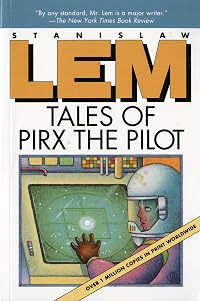
Back on the pilot returned to life - he can’t recall his past name, it could be Prix or Parvis. As readers, we know Parvis from his mini misadventure in Chapter One; Lem fans will recognize Prix from the author’s Tales of Prix the Pilot. Anyway, among the more intriguing sections of the novel is his return to consciousness and interactions with a Socrates-style teaching computer in efforts to help restore his memory and educate him on the latest technologies. A particular statement made by the teacher resonates on what is to follow once the ship attempts to communicate with the Quintans: “The Mystery of the Silent Universe has become a challenge to Earth’s science.”
Additionally captivating are the embedded shorter tales within the novel: the first tells how two sixteenth century Spanish conquistadors violated sacred ground in their attempt to unmask the mystery surrounding an ancient Aztec deity; and the second an excerpt from a book of science fiction the resuscitated pilot reads one evening, a spellbinding, spine chilling yarn about an Indiana Jones-style treasure seeker venturing through South American jungle to reach a vast region where termites rule.
Under a blazing tropical sun the termites have built over a million white mounds, row after row after row, thirty feet high and harder than cement. Each and every one of these mounds seethes with termite activity within. And at the very center of this termite city there is a bent, black mound.
Our adventurer recounts how he brought dynamite, airplane gasoline, insecticides, gas masks and other heavy duty equipment to lead an expedition to the land of termites and uncover the secrets of the black mound. However, what he ultimately discovers after penetrating to the heart of this insect nation deepens rather than solves any of nature’s secrets. I include a brief sketch of this embedded tale since it unquestionably contains many parallels with the ship's excursion to Quinta.
Reaching their destination and sending a series of digital transmissions but receiving no answer, a small crew voyages to the surface of Quinta in their probing craft, the Hermes. They detect one moving object the size of a boulder that increases its speed to escape their observation. The captain is quick to resolve: “Let’s catch that moth.” He sets the trajectory of pursuit and engages the craft’s hunt program. Go get ‘um cowboy! Less than a mile away from the Quinta prey, the Hermes discharges a missile with prehensile arms, grasps it and conducts an initial examination. Clearing any safety issue with DEUS, the crew then takes the trophy of their chase on board for future analysis.
Moth, pursuit, hunt, prey, trophy, chase - these are the actual words articulated by captain and crew. Such language is aggressive; such language is the language of war. How far are these future space explorers from the mindset of prehistoric hunters or the Greek warriors at the gates of Troy? How will the consequences of this initial assertive strategy play themselves out?
Pondering Stanislaw Lem’s work, many additional philosophic questions loom up for consideration. Here are several: Are humans so warlike that nearly any communication from aliens will be interpreted as a threat requiring retaliation? Why didn't Nakamura, the perceptive Japanese physicist, recommend a sense of humility all along? Nakamura states: Where there is mind, there is cruelty. Is this an accurate observation? Would it have been wise to include a Zen master on this mission teaching the crew meditation and the cultivation of "No Mind?" What's the sound of one brutal hand clapping?
“A man craves ultimate truths. Every mortal mind, I think, is that way. But what is ultimate truth? It's the end of the road, where there is no more mystery, no more hope. And no more questions to ask, since all the answers have been given. But there is no such place.
The Universe is a labyrinth made of labyrinths. Each leads to another. And wherever we cannot go ourselves, we reach with mathematics. Out of mathematics we build wagons to carry us into the nonhuman realms of the world.”
― Stanisław Lem, Fiasco show less
I thought this was pretty darn good. While there are important differences, it felt like a much more successful attempt to address the story of Arthur Clarke's Rendezvouz with Rama: man travels to meet with aliens, has a hard time communicating, finds surprises and danger, has a hard time figuring out what the heck's going on.
Lem populates his human ship with a small but truly diverse crew of scientists, pilots, a physician and catholic priest. Each of these characters at times plays an important role in the story. They bring diverse experiences, values, and personality types to a very stressful situation, allowing the dynamics of the interactions among the crew to play an important role in the novel. Lem's Quintans are one of the show more better conceived aliens I can remember, in surprising ways completely different than humans, and yet in other ways similar.
One of the more memorable things about the book is a superb first chapter that serves as an extended prelude and could easily be published as a stand alone short story. Set a couple hundred years before the rest of the story, it is a truly stunning tale of an attempted rescue mission on Titan.
Another thing I liked about Fiasco is that Lem makes you think. There are questions that are left unanswered, but the reader is given enough evidence to draw conclusions. Oddly enough, the identity of the protagonist is one of these unanswered questions (although the inclusion of the first chapter makes it pretty clear who the reader is supposed to assume the character is).
Fiasco is obviously a novel written during the cold war, and is clearly meant as a warning about mankind's future. And while in some ways it feels dated, we certainly cannot afford to forget how easily a reasonably intelligent species can get caught up in a downward spiral leading to very real possibilities of extinction. show less
Lem populates his human ship with a small but truly diverse crew of scientists, pilots, a physician and catholic priest. Each of these characters at times plays an important role in the story. They bring diverse experiences, values, and personality types to a very stressful situation, allowing the dynamics of the interactions among the crew to play an important role in the novel. Lem's Quintans are one of the show more better conceived aliens I can remember, in surprising ways completely different than humans, and yet in other ways similar.
One of the more memorable things about the book is a superb first chapter that serves as an extended prelude and could easily be published as a stand alone short story. Set a couple hundred years before the rest of the story, it is a truly stunning tale of an attempted rescue mission on Titan.
Another thing I liked about Fiasco is that Lem makes you think. There are questions that are left unanswered, but the reader is given enough evidence to draw conclusions. Oddly enough, the identity of the protagonist is one of these unanswered questions (although the inclusion of the first chapter makes it pretty clear who the reader is supposed to assume the character is).
Fiasco is obviously a novel written during the cold war, and is clearly meant as a warning about mankind's future. And while in some ways it feels dated, we certainly cannot afford to forget how easily a reasonably intelligent species can get caught up in a downward spiral leading to very real possibilities of extinction. show less
Members
- Recently Added By
Lists

Best Science Fiction Novels
816 works; 430 members

Truly alien aliens (SF)
42 works; 3 members

Arthur C. Clarke Award Winners and Shortlisted Books
219 works; 14 members
Author Information

364+ Works 32,438 Members
Polish science fiction writer Stanislaw Lem was born on September 12, 1921. A medical graduate of Cracow University, he is at home both in the sciences and in philosophy, and this broad erudition gives his writings genuine depth. He has published extensively, not only fiction, but also theoretical studies. His books have been translated into 41 show more languages and sold over 27 million copies. He gained international acclaim for The Cyberiad, a series of short stories, which was first published in 1974. A trend toward increasingly serious philosophical speculation is found in his later works, such as Solaris (1961), which was made into a Soviet film by Russian director Andrei Tarkovsky in 1972 and remade by Steven Soderbergh in 2002. He died on March 27, 2006 in Krakow at the age of 84. (Bowker Author Biography) show less
Some Editions
Awards and Honors
Awards
Notable Lists
Series
Belongs to Publisher Series
Alianza Cuatro (14)
Nébula (28)
Work Relationships
Common Knowledge
- Canonical title
- Fiasco
- Original title
- Fiasko
- Original publication date
- 1987
- People/Characters
- Angus Parvis; Pirx; Mark Tempe; Father Arago; Steergard; Nakamura (show all 13); Rotmont; Harrach; Gerbert; Lauger; Polassar; Kirsting; El Salam
- Important places
- Titan; Beta Harpyiae (star); Zeta Harpyiae (star); Quinta (planet); Septa (planet)
- Original language
- Polish
Classifications
- Genres
- Science Fiction, Fiction and Literature
- DDC/MDS
- 891.8537 — Literature & rhetoric Literatures of other languages East Indo-European and Celtic literatures West and South Slavic languages (Bulgarian, Slovene, Polish, Czech, Slovak, Serbo-Croatian, and Macedonian) Polish Polish fiction 1919–1989
- LCC
- PG7158 .L39 .F5313 — Language and Literature Slavic languages and literatures. Baltic languages. Albanian language Slavic. Baltic. Albanian Slavic Polish
- BISAC
Statistics
- Members
- 991
- Popularity
- 26,575
- Reviews
- 25
- Rating
- (3.93)
- Languages
- 16 — Catalan, Czech, English, French, German, Hungarian, Italian, Japanese, Lithuanian, Polish, Portuguese, Russian, Serbian, Spanish, Swedish, Turkish
- Media
- Paper, Audiobook, Ebook
- ISBNs
- 42
- ASINs
- 15