On This Page
Tags
Recommendations






















Member Reviews
Hospital Station by James White is the first book in the author’s science fiction series entitled Sector General and consists of five short stories that had been previously published in New Worlds magazine between 1957 and 1960.
Sector General is a huge inter-species hospital set in the outer reaches of the galaxy with a mission of offering medical assistance to all forms of life. The series builds on the challenges faced by the medical staff in diagnosing and solving the medical problems in the many aliens that they treat. The staff of the hospital is also multi-species so it needs to be able to supply all their needs, whether they breath oxygen or another gas, or need the amount of gravity required to be adjusted. Language problems show more are solved by the use of a translator system that works for all. Sector General has many departments and wards that are set to deal with every requirement needed.
These original five stories are mostly centered around one doctor. Dr. Conway is an idealistic, intelligent yet rather sheltered young doctor but as we read through the stories, his character develops and grows and by the end of the book I found him very likeable and trustworthy. Although the stories felt rather episodic and slightly repetitive, I enjoyed all of them and this first book has whetted my appetite for more. show less
Sector General is a huge inter-species hospital set in the outer reaches of the galaxy with a mission of offering medical assistance to all forms of life. The series builds on the challenges faced by the medical staff in diagnosing and solving the medical problems in the many aliens that they treat. The staff of the hospital is also multi-species so it needs to be able to supply all their needs, whether they breath oxygen or another gas, or need the amount of gravity required to be adjusted. Language problems show more are solved by the use of a translator system that works for all. Sector General has many departments and wards that are set to deal with every requirement needed.
These original five stories are mostly centered around one doctor. Dr. Conway is an idealistic, intelligent yet rather sheltered young doctor but as we read through the stories, his character develops and grows and by the end of the book I found him very likeable and trustworthy. Although the stories felt rather episodic and slightly repetitive, I enjoyed all of them and this first book has whetted my appetite for more. show less
James White was rumored to hate violence - and his books reflect that. Set in a hospital, these characters strive to preserve life, and look on violence towards any creature as abhorrent. In this atmosphere, we meet Conway and O'Mara, two characters who work to heal others in their own unique ways. Conway, a young and new doctor at the hospital, is at first, a quite unlikable character. Arrogant, bigoted, and self-righteous, and most of the book follows his journey from asshole to good person (and Doctor). O'Mara is a hilarious character, and the banter between him and Conway is well-done. But most of what I like about this book is the treatment of non-Earth-humans. Each is given its own culture, prejudice, food, atmosphere, ideas of show more beauty and justice, and in short - not Earth-human or even similar to them. Much of the drama in the story comes from the clash and the drive to understand each other, and in particular, to heal those who are different from you. White's creates a well-done world with many excellent characters. A fun, refreshing science fiction story, in particular, suited towards those who want something other then the laser-space-battles and pulpy hero stories.
Note: White has often been accused of misogynist writings. While that might be true of some of his works, it is relativity absent from this particular story. True, women are nurses, and it is their physical attributes that are commented on more than their mental or professional achievements, but considering the time the book was written (1962), it isn't as bad as it could be. show less
Note: White has often been accused of misogynist writings. While that might be true of some of his works, it is relativity absent from this particular story. True, women are nurses, and it is their physical attributes that are commented on more than their mental or professional achievements, but considering the time the book was written (1962), it isn't as bad as it could be. show less
Clever, well constructed puzzle stories, but overly reliant on one person figuring out what others have missed in spite of repeatedly asserting that the others have huge stores of experience and information. Also, the hospital is staffed with intelligent beings with only the vaguest hints of personal lives, so the setting, while stimulating offers no hint of comforts.
The first in White's multi-decade series of stories set at Sector General, the huge hospital in space at the end of the galaxy. A cover page blurb calls this a set of "related but not connected' episodes. The episodes are most definitely connected, introducing O'Mara, the hospital psychologist who arrives as the hospital is still being assembled, and then following the early career of doctor Conway, while also gradually introducing other characters who would feature in stories for the rest of the series.
It's easy to criticize the clunky writing and often contrived character motivations of these stories, but it's hard to dislike them. The concept of the huge hospital in space, the unending parade of very weird aliens and the medical show more ailments, even the cryptic 4-letter naming system to categorize alien physical types, all of these bits stick create a context for non-violent but often life-threatening puzzle problems that I want to return to. show less
It's easy to criticize the clunky writing and often contrived character motivations of these stories, but it's hard to dislike them. The concept of the huge hospital in space, the unending parade of very weird aliens and the medical show more ailments, even the cryptic 4-letter naming system to categorize alien physical types, all of these bits stick create a context for non-violent but often life-threatening puzzle problems that I want to return to. show less
As a retired RN myself I found this book about the trials and tribulations aboard a multi-species space hospital funny, fascinating, and poignant. Looking forward to reading the rest of the series!
First book in the Sector General series. It's a fix-up of five short stories set in a huge galactic hospital, where patients from many alien races are treated. The staff is also composed of professionals from many alien species. We do not find out how this works exactly, from a worldbuilding point of view: who pays for this hospital? Who are the patients, those who happen to be near it or do patients come from all over the galaxy?
Because of this series, James White is sometimes regarded as the father of medical science fiction. Although he is no Nobel Prize material, he seems to be a competent writer who knows how to craft an entertaining story. Since it's episodic, this book feels like a TV show, joining medical plot elements with some show more character work.
The stories are pleasant enough, with a pacifist undercurrent. The author abhors wars, and here the antagonists are normal illnesses, mental disorders and accidents. This is a nice change of pace, but also can be a limitation, because the stories end up feeling a bit similar. White imagines many interesting alien species, but paradoxically he doesn't have a background in medical or biological sciences, and it shows: more than problems of exobiology, we tend to get panicked patients going on a rampage through the hospital (the security there seems to be awful, by the way).
A successful medical TV show relies heavily on the interaction between main characters (doctors, normally). We have some of that here, but I feel the series would benefit from much more emphasis on characters.
It's also a bit dated (the stories were written in the last part of the 50s). As far as human professionals go, the doctors tend to be male and the nurses female.
The working style within the hospital is rather weird. On difficult cases one would expect a lot of temawork, with interdisciplinary teams. Instead we get a doctor in charge doing more or less as he pleases.
All in all, an interesting sample of a seldom-seen subgenre, but I had the impression that it had potential to be better. show less
Because of this series, James White is sometimes regarded as the father of medical science fiction. Although he is no Nobel Prize material, he seems to be a competent writer who knows how to craft an entertaining story. Since it's episodic, this book feels like a TV show, joining medical plot elements with some show more character work.
The stories are pleasant enough, with a pacifist undercurrent. The author abhors wars, and here the antagonists are normal illnesses, mental disorders and accidents. This is a nice change of pace, but also can be a limitation, because the stories end up feeling a bit similar. White imagines many interesting alien species, but paradoxically he doesn't have a background in medical or biological sciences, and it shows: more than problems of exobiology, we tend to get panicked patients going on a rampage through the hospital (the security there seems to be awful, by the way).
A successful medical TV show relies heavily on the interaction between main characters (doctors, normally). We have some of that here, but I feel the series would benefit from much more emphasis on characters.
It's also a bit dated (the stories were written in the last part of the 50s). As far as human professionals go, the doctors tend to be male and the nurses female.
The working style within the hospital is rather weird. On difficult cases one would expect a lot of temawork, with interdisciplinary teams. Instead we get a doctor in charge doing more or less as he pleases.
All in all, an interesting sample of a seldom-seen subgenre, but I had the impression that it had potential to be better. show less
Alien Emergencies was my introduction to the Sector General series. It contained books 6 through 8, so I could have opted to read Book 9 next but instead decided to go back to the beginning, Hospital Station. Although several of the stories do reference each other, Hospital Station is basically an anthology containing five short stories, so I'll be reviewing it as one.
All in all this was...okay. “Medic” and “Out-patient” were good, but the other stories all disappointed me a bit, for various reasons. I'm kind of glad that this wasn't my first experience with the Sector General series. I missed getting to see the full cast of characters I'd gotten to know in Alien Emergencies.
“Medic”
This story introduces O'Mara, the man show more who later becomes Sector General's Chief Psychologist. Sector General is still in the process of being built, and O'Mara is one of the people helping to put it together. Although he's well-educated in both psychology and electronics, he hasn't yet found an employer willing to look past his craggy face and tough build. Everyone figures that manual labor is all he's good for.
After a Hudlar couple is killed in an accident at the construction site, O'Mara is forced to take care of their baby until an investigation is completed and someone comes to take the baby away. Unfortunately O'Mara knows next to nothing about Hudlarian childcare, and his boss and coworkers, who blame him for the accident, aren't willing to provide much help.
It was kind of weird, considering how they all felt about him, that everyone was okay with O'Mara being solely in charge of a possibly traumatized infant. Yes, there were a few “if anything happens to that child” threats, but why not remove the possibility of anything happening to the baby by putting it in the care of someone people actually trusted?
Anyway, aside from that and some issues I had with the way a stuttering human character was handled, I thought this was one of the two best stories in the collection. I really enjoyed reading about O'Mara's efforts to provide the best Hudlarian childcare he could. All his information came from a book, he didn't have anywhere near the strength of an adult Hudlar, and the baby was too young to give him much feedback. Even so, he did pretty well.
“Sector General”
Sector General is now a functioning hospital. Here we have Dr. Conway's introduction, as well as the introduction of Educator tapes. Dr. Conway has to use an Educator tape for the first time in order to treat Telfi patients. The Telfi are a radiation-eating group-mind, and the Educator tape wreaks all kinds of havoc with Conway's thoughts. Unfortunately, his biases and assumptions about Monitors (space police officers, sort of) keep him from getting help until it's almost too late. This continues to be an issue after a ship crash lands into Sector General and a possibly confused and injured alien causes serious problems with the gravity all over the hospital.
I wonder if this was originally published as two stories? The part with the Educator tape and the part with the crash definitely worked nicely together, but they were distinct enough from each other to confuse me a little. I kept expecting the Telfi and/or the Educator tapes to come up again during the crash portion.
This story was a bit of a mess, to be honest. It felt like White was trying to say something complicated about pacifism and violence, but then it just sort of petered out. I also felt like White took the easy way out with the way he handled the details surrounding Conway's actions at the end.
Conway, a pacifist, was faced with a terrible decision. He tried to go for a middle ground option and ended up doing more than he'd intended. Instead of dealing with the repercussions of this decision, White scaled things back until it turned out that none of it was really all that bad after all. Except that it should have been, because no matter how things turned out in the end, at the time Conway thought he'd done something that went against everything he'd believed and had been taught. There should have been more emotional fallout.
I could sort of see what White was trying to say about Monitors and their work, but it felt like he just tossed a few things out there without properly trying to connect most of it. It was disappointing.
“Trouble with Emily”
In this story, Conway acts as an assistant and guide for a VUXG doctor (the letters refer to the series' being classification system – humans are DBDG). Dr. Arretapec has psi abilities (telepathy, telekinesis, a bit of precognition) and has for some reason chosen a seemingly healthy dinosaur as its patient.
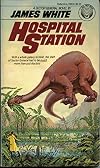
This was the story that inspired the book's cover art, which was actually pretty accurate. The dinosaur did indeed look like a brontosaurus with a spiky tail (one thing I didn't quite understand at first: although it looked similar to Earth's brontosaurus, it was actually a being from a completely different planet). Also, if you look closely you can see a little ball strapped to the man's shoulder. The man is Conway and the little ball is Dr. Arretapec.
Dinosaur lover that I am, I was looking forward to this one. Sadly, it wasn't quite as good as I had hoped. Watching Conway try to deal with Dr. Arretapec's condescending attitude was fun, but Dr. Arretapec's goal turned out to be a bit too big and lofty for my tastes. I also wondered about the ethics of it. On the one hand, the final goal was admirable. On the other hand, those were some pretty major changes Dr. Arretapec and its people were trying to bring about.
“Visitor at Large”
Dr. Conway gains a new assistant, the physically fragile and empathic Dr. Prilicla. Their tour of Sector General becomes more complicated when a young and frightened shapeshifting visitor runs loose through the hospital.
Dr. Prilicla is my favorite Sector General character, so I was really looking forward to this story. I enjoyed seeing Conway gradually adjust to his new assistant, who looked likely to get squashed at any minute but was actually very capable. Unfortunately, although Prilicla did get a chance to show off a little of what it could do, I felt that the character's appeal wasn't as apparent here as it was in the later stories I'd read. Its personality didn't really get a chance to shine.
As far as the visitor went, I had issues with the way that played out. It was during this story that I realized that White has a tendency to present problems with a psychological basis as something patients can get over just by really wanting to do so, or by having the proper motivation to do so. It came up in the first story, in the way O'Mara treated the stuttering human character, and it was the primary justification for Conway's incredibly cruel treatment of the young hospital visitor. It worked out in the end, but it made me very uncomfortable.
“Out-patient”
Conway is now a Senior Physician, which means he has a great deal more responsibility on his shoulders. In this story, he has to treat an unknown being rescued from a wrecked spaceship. He has to use clues from the wreck to try to figure out the being's atmospheric and gravity requirements, and the information doesn't make sense. The patient doesn't have long, either. Although it appears to be relatively uninjured, its whole body is gradually being covered by a tough malignant growth of some sort.
Like “Medic,” this was one of the better stories in the book. It was an intriguing medical mystery that tested Conway's trust in his own judgment and his willingness to make unpopular decisions.
I really enjoyed the medical mystery aspect of it, but I was a bit put off by Conway's behavior. He had only just become a Senior Physician, so his lack of willingness to talk to anyone seemed like an overreaction to his newly increased level of responsibility. I (and the characters) worried that he was so determined to prove himself that he'd accidentally kill his patient because he was afraid to ask for help. Just like in the previous story, it all worked out in the end. The only reason it worked for me this time around was because I felt that Conway had slightly better justifications for his actions here than he did in the previous story, but it still made for harrowing reading.
Additional Comments:
Just like in the Alien Emergencies omnibus, when O'Mara told Murchison that she couldn't use an Educator tape because female minds can't handle them, I was annoyed with the way female medical staff were written about in this book. For one thing, there was really only one confirmed female character, Murchison. For another, at the end of “Trouble with Emily” there was this exchange:
This conversation made me raise my eyebrows for multiple reasons. Sector General is a place with extremely diverse patients and staff members - even unconscious biases could get a staff member transferred elsewhere. O'Mara is one of the primary people who'd be evaluating staff members and their ability to work well with others. And yet he thinks “misogyny is an allowable neurosis”? Also, Conway's statement didn't strike me as being particularly misogynistic. Unless that was supposed to be a bad joke?
This stuff seems to happen most often with O'Mara, so maybe it's just a part of his character. The problem is that, at least in what I've read so far, not one male character calls him out for it, or even thinks about doing so.
All right, there was one last thing I wanted to bring up: the editing. This book's editing was terrible, with typos and misused words everywhere. It became particularly noticeable in the second half. Dr. Mannon's relationship with his beloved dog was viewed by aliens as a possibly “symbolic relationship” (53) or “symbiotic reassuringly” (103) rather than as a “symbiotic relationship,” Conway “talkeed” (134), plus a few other embarrassing mistakes.
(Original review posted on A Library Girl's Familiar Diversions.) show less
All in all this was...okay. “Medic” and “Out-patient” were good, but the other stories all disappointed me a bit, for various reasons. I'm kind of glad that this wasn't my first experience with the Sector General series. I missed getting to see the full cast of characters I'd gotten to know in Alien Emergencies.
“Medic”
This story introduces O'Mara, the man show more who later becomes Sector General's Chief Psychologist. Sector General is still in the process of being built, and O'Mara is one of the people helping to put it together. Although he's well-educated in both psychology and electronics, he hasn't yet found an employer willing to look past his craggy face and tough build. Everyone figures that manual labor is all he's good for.
After a Hudlar couple is killed in an accident at the construction site, O'Mara is forced to take care of their baby until an investigation is completed and someone comes to take the baby away. Unfortunately O'Mara knows next to nothing about Hudlarian childcare, and his boss and coworkers, who blame him for the accident, aren't willing to provide much help.
It was kind of weird, considering how they all felt about him, that everyone was okay with O'Mara being solely in charge of a possibly traumatized infant. Yes, there were a few “if anything happens to that child” threats, but why not remove the possibility of anything happening to the baby by putting it in the care of someone people actually trusted?
Anyway, aside from that and some issues I had with the way a stuttering human character was handled, I thought this was one of the two best stories in the collection. I really enjoyed reading about O'Mara's efforts to provide the best Hudlarian childcare he could. All his information came from a book, he didn't have anywhere near the strength of an adult Hudlar, and the baby was too young to give him much feedback. Even so, he did pretty well.
“Sector General”
Sector General is now a functioning hospital. Here we have Dr. Conway's introduction, as well as the introduction of Educator tapes. Dr. Conway has to use an Educator tape for the first time in order to treat Telfi patients. The Telfi are a radiation-eating group-mind, and the Educator tape wreaks all kinds of havoc with Conway's thoughts. Unfortunately, his biases and assumptions about Monitors (space police officers, sort of) keep him from getting help until it's almost too late. This continues to be an issue after a ship crash lands into Sector General and a possibly confused and injured alien causes serious problems with the gravity all over the hospital.
I wonder if this was originally published as two stories? The part with the Educator tape and the part with the crash definitely worked nicely together, but they were distinct enough from each other to confuse me a little. I kept expecting the Telfi and/or the Educator tapes to come up again during the crash portion.
This story was a bit of a mess, to be honest. It felt like White was trying to say something complicated about pacifism and violence, but then it just sort of petered out. I also felt like White took the easy way out with the way he handled the details surrounding Conway's actions at the end.
Conway, a pacifist, was faced with a terrible decision. He tried to go for a middle ground option and ended up doing more than he'd intended. Instead of dealing with the repercussions of this decision, White scaled things back until it turned out that none of it was really all that bad after all. Except that it should have been, because no matter how things turned out in the end, at the time Conway thought he'd done something that went against everything he'd believed and had been taught. There should have been more emotional fallout.
I could sort of see what White was trying to say about Monitors and their work, but it felt like he just tossed a few things out there without properly trying to connect most of it. It was disappointing.
“Trouble with Emily”
In this story, Conway acts as an assistant and guide for a VUXG doctor (the letters refer to the series' being classification system – humans are DBDG). Dr. Arretapec has psi abilities (telepathy, telekinesis, a bit of precognition) and has for some reason chosen a seemingly healthy dinosaur as its patient.
This was the story that inspired the book's cover art, which was actually pretty accurate. The dinosaur did indeed look like a brontosaurus with a spiky tail (one thing I didn't quite understand at first: although it looked similar to Earth's brontosaurus, it was actually a being from a completely different planet). Also, if you look closely you can see a little ball strapped to the man's shoulder. The man is Conway and the little ball is Dr. Arretapec.
Dinosaur lover that I am, I was looking forward to this one. Sadly, it wasn't quite as good as I had hoped. Watching Conway try to deal with Dr. Arretapec's condescending attitude was fun, but Dr. Arretapec's goal turned out to be a bit too big and lofty for my tastes. I also wondered about the ethics of it. On the one hand, the final goal was admirable. On the other hand, those were some pretty major changes Dr. Arretapec and its people were trying to bring about.
“Visitor at Large”
Dr. Conway gains a new assistant, the physically fragile and empathic Dr. Prilicla. Their tour of Sector General becomes more complicated when a young and frightened shapeshifting visitor runs loose through the hospital.
Dr. Prilicla is my favorite Sector General character, so I was really looking forward to this story. I enjoyed seeing Conway gradually adjust to his new assistant, who looked likely to get squashed at any minute but was actually very capable. Unfortunately, although Prilicla did get a chance to show off a little of what it could do, I felt that the character's appeal wasn't as apparent here as it was in the later stories I'd read. Its personality didn't really get a chance to shine.
As far as the visitor went, I had issues with the way that played out. It was during this story that I realized that White has a tendency to present problems with a psychological basis as something patients can get over just by really wanting to do so, or by having the proper motivation to do so. It came up in the first story, in the way O'Mara treated the stuttering human character, and it was the primary justification for Conway's incredibly cruel treatment of the young hospital visitor. It worked out in the end, but it made me very uncomfortable.
“Out-patient”
Conway is now a Senior Physician, which means he has a great deal more responsibility on his shoulders. In this story, he has to treat an unknown being rescued from a wrecked spaceship. He has to use clues from the wreck to try to figure out the being's atmospheric and gravity requirements, and the information doesn't make sense. The patient doesn't have long, either. Although it appears to be relatively uninjured, its whole body is gradually being covered by a tough malignant growth of some sort.
Like “Medic,” this was one of the better stories in the book. It was an intriguing medical mystery that tested Conway's trust in his own judgment and his willingness to make unpopular decisions.
I really enjoyed the medical mystery aspect of it, but I was a bit put off by Conway's behavior. He had only just become a Senior Physician, so his lack of willingness to talk to anyone seemed like an overreaction to his newly increased level of responsibility. I (and the characters) worried that he was so determined to prove himself that he'd accidentally kill his patient because he was afraid to ask for help. Just like in the previous story, it all worked out in the end. The only reason it worked for me this time around was because I felt that Conway had slightly better justifications for his actions here than he did in the previous story, but it still made for harrowing reading.
Additional Comments:
Just like in the Alien Emergencies omnibus, when O'Mara told Murchison that she couldn't use an Educator tape because female minds can't handle them, I was annoyed with the way female medical staff were written about in this book. For one thing, there was really only one confirmed female character, Murchison. For another, at the end of “Trouble with Emily” there was this exchange:
“O'Mara had paused then, shook his head wonderingly and went on, 'Not only do you get on exceptionally well with e-ts, but I don't hear a single whisper on the grapevine of you chasing the females of our species...'
'I don't have the time,' said Conway seriously. 'I doubt if I ever will.'
'Oh, well, misogyny is an allowable neurosis,' O'Mara had replied, then had gone on to discuss the new assistant.” (112)
This conversation made me raise my eyebrows for multiple reasons. Sector General is a place with extremely diverse patients and staff members - even unconscious biases could get a staff member transferred elsewhere. O'Mara is one of the primary people who'd be evaluating staff members and their ability to work well with others. And yet he thinks “misogyny is an allowable neurosis”? Also, Conway's statement didn't strike me as being particularly misogynistic. Unless that was supposed to be a bad joke?
This stuff seems to happen most often with O'Mara, so maybe it's just a part of his character. The problem is that, at least in what I've read so far, not one male character calls him out for it, or even thinks about doing so.
All right, there was one last thing I wanted to bring up: the editing. This book's editing was terrible, with typos and misused words everywhere. It became particularly noticeable in the second half. Dr. Mannon's relationship with his beloved dog was viewed by aliens as a possibly “symbolic relationship” (53) or “symbiotic reassuringly” (103) rather than as a “symbiotic relationship,” Conway “talkeed” (134), plus a few other embarrassing mistakes.
(Original review posted on A Library Girl's Familiar Diversions.) show less
Members
- Recently Added By
Lists

Best Science Fiction Novels
816 works; 430 members

Best medical fiction
26 works; 17 members

tell me where it hurts
36 works; 7 members

Physician-Writers
7 works; 2 members

Books Read in 2014
2,343 works; 86 members

#JustTheFacts2021Gold
60 works; 1 member

Book Worlds We'd Like To Visit
322 works; 158 members
Favorite Science Fiction
456 works; 218 members
Author Information

63+ Works 8,650 Members
Some Editions
Series

Belongs to Publisher Series
Work Relationships
Is contained in
Common Knowledge
- Canonical title
- Hospital Station
- Original title
- Hospital Station
- Original publication date
- 1962
- People/Characters
- Chief Psychologist O'Mara; Peter Conway; Dr. Mannen (as Dr. Mannon); Prilicla
- Important places
- Sector General (space station)
- Dedication
- TO BOB SHAW IN APPRECIATION
- First words
- The alien occupying O'Mara's sleeping compartment weighed roughly half a ton, possessed six short, thick appendages which served both as arms and legs and had a hide like a flexible armour plate.
Classifications
Statistics
- Members
- 671
- Popularity
- 42,796
- Reviews
- 19
- Rating
- (3.76)
- Languages
- 11 — Czech, Dutch, English, French, German, Italian, Lithuanian, Polish, Portuguese, Spanish, Swedish
- Media
- Paper, Audiobook, Ebook
- ISBNs
- 22
- ASINs
- 11