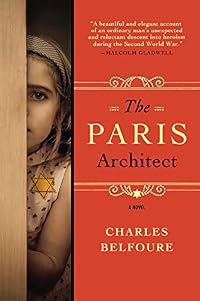
The Paris Architect
by Charles Belfoure
On This Page
Description
The New York Timesbestseller"A beautiful and elegant account of an ordinary man's unexpected and reluctant descent into heroism during the second world war." —Malcolm GladwellA thrilling debut novel of World War II Paris, from an author who's been called "an up and coming Ken Follett." (Booklist)In 1942 Paris, gifted architect Lucien Bernard accepts a commission that will bring him a great deal of money #65533;- and maybe get him killed. But if he's clever enough, he'll avoid any trouble. show more All he has to do is design a secret hiding place for a wealthy Jewish man, a space so invisible that even the most determined German officer won't find it. He sorely needs the money, and outwitting the Nazis who have occupied his beloved city is a challenge he can't resist. But when one of his hiding spaces fails horribly, and the problem of where to hide a Jew becomes terribly personal, Lucien can no longer ignore what's at stake. The Paris Architect asks us to consider what we owe each other, and just how far we'll go to make things right. Written by an architect whose knowledge imbues every page, this story becomes more gripping with every soul hidden and every life saved. show lessTags
Recommendations























Member Recommendations
BookshelfMonstrosity Each explores individual morality, justice, and Jewish identity in France during different eras. The Paris Architect offers a linear narrative of French and Jewish resistance in World War II; the denser, more complex Dream of Scipio treats 4th-20th century events.
20
BookshelfMonstrosity These gritty and richly detailed historical thrillers are about redemption and a higher purpose -- in Paris an architect works to hide Jews from the Nazis and in Vagabond a soldier hunts for the Holy Grail.
Member Reviews
Lucien is a young architect in Nazi-occupied Paris, growing desperate for a way to show his talent and, of course, to eat. He considers himself an atheist and was raised to hate Jews. So when a wealthy aristocrat who has turned to business offers him a commission with a potentially fatal catch, he wars with himself. Monsieur Manet is collaborating with the Nazis, refitting his automotive engine plants into war machinery plants, and helping the Nazis to build more. The pay for these fabulous opportunities is small, but the buildings will stand as testament to Lucien's skill. But to get these commissions, a price must be paid - clever hiding places built for the Jews Manet is helping to save. These commissions must be done before Lucien show more will be awarded the plant designs. They come with staggeringly generous fees, but if he is discovered, he will be tortured and killed by the Nazis.
The story is a study of how Lucien works through and grows in this moral thicket, and how it changes him over time. The architectural descriptions were compelling, the views of war-time Paris readable, and the characters worth knowing. It's inevitable that the reader ends with soul-searching. How would I have behaved in similar circumstances? show less
The story is a study of how Lucien works through and grows in this moral thicket, and how it changes him over time. The architectural descriptions were compelling, the views of war-time Paris readable, and the characters worth knowing. It's inevitable that the reader ends with soul-searching. How would I have behaved in similar circumstances? show less
I'd hoped to learn more about architecture, but what's there is mostly superficial. Belfoure evidently is qualified to provide more detailed discussions on architectural history, design, and technical challenges but chooses to focus on the plot and characters.
Belfoure has the germ of an interesting idea but does not write about it well. I prefer Alan Furst's novels: a similar sensibility with more intriguing structure, plotting, dialogue and characterization -- and simply better at the sentence level. Furst also grapples more significantly with the existential meaning of war, of how to be humane in such circumstances.
Belfoure has the germ of an interesting idea but does not write about it well. I prefer Alan Furst's novels: a similar sensibility with more intriguing structure, plotting, dialogue and characterization -- and simply better at the sentence level. Furst also grapples more significantly with the existential meaning of war, of how to be humane in such circumstances.
During World War II an architect in occupied Paris is hired to design secret hiding places for Jews. I wasn't expecting this one to be such a nail-biter, but I couldn't put it down. I loved that the book portrayed people on both sides of the conflict with questionable morals. Just because someone is on one side or the other doesn't make them completely good or bad. They are still just people, terrified by the events happening around them.
Neighbors lived in fear that a jew would be found hiding in their building and they would all be killed. Parisians were scared that refusing to cooperate with the Nazi officials would end in their imprisonment. It was a culture of fear and that makes some people brave and others weak.
Neighbors lived in fear that a jew would be found hiding in their building and they would all be killed. Parisians were scared that refusing to cooperate with the Nazi officials would end in their imprisonment. It was a culture of fear and that makes some people brave and others weak.
I have read many novels about different aspects of WWII and the Holocaust. However, not since reading "The Diary of a Young Girl" by Anne Frank when I was in grade school have I been able to imagine so clearly and felt so deeply the sheer terror of Gestapo boots pounding through an apartment or home and in one's isolation in a hiding space wondering if the space is safe enough from discovery. Lucien Bernard is an architect in Paris in 1924, and his story becomes more mesmerizing with each page read.
As individuals that have experience and expertise in a particular field become authors the passion for their field of choice and their real-life experiences bring an understanding and intimate knowledge that permeates every story crafted, show more heightens setting and scene descriptions, and adds realism to each conversation of the character that represents that field. After reading "The Paris Architect" I was not surprised to learn that Charles Belfoure is an architect and specifically that he practices historic preservation as both an architect and consultant.
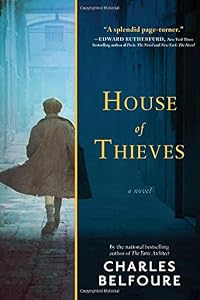
I look forward to reading Mr. Belfoure's second novel, "House of Thieves." show less
As individuals that have experience and expertise in a particular field become authors the passion for their field of choice and their real-life experiences bring an understanding and intimate knowledge that permeates every story crafted, show more heightens setting and scene descriptions, and adds realism to each conversation of the character that represents that field. After reading "The Paris Architect" I was not surprised to learn that Charles Belfoure is an architect and specifically that he practices historic preservation as both an architect and consultant.
I look forward to reading Mr. Belfoure's second novel, "House of Thieves." show less
Lucien is an architect in Paris during the German occupation. He is just trying to survive. Then a remarkable opportunity arises. He can earn a lot of money and maybe even advance his career, but there is a catch. The project involves building secret hiding places for Jews. Lucien is indifferent to the plight of the Jews, so it is not for any benevolent reason that he considers the job offer. His desire to provide some little luxuries for himself to and finally be working at a project that challenges him proves to be the motivation that causes him to say yes. So he starts working with Auguste Manet, his wealthy benefactor, hoping that he can just do this one job for him and then be done with it. But as he gets more involved with Manet show more and with a host of other characters - including Manet's clients and a new love interest-Lucien finds himself becoming personally involved with the project. After all, there is a certain thrill to using his skill to hide people and fool the Germans. But will he pay the ultimate price for playing this cat and mouse game with them?
I enjoyed this story on several levels. I enjoyed the historical details about what life was like in Vichy France. I enjoyed the novelty of an architect using his skill to design such clever hiding places--something for which there is a great historical precedent. And I also found that Lucien and Manet and the other characters, particularly Lucien's love interest, were real enough to me that I genuinely cared what happened to them. The ending may have been a bit contrived, but it was emotionally satisfying for those wanting the "good guys" to win. I highly recommend this book to those who enjoy well crafted historical fiction, especially if they enjoy those about World War II show less
I enjoyed this story on several levels. I enjoyed the historical details about what life was like in Vichy France. I enjoyed the novelty of an architect using his skill to design such clever hiding places--something for which there is a great historical precedent. And I also found that Lucien and Manet and the other characters, particularly Lucien's love interest, were real enough to me that I genuinely cared what happened to them. The ending may have been a bit contrived, but it was emotionally satisfying for those wanting the "good guys" to win. I highly recommend this book to those who enjoy well crafted historical fiction, especially if they enjoy those about World War II show less
The Paris Architect is brutal in its matter-of-factness. The German attitudes and actions towards Jews, in particular, but also anyone caught undermining German rule are nothing new; many a book discusses them or uses this malevolence to further their own stories. What makes The Paris Architect such a difficult read is the speed with which a situation devolves into violence and the even more shocking speed of recovery from that violence. People shot for living in the same apartment building as someone hiding a Jew, people shot for looking Jewish, for running without cause, for running with cause, for failing to collaborate, for capitulating too easily – no one was safe, but also no one looked askance when such things happened. People show more are shot, the bodies picked up and driven away, and everyone goes about their business as if there were never any interruptions. It is a cold picture of the blinders people wear in order to survive. Along the same lines, the torture scenes are also very uncomfortable to read. However, it is not the gory details, of which there are plenty, or the mere idea of torture that are the most disturbing. Instead, it is the idea that people would go to such extreme lengths to find one or two persons. Violence happens without warning, and people are brutalized in the most extreme fashions. As realistic as it might be, The Paris Architect is not for the easily disturbed.
In some regards, each of the characters is an archetype. Colonel Schlegel is so extreme in his hatred and vengeance. Lucien’s mistress, Adele, is too mercenary in her ambition. Manet is too enigmatic in his compassion and contradictory collaboration. Yet, these archetypes provide readers with a well-rounded view of the personalities at play during the Nazi occupation. While Schlegel may be fanatical in his hatred and single-mindedness and not every Nazi was quite as vitriolic as he is, there were still plenty of Germans who did fit Schlegel’s description. Conversely, Adele, Manet, and even Lucien are at the other end of the spectrum, struggling to survive, if not thrive, during the Nazi regime by having to balance the appearance of resistance with collaborative actions. One has no doubt that even if they are fictional characters, similar real-life people could easily be found. Even the Jews that flit onto and out of scenes with regularity are no more than caricatures as they show the wealthy and formerly powerful minority with the means to escape the tightening Nazi snare. Still, the generic impressions left by these one-dimensional characters drives the plot better than any fully-developed character because one knows what to expect from them. There are no doubts to Schlegel’s propensity for extreme behavior, or Adele’s greed, or Manet’s bribery skills. This general understanding of these secondary characters allows readers to focus on the real drama taking place within Lucien.
The Paris Architect is not all doom-and-gloom, although it is easy to get sucked down into the despair that comes with a seemingly hopeless situation. As Lucien evolves from the self-centered egoist to genuine humanitarian, the faith generated by his invisible hiding spots, as well as the courage of those hiding in such spots, infuses the entire story with hope – hope that good will prevail, that humanity’s compassion will out match mankind’s cruelty, that even the bleakest of situations is survivable in some regards and that all bad deeds are punishable. Lucien may be somewhat detestable in the beginning with his hatred of his wife, his anti-Semitism, his mistress, and especially his greed, but he definitely undertakes a metamorphosis that peels away the negative influences of his life and allows him to show readers his true self. In that aspect, The Paris Architect is a beautiful story of change, an adult’s coming-of-age story.
The action is fierce, the pacing blindingly fast, and the architectural details intricate. Combined with the thoroughly developed Lucien and his generic secondary cast, these elements create a novel that is spectacular in its scope and vivid in its imagery. The Paris Architect may be a glimpse into a significant, life-altering period in time in Paris’ long history of existence, but it is also a fascinating study in human nature and the broad spectrum of behavior one can find in any population. For all his faults, Lucien crawls under a reader’s skin and makes one care about his flaws as well as his innate goodness. The emphasis on people rather than on ideology makes it easy for readers to get lost in the plot, so absorbed in what is happening that the ending comes as a shock. With all this in its favor, it is no wonder The Paris Architect is October’s Indie Pick as well as a Bloggers Recommend selection for October. show less
In some regards, each of the characters is an archetype. Colonel Schlegel is so extreme in his hatred and vengeance. Lucien’s mistress, Adele, is too mercenary in her ambition. Manet is too enigmatic in his compassion and contradictory collaboration. Yet, these archetypes provide readers with a well-rounded view of the personalities at play during the Nazi occupation. While Schlegel may be fanatical in his hatred and single-mindedness and not every Nazi was quite as vitriolic as he is, there were still plenty of Germans who did fit Schlegel’s description. Conversely, Adele, Manet, and even Lucien are at the other end of the spectrum, struggling to survive, if not thrive, during the Nazi regime by having to balance the appearance of resistance with collaborative actions. One has no doubt that even if they are fictional characters, similar real-life people could easily be found. Even the Jews that flit onto and out of scenes with regularity are no more than caricatures as they show the wealthy and formerly powerful minority with the means to escape the tightening Nazi snare. Still, the generic impressions left by these one-dimensional characters drives the plot better than any fully-developed character because one knows what to expect from them. There are no doubts to Schlegel’s propensity for extreme behavior, or Adele’s greed, or Manet’s bribery skills. This general understanding of these secondary characters allows readers to focus on the real drama taking place within Lucien.
The Paris Architect is not all doom-and-gloom, although it is easy to get sucked down into the despair that comes with a seemingly hopeless situation. As Lucien evolves from the self-centered egoist to genuine humanitarian, the faith generated by his invisible hiding spots, as well as the courage of those hiding in such spots, infuses the entire story with hope – hope that good will prevail, that humanity’s compassion will out match mankind’s cruelty, that even the bleakest of situations is survivable in some regards and that all bad deeds are punishable. Lucien may be somewhat detestable in the beginning with his hatred of his wife, his anti-Semitism, his mistress, and especially his greed, but he definitely undertakes a metamorphosis that peels away the negative influences of his life and allows him to show readers his true self. In that aspect, The Paris Architect is a beautiful story of change, an adult’s coming-of-age story.
The action is fierce, the pacing blindingly fast, and the architectural details intricate. Combined with the thoroughly developed Lucien and his generic secondary cast, these elements create a novel that is spectacular in its scope and vivid in its imagery. The Paris Architect may be a glimpse into a significant, life-altering period in time in Paris’ long history of existence, but it is also a fascinating study in human nature and the broad spectrum of behavior one can find in any population. For all his faults, Lucien crawls under a reader’s skin and makes one care about his flaws as well as his innate goodness. The emphasis on people rather than on ideology makes it easy for readers to get lost in the plot, so absorbed in what is happening that the ending comes as a shock. With all this in its favor, it is no wonder The Paris Architect is October’s Indie Pick as well as a Bloggers Recommend selection for October. show less
Author Charles Belfoure is an architect as well as a writer. He is also the son of a woman who survived a forced labor camp in World War II. Combining these has resulted in a novel that is a serious contender for the best book I've read this year, or perhaps longer. I've studied that war for many years and learned that the way the Nazis turned human beings into monsters is beyond my comprehension. This story shows that monstrosity in spades.
The hero is an architect named Lucien Bernard who had deserted from the French Army along with many other officers when their post along the Maginot Line was not attacked by the Germans who had circled around the end. The French destroyed their uniforms and military IDs, and quietly melted into the show more civilian population. Soon he was back in Paris with his wife and no one the wiser. Being in Paris was horrible during the German occupation though. There was little food, people stood in line for hours only to find the shelves empty, or that the inflated price was more than they had. They kept rabbits in a hutch on the balcony so they could have meat occasionally. Bernard could find no work, and his marriage failed with the stress.
Then a wealthy French manufacturer contacted him about a job. Bernard soon found himself earning fabulous amounts of money, but the jobs were not only factories. They were also jobs that could get him tortured and killed: hiding places for Jews while they awaited transport to Switzerland or Spain. Bernard is terrified but also excited at the prospect of fooling the Germans, and it turns out that he has a gift for it.
As the story progresses we see terrible acts of violence with German soldiers laughing at the pain and terror they cause. Bernard is alternately proud and scared out of his mind, and so is the reader. I was totally wrapped up in this book, even dreaming about it. Meanwhile, he comes to care about the people he is protecting and enjoy the frustration of the searchers.
The Bernard he becomes makes me wonder whether I could possibly be that courageous, inventive, and loving. It's a wonderful tale of the power of love and decency to overcome evil, but this is no fairy tale with a happy ending. It's believable, moving, and exhausting.
Highly recommended
Source: Amazon Vine show less
The hero is an architect named Lucien Bernard who had deserted from the French Army along with many other officers when their post along the Maginot Line was not attacked by the Germans who had circled around the end. The French destroyed their uniforms and military IDs, and quietly melted into the show more civilian population. Soon he was back in Paris with his wife and no one the wiser. Being in Paris was horrible during the German occupation though. There was little food, people stood in line for hours only to find the shelves empty, or that the inflated price was more than they had. They kept rabbits in a hutch on the balcony so they could have meat occasionally. Bernard could find no work, and his marriage failed with the stress.
Then a wealthy French manufacturer contacted him about a job. Bernard soon found himself earning fabulous amounts of money, but the jobs were not only factories. They were also jobs that could get him tortured and killed: hiding places for Jews while they awaited transport to Switzerland or Spain. Bernard is terrified but also excited at the prospect of fooling the Germans, and it turns out that he has a gift for it.
As the story progresses we see terrible acts of violence with German soldiers laughing at the pain and terror they cause. Bernard is alternately proud and scared out of his mind, and so is the reader. I was totally wrapped up in this book, even dreaming about it. Meanwhile, he comes to care about the people he is protecting and enjoy the frustration of the searchers.
The Bernard he becomes makes me wonder whether I could possibly be that courageous, inventive, and loving. It's a wonderful tale of the power of love and decency to overcome evil, but this is no fairy tale with a happy ending. It's believable, moving, and exhausting.
Highly recommended
Source: Amazon Vine show less
Members
- Recently Added By
Lists

Historical Fiction
889 works; 90 members

Books Read in 2023
5,547 works; 145 members
Author Information

8 Works 2,231 Members
Awards and Honors
Awards
Work Relationships
Has as a reference guide/companion
Common Knowledge
- Canonical title
- The Paris Architect
- Original publication date
- 2013
- People/Characters
- Lucien Bernard; Auguste Manet
- Important places
- Paris, France
- Important events
- World War II
- First words
- Just as Lucien Bernard rounded the corner at the Rue La Boetie, a man running from the opposite direction almost collided with him.
- Last words
- (Click to show. Warning: May contain spoilers.)He smiled at the family. His family.
- Blurbers
- Blum, Jenna; Leroy, Margaret; Cheuse, Alan; McMorris, Kristina; Kramer, Julie; Hicks, Carol
Classifications
Statistics
- Members
- 1,679
- Popularity
- 13,229
- Reviews
- 80
- Rating
- (3.81)
- Languages
- English, Italian, Portuguese (Portugal)
- Media
- Paper, Audiobook, Ebook
- ISBNs
- 19
- UPCs
- 2
- ASINs
- 9