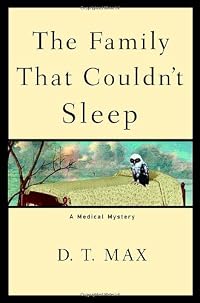
The Family that Couldn't Sleep
by D.T. Max
On This Page
Description
For two hundred years a noble Venetian family has suffered from an inherited disease that strikes their members in middle age, stealing their sleep, eating holes in their brains, and ending their lives in a matter of months. In Papua New Guinea, a primitive tribe is nearly obliterated by a sickness whose chief symptom is uncontrollable laughter. Across Europe, millions of sheep rub their fleeces raw before collapsing. In England, cows attack their owners in the milking parlors, while in the show more American West, thousands of deer starve to death in fields full of grass.What these strange conditions–including fatal familial insomnia, kuru, scrapie, and mad cow disease–share is their cause: prions. Prions are ordinary proteins that sometimes go wrong, resulting in neurological illnesses that are always fatal. Even more mysterious and frightening, prions are almost impossible to destroy because they are not alive and have no DNA–and the diseases they bring are now spreading around the world.
In The Family That Couldn’t Sleep, essayist and journalist D. T. Max tells the spellbinding story of the prion’s hidden past and deadly future. Through exclusive interviews and original archival research, Max explains this story’s connection to human greed and ambition–from the Prussian chemist Justus von Liebig, who made cattle meatier by feeding them the flesh of other cows, to New Guinean natives whose custom of eating the brains of the dead nearly wiped them out. The biologists who have investigated these afflictions are just as extraordinary–for example, Daniel Carleton Gajdusek, a self-described “pedagogic pedophiliac pediatrician” who cracked kuru and won the Nobel Prize, and another Nobel winner, Stanley Prusiner, a driven, feared self-promoter who identified the key protein that revolutionized prion study.
With remarkable precision, grace, and sympathy, Max–who himself suffers from an inherited neurological illness–explores maladies that have tormented humanity for centuries and gives reason to hope that someday cures will be found. And he eloquently demonstrates that in our relationship to nature and these ailments, we have been our own worst enemy.
. show less
Tags
Recommendations



















Member Reviews
An excellent history of prion diseases, framed by the story of an Italian family with a genetic prion disease, fatal familial insomnia, that kills by exhaustion. I'm equal parts fascinated by this disease's potential to illuminate the way sleep works, and horrified by the very thought of prion diseases.
Intensely interesting. Follows the history of infectious and inherited prion diseases through their outbreaks in animals and their appearance in humans using the story of the Venetian family with fatal familial insomnia as a backdrop. Nature is terrifying, especially when humans inadvertently amplify its horrors.
A fascinating historical and medical perspective on fatal familial insomnia and prion disorders in general, highlighting historical and modern controversies on these fascinating diseases. Max's strength lies in characterization and the placement of the events occurring in one family with FFI within a historical context. His prose is rich and readable. The subject matter is unspeakably sad, but Max handles a book about rapid neurodegeneration with ease, focusing on the excitement of discovery, the hopes of family and the scientific and medical curiosity evoked by the strange mysteries of prion disorders.
The major flaw is that by attempting to focus on prion disorders in general, what Max covers in breadth often lacks in depth. The show more discussion of kuru seems to focus on one of the main researcher's pedophilia to a large extent, which seems to occur in place of a real examination of the husband and wife team that did the anthropological work to discover the true origins of the disease. It would be both more salient and more interesting to focus instead on the controversies of cannibalism and how that discovery was made. In addition, Max remarks several times on the similarity between scrapie and FFI to the already discovered hereditary prion disorders CJD and GSS, without ever really discussing the discovery of those conditions. Since one of the stated goals of the book is to bring about public awareness and support for research to inherited prion disorders, more exploration of these two diseases would have added a lot, in addition to enriching the history of the field. show less
The major flaw is that by attempting to focus on prion disorders in general, what Max covers in breadth often lacks in depth. The show more discussion of kuru seems to focus on one of the main researcher's pedophilia to a large extent, which seems to occur in place of a real examination of the husband and wife team that did the anthropological work to discover the true origins of the disease. It would be both more salient and more interesting to focus instead on the controversies of cannibalism and how that discovery was made. In addition, Max remarks several times on the similarity between scrapie and FFI to the already discovered hereditary prion disorders CJD and GSS, without ever really discussing the discovery of those conditions. Since one of the stated goals of the book is to bring about public awareness and support for research to inherited prion disorders, more exploration of these two diseases would have added a lot, in addition to enriching the history of the field. show less
This book covers what sound like the most terrifying medical conditions I've ever read about: conditions caused by proteins misfolding in the brain, causing catastrophic symptoms and wreaking havoc on the patient and the patient's family. The family mentioned in the title suffers from a condition known as fatal familial insomnia, in which certain branches of the family, after middle age, suddenly lose the ability to sleep. Without the restorative effects of sleep, physical and mental decline set in. And the scary part about the disease is that the sufferers know exactly what's happening to them. Other diseases covered in the book are scrapie, bovine spongiform encephalopathy, and kuru. Mention is also made of diseases in which proteins show more may play a role and for which doctors hope a treatment can be found: Alzheimer's, Parkinson's, ALS and so on.
I read this book primarily for the fatal familial insomnia chapters, and they were very well done. I also liked the chapters on the other diseases, but I had already read about most of them in Jay Ingram's book Fatal Flaws. The Ingram book has the advantage of being published more recently (2012, rather than 2006 for this book), but this book is definitely the one you want to go to for the fatal familial insomnia information.
One caveat: if you're a hypochondriac or easily suggestible, maybe don't read the bits about insomnia if you're already having trouble sleeping. show less
I read this book primarily for the fatal familial insomnia chapters, and they were very well done. I also liked the chapters on the other diseases, but I had already read about most of them in Jay Ingram's book Fatal Flaws. The Ingram book has the advantage of being published more recently (2012, rather than 2006 for this book), but this book is definitely the one you want to go to for the fatal familial insomnia information.
One caveat: if you're a hypochondriac or easily suggestible, maybe don't read the bits about insomnia if you're already having trouble sleeping. show less
A friend has been reminding me to distinguish between an interesting topic and a topic I'd actually want to read a full-length book about. When I first heard of FFI I was fascinated, but honestly I'm not sure what 250 pages just on that would look like - probably science I wouldn't quite understand. Luckily this particular book covers more than FFI, giving a history of research into prions and prion disease research, with forays into kuru (always memorable if you've studied anthropology or traveled the south pacific) and scrapie. It was additionally interesting to read about mad cow, because I remember it, but wasn't at an age where I read the news closely, nevermind scientific papers. Overall very readable and interesting, despite the show more rather accepting treatment of Gajdusek. show less
themes: disease, heredity, science, sleep, farming/agriculture
So you've been having trouble sleeping? I bet your trouble is nothing compared to what this Italian family has gone through. They are cursed with the gene that causes Fatal Familial Insomnia, which is pretty much just what it sounds like. You inherit it, and you can't sleep, and you die. A few other things happen too, but that's the killer. The brain, and the rest of the body too, needs sleep.
But that's just the beginning of this book, although the author comes back to the family over and over. The real subject of the book is prion disease, that weird little twist that lets renegade proteins act like a virus and attack the body in ways that science can't yet combat.
The most show more familiar of these, and the only one that I recognized at the outset as a prion disease, is Mad Cow Disease, or bovine spongiform encephalopathy or BSE. That "spongiform" part is because it basically turns the brain into a spongy, gooey, hole-riddled mass. (Sorry if you were eating. Hope it wasn't beef.) And because the disease is caused by a deformed protein, cooking it will not not kill the disease. Neither will radiation, alcohol, antibiotics. In fact, almost nothing will kill it. It's seriously bad news.
I really liked this book. It reads more like a mystery. He does tend to throw around some medical jargon, and then later he'll oversimplify to avoid the jargon, so it's not perfect. But it was a read that will keep you up at night.
4 stars show less
So you've been having trouble sleeping? I bet your trouble is nothing compared to what this Italian family has gone through. They are cursed with the gene that causes Fatal Familial Insomnia, which is pretty much just what it sounds like. You inherit it, and you can't sleep, and you die. A few other things happen too, but that's the killer. The brain, and the rest of the body too, needs sleep.
But that's just the beginning of this book, although the author comes back to the family over and over. The real subject of the book is prion disease, that weird little twist that lets renegade proteins act like a virus and attack the body in ways that science can't yet combat.
The most show more familiar of these, and the only one that I recognized at the outset as a prion disease, is Mad Cow Disease, or bovine spongiform encephalopathy or BSE. That "spongiform" part is because it basically turns the brain into a spongy, gooey, hole-riddled mass. (Sorry if you were eating. Hope it wasn't beef.) And because the disease is caused by a deformed protein, cooking it will not not kill the disease. Neither will radiation, alcohol, antibiotics. In fact, almost nothing will kill it. It's seriously bad news.
I really liked this book. It reads more like a mystery. He does tend to throw around some medical jargon, and then later he'll oversimplify to avoid the jargon, so it's not perfect. But it was a read that will keep you up at night.
4 stars show less
Medical mystery, political commentary & scientific exploration of prions
This tells the story of a family that suffers from FFI (Fatal Familial Insomnia) which was a complete medical mystery until recently and how the diseases of Kuru (in cannibals tribes in Papua New Guinea), Creuzfeldt Jakob Disease (CJD) and BSE helped identify why members of a certain Italian family were falling victim to a disease that baffled the medical community and was seen as a family curse. Victims inherit a tendency to manufacture prions in their own bodies. These accumulate and destroy the brain's sleep centres, resulting in sweaty, hollow-eyed demented death. In order to tell their story the author covers much of what is known about Prion diseases show more discovered through research into Scrapie, Kuru, CJD & BSE by its sometimes maverick researchers – for example Carlton Gajdusek laid the groundwork in working out what caused Kuru but was also an enthusiastic paedophile who graphically recorded his sexual exploits with young Fore (a Papua New Guinea tribe) people in his laboratory diaries. D. T. Max weaves all this information into a engrossing narrative that shows that although we now know much more about Prions there is still much to learn and it appears that we may not have learned our lessons from the BSE crisis (hence the political commentary). Protein mis-folding is a hot topic in medicine now with possible applications to a great many diseases including Alzheimer’s, Huntingdon’s and Parkinson’s.
Overall – A fascinating medical detective story show less
This tells the story of a family that suffers from FFI (Fatal Familial Insomnia) which was a complete medical mystery until recently and how the diseases of Kuru (in cannibals tribes in Papua New Guinea), Creuzfeldt Jakob Disease (CJD) and BSE helped identify why members of a certain Italian family were falling victim to a disease that baffled the medical community and was seen as a family curse. Victims inherit a tendency to manufacture prions in their own bodies. These accumulate and destroy the brain's sleep centres, resulting in sweaty, hollow-eyed demented death. In order to tell their story the author covers much of what is known about Prion diseases show more discovered through research into Scrapie, Kuru, CJD & BSE by its sometimes maverick researchers – for example Carlton Gajdusek laid the groundwork in working out what caused Kuru but was also an enthusiastic paedophile who graphically recorded his sexual exploits with young Fore (a Papua New Guinea tribe) people in his laboratory diaries. D. T. Max weaves all this information into a engrossing narrative that shows that although we now know much more about Prions there is still much to learn and it appears that we may not have learned our lessons from the BSE crisis (hence the political commentary). Protein mis-folding is a hot topic in medicine now with possible applications to a great many diseases including Alzheimer’s, Huntingdon’s and Parkinson’s.
Overall – A fascinating medical detective story show less
Members
- Recently Added By
Lists

Non-Fiction Worth Reading
1,015 works; 253 members

To Read - Medicine
18 works; 1 member

Read These Too
458 works; 9 members

Weirdo Nonfiction
138 works; 3 members
Author Information

5+ Works 1,562 Members
Some Editions
Awards and Honors
Awards
Notable Lists
Common Knowledge
- Canonical title
- The Family that Couldn't Sleep
- Alternate titles
- The Family that Couldn't Sleep
- Epigraph
- Now all my hours are trances;
And all my nightly dreams
Are where the dark eye glances,
And where thy footstep gleams,
In what ethereal dances,
By what Italian streams.
—EDGAR ALLAN... (show all) POE, “The Assignation”
Protein, so far as we know, does not replicate itself all by itself, not on this planet anyway. Looked at this way, the [prion] seems the strangest thing in all biology and, until someone in some laboratory figures out what i... (show all)t is, a candidate for Modern Wonder.
—LEWIS THOMAS - Dedication
- For Sarah
Dove andrai tu andrò anch’io
e dove starai tu io pure starò - First words
- In October 1997, Stanley Prusiner, a professor at the University of California–San Francisco who had spent twenty-five years studying prions, went to Stockholm to receive the prize he called “the big one” from the King ... (show all)of Sweden.
- Last words
- (Click to show. Warning: May contain spoilers.)Someone somewhere someday will have a cure—or at least a name—for whatever it is that I have.
- Canonical DDC/MDS
- 616.83
- Canonical LCC
- RA644.P93
Classifications
- Genres
- Science & Nature, Nonfiction, General Nonfiction, History
- DDC/MDS
- 616.83 — Technology Medicine & health Diseases Diseases of nervous system and mental disorders Other organic diseases of central nervous system
- LCC
- RA644 .P93 — Medicine Public aspects of medicine Public aspects of medicine Public health. Hygiene. Preventive medicine Disease (Communicable and noninfectious) and public
- BISAC
Statistics
- Members
- 728
- Popularity
- 38,510
- Reviews
- 30
- Rating
- (3.92)
- Languages
- English, Spanish
- Media
- Paper, Audiobook, Ebook
- ISBNs
- 12
- ASINs
- 5