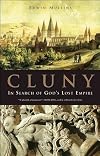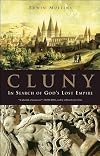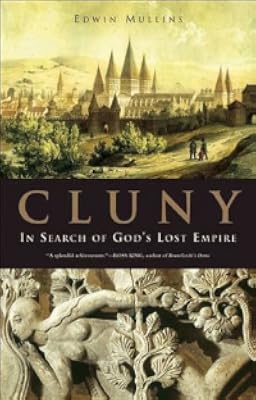
Cluny: In Search of God's Lost Empire
by Edwin Mullins
On This Page
Description
A monastery like no other, this is Cluny’s story from humble beginnings in the early Middle Ages, through centuries of immense wealth and sacred glory, to its decline, destroyed by the French Revolution. Much of Cluny’s enduring legacy lies in great cultural innovations sponsored by the abbey.Tags
Recommendations




















Member Reviews
Edwin Mullins' book on the Cluny Abbey was a surprising read in that I had never realised before the power and influence that some religious leaders exercised during the Middle Ages. Cluny was founded by the Duke of Burgundy in the 11th century; it was unique in its time in that the Duke established the Abbey so that it reported solely to the Pope - the Abbot of Cluny had no feudal overlords or local bishops to contend with.
This unique foundation was leveraged by a series of wise, influential and long-serving Abbots that took Cluny from humble beginnings to being the master monastery for thousands of other cloisters and commanding vast endowments and income from their lands. The Abbots, especially Hugh of Semur, used these riches to show more construct one of the greatest cathedrals of the time, as well as to further the influence of the Cluniac order. Hugh was one of the most influential men in Christendom, a confidante of the Pope, the Holy Roman Emperor and the kings of Spain, England and France. Cluny played a key role in the establishment of the Crusades, in the spread of the Church to Plantagenet England, the rift between the Pope and the Emperor and in the tragedy of the doomed philosopher Peter Abelard.
Covering the hundreds of years between Cluny's foundation and its ultimate destruction by a trio of greedy businessmen, Mullins' book is necessarily cursory at times, but he does manage to convey the grandeur of Cluny and the wisdom of its greatest leaders (and the folly of the not-so-great). I feel, however, that the author has been badly let down by his publisher. A book that talks so lovingly of grand buildings and art, and describes great and influential men deserves a sumptuous treatment. I would expect at least some plates showing portraits of the main players, photos of some of the many extant buildings Mullins discusses as well as of the very few museum pieces that still remain of the great Cluny church. Instead the book is just text, with the odd desultory thumbnail drawing tossed in at intervals. These drawings are uncaptioned, and it is left up to the reader to surmise what they represent. Cluny is a really interesting book let down badly by a publisher that has cranked out an el cheapo edition that fails to breathe life into it. show less
This unique foundation was leveraged by a series of wise, influential and long-serving Abbots that took Cluny from humble beginnings to being the master monastery for thousands of other cloisters and commanding vast endowments and income from their lands. The Abbots, especially Hugh of Semur, used these riches to show more construct one of the greatest cathedrals of the time, as well as to further the influence of the Cluniac order. Hugh was one of the most influential men in Christendom, a confidante of the Pope, the Holy Roman Emperor and the kings of Spain, England and France. Cluny played a key role in the establishment of the Crusades, in the spread of the Church to Plantagenet England, the rift between the Pope and the Emperor and in the tragedy of the doomed philosopher Peter Abelard.
Covering the hundreds of years between Cluny's foundation and its ultimate destruction by a trio of greedy businessmen, Mullins' book is necessarily cursory at times, but he does manage to convey the grandeur of Cluny and the wisdom of its greatest leaders (and the folly of the not-so-great). I feel, however, that the author has been badly let down by his publisher. A book that talks so lovingly of grand buildings and art, and describes great and influential men deserves a sumptuous treatment. I would expect at least some plates showing portraits of the main players, photos of some of the many extant buildings Mullins discusses as well as of the very few museum pieces that still remain of the great Cluny church. Instead the book is just text, with the odd desultory thumbnail drawing tossed in at intervals. These drawings are uncaptioned, and it is left up to the reader to surmise what they represent. Cluny is a really interesting book let down badly by a publisher that has cranked out an el cheapo edition that fails to breathe life into it. show less
Great reading on an early Benedictine monastery. I only wish that the volume had pictures of the remnants instead of the occasional line drawing.
Wonderful book about an amazing and pivotal place in the course of history.
Endorsed by Phillis Tickle on the back.
Een beschrijving van het wedervaren van de grootste abdij uit de geschiedenis van het Westerse christendom. Knap en overzichtelijk, eerder bedoeld voor de geïnteresseerde leek dan voor de gevorderde kenner.
Oct 28, 2012Dutch
Ratings
Members
- Recently Added By
Lists

Chronological 2018
17 works; 1 member
Author Information
29+ Works 495 Members
Classifications
- Genres
- Nonfiction, Religion & Spirituality, History, General Nonfiction, Art & Design
- DDC/MDS
- 271.1404443 — Religion History of Christianity Religious congregations and orders in church history Benedictines
- LCC
- BX2615 .C63 .M85 — Philosophy, Psychology and Religion Christian Denominations Christian Denominations Catholic Church Monasticism. Religious orders
- BISAC
Statistics
- Members
- 131
- Popularity
- 249,469
- Reviews
- 5
- Rating
- (3.37)
- Languages
- English
- Media
- Paper
- ISBNs
- 4
- ASINs
- 1