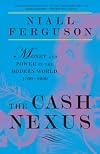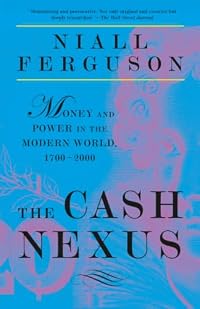
The Cash Nexus: Money and Power in the Modern World, 1700-2000
by Niall Ferguson
On This Page
Description
"The cash nexus is the crucial point where money and power meet. But does money make the political world go round? Does the success of democracy depend on economic growth? Does victory always go to the richest of the great powers? Or are financial markets the true 'masters' of the modern world?" "With the analytical boldness and the grasp of dazzling detail for which he is now famous, Ferguson offers a fascinating account of the evolution of today's economic and political landscape, from show more 'sleaze' to the single currency. Far from being driven by iron economic laws, he argues, modern history is the product of unpredictable political conflicts; and it is their impact on volatile financial markets that can make or break an empire."--Jacket. show lessTags
Recommendations







Member Reviews
Whew. Another big one from Ferguson. His books are a real treat to grapple with. He covers everything from novelists to bond yields to imperialism. Not your typical economic history.
He likes going after big issues, and he has some big claims to make. Some points he makes:
-Nations running debt is not always a bad thing.
-There is a relationship between taxation and war (not much of a surprise).
-Economics does not necessarily influence election results. Very heavy use of historical comparisons and tables here.
-The author finds a weak correlation between democracy and prosperity. Compare Singapore or China and Greece or Argentina.
-Gold is not necessarily a wise hedge investment in terms of economic crisis. Some recent events might be show more proving him right - gold's price has been fluctuating wildly in recent weeks almost as much as the stocks have.
-I note some unusual judgments on American power. He criticizes them for not being involved in any real wars, and as a clumsy giant, wrecking all with its mixture of idealism and realpolitik. This was written in the early 2000s. One might say that the United States is too eager to venture into war now.
-Ferguson also has a lot of nostalgia for the British empire, flawed and titanic and rampaging and topheavy as it was.
The Big Theme is the complex relationship between economics and politics. His 'square' diagram is very interesting.
The man seems to thrive off of controversy. I highly suggest you give this a peek, if you like his other books. show less
He likes going after big issues, and he has some big claims to make. Some points he makes:
-Nations running debt is not always a bad thing.
-There is a relationship between taxation and war (not much of a surprise).
-Economics does not necessarily influence election results. Very heavy use of historical comparisons and tables here.
-The author finds a weak correlation between democracy and prosperity. Compare Singapore or China and Greece or Argentina.
-Gold is not necessarily a wise hedge investment in terms of economic crisis. Some recent events might be show more proving him right - gold's price has been fluctuating wildly in recent weeks almost as much as the stocks have.
-I note some unusual judgments on American power. He criticizes them for not being involved in any real wars, and as a clumsy giant, wrecking all with its mixture of idealism and realpolitik. This was written in the early 2000s. One might say that the United States is too eager to venture into war now.
-Ferguson also has a lot of nostalgia for the British empire, flawed and titanic and rampaging and topheavy as it was.
The Big Theme is the complex relationship between economics and politics. His 'square' diagram is very interesting.
The man seems to thrive off of controversy. I highly suggest you give this a peek, if you like his other books. show less
A good example of how broad-brush history should be done - great themes integrating with solid bottom up research, charts and statistics.
Epigraph
In these complicated times . . . Cash Payment is the sole nexus between man and man . . . Cash Payment the sole nexus; and there are so many things which cash will not pay! Cash is a great miracle; yet it has not all power in Heaven, nor even on Earth. . . .
Thomas Carlyle, Chartism (1840)
The Gospel of Mammonism . . . has also its corresponding heaven. For there is one Reality among so many Phantasms; about one thing we are entirely in earnest: The making of money. . . . We have profoundly forgotten everywhere that Cash-payment is not the sole relation of human beings.
Thomas Carlyle, Past and Present (1843)
The bourgeoisie . . . has left remaining no other nexus between man and man than naked self-interest, than callous 'cash show more payment'.
Marx and Engels, The Communist Manifesto (1848)
We are told by men of science that all venture of mariners on the sea, all that counter-marching tribes and races that confounds all history with its dust and rumour, sprang from nothing more abstruse than the laws of supply and demand, and a certain natural instinct for cheap rations. To any one thinking deeply, this will seem a dull and pitiful explanation.
Robert Louis Stevenson, "Will o' the Mill" (1978)
Ferguson is a preeminent historian who here examines the profound relationship between economics and politics over the last three centuries. His two-fold agenda is to refute popular forms of economic determinism, in particular Paul Kennedy's theory of imperial ''overstretch'' as the cause of national decline and Francis Fukuyama's vision of triumphant democracy and capitalism.
By hindsight, Ferguson's point that Obama in Iraq might have taken his imperial responsibilities for running the global system more seriously seems particularly apt. Rather than having a reliable trading partner in the Middle East the high cost of Iraq was frittered away due to Obama's political agenda.
Neither economics nor political science can predict human history, which ''has hardly any linear causal relationships.'' Ferguson invokes Thomas Carlyle: ''Acted history . . . is an ever-living, ever-working Chaos of Being, wherein shape after shape bodies itself forth from innumerable elements.'' Now that the financial stability of the U.S. is questioned, and the leadership-less style of Obama, `leading from behind,' is common, world events will most likely decline if Ferguson is correct.
In the introduction he spells out the whole argument. War has often been the motor of economic development, especially financial change, and economics can greatly affect military prospects. Historically, certain institutions have been critically important: a rational system for tax collection, a parliament that legitimizes and refines taxation, a national debt that permits heavy borrowing to spread out the expense of war and a central bank that manages debt and money to benefit the state. Such institutions also energize the whole economy and speed its development. like the British Empire a century ago, the United States today is vulnerable not to overstretch but to ''understretch.'' Britain declined not because it strained its economy but because it failed to mobilize its resources in time to deter Germany. If Britain was determined to thwart rather than accommodate, he says, it should have built up a land army for the Continental battlefields where Europe's fate would be determined. Lack of resources was no excuse. In the 18th and early 19th centuries, a much poorer Britain successfully mobilized a much larger proportion of its national wealth for war. If the United States fails to mobilize its wealth, it too is likely to decline. America has declined. Ferguson continues, Americans are diffident about using their unprecedented power to impose democracy and market economies. By enlarging NATO they have enlarged their commitments, but failed to expand their capabilities accordingly. The ''leaders of the one state with the economic resources to make the world a better place lack the guts to do it.''
Ferguson has also correctly predicted the weakness of the European Monetary Union: he had given the community about as much chance for survival as the Latin Monetary Union of the 19th and early 20th centuries. Ferguson was right.
Ferguson asks fourteen questions to challenge economic determinism.
1. How far are modern states the products of war?
2. Is there an optimal "mix" of taxation?
3. What is the relationship between parliamentarization and bureaucratization?
4. Are government debts a source of weakness or strength?
5. Why have large government debts so often led to defaults and inflations?
6. What determines the interest rates governments pay when they borrow?
7. Are distributional conflicts best understood in terms of class or generations?
8. Does economic prosperity (or lavish campaign expenditure) lead to government popularity?
9. What are the implications of the globalization of finance?
10. What causes stock market bubbles?
11. How far can exchange rate systems or monetary unions increase international financial stability?
12. Does economic growth lead to democratization and/or vice versa?
13. Is the world becoming more politically fragmented or more integrated?
14. Are democratic powers vulnerable to military under stretch? (pp. 18-19).
How far are modern states the products of war?
Perhaps the lethal nature and destructive power of war has impacted the West following the two World Wars in the 20th Century. "Only in Europe has war grown less frequent since 1945" (p. 17). As mobilization has generally decreased since the 18th Century, the lethal nature and concentration of firepower has increased, though not dramatically increasing the cost of weaponry. 37.8 million civilians died in World War II, the most deadly of all wars, and coupled with the brevity of modern war the technology of devastation is staggering (p. 33). The capacity of war to kill increased dramatically. "From the time of Napoleon to the time of Hitler--born a mere 120 years apart--the increase was more than sixty-fold" (p. 34). World War II was the most destructive war in history with about 2.4% of the world's population killed in the conflict compared with 0.2% during the Napoleonic Era (p. 34). In the battle at Passchendaele in World War I the British sustained 8,222 deaths per mile for an advance of 45 miles (p. 38). The West has substituted capital for war personnel.
Ferguson describes the transition from the World War I warfare state to the latter day welfare state (p. 100). "Nothing is easier than spending the public money. It does not appear to belong to anybody. The temptation is overwhelming to bestow on anybody" (p. 101). There is a limit to taxation in that there is a point where it inhibits growth. show less
In these complicated times . . . Cash Payment is the sole nexus between man and man . . . Cash Payment the sole nexus; and there are so many things which cash will not pay! Cash is a great miracle; yet it has not all power in Heaven, nor even on Earth. . . .
Thomas Carlyle, Chartism (1840)
The Gospel of Mammonism . . . has also its corresponding heaven. For there is one Reality among so many Phantasms; about one thing we are entirely in earnest: The making of money. . . . We have profoundly forgotten everywhere that Cash-payment is not the sole relation of human beings.
Thomas Carlyle, Past and Present (1843)
The bourgeoisie . . . has left remaining no other nexus between man and man than naked self-interest, than callous 'cash show more payment'.
Marx and Engels, The Communist Manifesto (1848)
We are told by men of science that all venture of mariners on the sea, all that counter-marching tribes and races that confounds all history with its dust and rumour, sprang from nothing more abstruse than the laws of supply and demand, and a certain natural instinct for cheap rations. To any one thinking deeply, this will seem a dull and pitiful explanation.
Robert Louis Stevenson, "Will o' the Mill" (1978)
Ferguson is a preeminent historian who here examines the profound relationship between economics and politics over the last three centuries. His two-fold agenda is to refute popular forms of economic determinism, in particular Paul Kennedy's theory of imperial ''overstretch'' as the cause of national decline and Francis Fukuyama's vision of triumphant democracy and capitalism.
By hindsight, Ferguson's point that Obama in Iraq might have taken his imperial responsibilities for running the global system more seriously seems particularly apt. Rather than having a reliable trading partner in the Middle East the high cost of Iraq was frittered away due to Obama's political agenda.
Neither economics nor political science can predict human history, which ''has hardly any linear causal relationships.'' Ferguson invokes Thomas Carlyle: ''Acted history . . . is an ever-living, ever-working Chaos of Being, wherein shape after shape bodies itself forth from innumerable elements.'' Now that the financial stability of the U.S. is questioned, and the leadership-less style of Obama, `leading from behind,' is common, world events will most likely decline if Ferguson is correct.
In the introduction he spells out the whole argument. War has often been the motor of economic development, especially financial change, and economics can greatly affect military prospects. Historically, certain institutions have been critically important: a rational system for tax collection, a parliament that legitimizes and refines taxation, a national debt that permits heavy borrowing to spread out the expense of war and a central bank that manages debt and money to benefit the state. Such institutions also energize the whole economy and speed its development. like the British Empire a century ago, the United States today is vulnerable not to overstretch but to ''understretch.'' Britain declined not because it strained its economy but because it failed to mobilize its resources in time to deter Germany. If Britain was determined to thwart rather than accommodate, he says, it should have built up a land army for the Continental battlefields where Europe's fate would be determined. Lack of resources was no excuse. In the 18th and early 19th centuries, a much poorer Britain successfully mobilized a much larger proportion of its national wealth for war. If the United States fails to mobilize its wealth, it too is likely to decline. America has declined. Ferguson continues, Americans are diffident about using their unprecedented power to impose democracy and market economies. By enlarging NATO they have enlarged their commitments, but failed to expand their capabilities accordingly. The ''leaders of the one state with the economic resources to make the world a better place lack the guts to do it.''
Ferguson has also correctly predicted the weakness of the European Monetary Union: he had given the community about as much chance for survival as the Latin Monetary Union of the 19th and early 20th centuries. Ferguson was right.
Ferguson asks fourteen questions to challenge economic determinism.
1. How far are modern states the products of war?
2. Is there an optimal "mix" of taxation?
3. What is the relationship between parliamentarization and bureaucratization?
4. Are government debts a source of weakness or strength?
5. Why have large government debts so often led to defaults and inflations?
6. What determines the interest rates governments pay when they borrow?
7. Are distributional conflicts best understood in terms of class or generations?
8. Does economic prosperity (or lavish campaign expenditure) lead to government popularity?
9. What are the implications of the globalization of finance?
10. What causes stock market bubbles?
11. How far can exchange rate systems or monetary unions increase international financial stability?
12. Does economic growth lead to democratization and/or vice versa?
13. Is the world becoming more politically fragmented or more integrated?
14. Are democratic powers vulnerable to military under stretch? (pp. 18-19).
How far are modern states the products of war?
Perhaps the lethal nature and destructive power of war has impacted the West following the two World Wars in the 20th Century. "Only in Europe has war grown less frequent since 1945" (p. 17). As mobilization has generally decreased since the 18th Century, the lethal nature and concentration of firepower has increased, though not dramatically increasing the cost of weaponry. 37.8 million civilians died in World War II, the most deadly of all wars, and coupled with the brevity of modern war the technology of devastation is staggering (p. 33). The capacity of war to kill increased dramatically. "From the time of Napoleon to the time of Hitler--born a mere 120 years apart--the increase was more than sixty-fold" (p. 34). World War II was the most destructive war in history with about 2.4% of the world's population killed in the conflict compared with 0.2% during the Napoleonic Era (p. 34). In the battle at Passchendaele in World War I the British sustained 8,222 deaths per mile for an advance of 45 miles (p. 38). The West has substituted capital for war personnel.
Ferguson describes the transition from the World War I warfare state to the latter day welfare state (p. 100). "Nothing is easier than spending the public money. It does not appear to belong to anybody. The temptation is overwhelming to bestow on anybody" (p. 101). There is a limit to taxation in that there is a point where it inhibits growth. show less
Disappointing. Ferguson writes a lot, but doesn't write in an especially compelling manner.
Ratings
Members
- Recently Added By
Published Reviews
ThingScore 75
The Cash Nexus is devoted to a single, if obvious, truth: economics inclines but does not determine the history of the world. Human beings are not rational agents. Who wants to be a millionaire? Well, most people think they do. But most people are also bad at assessing their own economic best interests. "Bounded rationality" locks us inside misleading preconceptions and emotions. In any case, show more Ferguson maintains, there are no objectively right answers on this syllabus that humanity pursues. show less
added by mikeg2
Lists

BEST BOOKS TO UNDERSTAND XX CENTURY'S HISTORY
63 works; 3 members

Ten books that most shaped your view of history
91 works; 12 members

Europe
205 works; 6 members

Non-Fiction Worth Reading
1,015 works; 260 members
Author Information

59+ Works 17,980 Members
Niall Ferguson was born April 18, 1964, in Glasgow. He is a Scottish historian. He specializes in financial and economic history as well as the history of empire. He is the Laurence A. Tisch Professor of History at Harvard University and the William Ziegler Professor of Business Administration at Harvard Business School. His books include Paper show more and Iron: Hamburg Business and German Politics in the Era of Inflation 1897-1927 (1993), Virtual History: Alternatives and Counterfactuals (1997), The Pity of War: Explaining World War One (1998), The World's Banker: The History of the House of Rothschild (1998), The Cash Nexus: Money and Power in the Modern World, 1700-2000 (2001), Empire: The Rise and Demise of the British World Order and the Lessons for Global Power (2003), Colossus: The Rise and Fall of the American Empire (2004), The War of the World: Twentieth-Century Conflict and the Descent of the West (2006) and The Ascent of Money: A Financial History of the World (2008), Civilization: The West and the Rest (2011) , The Great Degeneration: How Institutions Decay and Economies Die, and The Square and the Tower: Networks and Power, from the Freemasons to Facebook. (Bowker Author Biography) show less
Awards and Honors
Awards
Common Knowledge
- Original publication date
- 2001
- Epigraph
- In these complicated times . . . Cash Payment is the sole nexus between man and man . . . Cash Payment the sole nexus; and there are so many things which cash will not pay! Cash is a great miracle; yet it has not all power in... (show all) Heaven, nor even on Earth. . . .
Thomas Carlyle, Chartism (1840)
The Gospel of Mammonism . . . has also its corresponding heaven. For there is one Reality among so many Phantasms; about one thing we are entirely in earnest: The making of money. . . . We have profoundly forgotten eve... (show all)rywhere that Cash-payment is not the sole relation of human beings.
Thomas Carlyle, Past and Present (1843)
The bourgeoisie . . . has left remaining no other nexus between man and man than naked self-interest, than callous 'cash payment'.
Marx and Engels, The Communist Manifesto (1848)
We are told by men of science that all venture of mariners on the sea, all that counter-marching tribes and races that confounds all history with its dust and rumour, sprang from nothing more abstruse than the laws of supply ... (show all)and demand, and a certain natural instinct for cheap rations. To any one thinking deeply, this will seem a dull and pitiful explanation.
Robert Louis Stevenson, "Will o' the Mill" (1978) - Publisher's editor
- Winder, Simon; Fehr, Don
- Blurbers
- Davis, Lance; Capie, Forrest; Bordo, Michael D.; Sylla, Richard
Classifications
- Genres
- Economics, History, Nonfiction, Business, General Nonfiction
- DDC/MDS
- 330 — Social sciences Economics Economics
- LCC
- HJ235 .F47 — Social sciences Public finance Public finance History
- BISAC
Statistics
- Members
- 580
- Popularity
- 50,473
- Reviews
- 4
- Rating
- (3.58)
- Languages
- 7 — Dutch, English, German, Italian, Polish, Portuguese, Spanish
- Media
- Paper, Ebook
- ISBNs
- 15
- ASINs
- 5