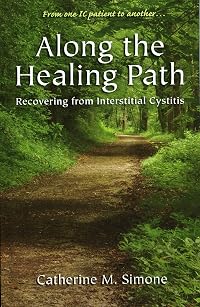
Along the Healing Path : Recovering from Interstitial Cystitis
by Catherine M. Simone
On This Page
Description
Compassionate and insightful, ALONG THE HEALING PATH is a must-read for anyone who suffers or knows someone suffering from IC or a related condition. In this book packed with informative resources, causal explanations and connections, along with treatment ideas and guidance, readers will learn: How to determine their own individual IC (PBS/OB) situation and how to develop a healing plan specific to their personal needs; About cancer, breast implants, histamine intolerance and specific show more nutrient and mineral deficiencies, all of which are never-before-discussed topics in terms of IC; About foods that help heal IC, rather than simply a list of foods to avoid; How cannabis can be used for pain, symptom relief, and healing; How to use various essential oils, herbs, natural supplements, and alternative treatments. show lessTags
Member Reviews
This second of the three books penned by Catherine Simone is another essential addition to the library of I.C. sufferers.
Catherine informs us that I.C. is not just a bladder disease but affects the whole body. I.C. patients have a toxic body. We have to learn how to get rid of the toxins gently and slowly in order not to add to our discomfort.
One of our problems is that very few doctors, if any, understand what I.C. is, and how painful it is. This results in we ourselves having to take complete responsibility for our getting healed from the disease. (Of course, this is really always the case, whatever the nature of our health problems.)
The author points out that a toxic body and colon do not absorb nutrition , presenting further show more problems, and that a toxic body also promotes allergies and sensitivities. We I.C. patients are extremely sensitive. (I can attest to that.)
We need to 1) get out of pain 2) soothe our insides 3) feel our way through our healing 4) identify our allergies and sensitivities 5) identify our sources of toxins and eliminate them as much as possible 6) cleanse gently and slowly and 7) rebuild.
Re 4) she informs us about NAET (Nambudripad Allergy Elimination Technique). This technique uses acupuncture and/or acupressure together with kinesiology to identify and eliminate allergies. NAET practitioners are found in the US and several European countries (and perhaps elsewhere in the world, I don’t know). Check on the net to find a practitioner in your area. Unfortunately, there appear to be none as yet in Denmark, where I live.
Common sources of toxins are mercury amalgam fillings, pharmaceutical medications, cigarette smoke and chemicals, metals and synthetic materials. Not only do your mercury fillings have to be removed in as safe a way as possible, the mercury remaining in your body will subsequently have to be cleansed out too.
Catherine stresses that we all have differing symptoms, being “polluted” in different ways, and therefore need to find our own individual healing path.
Not only doctors but also many alternative practitioners fail to understand I.C. and try to dictate to us what we should do, since they don’t comprehend our extreme sensitivity, both to homeopathic remedies and herbs. I can attest to this also – absolutely. So these practitioners can hurt us too. We need always to trust ourselves first and foremost and be extremely cautious when trying new remedies and following the admonitions of practitioners who think they always know what’s best for us. Just because something is natural doesn’t mean it is safe for us.
This said, the book contains a very useful chapter on herbs. As in Catherine’s other books, the No. 1 recommendation is marshmallow root tea, which soothes and heals all mucous membranes and thus the bladder. There was new information in this book, so now I understand that more is not necessarily better - half a teaspoon is adequate for one cup and you just need to dunk the tea ball containing this amount into the cup of hot water a few times and don’t need to steep it for ten minutes.
Comfrey leaf tea also soothes and heals, and comfrey absorbs toxins from the intestines. Comfrey leaves are anti-inflammatory. Use it a few times a week, The benefits and drawbacks of many other herbs are also described, including raspberry leaf, cat’s claw, catnip, mullein, etc, etc.
There is also an important chapter about other natural products, including vitamins and minerals, lavender, tea tree oil, rose oil, baking soda, MSM, etc. etc.
Catherine talks to us from personal experience of these herbs and natural products and how they affected/alleviated her I.C.
In the final chapter we are given instructions and advice about healing baths. Use a baking soda base of app. ½ to one cup. Add a few drops of tea tree oil and a couple of drops of lavender or rose essential oil, for instance. Put a few pinches of comfrey leaf, sage and perhaps parsley in a tea ball and put it into the water. Parsley helps with bloating and edema.
Catherine provides us with advice on healing baths, skin brushing, rebounding, NAET, etc, etc.
This is a great, invaluable book for I.C. sufferers. The only negative factor for me about the book was the author’s use/non-use of apostrophes, poor spelling and the like, and this of course is of no importance in contrast to the invaluable help given about how to soothe our pain and effect our healing from I.C.
I would strongly advise you to buy this book, too (in addition to her two others), if you are afflicted with the disease. show less
Catherine informs us that I.C. is not just a bladder disease but affects the whole body. I.C. patients have a toxic body. We have to learn how to get rid of the toxins gently and slowly in order not to add to our discomfort.
One of our problems is that very few doctors, if any, understand what I.C. is, and how painful it is. This results in we ourselves having to take complete responsibility for our getting healed from the disease. (Of course, this is really always the case, whatever the nature of our health problems.)
The author points out that a toxic body and colon do not absorb nutrition , presenting further show more problems, and that a toxic body also promotes allergies and sensitivities. We I.C. patients are extremely sensitive. (I can attest to that.)
We need to 1) get out of pain 2) soothe our insides 3) feel our way through our healing 4) identify our allergies and sensitivities 5) identify our sources of toxins and eliminate them as much as possible 6) cleanse gently and slowly and 7) rebuild.
Re 4) she informs us about NAET (Nambudripad Allergy Elimination Technique). This technique uses acupuncture and/or acupressure together with kinesiology to identify and eliminate allergies. NAET practitioners are found in the US and several European countries (and perhaps elsewhere in the world, I don’t know). Check on the net to find a practitioner in your area. Unfortunately, there appear to be none as yet in Denmark, where I live.
Common sources of toxins are mercury amalgam fillings, pharmaceutical medications, cigarette smoke and chemicals, metals and synthetic materials. Not only do your mercury fillings have to be removed in as safe a way as possible, the mercury remaining in your body will subsequently have to be cleansed out too.
Catherine stresses that we all have differing symptoms, being “polluted” in different ways, and therefore need to find our own individual healing path.
Not only doctors but also many alternative practitioners fail to understand I.C. and try to dictate to us what we should do, since they don’t comprehend our extreme sensitivity, both to homeopathic remedies and herbs. I can attest to this also – absolutely. So these practitioners can hurt us too. We need always to trust ourselves first and foremost and be extremely cautious when trying new remedies and following the admonitions of practitioners who think they always know what’s best for us. Just because something is natural doesn’t mean it is safe for us.
This said, the book contains a very useful chapter on herbs. As in Catherine’s other books, the No. 1 recommendation is marshmallow root tea, which soothes and heals all mucous membranes and thus the bladder. There was new information in this book, so now I understand that more is not necessarily better - half a teaspoon is adequate for one cup and you just need to dunk the tea ball containing this amount into the cup of hot water a few times and don’t need to steep it for ten minutes.
Comfrey leaf tea also soothes and heals, and comfrey absorbs toxins from the intestines. Comfrey leaves are anti-inflammatory. Use it a few times a week, The benefits and drawbacks of many other herbs are also described, including raspberry leaf, cat’s claw, catnip, mullein, etc, etc.
There is also an important chapter about other natural products, including vitamins and minerals, lavender, tea tree oil, rose oil, baking soda, MSM, etc. etc.
Catherine talks to us from personal experience of these herbs and natural products and how they affected/alleviated her I.C.
In the final chapter we are given instructions and advice about healing baths. Use a baking soda base of app. ½ to one cup. Add a few drops of tea tree oil and a couple of drops of lavender or rose essential oil, for instance. Put a few pinches of comfrey leaf, sage and perhaps parsley in a tea ball and put it into the water. Parsley helps with bloating and edema.
Catherine provides us with advice on healing baths, skin brushing, rebounding, NAET, etc, etc.
This is a great, invaluable book for I.C. sufferers. The only negative factor for me about the book was the author’s use/non-use of apostrophes, poor spelling and the like, and this of course is of no importance in contrast to the invaluable help given about how to soothe our pain and effect our healing from I.C.
I would strongly advise you to buy this book, too (in addition to her two others), if you are afflicted with the disease. show less
Ratings
Members
- Recently Added By
Author Information
3 Works 19 Members
Classifications
Statistics
- Members
- 9
- Popularity
- 2,311,658
- Reviews
- 1
- Rating
- (4.00)
- Languages
- English
- Media
- Paper, Ebook
- ISBNs
- 3