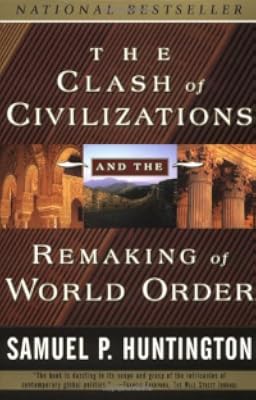
The Clash of Civilizations and the Remaking of World Order
by Samuel P. Huntington
On This Page
Description
In the summer of 1993 Foreign Affairs published an article entitled "The Clash of Civilizations?" by Samuel Huntington. No article, according to the editors of that distinguished journal, has generated more discussion since George Kennan's "X" article on containment in the 1940s. Now, Mr. Huntington expands on his article, explores further the issues he raised then, and develops many new penetrating and controversial analyses. In the article, he posed the question whether conflicts between show more civilizations would dominate the future of world politics. In the book, he gives his answer, showing not only how clashes between civilizations are the greatest threat to world peace but also how an international order based on civilizations is the best safeguard against war. show lessTags
Recommendations








Member Reviews
When Civilizations Clash
This book is as ambitious as its full title--The Clash of Civilizations and the Remaking of the World Order--is long. Published in 1997, its author, Samuel Huntington, lays out what he sees as the new alignment of the world in the wake of the end of the Cold War and the sudden disappearance of the communist block as the arch-foe of the NATO countries and their allies and client states.
The year was probably just enough time after the 50 years of tension to see the inklings of the new alignments coming. That the basic shape of the world today, its political blocks, its new tensions, largely conforms to Huntington's vision, owes a lot to this fact. At the same time, Huntington deserves props for the accuracy of show more his main prediction as well as a few subordinate ones.
I read this book as part of a dive into the (non-fictional) conservative literature corpus and I would put it near the top of what I've read so far in terms of understanding where many (most?) on the US right are coming from.
Culture matters
The foundation of the new international political order rests on the notion that absent any larger concerns groups, up to and including nations, will tend to gather culturally. To be clear, this is an utterly uncontroversial thing to say. No social scientist would disagree with it. There are of course always exceptions, both individuals and countries--it's called a tendency for a reason.
So, while on the one hand, this is obvious to the point of banality, on the other, we often don't accept it. It's probably also fair to say that in the specific context of the immediate post-Cold War world, more than a few people had a lot trouble accepting it and its implications.
Now, just because we acknowledge this outgrowth of our innate tribalism doesn't mean we shouldn't work to bridge these cultural divides. Human cultural differences and tendency to prefer the familiar isn't going anywhere soon, so we should always be aware that this work is difficult and frustrating and no matter how many bridges get built, more will always be needed.
This goes to the heart of a core conservative belief: that there are limitations on what we can achieve socially and we ought to be careful about how and how fast we try to create social change. In the more extreme forms of this we ought not to try at all; further down the scale, you find nationalist notions and, well, you don't need me to finish this extrapolation for you, do you? But regardless of where one sits on this social policy conservatism scale, you get certain corollaries, like suspicion (or stronger dislikes) of authority and big government.
The New Current World Order
Much of the middle part of the book is taken up by laying out the culture-based civilizations to come (as seen from 1997) and looking at the world today, Huntington was downright prescient: Western (Western Europe, the US, Canada, Australia, etc.), Asian (China and most of the far east, but NOT Japan), Islamic (countries that are majority Muslim of course), Latin (the Americas south of the US), and African (sub-Saharan Africa, basically).
One notable division of these civilizations is the presence of a core country, for example the US within Western, China within Asian. Conversely, there's no obvious core country in the Islamic civilization, at least not in the same way that China dominates and can put pressure on other Asian countries. Likewise, Latin America is in a strange situation: the obvious contender is Brazil, but its status is hampered by its linguistic isolation.
Swing States
Wondering about Japan? Well, it and a couple other countries--India and Russia--are single-country civilizations. And they have particular roles to play too. If you follow US elections, think swing states, basically.
After this, Huntington discusses the fault lines and conflicts that he sees arising. Again, there's nothing here that will surprise any observer from 2017, though some missed opportunities might be noted. He stresses the importance of the single-country civilizations for tipping balances of power, and astute 21st century readers will surely have noticed failure of the West and Russia to bridge their differences as a counter to Islam and/or China. (Blame goes on both sides in this, if you ask me, but such a discussion is outside the scope of this review.)
Riding Two Horses
Another thing he addresses are so-called conflicted countries (possibly not the word he used, I'm writing this two books after having read Clash and I'm too lazy to check). These are countries straddling two civilizations.
The best example is Turkey, teetering between the West and Islam. But another is Mexico, semi-Western and part of the NAFTA agreement, but still very Latin too. Huntington does not have much good to say about countries in this position in a world where things are aligned primarily along culture. And looking at the how things are going in Turkey today, it's hard to say he's wrong. In his estimation, the differences between Islamic and Western civilizations are too much to allow Turkey to make the jump (to say nothing of how the EU has been, shall we say, less than enthusiastic about it joining). Mexico, he conjectures, might manage it: Latin America was settled by Europeans too after all, so Mexico (and Latin America in general) should be an easier fit with the West.
Doom and Gloom
The end of the book is largely occupied with more conservative notions about culture and civilization. In particular, dire predictions about the fate of Western civilization and culture should it fail to remain cohesive and fail to keep at least one or two of Russian, India, and Japan as friends against Asia and to a lesser extent, Islam.
He also worries that if too many Latins settle in the US, it could become a conflicted country too.
Finally, there's a full-on doomsday scenario involving North Korea, which, while the details are way off, certainly seems relevant in general today.
Bottom Line
So, overall, I think it's a book worth reading regardless of your politics. Certainly, the basic ideas seem to accurately reflect the world today and as such constitute a useful model for understanding it. Like all models, it has its limitations though. And of course, there's no predicting monkey wrenches: Donald Trump, for example, probably has Huntington rolling over in his grave (and indeed, anyone who accepts Huntington's argument that the West needs to hang together and cultivate swing civilizations like Japan if it wants to preserve its Westernness ought to be alarmed by Trump). Putin too might be considered one, though the West certainly did it's share to agitate Russia over the last 20 years.
At least as important as its value as a way to view the world is the insight I see it giving on conservatism in the United States today. Many of the ideas in it are plain in what conservatives are concerned about and the policies they support. You may think the whole premise is BS but still gain an understanding of conservatives.
Finally, I should add that its well-written and its clear Huntington (a political scientist by education and trade) is well-informed. show less
This book is as ambitious as its full title--The Clash of Civilizations and the Remaking of the World Order--is long. Published in 1997, its author, Samuel Huntington, lays out what he sees as the new alignment of the world in the wake of the end of the Cold War and the sudden disappearance of the communist block as the arch-foe of the NATO countries and their allies and client states.
The year was probably just enough time after the 50 years of tension to see the inklings of the new alignments coming. That the basic shape of the world today, its political blocks, its new tensions, largely conforms to Huntington's vision, owes a lot to this fact. At the same time, Huntington deserves props for the accuracy of show more his main prediction as well as a few subordinate ones.
I read this book as part of a dive into the (non-fictional) conservative literature corpus and I would put it near the top of what I've read so far in terms of understanding where many (most?) on the US right are coming from.
Culture matters
The foundation of the new international political order rests on the notion that absent any larger concerns groups, up to and including nations, will tend to gather culturally. To be clear, this is an utterly uncontroversial thing to say. No social scientist would disagree with it. There are of course always exceptions, both individuals and countries--it's called a tendency for a reason.
So, while on the one hand, this is obvious to the point of banality, on the other, we often don't accept it. It's probably also fair to say that in the specific context of the immediate post-Cold War world, more than a few people had a lot trouble accepting it and its implications.
Now, just because we acknowledge this outgrowth of our innate tribalism doesn't mean we shouldn't work to bridge these cultural divides. Human cultural differences and tendency to prefer the familiar isn't going anywhere soon, so we should always be aware that this work is difficult and frustrating and no matter how many bridges get built, more will always be needed.
This goes to the heart of a core conservative belief: that there are limitations on what we can achieve socially and we ought to be careful about how and how fast we try to create social change. In the more extreme forms of this we ought not to try at all; further down the scale, you find nationalist notions and, well, you don't need me to finish this extrapolation for you, do you? But regardless of where one sits on this social policy conservatism scale, you get certain corollaries, like suspicion (or stronger dislikes) of authority and big government.
The New Current World Order
Much of the middle part of the book is taken up by laying out the culture-based civilizations to come (as seen from 1997) and looking at the world today, Huntington was downright prescient: Western (Western Europe, the US, Canada, Australia, etc.), Asian (China and most of the far east, but NOT Japan), Islamic (countries that are majority Muslim of course), Latin (the Americas south of the US), and African (sub-Saharan Africa, basically).
One notable division of these civilizations is the presence of a core country, for example the US within Western, China within Asian. Conversely, there's no obvious core country in the Islamic civilization, at least not in the same way that China dominates and can put pressure on other Asian countries. Likewise, Latin America is in a strange situation: the obvious contender is Brazil, but its status is hampered by its linguistic isolation.
Swing States
Wondering about Japan? Well, it and a couple other countries--India and Russia--are single-country civilizations. And they have particular roles to play too. If you follow US elections, think swing states, basically.
After this, Huntington discusses the fault lines and conflicts that he sees arising. Again, there's nothing here that will surprise any observer from 2017, though some missed opportunities might be noted. He stresses the importance of the single-country civilizations for tipping balances of power, and astute 21st century readers will surely have noticed failure of the West and Russia to bridge their differences as a counter to Islam and/or China. (Blame goes on both sides in this, if you ask me, but such a discussion is outside the scope of this review.)
Riding Two Horses
Another thing he addresses are so-called conflicted countries (possibly not the word he used, I'm writing this two books after having read Clash and I'm too lazy to check). These are countries straddling two civilizations.
The best example is Turkey, teetering between the West and Islam. But another is Mexico, semi-Western and part of the NAFTA agreement, but still very Latin too. Huntington does not have much good to say about countries in this position in a world where things are aligned primarily along culture. And looking at the how things are going in Turkey today, it's hard to say he's wrong. In his estimation, the differences between Islamic and Western civilizations are too much to allow Turkey to make the jump (to say nothing of how the EU has been, shall we say, less than enthusiastic about it joining). Mexico, he conjectures, might manage it: Latin America was settled by Europeans too after all, so Mexico (and Latin America in general) should be an easier fit with the West.
Doom and Gloom
The end of the book is largely occupied with more conservative notions about culture and civilization. In particular, dire predictions about the fate of Western civilization and culture should it fail to remain cohesive and fail to keep at least one or two of Russian, India, and Japan as friends against Asia and to a lesser extent, Islam.
He also worries that if too many Latins settle in the US, it could become a conflicted country too.
Finally, there's a full-on doomsday scenario involving North Korea, which, while the details are way off, certainly seems relevant in general today.
Bottom Line
So, overall, I think it's a book worth reading regardless of your politics. Certainly, the basic ideas seem to accurately reflect the world today and as such constitute a useful model for understanding it. Like all models, it has its limitations though. And of course, there's no predicting monkey wrenches: Donald Trump, for example, probably has Huntington rolling over in his grave (and indeed, anyone who accepts Huntington's argument that the West needs to hang together and cultivate swing civilizations like Japan if it wants to preserve its Westernness ought to be alarmed by Trump). Putin too might be considered one, though the West certainly did it's share to agitate Russia over the last 20 years.
At least as important as its value as a way to view the world is the insight I see it giving on conservatism in the United States today. Many of the ideas in it are plain in what conservatives are concerned about and the policies they support. You may think the whole premise is BS but still gain an understanding of conservatives.
Finally, I should add that its well-written and its clear Huntington (a political scientist by education and trade) is well-informed. show less
Published in 1996, 'The Clash of Civilizations' is a major book aiming at describing and predicting international relations post-Cold War era. In fact, expanding upon an article bearing the same title and that he wrote for 'Foreign Affairs' back in 1993, Samuel Huntington proposes here a new geopolitical paradigm, so as to understand (or at least try!) the world following the collapse of the Communist model.
'People define themselves in terms of ancestry, religion, language, history, values, customs, and institutions. They identify with cultural groups: tribes, ethnic groups, religious communities, nations, and, at the broadest level, civilizations. People use politics not just to advance their interests but also to define their show more identity.'
To him indeed, the major mistake most analysts committed upon seeing the fall of the Soviet regime was to see, in the triumph of economical liberalism, the triumph, also, of Western values -that is, philosophical liberalism. He warns: if it's tempting to believe that the successful spread of English language or of global capitalism lead to a westernisation of the planet, what define whole groups of individuals, people beyond nations, are not the lingua franca they use, nor the goods they consume, but, something deeper and stronger: their cultural identities, the civilization to which they belong.
Trying to explain what make the essence of a civilisation, showing how elusive is the concept itself (as different civilisations have always been influencing each others, evolved over time, and are each subject to their own dynamism and internal conflicts and divisions) he manages to demonstrate that, nevertheless, they remain powerful factors forging strong identarian entities. In fact, listing eight civilisations as of nowadays (Chinese, Japanese, Hindu, Islamic, Orthodox, Latin American, African, Western), a list which has its own limitations and weaknesses as he, himself, is willing to admit, he affirms that the complex identities they each embody are way too complex to give way to the so-called universalism of western values. In other words: a world modernising itself (capitalism, science and technologies...) is not necessarily a world westernising itself, even if the ideologies which have allowed such modernisation in the first place have their roots in the Western world. He goes even further, by claiming that some civilisations can perfectly accept such modernisation while rejecting the Western model; a model they may deem 'arrogant, materialist, repressive, brutal and decadent', and, so, as a result, offer alternatives by drawing into the traditionalisms of other cultures.
'The West won the world not by the superiority of its ideas or values or religion […] but rather by its superiority in applying organized violence. Westerners often forget this fact; non-Westerners never do.'
In depth, thorough, rich in predictions (some of a baffling accuracy, others far more dubious) and containing detailed analyses of what to expect in a world post-Cold War era, he manages in fact to explain the identarian crises of some countries (e.g. Australia, Russia, Turkey, Mexico...) while foreseeing, in opposition to a Western world he sees getting weaker and more and more isolated, both the economic awakening of Asian countries led by China, and, the growing dangers of a certain Muslim fanaticism.
The topic of Islam is contentious. This is, in fact, where this book becomes highly controversial.
Of course, the author acknowledges that Islamic culture is rich and varied; and that different countries have been attempting to gain an ideological control upon it, with varying degrees of success! His point, though, is that Islam, as a religion, not only remains such a powerful denominator that it can transcends nationalisms, but, also, that it can be abused (for a whole bunch of reasons he actually delves into here) for political gains. Should some of its more radical and violent trends succeed in doing so, we would actually obtain, according to him, nothing less but a whole civilisation at war -a global jihad.
Sure, it would be deeply naïve to ignore here the pattern which has been at play even back in the nineties, when this book was written. Indonesia, Malaysia, Kashmir, Palestine, Sudan, Egypt, Bosnia, Iran... Samuel Huntington has done here more than predicting the upcoming success of the radical Islamists that would hijack some Muslim cultures themselves. He showed, also, how bloody Muslim borders can be, serving ethnic and religious conflicts wherever the 'Islamic civilisation' 'clashes' with a different one. In fact, he simply had a look at the world around him to sustain his claim that future conflicts won't be of an economical order, but civilizational. Was he right?
Well, his thesis was and still is very controversial! Personally, I found the civilizational lines he draws somehow questionable. I also believe, unlike the author, that the conflicts involving Islam are of an ideological order and certainly not of a cultural one. In every case indeed -and they are many, I give him that!- it remains a certain trend of Islam at war against a certain view of the Western world (its values, mainly), certainly not a return to the Crusades! Having said that, Samuel Huntington knows how to argue for a valuable and relevant paradigm, even if it's a paradigm which has to be strongly nuanced on many aspects. If anything, I would encourage anyone interested to read it, not for what it claims, but for what it doesn't. Here's the typical example of a book which, indeed, has been so debated (by many who hadn't read it, clearly) that its core thesis has often been lost, when not plainly caricatured and twisted to the point of ridiculousness! In the end, think what you want of his naïve definition of what constitute a civilisation (an elusive concept, as he admits himself) and/ or reject (as I do) his view that the Islamic world is a unified block at war with others (I won't even touch upon his handling of immigration issues, way too light to be of any relevance) the thing is, he had warned against Interventionism (American especially) as its consequences would be absolutely catastrophic. He had also encouraged the Western world to defend its identity, especially when pitted against other civilisations becoming more dynamic both economically and culturally. Some of its writing were on the wall, after all...
Agree or don't, but here's a thought provoking read. show less
'People define themselves in terms of ancestry, religion, language, history, values, customs, and institutions. They identify with cultural groups: tribes, ethnic groups, religious communities, nations, and, at the broadest level, civilizations. People use politics not just to advance their interests but also to define their show more identity.'
To him indeed, the major mistake most analysts committed upon seeing the fall of the Soviet regime was to see, in the triumph of economical liberalism, the triumph, also, of Western values -that is, philosophical liberalism. He warns: if it's tempting to believe that the successful spread of English language or of global capitalism lead to a westernisation of the planet, what define whole groups of individuals, people beyond nations, are not the lingua franca they use, nor the goods they consume, but, something deeper and stronger: their cultural identities, the civilization to which they belong.
Trying to explain what make the essence of a civilisation, showing how elusive is the concept itself (as different civilisations have always been influencing each others, evolved over time, and are each subject to their own dynamism and internal conflicts and divisions) he manages to demonstrate that, nevertheless, they remain powerful factors forging strong identarian entities. In fact, listing eight civilisations as of nowadays (Chinese, Japanese, Hindu, Islamic, Orthodox, Latin American, African, Western), a list which has its own limitations and weaknesses as he, himself, is willing to admit, he affirms that the complex identities they each embody are way too complex to give way to the so-called universalism of western values. In other words: a world modernising itself (capitalism, science and technologies...) is not necessarily a world westernising itself, even if the ideologies which have allowed such modernisation in the first place have their roots in the Western world. He goes even further, by claiming that some civilisations can perfectly accept such modernisation while rejecting the Western model; a model they may deem 'arrogant, materialist, repressive, brutal and decadent', and, so, as a result, offer alternatives by drawing into the traditionalisms of other cultures.
'The West won the world not by the superiority of its ideas or values or religion […] but rather by its superiority in applying organized violence. Westerners often forget this fact; non-Westerners never do.'
In depth, thorough, rich in predictions (some of a baffling accuracy, others far more dubious) and containing detailed analyses of what to expect in a world post-Cold War era, he manages in fact to explain the identarian crises of some countries (e.g. Australia, Russia, Turkey, Mexico...) while foreseeing, in opposition to a Western world he sees getting weaker and more and more isolated, both the economic awakening of Asian countries led by China, and, the growing dangers of a certain Muslim fanaticism.
The topic of Islam is contentious. This is, in fact, where this book becomes highly controversial.
Of course, the author acknowledges that Islamic culture is rich and varied; and that different countries have been attempting to gain an ideological control upon it, with varying degrees of success! His point, though, is that Islam, as a religion, not only remains such a powerful denominator that it can transcends nationalisms, but, also, that it can be abused (for a whole bunch of reasons he actually delves into here) for political gains. Should some of its more radical and violent trends succeed in doing so, we would actually obtain, according to him, nothing less but a whole civilisation at war -a global jihad.
Sure, it would be deeply naïve to ignore here the pattern which has been at play even back in the nineties, when this book was written. Indonesia, Malaysia, Kashmir, Palestine, Sudan, Egypt, Bosnia, Iran... Samuel Huntington has done here more than predicting the upcoming success of the radical Islamists that would hijack some Muslim cultures themselves. He showed, also, how bloody Muslim borders can be, serving ethnic and religious conflicts wherever the 'Islamic civilisation' 'clashes' with a different one. In fact, he simply had a look at the world around him to sustain his claim that future conflicts won't be of an economical order, but civilizational. Was he right?
Well, his thesis was and still is very controversial! Personally, I found the civilizational lines he draws somehow questionable. I also believe, unlike the author, that the conflicts involving Islam are of an ideological order and certainly not of a cultural one. In every case indeed -and they are many, I give him that!- it remains a certain trend of Islam at war against a certain view of the Western world (its values, mainly), certainly not a return to the Crusades! Having said that, Samuel Huntington knows how to argue for a valuable and relevant paradigm, even if it's a paradigm which has to be strongly nuanced on many aspects. If anything, I would encourage anyone interested to read it, not for what it claims, but for what it doesn't. Here's the typical example of a book which, indeed, has been so debated (by many who hadn't read it, clearly) that its core thesis has often been lost, when not plainly caricatured and twisted to the point of ridiculousness! In the end, think what you want of his naïve definition of what constitute a civilisation (an elusive concept, as he admits himself) and/ or reject (as I do) his view that the Islamic world is a unified block at war with others (I won't even touch upon his handling of immigration issues, way too light to be of any relevance) the thing is, he had warned against Interventionism (American especially) as its consequences would be absolutely catastrophic. He had also encouraged the Western world to defend its identity, especially when pitted against other civilisations becoming more dynamic both economically and culturally. Some of its writing were on the wall, after all...
Agree or don't, but here's a thought provoking read. show less
I'm aware of just how influential this book has been ever since it was published and I'm also aware of the author's tremendous reputation, but I've never been able to come to a decisive opinion on this book. I've always felt conflicted. I didn't like it very much, didn't agree with much, but in retrospect, I think I didn't like it because I DID agree with a great deal, but simply didn't want to admit it. I think Huntington had a better grasp on the coming future than his equally famous colleague, Francis Fukuyama, ever did. Sadly. Recommended as a kind of gruesome look into the future which was all too relevant.
Comprehensive. Yet, the argument that civilizations are the base unit, and that they don't get along or trust each other, is very poorly argued, straw men litter the pages, separated often by strings of non-sequiturs. That being said, the analysis is still often very astute; even if Huntington is wrong, something like his thesis is most probably correct. All in all, worth reading, especially now that China, Russia, and Islam are all on the ascendant. Japan, heh, not so much. There's some pretty good humor to be found in the Japan parts of this book, written when it looked like Japan's strong economy was here to stay.
3 stars on oc
3 stars on oc
20 years on still Huntington’s analysis holds ground of an impending & inevitable clash between Western Judeo-Christian & Islamic civilization along with the rise of Southeast asian powers which has the potential to throw mankind back in cauldrons of chaos .
Huntington's foundational principle that state boundaries do not necessarily matter and people tend to align themselves always along ancient tribal lines of civilization during conflict ; this can be seen in today’s world with the rise of radical fundamentalism in Islam and the states backing it by remaining quiescent not just due to geo-polictical reasons, but rather due to historical ties dating back to 11th century .
I was quite impressed by the overall analysis of the show more political landscape post cold war in particular the prediction of annexation of Crimea & further the exacerbation of Kashmir issue considering this book was published in 1996. show less
Huntington's foundational principle that state boundaries do not necessarily matter and people tend to align themselves always along ancient tribal lines of civilization during conflict ; this can be seen in today’s world with the rise of radical fundamentalism in Islam and the states backing it by remaining quiescent not just due to geo-polictical reasons, but rather due to historical ties dating back to 11th century .
I was quite impressed by the overall analysis of the show more political landscape post cold war in particular the prediction of annexation of Crimea & further the exacerbation of Kashmir issue considering this book was published in 1996. show less
This book made me think. It is interesting that the major part of the text was written in 1996, and seems to be coming to fruition in the last decade (from 2010 and forward based on when I read the book). My big takeaway is the need abolish religions, as they seem to be a root cause of conflict.
Amazing. Thought provoking. Scary.
This detailed, thoroughly researched book gave me quite a lot to think about regarding the dynamics of international relations.
Interestingly - it was written in the mid 90s, BEFORE 9-11 and all of the current economic and political upheaval.
What I took away from this:
-China will be the next dominant superpower
-Islam is going to be a force to be reckoned with -for good or ill -to a degree unsurpassed in history
-US intervention in the Middle East - regardless of the immediate "threat" solved- always winds up as a
bad idea long term
I finished this book a few weeks before the Libya mess started and I have a bad feeling about it. It fits the pattern to a T.
This detailed, thoroughly researched book gave me quite a lot to think about regarding the dynamics of international relations.
Interestingly - it was written in the mid 90s, BEFORE 9-11 and all of the current economic and political upheaval.
What I took away from this:
-China will be the next dominant superpower
-Islam is going to be a force to be reckoned with -for good or ill -to a degree unsurpassed in history
-US intervention in the Middle East - regardless of the immediate "threat" solved- always winds up as a
bad idea long term
I finished this book a few weeks before the Libya mess started and I have a bad feeling about it. It fits the pattern to a T.
Members
- Recently Added By
Lists

Best General History Books
50 works; 22 members

BEST BOOKS TO UNDERSTAND XX CENTURY'S HISTORY
63 works; 3 members

Will Durant's 100 Books: An Update
46 works; 4 members
Non-Fiction Worth Reading
1,016 works; 256 members

Fake Top 100 Nonfiction
79 works; 3 members

Política - Clásicos
164 works; 2 members

The Joe Rogan Experience Library
254 works; 3 members

Shaykh Hamza's Book Recommendations
439 works; 3 members

If Books Could Kill Podcast
52 works; 1 member

My wishlist
85 works; 1 member

Foundational Books in International Relations
13 works; 1 member
Author Information

25+ Works 5,430 Members
Samuel P. Huntington was the Albert J. Weatherhead III University Professor at Harvard University and chairman of the Harvard Academy for International and Area Studies. He was previously director of security planning for the National Security Council in the Carter administration, the founder and coeditor of Foreign Policy, and president of the show more American Political Science Association. Mr. Huntington died in 2008. show less
Some Editions
Awards and Honors
Series
Belongs to Publisher Series
Common Knowledge
- Canonical title*
- Le choc des civilisations
- Original title
- The clash of civilizations and the remaking of world order
- Original publication date
- 1996 (1e édition originale américaine, Simon and Schuster) (1e édition originale américaine, Simon and Schuster); 1997 (1e traduction et édition française, Odile Jacob) (1e traduction et édition française, Odile Jacob); 2000-04-22 (Réédition française, Poche histoire, Odile Jacob) (Réédition française, Poche histoire, Odile Jacob); 2021-05 12 (Réédition française, Odile Jacob) (Réédition française, Odile Jacob)
- Epigraph*
- /
- Dedication*
- À Nancy,
qui a supporté « le choc » en gardant le sourire. - First words
- On January 3, 1992, a meeting of Russian and American scholars took place in the auditorium of a government building in Moscow.
- Quotations
- Again and again both Westerners and non-Westerners point to individualism as the central distinguishing mark of the West.
- Last words
- (Click to show. Warning: May contain spoilers.)In the emerging era, clashes of civilizations are the greatest threat to world peace, and an international order based on civilizations is the surest safeguard against world war.
- Blurbers
- Kissinger, Henry A.; Brzezinski, Zbigniew; Elliott, Michael; Bernstein, Richard; Gungwu, Wang
- Original language
- English
*Some information comes from Common Knowledge in other languages. Click "Edit" for more information.
Classifications
Statistics
- Members
- 3,772
- Popularity
- 4,245
- Reviews
- 38
- Rating
- (3.56)
- Languages
- 20 — Arabic, Chinese, Czech, Danish, Dutch, English, Estonian, Finnish, French, German, Hungarian, Italian, Japanese, Polish, Portuguese, Serbian, Slovenian, Spanish, Swedish, Turkish
- Media
- Paper, Audiobook, Ebook
- ISBNs
- 89
- ASINs
- 25