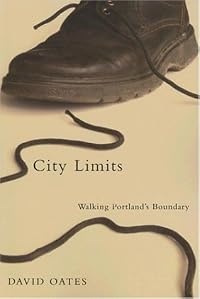
City Limits: Walking Portland's Boundary
by David Oates
On This Page
Description
"Portland's Urban Growth Boundary (UGB) was designed to hold the bursting metropolitan area in check while protecting Willamette Valley orchards and fields from sprawling suburbia. David Oates traveled the 260-mile boundary that defines Portland to discover how the UGB has contributed to that success. City Limits is his record of the journey." "From conversations with the people he encounters on his walks, Oates comes to view the UGB as a long-running experiment in community control over show more development. But in recent years, the growth boundary has come under fire from developers, property rights advocates, and other critics. Just after Oates completed his walks, a statewide vote gutted Oregon's land use laws." "Oates explores issues of conformity and conflict on the UGB in the company of various individuals he sometimes invites along for the day's walk - artists, writers, urban planners, environmentalists, developers, a politician, a wine grape grower. Reflecting Oates's belief in the power of community and collaboration, many of their thoughts and writings about the experience are included in the book."--Jacket show lessTags
Recommendations






Member Reviews
There is a line around the Portland metropolitan area called the Urban Growth Boundary – a controversial land use tool designed to control sprawl and protect Oregon’s farmland and scenic beauty. It’s one of those things that sounds like a terrific -- if somewhat utopian -- idea but that gets messy in practice.
Inner city yuppies, me included, tend to like the idea of the UGB because we can live in old, established neighborhoods with tree-lines sidewalks, but drive to a vineyard tasting room in 30 minutes. For families looking for an affordable house in the exurbs, or the grandchildren of farmers unable to subdivide just because they are on the other side of the line from a new strip mall, the UGB can seem like an arbitrary, show more unfettered exercise of government interference.
In City Limits: Walking Portland's Boundary, David Oates explores the UGB line – physically and metaphorically. He spent two years walking and kayaking around the entire boundary and writing essays inspired by his explorations. He also includes essays by some of the people he invited on his journeys, and dialogs with a few of his favorite dead environmentalists, such as John Muir.
Oates is definitely in the pro-UGB camp, sometimes waxing rhapsodic about the glories of centralized urban planning. But he shows a libertarian streak that chaffs at capricious and heavy-handed government action. While he bemoans -- with the drama of Chicken Little -- voters’ attempts to dismantle the current land use system, he acknowledges that a “system which seems immune to logic, above explanation, and insulated from individual citizens’ rights, complaints, and questions” will inspire revolt. If not evenly balanced, City Limits at least recognizes that there are two sides to the debate.
The book is best when Oates writes about what he sees and the people he meets while walking the boundary. He has a lyrical style that brings life to his subject, especially his musings on how people chose to live together. His poetic imagery occasionally overwhelms his ideas, and his imagined dialog with Italo Calvino is downright mystifying, but overall, reading his essays is like walking and talking with a thoughtful friend.
Also posted on Rose City Reader. show less
Inner city yuppies, me included, tend to like the idea of the UGB because we can live in old, established neighborhoods with tree-lines sidewalks, but drive to a vineyard tasting room in 30 minutes. For families looking for an affordable house in the exurbs, or the grandchildren of farmers unable to subdivide just because they are on the other side of the line from a new strip mall, the UGB can seem like an arbitrary, show more unfettered exercise of government interference.
In City Limits: Walking Portland's Boundary, David Oates explores the UGB line – physically and metaphorically. He spent two years walking and kayaking around the entire boundary and writing essays inspired by his explorations. He also includes essays by some of the people he invited on his journeys, and dialogs with a few of his favorite dead environmentalists, such as John Muir.
Oates is definitely in the pro-UGB camp, sometimes waxing rhapsodic about the glories of centralized urban planning. But he shows a libertarian streak that chaffs at capricious and heavy-handed government action. While he bemoans -- with the drama of Chicken Little -- voters’ attempts to dismantle the current land use system, he acknowledges that a “system which seems immune to logic, above explanation, and insulated from individual citizens’ rights, complaints, and questions” will inspire revolt. If not evenly balanced, City Limits at least recognizes that there are two sides to the debate.
The book is best when Oates writes about what he sees and the people he meets while walking the boundary. He has a lyrical style that brings life to his subject, especially his musings on how people chose to live together. His poetic imagery occasionally overwhelms his ideas, and his imagined dialog with Italo Calvino is downright mystifying, but overall, reading his essays is like walking and talking with a thoughtful friend.
Also posted on Rose City Reader. show less
Ratings
Members
- Recently Added By
Author Information
24+ Works 141 Members
Common Knowledge
- Important places
- Portland, Oregon, USA
Classifications
- Genres
- Nonfiction, General Nonfiction, History
- DDC/MDS
- 307.1 — Society, Government, and Culture Social sciences, sociology & anthropology Communities Planning & Development
- LCC
- HT168 .P67 .O37 — Social sciences Communities. Classes. Races Communities. Classes. Races Urban groups. The city. Urban sociology City planning
- BISAC
Statistics
- Members
- 20
- Popularity
- 1,277,024
- Reviews
- 1
- Rating
- (3.33)
- Languages
- English
- Media
- Paper
- ISBNs
- 1