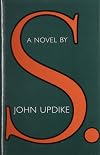
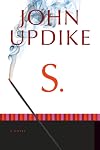
S
by John Updike
On This Page
Description
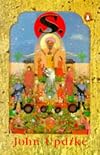
S. is the story of Sarah P. Worth, a thoroughly modern spiritual seeker who has become enamored of a Hindu mystic called the Arhat. A native New Englander, she goes west to join his ashram in Arizona, and there struggles alongside fellow sannyasins (pilgrims) in the difficult attempt to subdue ego and achieve moksha (salvation, release from illusion). “S.” details her adventures in letters and tapes dispatched to her husband, her daughter, her brother, her dentist, her hairdresser, and show more her psychiatrist—messages cleverly designed to keep her old world in order while she is creating for herself a new one. This is Hester Prynne’s side of the triangle described by Hawthorne’s Scarlet Letter; it is also a burlesque of the quest for enlightenment, and an affectionate meditation on American womanhood. show lessTags
Recommendations






















Member Reviews
Updike has a gift for the ingenious simile and evocative description, but no sense of proportion or tact. His overfurnished paragraphs are filled with freckles like pencil shavings and "esses" like a just-extinguished match and strings of raindrops played by the wind like fingers on a harp until you're visualizing a harpist stubbing out a match on a newly-sharpened pencil but not the scene he is actually describing. Or you lose the train of a conversation as he pauses to describe the boar's head on a bottle of Gordon's gin & the rind on the Gouda cheese or to note that the dish rack from which an inconsequential dish is taken is made of rubber-coated wire. Sometimes the detail arguably reveals character or setting or comments on show more overconsumption or whatever, but frankly most of the time it seems superfluous & indulgent: Updike is just offering endless description because that is the only thing he can do better than anybody else.
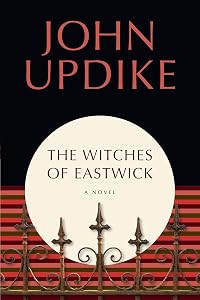
Aside from the allurements (such as they are) of Updike's style, this novel feels rather miscellaneous, a loose assortment of descriptions of the weather, exposition-heavy telephone conversations, lore about witchcraft (I wanted more of this), Pynchonesque talk about the second law of thermodynamics, middle-aged group sex, Hawthornesque character names (Arthur Hallybread, etc.), and some fairly effective magical-realist set-pieces. There's plenty to sink your teeth into, but the whole is less than the sum of the parts. While Updike brings in the historical notion of the "witch" as an invention of patriarchy, its persecuted other (the midwife, etc.) it is unclear how this is supposed to connect to these witches, who do, in fact, practice real magic, and use it mainly to hurt other women. And Darryl Van Horne's disquisitions on pop art, alternative energy, the second law of thermodynamics, and parasitic worms don't seem, in the end, fully germane, any more than the pedestrian musicological analysis of Bach's second cello suite that grinds the novel to a halt about thirty pages from the end.
Symptomatic of the disconnectedness of the novel is the narrative voice, which drifts between Faulknerian collective narration (the "we" of Eastwick) and conventional third-person omniscience.
In the end we're left with the descriptive passages, which can be comically overdone but can also be striking. A minor novelist with a major style, as Bloom (rightly, for once) opined. show less
Aside from the allurements (such as they are) of Updike's style, this novel feels rather miscellaneous, a loose assortment of descriptions of the weather, exposition-heavy telephone conversations, lore about witchcraft (I wanted more of this), Pynchonesque talk about the second law of thermodynamics, middle-aged group sex, Hawthornesque character names (Arthur Hallybread, etc.), and some fairly effective magical-realist set-pieces. There's plenty to sink your teeth into, but the whole is less than the sum of the parts. While Updike brings in the historical notion of the "witch" as an invention of patriarchy, its persecuted other (the midwife, etc.) it is unclear how this is supposed to connect to these witches, who do, in fact, practice real magic, and use it mainly to hurt other women. And Darryl Van Horne's disquisitions on pop art, alternative energy, the second law of thermodynamics, and parasitic worms don't seem, in the end, fully germane, any more than the pedestrian musicological analysis of Bach's second cello suite that grinds the novel to a halt about thirty pages from the end.
Symptomatic of the disconnectedness of the novel is the narrative voice, which drifts between Faulknerian collective narration (the "we" of Eastwick) and conventional third-person omniscience.
In the end we're left with the descriptive passages, which can be comically overdone but can also be striking. A minor novelist with a major style, as Bloom (rightly, for once) opined. show less
I can admire what Updike did here, and I enjoyed the epistolary format (which really made the book, in my opinion), but I can't say that I felt this stood up to Updike's other works--or, those that I've read, anyway. It felt a little bit like a literary experiment, more than a book I could really engage with and enjoy, and it quickly became fairly predictable. I suppose it's something I might recommend to English majors and writers thinking to experiment in this territory, but otherwise, it's probably not something I'd recommend. It is what it is, and it's well done and beautifully written, but it's likely one I'll remember for the wrong reasons (in my opinion).
Odd book, and so much Buddhist words that I skipped some paragraphs. But liked it. Updike is funny and I think the Wasp-Jew theme, men women, well done. Curious about how Updike saw the world, and how waspishness was part of him.
Susan is a North Shore matron who leaves her cheating, surgeon, husband to join an Ashram in Arizona after studying Buddhism with some friends. She tells her story via letters sent to her husband, daughter, best friends, mother, brother, etc. At first Susan finds peace at the ashram until she discovers her yogi for the sham that he is. An often funny story which was a bit long.
A doctor's wife from the northshore goes to an ashram in Arizona to find enlightenment and finds all the usual problems that humans have, but does manage to throw off many of the deceptions of a more conventional life. Lots of fun satire.
Reading this book twenty-five years after its publication was a real pleasure. Mr. Updike captured the fun, sweet decade of the eighties. The novel is a great recap of the eighties and a primer on at least one version of commercial Buddhism - Oh, and irony - lots of delicious irony. The issues raised are somewhat dated, but if you were around in the eighties, the situations will be familiar.
S. is a novel which uses the letters and tapes of a middle-aged WASP woman to chronicle her time in a Rajneesh-style Arizona ashram. While I was intrigued by the concept, I had mixed feelings about the work. The epistolary structure offered an unusually intimate view into the main character’s world, but because S. was not a woman I found very sympathetic, her monologues didn’t speak to me personally.
This book is supposedly a satire, and I will agree that it is entertaining on that level. But I do think Updike crosses the line from satire to cynicism in a number of places. Still, it’s an interesting read.
This book is supposedly a satire, and I will agree that it is entertaining on that level. But I do think Updike crosses the line from satire to cynicism in a number of places. Still, it’s an interesting read.
Members
- Recently Added By
Lists

One Letter Titles
31 works; 4 members
Author Information

343+ Works 53,899 Members
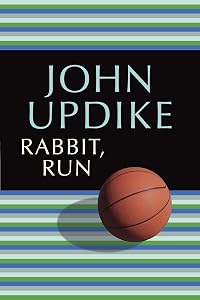
American novelist, poet, and critic John Updike was born in Reading, Pennsylvania on March 18, 1932. He received an A.B. degree from Harvard University, which he attended on a scholarship, in 1954. After graduation, he accepted a one-year fellowship to study painting at the Ruskin School of Drawing and Fine Art in Oxford, England. After returning show more from England in 1955, he worked for two years on the staff of The New Yorker. This marked the beginning of a long relationship with the magazine, during which he has contributed numerous short stories, poems, and book reviews. Although Updike's first published book was a collection of verse, The Carpentered Hen and Other Tame Creatures (1958), his renown as a writer is based on his fiction, beginning with The Poorhouse Fair (1959). During his lifetime, he wrote more than 50 books and primarily focused on middle-class America and their major concerns---marriage, divorce, religion, materialism, and sex. Among his best-known works are the Rabbit tetrology---Rabbit, Run (1960), Rabbit Redux (1971), Rabbit Is Rich (1981), and Rabbit at Rest (1988). Rabbit, Run introduces Harry "Rabbit" Angstrom as a 26-year-old salesman of dime-store gadgets trapped in an unhappy marriage in a dismal Pennsylvania town, looking back wistfully on his days as a high school basketball star. Rabbit Redux takes up the story 10 years later, and Rabbit's relationship with representative figures of the 1960s enables Updike to provide social commentary in a story marked by mellow wisdom and compassion in spite of some shocking jolts. In Rabbit Is Rich, Harry is comfortably middle-aged and complacent, and much of the book seems to satirize the country-club set and the swinging sexual/social life of Rabbit and his friends. Finally, in Rabbit at Rest, Harry arrives at the age where he must confront his mortality. Updike won the Pulitzer Prize for both Rabbit Is Rich and Rabbit at Rest. Updike's other novels range widely in subject and locale, from The Poorhouse Fair, about a home for the aged that seems to be a microcosm for society as a whole, through The Court (1978), about a revolution in Africa, to The Witches of Eastwick (1984), in which Updike tries to write from inside the sensibilities of three witches in contemporary New England. The Centaur (1963) is a subtle, complicated allegorical novel that won Updike the National Book Award in 1964. In addition to his novels, Updike also has written short stories, poems, critical essays, and reviews. Self-Consciousness (1989) is a memoir of his early life, his thoughts on issues such as the Vietnam War, and his attitude toward religion. He was elected to the American Academy of Arts and Letters in 1977. He died of lung cancer on January 27, 2009 at the age of 76. (Bowker Author Biography) John Updike was born in 1932, in Shillington, Pennsylvania. Since 1957 he has lived in Massachusetts. His novels have won the Pulitzer Prize, the National Book Award, the National Book Critics Circle Award, & the Howells Medal. (Publisher Provided) John Updike was born in 1932 and attended Harvard College and the Ruskin School of Drawing and Fine Art in Oxford, England. Form 1955 to 1957 he was a staff member of The New Yorker, which he contributed numerous writings. Updike's art criticism has appeared in publications including Arts and Antiques, The New Republic, The New York Times Book Review, and Realites, among many others. He is the author of such best-selling novels as Rabbit Run and Rabbit is Rich. His many works of fiction, poetry and criticism have been awarded the Pulitzer Prize, the National Book Award, the American Book Award, and the National Book Critics Circle Award. For the past 40 years he has lived in Massachusetts. (Publisher Provided) John Updike is the author of some 50 books, including collections of short stories, poems, & criticism. His novels have won the Pulitzer Prize, the National Book Award, the National Book Critics Circle Award, & the Howells Medal. Born in Shillington, Pennsylvania, in 1932, he has lived in Massachusetts since 1957. (Publisher Provided) show less
Awards and Honors
Distinctions
Series
Belongs to Publisher Series
Common Knowledge
- Canonical title*
- S
- Original title
- S
- Original publication date
- 1988
- People/Characters
- Sarah "Sally" Worth
- Epigraph
- She had dark and abundant hair, so glossy that it threw off the sunshine with a gleam, and a face which, besides being beautiful from regularity of feature and richness of complexion, had the impressiveness belonging to a mar... (show all)ked brow and deep black eyes. She was lady-like, too, after the manner of the feminine gentility of those days; characterized by a certain state and dignity, rather than by the delicate, evanescent, and indescribable grace, which is now recognized as its indication. And never had Hester Prynne appeared more lady-like, in the antique interpretation of the term, than as she issued from the prison. Those who had before known her, and had expected to behold her dimmed and obscured by a disastrous cloud, were astonished, and even startled, to perceive how her beauty shone out, and made a halo of the misfortune and ignominy in which she was enveloped.
* * *
Much of the marble coldness of Hester's impression was to be attributed to the circumstance that her life had turned, in a great measure, from passion and feeling, to thought. Standing alone in the world,—alone, as to any dependence on society, and with little Pearl to be guided and protected,—alone, and hopeless of retrieving her position, even had she not scorned to consider it desirable,—she cast away the fragments of a broken chain. The world's law was no law for her mind.
—Nathaniel Hawthorne, The Scarlet Letter. - First words
- &nb... (show all)sp; April 21
Dearest Charles—
The distance between us grows, even as my pen hesitates. - Last words
- (Click to show. Warning: May contain spoilers.)Where I am now, the winter days are about the length of spring days in New England, and for that first half-hour of the dark as I sit reading zoology or cosmology or just staring into space I catch myself listening for the grinding sound of the garage door sliding up, in obedience to its own inner eye.
Ever,
S. - Publisher's editor
- Jones, Judith
- Disambiguation notice
- Should not be confused or merged with [http://www.librarything.com/work/1424...] by Doug Dorst.
*Some information comes from Common Knowledge in other languages. Click "Edit" for more information.
Classifications
Statistics
- Members
- 956
- Popularity
- 27,869
- Reviews
- 12
- Rating
- (3.38)
- Languages
- 12 — Chinese, Danish, Dutch, English, French, German, Hungarian, Italian, Russian, Spanish, Swedish, Turkish
- Media
- Paper, Audiobook, Ebook
- ISBNs
- 26
- ASINs
- 9