The Book of Skaith
by Leigh Brackett
The Book of Skaith (Collections and Selections — Omnibus 1-3), Eric John Stark (Collections and Selections — 3-5)
On This Page
Tags
Recommendations












Member Reviews
Leigh Brackett's golden age planetary romances are some of the most enjoyable science fiction adventure stories ever written. In the later Skaith trilogy, here bound as a single volume, she revived her character Eric John Stark, a "mercenary specializing in the small wars of remote peoples fighting for survival against stronger opponents" (466). The original stories had Stark, "an Earthman out of Mercury," on Brackett's Barsoom-like Mars, but here he is set in the expanded context of a Galactic Union, and the three books detail his exploits on the planet Skaith, which lies outside the Union. Readers who enjoyed the earlier stories are pretty much conscripted by the author into whatever retconning will make Skaith follow Mars.
Skaith is a show more largely exhausted planet under a declining star, and the story here thus partakes of the atmosphere and contents of the "Dying Earth" subgenre, without actually being set on Earth. The human natives of Skaith have thrown off mutated branches to cope with the changes to their world, but they never achieved space travel, and are still mostly isolated from the interstellar comity. The senescent cultures of Skaith include human sacrifice, cannibalism, suicide cults, and other sanctioned depravities, but the largest political and economic organization consists of the government of Wandsmen, administrators under the semi-mythical Lords Protector, who use mercenary troops to maintain order in the cities of the planet's fertile belt, while organizing subsistence for the great masses of "Farers" -- hippy vagrants who form destructive mobs at the behest of the Wandsmen.
The positing of the Wandsmen and Farers as the villains in this tale seems to insert something like an Objectivist right-wing political morality into the narrative, but the heroes from the Galactic Union have a left-heroic ambience: the guerilla revolutionary Stark, and his mentor the technocratic diplomat Ashton. The culpability of the Lords Protector consists of their narrow vision and refusal to allow the possibility of outside assistance to undermine their inherited power.
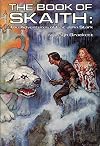
The book club edition I read was cheaply made, and otherwise offered the following features of note: Each of the three component books begins with a beautiful little map of the portion of Skaith in which most of its action takes place. The artist for these is uncredited. The dust jacket art by Don Maitz is not so commendable. It depicts what was intended to be a terrifying Northhound as an outsized puppy with bared teeth, and makes the black Stark look like a tanned white man. (To be fair, he's downright pale in most of the paperback cover art for the books.) The imperturable seeress Gerrith -- who wasn't present for that scene in the book -- is shown as a frightened girl. There is also a "Guide to Characters and Locale" as an appendix, which seems quite superfluous, and has the tone of notes made by Brackett in her original drafting of the story. It might have been useful as an appendix to the second or third book if read separately from the first.
Reading The Ginger Star, The Hounds of Skaith and The Reavers of Skaith in a single go is certainly the way to enjoy them. Each of the first two arrives at a point of dramatic resolution, but with nothing like an overall success or failure of Stark's mission on Skaith. They read quickly: Brackett is an efficient and effective storyteller. But the mood of decline pervades them, whether rooted in the mid-1970s atmosphere of the US (palpable in some instances), the fact that Brackett's brilliant pulp efforts were long behind her, or simply the chosen scenario of a planet circling closer to its demise. They don't quite measure up to her earlier Martian and Venusian yarns. Still, an imaginative reader can relish many of the characters, scenes, and episodes offered here. show less
Skaith is a show more largely exhausted planet under a declining star, and the story here thus partakes of the atmosphere and contents of the "Dying Earth" subgenre, without actually being set on Earth. The human natives of Skaith have thrown off mutated branches to cope with the changes to their world, but they never achieved space travel, and are still mostly isolated from the interstellar comity. The senescent cultures of Skaith include human sacrifice, cannibalism, suicide cults, and other sanctioned depravities, but the largest political and economic organization consists of the government of Wandsmen, administrators under the semi-mythical Lords Protector, who use mercenary troops to maintain order in the cities of the planet's fertile belt, while organizing subsistence for the great masses of "Farers" -- hippy vagrants who form destructive mobs at the behest of the Wandsmen.
The positing of the Wandsmen and Farers as the villains in this tale seems to insert something like an Objectivist right-wing political morality into the narrative, but the heroes from the Galactic Union have a left-heroic ambience: the guerilla revolutionary Stark, and his mentor the technocratic diplomat Ashton. The culpability of the Lords Protector consists of their narrow vision and refusal to allow the possibility of outside assistance to undermine their inherited power.
The book club edition I read was cheaply made, and otherwise offered the following features of note: Each of the three component books begins with a beautiful little map of the portion of Skaith in which most of its action takes place. The artist for these is uncredited. The dust jacket art by Don Maitz is not so commendable. It depicts what was intended to be a terrifying Northhound as an outsized puppy with bared teeth, and makes the black Stark look like a tanned white man. (To be fair, he's downright pale in most of the paperback cover art for the books.) The imperturable seeress Gerrith -- who wasn't present for that scene in the book -- is shown as a frightened girl. There is also a "Guide to Characters and Locale" as an appendix, which seems quite superfluous, and has the tone of notes made by Brackett in her original drafting of the story. It might have been useful as an appendix to the second or third book if read separately from the first.
Reading The Ginger Star, The Hounds of Skaith and The Reavers of Skaith in a single go is certainly the way to enjoy them. Each of the first two arrives at a point of dramatic resolution, but with nothing like an overall success or failure of Stark's mission on Skaith. They read quickly: Brackett is an efficient and effective storyteller. But the mood of decline pervades them, whether rooted in the mid-1970s atmosphere of the US (palpable in some instances), the fact that Brackett's brilliant pulp efforts were long behind her, or simply the chosen scenario of a planet circling closer to its demise. They don't quite measure up to her earlier Martian and Venusian yarns. Still, an imaginative reader can relish many of the characters, scenes, and episodes offered here. show less
Shamefully obscure and infinitely worth reading. A lost-colony story by the author of _The Empire Strikes Back_ -- and of quality about equal to TESB.
Has its flaws, sometimes quite visible ones (Stark is approximately the *only* person who would have any chance whatsoever of doing some of the things he does), but well worth reading nonetheless. The characters are a long way from contrived; would be 5 star if only I could say the same about certain moments of the plot...
Has its flaws, sometimes quite visible ones (Stark is approximately the *only* person who would have any chance whatsoever of doing some of the things he does), but well worth reading nonetheless. The characters are a long way from contrived; would be 5 star if only I could say the same about certain moments of the plot...
I can't really decide whether I disliked the book or not. It's pulp fiction in the extreme...sort of a Tarzan meets John Carter type of thing. I'll give it the benefit of the doubt on a neutral 2 stars.
Ratings
Members
- Recently Added By
Lists

Sword & Planet / Futuristic Fantasy
16 works; 4 members
Author Information

172+ Works 7,128 Members
Series

The Book of Skaith
3 works (Collections and Selections — Omnibus 1-3)

Eric John Stark
8 works (Collections and Selections — 3-5)
Belongs to Publisher Series
Science Fiction Book Club (3047)
Work Relationships
Common Knowledge
- Canonical title
- The Book of Skaith
- Original title
- The Ginger Star; The Hounds of Skaith; The Reavers of Skaith
- Original publication date
- 1976
- People/Characters
- Eric John Stark; N'Chaka; Man-Without-A-Tribe; Simon Ashton; Yarrod; Gerrith (show all 29); Halk; Breca; Alderyk; Klatlekt; Sabak; Tuchvar; Baya; Ferdias; Gelmar; Pedrallon; Kell A Marg; Hargoth; Sanghalain; Morn; Kazimni; Penkawr-Che; Norverann; Delbane; Darik; Astrane; Aud; Gengan; Old Sun
- Important places
- Skaith (fictional planet)
- Important events
- Search for Foster Father Ashton
- First words
- The Ginger Star:
Stark got his final view of Pax from the tender, going out to the spaceport moon, and that was the best view he had had of it. - Last words
- (Click to show. Warning: May contain spoilers.)The Reavers of Skaith:
Old Sun watched it wiht a dull, uncomprehending eye until it disappeared.
Classifications
Statistics
- Members
- 167
- Popularity
- 196,877
- Reviews
- 3
- Rating
- (3.92)
- Languages
- English
- Media
- Paper, Ebook
- ISBNs
- 1
- ASINs
- 9