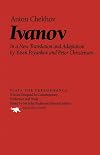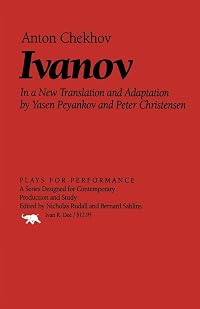
Ivanov
by Anton Chekhov
On This Page
Description
Mortido begins with a Mexican fable about death and ends in the Western suburbs. In between it takes in the public housing on Belvoir Street, Krispy Kreme doughnuts, quinoa, Nazi Germany, Qantas, Coca-Cola, a seventh birthday party, the Surry HiTags
Recommendations



























Member Reviews
My ears were ringing after finishing this play, because it felt like everyone was yelling all the time. Ivanov, the title character, is a disillusioned, burned-out 35-year-old who no longer loves his wife but can’t actually tell her himself because that would be too easy. He has an affair with a younger woman and everyone thinks he’s after her for the money, so there’s a lot of shouting about that. The estate he lives on isn’t making much money and his loans are being called in, so there’s a lot of angsting about that. I’m around Ivanov’s age and can definitely relate to feeling like a failure after acquiring a lot of responsibilities that you can’t keep up with, but I couldn’t condone his keeping his wife in the dark, show more nor the fact that he and others hid from her that she was dying of tuberculosis. show less
'Ivanov' (1887) was Anton Chekhov's first play, tested (and a failure) in Moscow but revised and a triumph in St. Petersburg. It is an accomplished work albeit with flaws that relate more to theatrical taste in nineteenth century Europe than inexperience.
Where it scores is as a depiction of black depression in a man who once appeared to have everything but whose world is falling apart because he has lost his ability to cope. Nicolai Ivanov becomes withdrawn and cold and this leads to social misinterpretation of his precise motives.
What seems to be a nervous breakdown can be matched equally to a strategy of callous seduction and material greed. Chekhov allows us to believe that such a strategy could explain a lot until we see Ivanov show more speak for himself. Ambiguity allows us to see and even share in how society might view him.
The flaws are simply those of offering stereotypical personae, a rather ridiculous view of female passion and a highly melodramatic ending. Almost parodying the author before there are works to parody, yes, a gun appears in the first act.
These are flaws of audience expectation as nineteenth century theatre transitioned from broader entertainment to a more artistic modernism that was shifting from plot to character. Chekhov overcomes these by making his stereotypes into human beings and through Ivanov himself.
Ivanov does not easily attract our sympathy. He is mentally ill but his mental illness damages everyone around him. His self awareness knows he is doing this damage but he can do no other. The final solution to the story may not be to our taste but it is socially conclusive.
This aspect of the tension between society and individual is very much part of the new modernist mind-set. The social here is the sort of small-time rural gentle one that might have driven anyone with something more to them mad but there is no or little malice in these people.
Perhaps the eventual success in St. Petersburg partly owed itself to a sophisticated urban audience appreciating that Ivanov might be them if they were trapped in the country amongst peasants, shortages of money (a constant theme), rural management and small circles of people.
It is never crudely stated that Ivanov has lost his mojo because he has moved from university and urban life to the country and allowed his finances to decay to the point where his life is just one perpetual turning over of debt but it is a suspicion. Many middle class Russians would fear such a fate.
In the tension between society (small time though it is) and the individual, it is in fact society that constantly tries to do the best for Ivanov even if it cannot understand him. It is Ivanov who destroys Ivanov. The destruction comes from something deep within him that he cannot exorcise.
The play is inconclusive in that way that life is. There are no social services or internet. People cling together according to social conventions that are best not investigated too closely. There are certainly norms which it is best not to be too rigid or priggish about - Eugene Lvov, the doctor, is a prig.
Indeed, if the issue at hand is 'what is best for everyone', maybe Ivanov's eventual solution is the best although not desired by anyone. Lvov represents the destructive capacity of the excessively honest man of high principle. Society functions best outside both solipsism and moral posturing.
Is it a humane play? Actually it is not. It is a play about humanity which is a very different thing. It seems to be not only about a man at the end of his tether but about how society muddles along trying to cope with the outlier and the intellectual. In the end, the latter are surplus to requirements. show less
Where it scores is as a depiction of black depression in a man who once appeared to have everything but whose world is falling apart because he has lost his ability to cope. Nicolai Ivanov becomes withdrawn and cold and this leads to social misinterpretation of his precise motives.
What seems to be a nervous breakdown can be matched equally to a strategy of callous seduction and material greed. Chekhov allows us to believe that such a strategy could explain a lot until we see Ivanov show more speak for himself. Ambiguity allows us to see and even share in how society might view him.
The flaws are simply those of offering stereotypical personae, a rather ridiculous view of female passion and a highly melodramatic ending. Almost parodying the author before there are works to parody, yes, a gun appears in the first act.
These are flaws of audience expectation as nineteenth century theatre transitioned from broader entertainment to a more artistic modernism that was shifting from plot to character. Chekhov overcomes these by making his stereotypes into human beings and through Ivanov himself.
Ivanov does not easily attract our sympathy. He is mentally ill but his mental illness damages everyone around him. His self awareness knows he is doing this damage but he can do no other. The final solution to the story may not be to our taste but it is socially conclusive.
This aspect of the tension between society and individual is very much part of the new modernist mind-set. The social here is the sort of small-time rural gentle one that might have driven anyone with something more to them mad but there is no or little malice in these people.
Perhaps the eventual success in St. Petersburg partly owed itself to a sophisticated urban audience appreciating that Ivanov might be them if they were trapped in the country amongst peasants, shortages of money (a constant theme), rural management and small circles of people.
It is never crudely stated that Ivanov has lost his mojo because he has moved from university and urban life to the country and allowed his finances to decay to the point where his life is just one perpetual turning over of debt but it is a suspicion. Many middle class Russians would fear such a fate.
In the tension between society (small time though it is) and the individual, it is in fact society that constantly tries to do the best for Ivanov even if it cannot understand him. It is Ivanov who destroys Ivanov. The destruction comes from something deep within him that he cannot exorcise.
The play is inconclusive in that way that life is. There are no social services or internet. People cling together according to social conventions that are best not investigated too closely. There are certainly norms which it is best not to be too rigid or priggish about - Eugene Lvov, the doctor, is a prig.
Indeed, if the issue at hand is 'what is best for everyone', maybe Ivanov's eventual solution is the best although not desired by anyone. Lvov represents the destructive capacity of the excessively honest man of high principle. Society functions best outside both solipsism and moral posturing.
Is it a humane play? Actually it is not. It is a play about humanity which is a very different thing. It seems to be not only about a man at the end of his tether but about how society muddles along trying to cope with the outlier and the intellectual. In the end, the latter are surplus to requirements. show less
A convoluted morality play in which the main character spends all of his time either complaining how sad he is or arguing about how bad of a person he either is or isn't. There is some excellent writing in here, of course, but I didn't find the play overly compelling or even convincingly philosophical, just a bunch of people alternately gossiping and complaining, so much so that it was a relief when Chekhov's Gun finally came full circle. I'm sure others will argue the play's superiority, and it's possible they are right, but it just didn't appeal to me.
National Theatre (Young Chekhov Season) : Astoundingly good, I wasn't familiar with the play before viewing but it has that perfect mix of tragedy and comedy that the best Chekhov has - assuming it's not just the adaptation, it's interesting reading the reviews here of readers who don't see any comedy in the play. Saying that though, was mulling over lots on the way out and throughout, definitely aiming to see the other 2 plays as part of the season.
It can be easy to get frustrated with the characters in this play, but it's interesting to sit down and analyze them.
Good. In keeping with his other plays. Do not read this if you want something light and fun - it is neither.
Treading a fine line between broad comedy and tragic melodrama, Ivanov is the most accessible of Chekhov's plays. Written when Chekhov was only twenty-seven, Ivanov is a dazzling portrait of a man too intelligent and too bored to endure his provincial life. The brilliant, restless Nikolai Ivanov is plagued with guilt and frustration when he finds himself drawn to a beautiful young girl who threatens to destroy the moral foundations of his world. Directed by Yuri Yeremin, Artistic Director of the Pushkin Theatre.
Members
- Recently Added By
Lists

Hulk's Essential Reading List
38 works; 1 member

My Play Collection
769 works; 3 members
Author Information

2,710+ Works 45,151 Members
Anton Pavlovich Chekhov was born in the provincial town of Taganrog, Ukraine, in 1860. In the mid-1880s, Chekhov became a physician, and shortly thereafter he began to write short stories. Chekhov started writing plays a few years later, mainly short comic sketches he called vaudvilles. The first collection of his humorous writings, Motley show more Stories, appeared in 1886, and his first play, Ivanov, was produced in Moscow the next year. In 1896, the Alexandrinsky Theater in St. Petersburg performed his first full- length drama, The Seagull. Some of Chekhov's most successful plays include The Cherry Orchard, Uncle Vanya, and Three Sisters. Chekhov brought believable but complex personalizations to his characters, while exploring the conflict between the landed gentry and the oppressed peasant classes. Chekhov voiced a need for serious, even revolutionary, action, and the social stresses he described prefigured the Communist Revolution in Russia by twenty years. He is considered one of Russia's greatest playwrights. Chekhov contracted tuberculosis in 1884, and was certain he would die an early death. In 1901, he married Olga Knipper, an actress who had played leading roles in several of his plays. Chekhov died in 1904, spending his final years in Yalta. (Bowker Author Biography) show less
Some Editions
Awards and Honors
Series
Belongs to Publisher Series
Work Relationships
Common Knowledge
- Canonical title
- Ivanov
- Original title
- Иванов
Classifications
- Genre
- Fiction and Literature
- DDC/MDS
- 891.723 — Literature & rhetoric Literatures of other languages East Indo-European and Celtic literatures Russian and East Slavic languages Russian drama 1800–1917
- LCC
- PG3456 .I8 — Language and Literature Slavic languages and literatures. Baltic languages. Albanian language Slavic. Baltic. Albanian Russian literature Individual authors and works 1870-1917 Chekhov
- BISAC
Statistics
- Members
- 189
- Popularity
- 173,962
- Reviews
- 8
- Rating
- (3.55)
- Languages
- 8 — Arabic, Czech, Dutch, English, French, German, Italian, Russian
- Media
- Paper, Ebook
- ISBNs
- 59
- ASINs
- 8