The Colors of Space
by Marion Zimmer Bradley
On This Page
Description
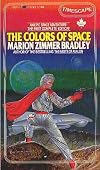
Protagonist Bart Steele has big plans for his father's spaceship taxi fleet. He wants to steal the secret of super-fast space travel from an insular race of aliens known as the Lhari--and develops a daring plan to pull it off. Will Steele escape with the secret technology--and his life?Tags
Recommendations




















Member Reviews
The Colours of Space by Marion Zimmer Bradley is not the first book I've read by Bradley, but it is the first I've read in several years. I listened to the LibriVox public domain recording, which is free to download from their website and from Project Gutenberg. On the other hand, compared with audiobooks read by professional voice actors, the quality of the books I've sampled from LibriVox (this one included) leaves somewhat to be desired. I suggest readers decide for themselves how problematic they find the quality (different chapters read by different people with a variety of accents). My review — henceforth — is about the story, not the quality of the recording.
The Colours of Space was written in 1963. I think if it was written show more now, it would certainly be counted as YA and would probably have been written with a different tone. I'm not sure it stands up to today's market. As it is, it provides an interesting view of science (fictional) ideas from the 60s including a misconception that the title is based on.
The main character, Bart, is seventeen and has just graduated as an astro(navi)gator. When waiting to meet his father at the spaceport, a different man shows up, claiming to be his father. Bart goes along with it because he doesn't want to put the man's life in danger from the alien Lhari who have a monopoly on interstellar travel. Supposedly, this is because humans can't survive the warp drive without being in suspended animation sleep but as Bart soon learns as he becomes embroiled in interstellar events, this isn't the entire story.
The main thing, I found, which distinguished this book from more modern YA is how stupid the main character was. Of course many YA characters make stupid decisionsto drive the plot along and it wasn't really that. It's more that in recent books the characters appear to be cleverer and less... emotionally ignorant. I'm not sure that's the right phrase to use, but ignorant in different ways. By contrast, I was frequently (and incredulously) frustrated by how stupidly Bart was acting. Especially when he embarked on a dangerous saving the world mission without being in possession of very many facts or reasons (to motivate him, I mean). Mind you, his fumblings in the dark were amusing at times, just not intentionally. And he did get a bit smarter and more with it as the book progressed.
An other major source of amusement for me was the outdated science. The title of the novel — The Colours of Space — refers to the stars being much more brightly coloured when seen in space, as compared with when seen from inside the Earth's atmosphere. (There's another reference there to plot elements as well, which I won't spoil, but I read the main reference as being to the multi-coloured stars.) The thing is, the phenomenon, as described in the story, is not entirely real. Yes, stars come in different colours, but those colours range from red to yellow, white and blue. There are no green stars. More on this over at my blog. show less
The Colours of Space was written in 1963. I think if it was written show more now, it would certainly be counted as YA and would probably have been written with a different tone. I'm not sure it stands up to today's market. As it is, it provides an interesting view of science (fictional) ideas from the 60s including a misconception that the title is based on.
The main character, Bart, is seventeen and has just graduated as an astro(navi)gator. When waiting to meet his father at the spaceport, a different man shows up, claiming to be his father. Bart goes along with it because he doesn't want to put the man's life in danger from the alien Lhari who have a monopoly on interstellar travel. Supposedly, this is because humans can't survive the warp drive without being in suspended animation sleep but as Bart soon learns as he becomes embroiled in interstellar events, this isn't the entire story.
The main thing, I found, which distinguished this book from more modern YA is how stupid the main character was. Of course many YA characters make stupid decisions
An other major source of amusement for me was the outdated science. The title of the novel — The Colours of Space — refers to the stars being much more brightly coloured when seen in space, as compared with when seen from inside the Earth's atmosphere. (There's another reference there to plot elements as well, which I won't spoil, but I read the main reference as being to the multi-coloured stars.) The thing is, the phenomenon, as described in the story, is not entirely real. Yes, stars come in different colours, but those colours range from red to yellow, white and blue. There are no green stars. More on this over at my blog. show less
This was an interesting sort of scifi/fantasy story. Space 'elves', the Lhari, brought spaceflight to humanity, but have used it to subjugate humans and other races ever since. Some humans are trying to fight back and earn the ability to travel space without relying on them. A short novel in the tradition of 60's scifi, without being over complicated or too detailed. Its also not as preachy as some of Bradley's later works. Good reading.
This is not up to MZB's normal standard. Whatever you think of the plot, and I don't agree that it is all that predictable, the medical details are so bad that they disrupt the suspesion of disbelief this sort of book depends on.
“Pico review” written for the SF fanzine OtherRealms (SF review zine by Chuq Von Rospach, Jan. 1991): I bought this reprint of an old MZB story because I'm always on the lookout for MZB I've missed and because the illustrator, Lee Moyer, is someone I'm acquainted with through fandom. It is a good, juvenile story, if you can get past some of the very dated feel. The Lhari control all interstellar space travel, with a monopoly on the only working warp drive. Humans can't use it directly, they must be kept in suspended animation during warp travel or die. Bart Steele is half human and half Mentorian, his Mentorian mother was a mathematician on a Lhari ship. Since the Mentorians are the only race able to work directly with the Lhari, show more humans resent them for it. The title refers to the main difference between the species in this book - the Lhari don't see any colors in the spectral range that humans do. The Mentorians can see human colors and into the Lhari range. Bart sets out to find the "eighth" color - the secret to warp power - and faces dangerous adventures aboard a Lhari ship to find it. He learns the Lhari aren't as superior or as different as they have lead humans to believe. show less
As opposed to Proust, this reminds me of early adolescence in a positive way. I received a few bucks a week for allowance and I'd rush to the bookstore, then stand in delicious agony before the fantasy and science fiction racks, endlessly considering which 1 or 2 paperbacks to get. I'd usually get 2 at $1.50 or $1.75 apiece, go home, read them, and the next day face 6 more days without books. The Colors of Space recalled this experience: I started it on DailyLit, sent for the next installment, sent for the next installment, and before you know it, I was done and started on the second Marion Zimmer Bradley. As to plot and writing, these were also familiar--straightforward space cowboy story, simple plot, no real subplot, resolution, show more space cowboy becomes a space cowman. Mind you, I'm not complaining. It's like eating a little bag of lemon drops--sweet, familiar, pleasant, and not of great consequence. show less
Opening Sentence: “…It was a week before the Lhari ship went into warp-drive, and all that time young Bart Steele had stayed in his cabin…”
Bart Steel has just graduated from the SpaceAcademy, and is returning home. His father manages a fleet of close inter-planetary space ships, however travel beyond the planets is exclusively monopolised by the Lhari. Humans can only travel on Lhari passenger ships in cold sleep because they are told that they are not able to withstand the stresses of hyperspace travel.The Lhari are not willing to share the secret of how they achieve warp-speed; plans are afoot to change this. Humans have worked out that the Lhari fuel source consists of eight colours, seven have been identified but the eighth show more colour remains unknown; THE COLORS OF SPACE is about the search for that eighth colour, and what extent people will go to get that knowledge.
On his arrival at a space port, circumstances quickly place Bart undercover as a crew member on a Lhari ship that is travelling to their home planet. Bart’s outward physical appearance has been surgically changed to match those of the Lhari; his mission is to discover the secret of the mystery eighth colour.
As expected, living cheek by jowl with the Lhari, young Bart finds that his Lhari crewmates are not the monsters the humans have been led to believe. Soon the point comes where young Bart has to make some very grown-up decisions that will affect the whole future of space relations.
THE COLORS OF SPACE is easy to read, fast-paced and a good, if not a little predictable story. show less
Bart Steel has just graduated from the SpaceAcademy, and is returning home. His father manages a fleet of close inter-planetary space ships, however travel beyond the planets is exclusively monopolised by the Lhari. Humans can only travel on Lhari passenger ships in cold sleep because they are told that they are not able to withstand the stresses of hyperspace travel.The Lhari are not willing to share the secret of how they achieve warp-speed; plans are afoot to change this. Humans have worked out that the Lhari fuel source consists of eight colours, seven have been identified but the eighth show more colour remains unknown; THE COLORS OF SPACE is about the search for that eighth colour, and what extent people will go to get that knowledge.
On his arrival at a space port, circumstances quickly place Bart undercover as a crew member on a Lhari ship that is travelling to their home planet. Bart’s outward physical appearance has been surgically changed to match those of the Lhari; his mission is to discover the secret of the mystery eighth colour.
As expected, living cheek by jowl with the Lhari, young Bart finds that his Lhari crewmates are not the monsters the humans have been led to believe. Soon the point comes where young Bart has to make some very grown-up decisions that will affect the whole future of space relations.
THE COLORS OF SPACE is easy to read, fast-paced and a good, if not a little predictable story. show less
The Colors of Space By Marion Zimmer Bradley
I remember reading this a long time ago. Some time after the 1963 edition was published. I decided to read it again and see if it still stood well against time.
Bart Steele is a young Vegan who has come to Earth to study at the academy. He is a product of a human and Mentorian pair, although he lost his mother, the Mentorian, early in his life. His father owns a space shipping business that struggles as it must against the monopoly that the Lhari race has over interstellar flight. The Lhari have made it clear that only Lhari can survive while the warp-drive is active and that all other races must go into cold-sleep.
This monopoly causes Bart and many others to have a prejudice against the show more Lhari.
On graduation Bart is to meet his father at the Lhari spaceport where he will return home. Bart will never see his father again and will be catapulted into a universe of danger and intrigue. He discovers that his father and several others have died while trying to obtain the secrets of the Lhari and of the warp-drive. Bart is thrust into his father's world while he's become a fugitive from Lhari authorities.
The Lhari are not able to perceive colors the way humans and Mentorians do and this becomes a major plot device or I should say part of several plot devices. This is the only part that my more mature insight has quibbles about during this read. There are some big things that are hinged on this color disability that might not work quite as well as I once believed. One major one is that the Lhari could not tell something was red hot because they couldn't see the red. Since often survival hinges on such things there would likely have been another way for them to discern that a surface they were working on in their ship might be hot.
Most everything else in the story seems to stand the test of time and still seems to work quite well to move the plot along. Since not enough is revealed about how a specific disguise is worked out, it might seem a bit thin but it still works here.
The story itself beyond being science fiction seems to contain a mix of moral elements as regards prejudices and race hate. It becomes a story of a young mans journey to grow to maturity in his thinking and his beliefs.
J.L.Dobias show less
I remember reading this a long time ago. Some time after the 1963 edition was published. I decided to read it again and see if it still stood well against time.
Bart Steele is a young Vegan who has come to Earth to study at the academy. He is a product of a human and Mentorian pair, although he lost his mother, the Mentorian, early in his life. His father owns a space shipping business that struggles as it must against the monopoly that the Lhari race has over interstellar flight. The Lhari have made it clear that only Lhari can survive while the warp-drive is active and that all other races must go into cold-sleep.
This monopoly causes Bart and many others to have a prejudice against the show more Lhari.
On graduation Bart is to meet his father at the Lhari spaceport where he will return home. Bart will never see his father again and will be catapulted into a universe of danger and intrigue. He discovers that his father and several others have died while trying to obtain the secrets of the Lhari and of the warp-drive. Bart is thrust into his father's world while he's become a fugitive from Lhari authorities.
The Lhari are not able to perceive colors the way humans and Mentorians do and this becomes a major plot device or I should say part of several plot devices. This is the only part that my more mature insight has quibbles about during this read. There are some big things that are hinged on this color disability that might not work quite as well as I once believed. One major one is that the Lhari could not tell something was red hot because they couldn't see the red. Since often survival hinges on such things there would likely have been another way for them to discern that a surface they were working on in their ship might be hot.
Most everything else in the story seems to stand the test of time and still seems to work quite well to move the plot along. Since not enough is revealed about how a specific disguise is worked out, it might seem a bit thin but it still works here.
The story itself beyond being science fiction seems to contain a mix of moral elements as regards prejudices and race hate. It becomes a story of a young mans journey to grow to maturity in his thinking and his beliefs.
J.L.Dobias show less
Members
- Recently Added By
Lists

Favorite Science Fiction by Women Authors
737 works; 202 members

Books Read in 2019
4,052 works; 108 members

To Read (Prospector)
86 works; 1 member

Favorite Science Fiction
452 works; 216 members
Author Information

407+ Works 98,700 Members
Marion Zimmer Bradley is a science-fiction and fantasy writer, novelist, and editor. She was born in Albany, New York on June 3, 1930. Bradley attended the New York State College for Teachers from 1946 to 1948. She earned a B.A. from Hardin Simmons University in 1964. Bradley did graduate work at the University of California at Berkeley from 1965 show more to 1967. Bradley sold her first story to Fantastic Amazing Stories as part of an amateur fiction contest. She sold her first professional story to Vortex Science Fiction in 1952. Her novels include The Sword of Aldones and The Planet Savers. Both novels were set on Darkover, the setting for more than 20 subsequent Bradley novels. Bradley also wrote The Mists of Avalon, a reworking of the King Arthur legend with more emphasis on the female characters. She used the same approach with The Firebrand, which was based on The Iliad. In addition to writing more than 85 books, Bradley was the editor of an annual anthology for DAW Books, as well as the editor of Marion Zimmer Bradley's Fantasy Magazine. Bradley died in 1999. (Bowker Author Biography) Marion Zimmer Bradley was the bestselling author of "The Mists of Avalon", "Lady of Avalon", "The Forest House", & "The Firebrand", as well as the popular Darkover series of science fiction novels. She died in 1999. (Bowker Author Biography) show less
Some Editions
Series
Belongs to Publisher Series
Work Relationships
Common Knowledge
- Canonical title
- The Colors of Space
- Original title
- The Colors of Space
- Original publication date
- 1963
- Dedication
- To David Stephen
- First words
- It was a week before the Lhari ship went into warp-drive, and all that time young Bart Steele had stayed in his cabin.
- Last words*
- (Click to show. Warning: May contain spoilers.)Et tout les autres Theradins aussi.
- Publisher's editor*
- Jacques Goimard
- Original language
- English
*Some information comes from Common Knowledge in other languages. Click "Edit" for more information.
Classifications
Statistics
- Members
- 495
- Popularity
- 60,713
- Reviews
- 16
- Rating
- (3.46)
- Languages
- 5 — Danish, English, French, German, Portuguese
- Media
- Paper, Audiobook, Ebook
- ISBNs
- 59
- ASINs
- 22