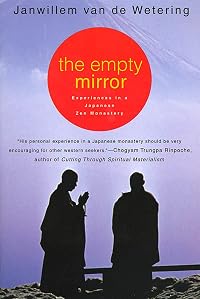
The Empty Mirror: Experiences in a Japanese Zen Monastery
by Janwillem van de Wetering
Zen trilogy (1)
On This Page
Description
Seen by many as a contemporary classic, Janwillem van de Wetering's small and admirable memoir records the experiences of a young Dutch student-later a widely celebrated mystery writer-who spent a year and a half as a novice monk in a Japanese Zen Buddhist monastery. As Chogyam Trungpa Rinpoche, author of Cutting Through Spiritual Materialism, has written, The Empty Mirror "should be very encouraging for other Western seekers." It is the first book in a trilogy that continues with A Glimpse show more of Nothingness and Afterzen. show lessTags
Recommendations

























Member Recommendations
pingdjip A young man chasing a dream confronts his own limitations. Sober, subtle and ruthlessly honest.

JuliaMaria Sehr gut geschriebene persönliche Memoiren sich dem Zen-Buddhismus und der Meditation zu nähern.
Member Reviews
A humorous, grouchy, true story: In the summer of 1958 Janwillem van de Wetering showed up at the door of a Zen monastery in Kyoto Japan, knowing pretty much no one, not speaking the language, and without a really good idea what he was doing there. This book describes, with a certain amount of humor and what seems to be quite a bit of honesty, the months that followed (interlaced with Zen stories that he heard during those months, including some that I hadn't heard anywhere else before; I like Zen stories).
There aren't many dates in the book (or I wasn't paying enough of that kind of attention to notice them), but I think he stayed at the monastery for more than six months and less than two years. His descriptions of the time are show more interesting, funny, warm, vivid, and all sorts of good words like that (and also rather dark, mordant and/or grouchy in tone, often frustrated, impatient, dissatisfied). He did not find the answers to life's problems, his knees hurt alot, he misunderstood the head monk and Zen master frequently, and he (like the other residents of the monastery) cheated and broke the rules with impressive frequency.
The writing is spare and specific; this is the story of what one particular set of months in one particular monastery were like. Any broad conclusions about The Meaning Of Zen Training or anything else are left pretty much entirely to the reader.
The author left feeling that the whole thing had perhaps been a failure; but the master said "now you are a little awake; so awake that you will never fall asleep again". Which altogether is more satisfying, I think, than perky converts describing how happy and fulfilled their new meme complex has made them.
One tiny annoyance that struck me as out of keeping with the tone of the rest of the book: on a crowded train ride during a brief trip away from the monastery to renew his Dutch passport, he concentrates so hard on the feeling of a woman who is pressed up against him that he convinces himself that he is mentally influencing her to rub herself against him, trembling. She got off at the next station (can hardly blame her!), and he concludes that the idea that "someone who has trained his will can influence others, without saying anything, without doing anything observable, had now been proved", but that that's not really the point of Zen and he probably shouldn't do it anymore. He doesn't seem to consider the possibility that he's just proven that he can fool himself, which seems to me much more likely, and something that should have occurred to anyone actually paying attention.
But that's just a nit (I like nits), and perhaps adds as much to the book as it takes away from it. I very much enjoyed reading it (and it didn't take long; it's 146 pages, with little or no bogging down). He has at least two other books about his experiences in other vaguely Zen-related places; I intend to someday maybe read those also. show less
There aren't many dates in the book (or I wasn't paying enough of that kind of attention to notice them), but I think he stayed at the monastery for more than six months and less than two years. His descriptions of the time are show more interesting, funny, warm, vivid, and all sorts of good words like that (and also rather dark, mordant and/or grouchy in tone, often frustrated, impatient, dissatisfied). He did not find the answers to life's problems, his knees hurt alot, he misunderstood the head monk and Zen master frequently, and he (like the other residents of the monastery) cheated and broke the rules with impressive frequency.
The writing is spare and specific; this is the story of what one particular set of months in one particular monastery were like. Any broad conclusions about The Meaning Of Zen Training or anything else are left pretty much entirely to the reader.
The author left feeling that the whole thing had perhaps been a failure; but the master said "now you are a little awake; so awake that you will never fall asleep again". Which altogether is more satisfying, I think, than perky converts describing how happy and fulfilled their new meme complex has made them.
One tiny annoyance that struck me as out of keeping with the tone of the rest of the book: on a crowded train ride during a brief trip away from the monastery to renew his Dutch passport, he concentrates so hard on the feeling of a woman who is pressed up against him that he convinces himself that he is mentally influencing her to rub herself against him, trembling. She got off at the next station (can hardly blame her!), and he concludes that the idea that "someone who has trained his will can influence others, without saying anything, without doing anything observable, had now been proved", but that that's not really the point of Zen and he probably shouldn't do it anymore. He doesn't seem to consider the possibility that he's just proven that he can fool himself, which seems to me much more likely, and something that should have occurred to anyone actually paying attention.
But that's just a nit (I like nits), and perhaps adds as much to the book as it takes away from it. I very much enjoyed reading it (and it didn't take long; it's 146 pages, with little or no bogging down). He has at least two other books about his experiences in other vaguely Zen-related places; I intend to someday maybe read those also. show less
An honest and straight-forward account of a year-long retreat in Japan. The author doesn't hide the difficulties he had during his prolonged practice. Besides motivational issues, he also had trouble adjusting to the strict discipline and routine in the monastery. Many of his philosophical questions went unanswered during his stay, partly because of the culture clash between post-war Japan and the Netherlands.
Read before: 24-09-2011
Read before: 24-09-2011
Just fantastic.
This was given to me as a gift from Aunt Alex, and I am so grateful. It is such a unique story- a Dutchman who moves to Japan to live in a Zen monastery and study Buddhism. Being someone who has always wanted to do that, I found this very enlightening. I enjoyed this in the same lines as David Chadwick's "Thank You and Ok!: An American Zen Failure in Japan". Both looked at not only the rigors of the Zen monastic life, but also the social constructs of being a westerner immersed in a foreign philosophy in a foreign culture and country.
Wonderful read for anyone interesting in the topc.
(Thank you, Aunt Alex!)
This was given to me as a gift from Aunt Alex, and I am so grateful. It is such a unique story- a Dutchman who moves to Japan to live in a Zen monastery and study Buddhism. Being someone who has always wanted to do that, I found this very enlightening. I enjoyed this in the same lines as David Chadwick's "Thank You and Ok!: An American Zen Failure in Japan". Both looked at not only the rigors of the Zen monastic life, but also the social constructs of being a westerner immersed in a foreign philosophy in a foreign culture and country.
Wonderful read for anyone interesting in the topc.
(Thank you, Aunt Alex!)
Seen by many as a contemporary classic, Janwillem van de Wetering's small and admirable memoir records the experiences of a young Dutch student—later a widely celebrated mystery writer—who spent a year and a half as a novice monk in a Japanese Zen Buddhist monastery.
We follow the author through some of his experiences and gain insight into how difficult it can be to study a new religion in a foreign country. He seems to alternate between being amazed and being baffled.
'It seems obvious that van e Wetering's eight months in a Kyoto monastery still afect the course of his existence.'-The Boston Globe
'A vivid humorous, and slightly disillusioning account of a Dutchman's frustrating struggle toward enlightenment in a Japanese Zen monastery. Insightful, funny.'-Carl Rogers
'As might be expected, the author shows a deep respect for the taechings of Zen. What makes this account extraordinary, however, is that the book contains none of the convert's irritating certitude, and no suggestion that the reader rush to follow the author's example.'-Time
'What is accessible is the day-to-day description of life, of the monks themselves and of the others he met, of the jokes they played and tthe food they ate, of the show more moments of satori, the explosive moment of an understanding surpassing understanding.'-Los Angeles Times
'What emerges is a work of nonfiction told through the ingenuous presona of van de Wetering, that is as enjoyable to read as a well-crafted novel.'-East West Journal
Contents
The gate of the monastery, a chicken, and a vendor of noodles
Meditating hurts
Life is suffering
Caught between the tigers
A large glass of soya sauce and a dengerous snake
A thirsty fish
A difference of rank and a pigeon's egg
The first sesshin and the whale's penis
A little black magic
Rohatsu, week of weeks
The eightfold path and a jump into the swamp
A shameless day and satori in the willow quarter
Devils are no good, you know that, don't you?
If you don't hold out your hand a Zen master will be murdered
A court lady iscourteously treated
Attempted manslaughter and doing some shopping
Is a cloud a member of the sky?
Whatever ends begins show less
'A vivid humorous, and slightly disillusioning account of a Dutchman's frustrating struggle toward enlightenment in a Japanese Zen monastery. Insightful, funny.'-Carl Rogers
'As might be expected, the author shows a deep respect for the taechings of Zen. What makes this account extraordinary, however, is that the book contains none of the convert's irritating certitude, and no suggestion that the reader rush to follow the author's example.'-Time
'What is accessible is the day-to-day description of life, of the monks themselves and of the others he met, of the jokes they played and tthe food they ate, of the show more moments of satori, the explosive moment of an understanding surpassing understanding.'-Los Angeles Times
'What emerges is a work of nonfiction told through the ingenuous presona of van de Wetering, that is as enjoyable to read as a well-crafted novel.'-East West Journal
Contents
The gate of the monastery, a chicken, and a vendor of noodles
Meditating hurts
Life is suffering
Caught between the tigers
A large glass of soya sauce and a dengerous snake
A thirsty fish
A difference of rank and a pigeon's egg
The first sesshin and the whale's penis
A little black magic
Rohatsu, week of weeks
The eightfold path and a jump into the swamp
A shameless day and satori in the willow quarter
Devils are no good, you know that, don't you?
If you don't hold out your hand a Zen master will be murdered
A court lady iscourteously treated
Attempted manslaughter and doing some shopping
Is a cloud a member of the sky?
Whatever ends begins show less
If I could only keep 10 books, this would be one of them.
Members
- Recently Added By
Published Reviews
'De lege spiegel' is de titel van een zenverhaal, dat de Nederlandse (detective-)schrijver Jan Willem van de Wetering, tijdens zijn anderhalf jaar durende zenstudie/opleiding in Japan, te horen krijgt. In zijn boek beschrijft hij hoe hij wordt aangenomen als discipel van een Zen-meester, hoe hij worstelt met de strenge discipline in het klooster en vooral hoe hij met grote inspanning mediteert show more op zijn koan. De koan is de raadselachtige spreuk, die boeddhistische Zen-meesters van sommige scholen, aan hun leerlingen opgeven als onderwerp voor de meditatie. Oplossen van de koan betekent het bereiken van een graad van Verlichting (satori). Behalve van de bewustzijnsverandering van de schrijver, krijgt de lezer van dit leerzame leesboek een heldere indruk van de gebruiken, de inrichting en het dagelijks leven in een 20e-eeuws Zen-klooster in Japan.
(Biblion recensie, Redactie..) show less
(Biblion recensie, Redactie..) show less
added by karnoefel
Author Information

94+ Works 6,391 Members
Janwillem Van de Wetering was born in Rotterdam, Netherlands on February 12, 1931. He traveled extensively, both geographically and philosophically, his adventures ranging from being a motorcycle gang member to a Buddhist, a real estate salesman in Australia to an exporter in Holland. He was a police officer in Amsterdam from 1966 to 1975 and his show more crime novels featuring detectives Grijpstra and De Gier were based on his experiences. He also wrote a trilogy based on the time he spent at a Japanese Zen Buddhist monastery and wrote children's books about a porcupine named Hugh Pine. In 1984, he received the French Grand Prix de Littérature Policière. He died on July 4, 2008 at the age of 77. (Bowker Author Biography) show less
Series

Common Knowledge
- Canonical title*
- Der leere Spiegel
- Original title
- De Lege Spiegel
- Important places
- Kyoto, Japan
- Epigraph
- "The empty mirror," he said. "If you could really understand that, there would be nothing left here for you to look for."
- Blurbers
- Chogyam Trungpa
*Some information comes from Common Knowledge in other languages. Click "Edit" for more information.
Classifications
- Genres
- Religion & Spirituality, Nonfiction, Biography & Memoir, General Nonfiction, Philosophy
- DDC/MDS
- 294.3657092 — Religion Other religions Buddhism/Hinduism Buddhism The Buddha, Monasticism Monastics
- LCC
- BQ9294.4 .J3 .W4713 — Philosophy, Psychology and Religion Buddhism Buddhism Modifications, schools, etc. Special modifications, sects, etc. Zen Buddhism
- BISAC
Statistics
- Members
- 585
- Popularity
- 50,252
- Reviews
- 12
- Rating
- (4.03)
- Languages
- 8 — Danish, Dutch, English, Estonian, French, German, Italian, Spanish
- Media
- Paper, Ebook
- ISBNs
- 28
- ASINs
- 8