On This Page
Description
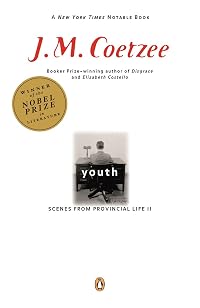
The second instalment of J. M. Coetzee's fictionalised 'memoir' is a remarkable portrait of a consciousness, isolated and adrift, turning in on itself, of a young man struggling to find his way in the world, written with tenderness and a fierce clarity. He has escaped South Africa. Everything is going well, he has attained his first goal, he ought to be happy. In fact, as the weeks pass, he finds himself more and more miserable. In this unforgiving portrait of the artist as a young man, John show more flees his apartheid-riven homeland for the bleak London of the early 1960s, where he aspires to become a writer. There he becomes trapped in stultifying computer-programming work and brief, unsatisfying affairs, turning ever inwards in the struggle to realise his ambitions. show lessTags
Recommendations





Member Recommendations
pingdjip A young man chasing a dream confronts his own limitations. Sober, subtle and ruthlessly honest.
CGlanovsky Fictionalized account of the author's youth struggling to succeed as an artist in the city.
Member Reviews
J. M. Coetzee is a strange author to me. Not unlike Cormac McCarthy, he has written books that I've loved (Disgrace) and books that I've despised (Life & Times of Michael K), and though I know he is a supremely talented writer, he's a bit up in the air in my book. So I approached Youth with caution, and while it was not a disappointment, I can't say I was overwhelmed by it either.
The story is a strange mix of fiction and nonfiction, a book that reads like a novel but seems inspired (right down to the protagonist's name, John) by the author's life. It essentially comprises the details of John's coming of age, from his early work in South Africa to his escape to and disenchantment in London, working jobs to try and support his true dream show more of being a poet. Along the way he has failed love affairs and laments the difficulty of the life he has chosen, meditating on literature and beauty while trying to make ends meet in a hectic, difficult city.
The problem with a narrative constructed in such a way is that it constantly feels imbalanced, as if it's trying to negotiate a middle ground between the intense personal reflection and the day-by-day grind of the plot points. It's far more interesting to hear what Coetzee's hero is thinking, but it gets bogged down in endless description of computers and offices. It never feels like the plot has any trajectory--which may be the point, since the relatively apathetic John doesn't have much of one either--but that doesn't a great story make, as it turns out.
Thematically, the novel is greater than the sum of its parts. It feels natural to take love, sex, and poetry and constantly meld them throughout the work, and for the most part the effect of these images are clear and not forced. It seems a bit of stretch late in the work when John blames his failings in life on his insufficiencies in the bedroom, but it's also consistent with the mentality of a man his age. And despite being a reflection on life in the 1960s, the vaguely emo-ish tone of the text (which was written in 2002) feels contemporary enough to work.
All told, Youth is a bleak and fairly depressing look at Coetzee's early life, but it has its share of satisfying moments. Those looking for a clear arc from start to finish will likely be irritated--and while I don't know if reading Boyhood (Scenes from Provincial Life) first makes this any more coherent, it's still an engaging and honest look at one's own trials and tribulations. show less
The story is a strange mix of fiction and nonfiction, a book that reads like a novel but seems inspired (right down to the protagonist's name, John) by the author's life. It essentially comprises the details of John's coming of age, from his early work in South Africa to his escape to and disenchantment in London, working jobs to try and support his true dream show more of being a poet. Along the way he has failed love affairs and laments the difficulty of the life he has chosen, meditating on literature and beauty while trying to make ends meet in a hectic, difficult city.
The problem with a narrative constructed in such a way is that it constantly feels imbalanced, as if it's trying to negotiate a middle ground between the intense personal reflection and the day-by-day grind of the plot points. It's far more interesting to hear what Coetzee's hero is thinking, but it gets bogged down in endless description of computers and offices. It never feels like the plot has any trajectory--which may be the point, since the relatively apathetic John doesn't have much of one either--but that doesn't a great story make, as it turns out.
Thematically, the novel is greater than the sum of its parts. It feels natural to take love, sex, and poetry and constantly meld them throughout the work, and for the most part the effect of these images are clear and not forced. It seems a bit of stretch late in the work when John blames his failings in life on his insufficiencies in the bedroom, but it's also consistent with the mentality of a man his age. And despite being a reflection on life in the 1960s, the vaguely emo-ish tone of the text (which was written in 2002) feels contemporary enough to work.
All told, Youth is a bleak and fairly depressing look at Coetzee's early life, but it has its share of satisfying moments. Those looking for a clear arc from start to finish will likely be irritated--and while I don't know if reading Boyhood (Scenes from Provincial Life) first makes this any more coherent, it's still an engaging and honest look at one's own trials and tribulations. show less
http://shawjonathan.wordpress.com/2009/12/01/coetzees-youth/
This is the second of three (so far) novels in Coetzee's Scenes from Provincial Life series, which are fiction, but also by strong implication unsparing autobiography. It takes up our hero as an 18 year old student and aspiring poet living in a one-room flat in Capetown and drops him again as a 24 year old computer programmer living in an upstairs room in a house in the depths of the Berkshire countryside, convinced that he is a total failure.
It's the 1960s. The young Coetzee is committed to escape being defined by his family, trapped in the dullness of colonial life, and torn apart in what he sees as the impending revolution in South Africa. He aspires to the status of poet, show more and theorises endlessly to himself about how he should live (as opposed to write) to achieve that aim. He agonises over his incompetence in relationships with women, over which writers and artists he should emulate (Ezra Pound presides over his pantheon, and Beckett the novelist is a late apparition), over how to shake off his colonial identity. He rationalises his moment of appalling behaviour and then berates himself for his rationalising. He aspires to Angst, but realises his sole talent is for 'misery, dull, honest misery'.
Young Coetzee's misery, confusion about sex, self castigation, romantic theorising and bitter disillusion are all presented without commentary, but with a gentle irony – which may derive partly from the reader's knowledge that this pathetic youth went on to win the Nobel Prize (and possibly that an idea that comes and goes on page 138 was the seed of his first novel), but which also simmers in the prose, bubbling to the surface as outright comedy often enough to suggest, without invalidating the character's intensely felt experience, that an older, wiser head is constantly there, shaping the story. My favourite bubble pops up when young Coetzee, who lives alone and feeds himself with classic adolescent male incompetence, is ruminating on Ford Madox Ford:
'Ford says that the civilization of Provence owes its lightness and grace to a diet of fish and olive oil and garlic. In his new lodgings in Highgate, out of deference to Ford, he buys fish fingers instead of sausages, fries them in olive oil instead of butter, sprinkles garlic salt over them.'
We do wonder if he misses the point about so much else by quite so wide a mark.
Young Coetzee was writing an academic thesis on Ford. The paragraph after the one I just quoted describes the thesis as involving 'the task of reducing his hundreds of pages of notes in tiny handwriting to a web of connected prose'. My sense is that this book has achieved something very like that: whether Coetzee has drawn on actual diaries from that period or on the virtual pages of his recollection, he has created from his material a shiny, elegant narrative web.
Early in his stay in London, young Coetzee hears a BBC talk about the Russian poet Joseph Brodsky and is enraptured by his poetry. He reflects on what Brodsky and a handful of other poets mean to him:
'they release their words into the air, and along the airwaves the words speed to his room, the words of the poets of his time, telling him again of what poetry can be and therefore what he can be, filling him with joy that he inhabits the same earth as they. 'Signal heard in London – please continue to transmit': that is the message he would send them if he could.'
If in my early 20s I could have received this book as a signal, I would have responded, I'm sure, with a very similar joy. As it is, confident though I am that J M Coetzee won't be reading my blog, I'm sending him a belated message on behalf of my younger self: 'Signal heard in Sydney 40 years later – please continue to transmit.' show less
This is the second of three (so far) novels in Coetzee's Scenes from Provincial Life series, which are fiction, but also by strong implication unsparing autobiography. It takes up our hero as an 18 year old student and aspiring poet living in a one-room flat in Capetown and drops him again as a 24 year old computer programmer living in an upstairs room in a house in the depths of the Berkshire countryside, convinced that he is a total failure.
It's the 1960s. The young Coetzee is committed to escape being defined by his family, trapped in the dullness of colonial life, and torn apart in what he sees as the impending revolution in South Africa. He aspires to the status of poet, show more and theorises endlessly to himself about how he should live (as opposed to write) to achieve that aim. He agonises over his incompetence in relationships with women, over which writers and artists he should emulate (Ezra Pound presides over his pantheon, and Beckett the novelist is a late apparition), over how to shake off his colonial identity. He rationalises his moment of appalling behaviour and then berates himself for his rationalising. He aspires to Angst, but realises his sole talent is for 'misery, dull, honest misery'.
Young Coetzee's misery, confusion about sex, self castigation, romantic theorising and bitter disillusion are all presented without commentary, but with a gentle irony – which may derive partly from the reader's knowledge that this pathetic youth went on to win the Nobel Prize (and possibly that an idea that comes and goes on page 138 was the seed of his first novel), but which also simmers in the prose, bubbling to the surface as outright comedy often enough to suggest, without invalidating the character's intensely felt experience, that an older, wiser head is constantly there, shaping the story. My favourite bubble pops up when young Coetzee, who lives alone and feeds himself with classic adolescent male incompetence, is ruminating on Ford Madox Ford:
'Ford says that the civilization of Provence owes its lightness and grace to a diet of fish and olive oil and garlic. In his new lodgings in Highgate, out of deference to Ford, he buys fish fingers instead of sausages, fries them in olive oil instead of butter, sprinkles garlic salt over them.'
We do wonder if he misses the point about so much else by quite so wide a mark.
Young Coetzee was writing an academic thesis on Ford. The paragraph after the one I just quoted describes the thesis as involving 'the task of reducing his hundreds of pages of notes in tiny handwriting to a web of connected prose'. My sense is that this book has achieved something very like that: whether Coetzee has drawn on actual diaries from that period or on the virtual pages of his recollection, he has created from his material a shiny, elegant narrative web.
Early in his stay in London, young Coetzee hears a BBC talk about the Russian poet Joseph Brodsky and is enraptured by his poetry. He reflects on what Brodsky and a handful of other poets mean to him:
'they release their words into the air, and along the airwaves the words speed to his room, the words of the poets of his time, telling him again of what poetry can be and therefore what he can be, filling him with joy that he inhabits the same earth as they. 'Signal heard in London – please continue to transmit': that is the message he would send them if he could.'
If in my early 20s I could have received this book as a signal, I would have responded, I'm sure, with a very similar joy. As it is, confident though I am that J M Coetzee won't be reading my blog, I'm sending him a belated message on behalf of my younger self: 'Signal heard in Sydney 40 years later – please continue to transmit.' show less
Youth is the second of Coetzee's "Scenes from Provincial Life" autobiographical trilogy. This time, John is young and desperate to leave South Africa, to go and become a poet in London. London is not quite what he expected.
Again, Coetzee holds up a blowtorch to his young life, and shows himself warts and all without sugar coating his failings as a human being. I would say I didn't think he liked himself that much, only I saw a lot of myself in him too, so I think he was just being brutally honest. C'mon, who hasn't been an absolute fool at one time or another as a young person? At least he admits it, and makes fascinating reading out of it.
But it wasn't mean or nasty, I think he was able to mostly laugh at his youthful foibles (the show more biggest: waiting for the woman who through passionate sex will open him up to the poetic creativity he so desperately desires; and the worry that maybe he needs to get the poetry right before he can meet his destined woman). It was also interesting being in a dark, miserable London in the early 1960s. Not to mention the computer programming. (Really.)
It does end on a bleak note, however, with his youthful ambition apparently discarded in the need to have a job. But not totally bleak: this man did go on to win the Nobel Prize for literature. (But not for poetry...) show less
Again, Coetzee holds up a blowtorch to his young life, and shows himself warts and all without sugar coating his failings as a human being. I would say I didn't think he liked himself that much, only I saw a lot of myself in him too, so I think he was just being brutally honest. C'mon, who hasn't been an absolute fool at one time or another as a young person? At least he admits it, and makes fascinating reading out of it.
But it wasn't mean or nasty, I think he was able to mostly laugh at his youthful foibles (the show more biggest: waiting for the woman who through passionate sex will open him up to the poetic creativity he so desperately desires; and the worry that maybe he needs to get the poetry right before he can meet his destined woman). It was also interesting being in a dark, miserable London in the early 1960s. Not to mention the computer programming. (Really.)
It does end on a bleak note, however, with his youthful ambition apparently discarded in the need to have a job. But not totally bleak: this man did go on to win the Nobel Prize for literature. (But not for poetry...) show less
Another great novel(la) from Coetzee. This guy has such a way with words. He just sucks you in. His novels are never uplifting but they describe the human condition with such vivid clarity that it almost makes you feel embarrassed to be a member of the species.
Youth is heavily based on Coetzee’s own experience of emigrating to early 1960s London. Even if you don’t know this when you pick it up, it’s apparent very early on. This lends the book an amazing realism which envelopes you in the character.
Having been a youth and, like Coetzee, been confronted with the myriad choices that lie before you in your early 20s as well as stretches in foreign countries, I completely related to the angst that “John” feels at every turn. Taking show more jobs that are compromises for the idealism he feels must be, surely, raging deep down in his being, this is a journey of self-discovery which leads pretty much nowhere.
While some might be frustrated with the brevity of the work and the lack of resolution I think this is a perfect vehicle for a description of youth. There is no defining moment in any of us where we can say we have arrived at adulthood. It’s not a matter of initiation but of self-realisation and that is paced differently for us all. For some it can take decades. This was the strength of the novel for me.
I felt very close to “John” and not least because that’s my first name. I related to his insecurities, to his fears and to his constant self-questioning. I wish he’d written this two decades before he did and that I’d had it available to me just as I was leaving school. It would have been much more important to me then. Nevertheless, it was a very good read and has spurred me on to read more of Coetzee. show less
Youth is heavily based on Coetzee’s own experience of emigrating to early 1960s London. Even if you don’t know this when you pick it up, it’s apparent very early on. This lends the book an amazing realism which envelopes you in the character.
Having been a youth and, like Coetzee, been confronted with the myriad choices that lie before you in your early 20s as well as stretches in foreign countries, I completely related to the angst that “John” feels at every turn. Taking show more jobs that are compromises for the idealism he feels must be, surely, raging deep down in his being, this is a journey of self-discovery which leads pretty much nowhere.
While some might be frustrated with the brevity of the work and the lack of resolution I think this is a perfect vehicle for a description of youth. There is no defining moment in any of us where we can say we have arrived at adulthood. It’s not a matter of initiation but of self-realisation and that is paced differently for us all. For some it can take decades. This was the strength of the novel for me.
I felt very close to “John” and not least because that’s my first name. I related to his insecurities, to his fears and to his constant self-questioning. I wish he’d written this two decades before he did and that I’d had it available to me just as I was leaving school. It would have been much more important to me then. Nevertheless, it was a very good read and has spurred me on to read more of Coetzee. show less
It's not a glamourous book. Actually the events within are mundane, but the thoughts of the narrator are what give the story colour. Some pages made me feel like I was looking into a mirror. I found it very satisfying. Learning to look outside oneself; coming to terms with a non-Romantic life; struggling with the sometimes intense loneliness of the expatriated existence; these are the themes unfolded plainly.
Another stellar read from Coetzee. I started this and next minute I was looking at the free end page...I devoured it. Not much happens, traditionally plot wise. But I couldn't help but see myself in this book, with the characters musings on poetry, the minor tragedies of an artist trying to find his art, in a world heavily reliant on pathetic and mundane rituals, also known as making a living.
How do bitter and twisted, lonely, emotionally crippled older men start out? Men whose relationships, if any, have always soured early, men whose jobs are all that sustain them, mediocre jobs with colleagues who never become friends. Men whose strict weekend routines stop loneliness from being more than an uneasy feeling which never quite comes to the surface. Never quite acknowledged.
They start out as bitter and twisted Youth. In this novel by Coetzee, we see the establishment of such a being, a young man who thinks somehow that his cold alienating ways will make him a poet. When it turns out that he has nothing more in him than the capacity to be a computer programmer, and an undistinguished one of those, he sees his future as a show more hollow meaningless thing. We do not find out if his life remained the mean and nasty existence he portended.
Enter Nagasaki. Here we meet a man who might be the person Youth foresaw. Towards the end of his nondescript career he is alone, as far as we know he has never had a meaningful relationship with anybody, including his relations. When not at work he is at home, when at home, the person he talks to is himself. He has no friends, no interests, nothing about him justifies his carbon footprint. Like Youth, he is given the opportunity to live, to behave with largesse, to give. Like Youth he cannot do that. Both of them experience discomfort, unease at their utter meanness of spirit, but neither is capable of being a new person.
Is this inevitable? Enter Mr Stone of Mr Stone and the Knights Companion.
rest here: https://alittleteaalittlechat.wordpress.com/2016/05/30/studies-in-bitter-and-twi... show less
They start out as bitter and twisted Youth. In this novel by Coetzee, we see the establishment of such a being, a young man who thinks somehow that his cold alienating ways will make him a poet. When it turns out that he has nothing more in him than the capacity to be a computer programmer, and an undistinguished one of those, he sees his future as a show more hollow meaningless thing. We do not find out if his life remained the mean and nasty existence he portended.
Enter Nagasaki. Here we meet a man who might be the person Youth foresaw. Towards the end of his nondescript career he is alone, as far as we know he has never had a meaningful relationship with anybody, including his relations. When not at work he is at home, when at home, the person he talks to is himself. He has no friends, no interests, nothing about him justifies his carbon footprint. Like Youth, he is given the opportunity to live, to behave with largesse, to give. Like Youth he cannot do that. Both of them experience discomfort, unease at their utter meanness of spirit, but neither is capable of being a new person.
Is this inevitable? Enter Mr Stone of Mr Stone and the Knights Companion.
rest here: https://alittleteaalittlechat.wordpress.com/2016/05/30/studies-in-bitter-and-twi... show less
Members
- Recently Added By
Lists

1001 Books You Must Read Before You Die
1,448 works; 1,133 members
Author Information

113+ Works 42,217 Members
J.M. Coetzee's full name is John Michael Coetzee. Born in Cape Town, South Africa, in 1940, Coetzee is a writer and critic who uses the political situation in his homeland as a backdrop for many of his novels. Coetzee published his first work of fiction, Dusklands, in 1974. Another book, Boyhood, loosely chronicles an unhappy time in Coetzee's show more childhood when his family moved from Cape Town to the more remote and unenlightened city of Worcester. Other Coetzee novels are In the Heart of the Country and Waiting for the Barbarians. Coetzee's critical works include White Writing and Giving Offense: Essays on Censorship. Coetzee is a two-time recipient of the Booker Prize and in 2003, he won the Nobel Literature Award. (Bowker Author Biography) J. M. Coetzee's books include "Boyhood", "Dusklands", "In the Heart of the Country", "Waiting for the Barbarians", "Life & Times of Michael K", "Foe", & "The Master of Petersburg". A professor of general literature at the University of Cape Town, Coetzee has won many literary awards, including the CNA Prize (South Africa's premier literary award), the Booker Prize (twice), the Prix Etranger Femina, the Jerusalem Prize, the Lannan Literary Award, & The Irish Times International Fiction Prize. (Publisher Provided) show less
Some Editions
Awards and Honors
Distinctions
Notable Lists
Series

Belongs to Publisher Series
Work Relationships
Common Knowledge
- Canonical title
- Youth
- Original title
- Youth
- Alternate titles
- Youth: Scenes from a Provincial Life II; Scenes from a Provincial Life II: Youth
- Original publication date
- 2002 (1e édition orriginale anglaise, Secker and Waburg, London) (1e é | dition orriginale anglaise, Secker and Waburg, London); 2003-05-06 (1e traduction et édition française, Cadre vert, Seuil) (1e traduction et é | dition franç | aise, Cadre vert, Seuil)
- People/Characters
- John
- Important places
- London, England, UK; Cape Town, Western Cape, South Africa; Berkshire, England, UK
- Epigraph
- Wer den Dichter will verstehen
muß in Dichters Lande gehen.
- Goethe - First words
- He lives in a one-room flat near Mowbray railway station, for which he pays eleven guineas a month.
- Last words
- (Click to show. Warning: May contain spoilers.)When that have fetched Ganapathy they might as well come and fetch him too.
- Original language
- English
Classifications
Statistics
- Members
- 1,844
- Popularity
- 11,751
- Reviews
- 43
- Rating
- (3.65)
- Languages
- 16 — Catalan, Chinese, Czech, Danish, Dutch, English, Finnish, French, German, Galician, Italian, Norwegian (Bokmål), Polish, Spanish, Swedish, Portuguese (Portugal)
- Media
- Paper, Audiobook, Ebook
- ISBNs
- 53
- ASINs
- 8