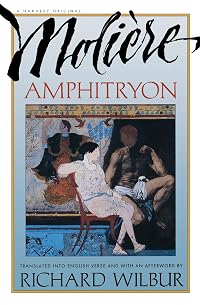
Amphitryon
by Molière
On This Page
Description
Jean-Baptiste Poquelin is better known to us by his stage name of Molie?re. He was born in Paris, to a prosperous well-to-do family on 15th January 1622. In 1631, his father purchased from the court of Louis XIII the posts of "valet of the King's chamber and keeper of carpets and upholstery" which Molie?re assumed in 1641. The benefits included only three months' work per annum for which he was paid 300 livres and also provided a number of lucrative contracts. However in June 1643, at 21, show more Molie?re abandoned this for his first love; a career on the stage. He partnered with the actress Madeleine Be?jart, to found the Illustre The?a?tre at a cost of 630 livres. Unfortunately despite their enthusiasm, effort and ambition the troupe went bankrupt in 1645. Molie?re and Madeleine now began again and spent the next dozen years touring the provincial circuit. His journey back to the sacred land of Parisian theatres was slow but by 1658 he performed in front of the King at the Louvre. From this point Molie?re both wrote and acted in a large number of productions that caused both outrage and applause. His many attacks on social conventions, the church, hypocrisy and other areas whilst also writing a large number of comedies, farces, tragicomedies, come?die-ballets are the stuff of legend. 'Tartuffe', 'The Misanthrope', 'The Miser' and 'The School for Wives' are but some of his classics. His death was as dramatic as his life. Molie?re suffered from pulmonary tuberculosis. One evening he collapsed on stage in a fit of coughing and haemorrhaging while performing in the last play he'd written, in which, ironically, he was playing the hypochondriac Argan, in 'The Imaginary Invalid'. Molie?re insisted on completing his performance. Afterwards he collapsed again with another, larger haemorrhage and was taken home. Priests were sent for to administer the last rites. Two priests refused to visit. A third arrived too late. On 17th February 1673, Jean-Baptiste Poquelin, forever to be known as Molie?re, was pronounced dead in Paris. He was 51. show lessTags
Recommendations































Member Reviews
Richard Wilbur’s Molière translations are all pure pleasure to read, and Amphitryon is no exception. It is set in Ancient Greece (although the characters all have Roman names) and provides a comic/farcical version of the Greek myth about Zeus/Jupiter’s disguised seduction of the wife of a Greek general. The irregular rhyme and meter delightfully complements the text, lend a light wittiness to a what is by now a reasonably stock story.
Amphitryon is Moliere's play about how Jupiter seduced Alkmene, the wife of Amphitryon, by disguising himself as her husband. Although Jupiter succeeds and leaves behind a pregnancy that will become Hercules, he is frustrated to find out that he did not succeed on his own - he only succeeded because Alkmeme that he was her husband Amphitryon.
I read this after reading and seeing a production of a Kleist play by the same name. In comparison to the other Kleist works, it is actually funny in spots. Because I was so surprised at this, I was curious how this could be and read that Kleist had based this on a play be the same name by Moliere. What I found, however, was that the Kleist play was essentially just a translation of the Moliere show more piece. The Moliere piece was better. show less
I read this after reading and seeing a production of a Kleist play by the same name. In comparison to the other Kleist works, it is actually funny in spots. Because I was so surprised at this, I was curious how this could be and read that Kleist had based this on a play be the same name by Moliere. What I found, however, was that the Kleist play was essentially just a translation of the Moliere show more piece. The Moliere piece was better. show less
Richard Wilbur
Amphitryon est une comédie de Molière en trois actes et en vers, qualifiée de classique. Elle est largement calquée sur l’Amphitryon de Plaute. La première représentation eut lieu au Palais-Royal le 13 janvier 1668. Le 16 janvier, la pièce est jouée au Tuileries devant Louis XIV. C’est un succès immédiat ; elle sera jouée vingt-neuf fois entre le 13 janvier et Pâques 1668. Molière, qui a alors 46 ans, tient le rôle de Sosie. Un parfum de scandale entoure la pièce, certains prétendant que, sous les traits de Jupiter, se cache Louis XIV, et qu’ainsi Molière critiquait les amours du roi Soleil. La popularité de l'œuvre est telle que deux de ses personnages sont entrés dans le langage courant : * Sosie, serviteur show more d'Amphitryon, a donné le mot français « sosie », pour désigner une personne ressemblant à une autre, comme pour Mercure et Sosie ; de même, dans un langage soutenu, un amphitryon désigne un hôte qui offre un dîner, suivant le vers célèbre de la pièce : « le véritable Amphitryon est l'Amphitryon où l'on dîne » show less
Jan 9, 2011French
Ratings
Members
- Recently Added By
Author Information

The French dramatist Moliere was born Jean-Baptiste Poquelin on January 15, 1622, in Paris. The son of a wealthy tapestry merchant, he had a penchant for the theater from childhood. In 1636, he was sent off to school at the Jesuit College of Claremont and in 1643, he embarked upon a 13-year career touring in provincial theater as a troupe member show more of Illustre Theatre, a group established by the family Bejarts. He married a daughter of the troupe, Armande Bejart, in 1662 and changed his name to Moliere. The French King Louis XIV, becoming entranced with the troupe after seeing a performance of The Would-Be Gentleman, lent his support and charged Moliere with the production of comedy ballets in which he often used real-life human qualities as backdrops rather than settings from church or state. Soon, Moliere secured a position at the Palais-Royal and committed himself to the comic theater as a dramatist, actor, producer, and director. Moliere is considered to be one of the preeminent French dramatists and writers of comedies; his work continues to delight audiences today. With L'Ecole des Femmes (The School for Wives) Moliere broke with the farce tradition, and the play, about the role played by women in society and their preparation for it, is regarded by many as the first great seriocomic work of French literature. In Tartuffe (1664), Moliere invented one of his famous comic types, that of a religious hypocrite, a character so realistic that the king forbade public performance of the play for five years. Moliere gave psychological depth to his characters, engaging them in facial antics and slapstick comedy, but with an underlying pathos. Jean Baptiste Moliere died in 1673. (Bowker Author Biography) show less
Some Editions
Series
Belongs to Publisher Series
Reclams Universal-Bibliothek (8488)
Work Relationships
Is contained in
Amphitryon / Bourgeois Gentleman / Dom Juan / Imaginary Invalid / Misanthrope / Miser / Tartuffe by Molière
Theatre Complet de Moliere, Tome III (Le Misanthrope, Le Medecin malgre lui, Melicerte, Pastorale comique, Le Sicilien, Amphitryon, Georges Dandin, L'Avare, Monsieur de Pourceaugnac, Les Amants magnifiques) by Molière
Was inspired by
Common Knowledge
- Canonical title*
- Amphitryon
- Original title
- Amphitryon
- Original publication date
- 1668 (original French) (original French); 1668-01-13; 1995 (English: Wilbur) (English: Wilbur)
- People/Characters*
- Amphitryon; Alcmene; Jupiter; Sosius; Cleantia; Mercurius
- Important places*
- Thebe, Griekenland
- Original language*
- Français
*Some information comes from Common Knowledge in other languages. Click "Edit" for more information.
Classifications
Statistics
- Members
- 172
- Popularity
- 190,027
- Reviews
- 4
- Rating
- (3.71)
- Languages
- 11 — Catalan, Czech, Danish, Dutch, English, Esperanto, Estonian, Finnish, French, German, Italian
- Media
- Paper, Ebook
- ISBNs
- 36
- ASINs
- 9