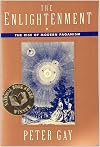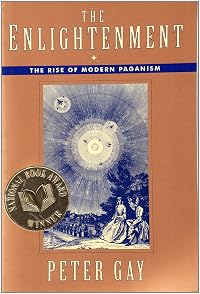
The Enlightenment: The Rise of Modern Paganism
by Peter Gay
On This Page
Description
In the twentieth century, however, the Enlightenment has often been judged harshly for its apparently simplistic optimism. Now a master historian goes back to the sources to give a fully rounded account of its true accomplishments.Tags
Recommendations












Member Reviews
For readers in the History of Ideas, The Enlightenment is intellectual history of the highest order, with Peter Gay’s erudition clearly on display, and a bibliographical essay (taking up fully a quarter of the bound pages) to make you cry for all you will never have time to read.
The focus here is on the effort by the philosophes and their fellow travelers to overcome, as they saw it, the irrationality and superstitions of medieval Scholasticism. This is a well-known story of the 17th-18th c. European Enlightenment. What makes Gay’s book useful is the attention that he pays to the congruities between the brightest lights of Christian theology and the ‘enlightened’ thinkers. After a thorough examination of the Enlightenment show more sources (again, that delicious bibliography), Gay doubles back and uncovers the work of late-medieval churchmen who were writing exegetical critiques of the extant orthodoxies—and in so doing anticipated many of the attacks leveled against Scholasticism by the philosophes. Many of the churchmen were proto-scientists, motivated by the Christian view of rationality and inspired to investigate the natural world so as to better understand divine purpose. For a while, writes Gay, theology became philosophy, but the Reformation challenge provoked a reactionary retrenchment, and theologians largely abandoned rationality for myth. It was the elevation of ‘mere myth’ to the status of philosophy that riled up so many of the philosophes.
Peter Gay makes a strong case for understanding the European Enlightenment not as a sudden repudiation of medieval irrationality, but as a gradual evolution in western philosophy. And while the philosophes claimed ancestry among the Classical Greeks, there was a more immediate antecedent of which they were ignorant. show less
The focus here is on the effort by the philosophes and their fellow travelers to overcome, as they saw it, the irrationality and superstitions of medieval Scholasticism. This is a well-known story of the 17th-18th c. European Enlightenment. What makes Gay’s book useful is the attention that he pays to the congruities between the brightest lights of Christian theology and the ‘enlightened’ thinkers. After a thorough examination of the Enlightenment show more sources (again, that delicious bibliography), Gay doubles back and uncovers the work of late-medieval churchmen who were writing exegetical critiques of the extant orthodoxies—and in so doing anticipated many of the attacks leveled against Scholasticism by the philosophes. Many of the churchmen were proto-scientists, motivated by the Christian view of rationality and inspired to investigate the natural world so as to better understand divine purpose. For a while, writes Gay, theology became philosophy, but the Reformation challenge provoked a reactionary retrenchment, and theologians largely abandoned rationality for myth. It was the elevation of ‘mere myth’ to the status of philosophy that riled up so many of the philosophes.
Peter Gay makes a strong case for understanding the European Enlightenment not as a sudden repudiation of medieval irrationality, but as a gradual evolution in western philosophy. And while the philosophes claimed ancestry among the Classical Greeks, there was a more immediate antecedent of which they were ignorant. show less
The origins of the intellectual movement that looked back to ancient Roman authors, and ahead to free thought and criticism of religion and government. Peter Gay elucidates the thoughts of Voltaire, Diderot, Rousseau, Hume, Kant, Lessing and other philosopes in the 18th century. These authors all drew from Roman writers like Cicero, Seneca, Lucretius and the Greek philosophers, finding inspiration in stoicism and pagan beliefs. They despised Christianity and its superstitions. Hume was famous for his calm and acceptance of death because many comtemporary writers, like James Boswell, expected Hume to return to religion in the face of death. The American founding fathers are part of this movement, and created the Declaration of show more Independence with enlightenment principles in mind.
The text is dense with long quotations from the philosophes, and descriptions of their milieu. There is a long bibliographic essay at the end of the main text. show less
The text is dense with long quotations from the philosophes, and descriptions of their milieu. There is a long bibliographic essay at the end of the main text. show less
Ratings
Members
- Recently Added By
Lists

Books in the Bibliography of The History of Hell by Alice K. Turner
155 works; 1 member
Author Information

57+ Works 8,246 Members
Awards and Honors
Awards
Common Knowledge
- Canonical title
- The Enlightenment: The Rise of Modern Paganism
- Original title
- The Enlightenment: An Interpretation: The Rise of Modern Paganism
- Original publication date
- 1966
- Important events
- Enlightenment
- Dedication
- For Ruthie
- First words
- There were many philosophes in the eighteenth century, but there was only one Enlightenment.
- Last words
- (Click to show. Warning: May contain spoilers.)Without melodrama but with the sober eloquence one would expect from an accomplished classicist, Hume makes plain that since God is silent, man is his own master: he must live in a disenchanted world, submit everything to criticism, and make his own way.
Classifications
- Genres
- History, Nonfiction, Philosophy, General Nonfiction, Religion & Spirituality
- DDC/MDS
- 190.9033 — Philosophy & psychology Modern western philosophy Modern western and other noneastern philosophy Biography; Enlightenment - History By Place 18th-century philosophers
- LCC
- B802 .G3 — Philosophy, Psychology and Religion Philosophy (General) By period Modern
- BISAC
Statistics
- Members
- 666
- Popularity
- 43,327
- Reviews
- 2
- Rating
- (4.23)
- Languages
- Chinese, Dutch, English, German
- Media
- Paper, Ebook
- ISBNs
- 7
- ASINs
- 11