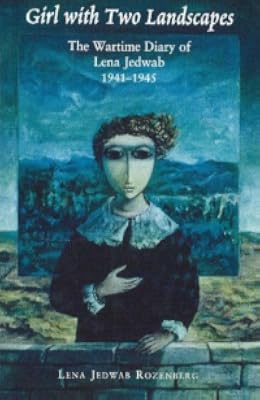
Girl with Two Landscapes: The Wartime Diary of Lena Jedwab, 1941-1945
by Lena Jedwab Rozenberg
On This Page
Description
She said goodbye to her parents, her brother, and her sister and set off to enjoy two months in the country. That was the last time she ever saw her family. In June 1941, sixteen-year-old Lena Jedwab from Bialystok arrived at summer camp in Russia-just when Germany invaded the Soviet Union. Shortly after, stranded by war in a children's home in Russia, Lena began to keep a diary, which she kept until the end of World War II. The diary chronicles her personal experiences of loneliness, pain, show more confusion, and her desire for love and recognition and also shows us vivid pictures of the world in which she lived and the world she had lost. Lena wrote her diary in Yiddish, not only because it was her mother tongue, but also as a conscious effort to maintain her Jewish identity. Her writing shows exceptional literary talent, full of subtlety and sensitivity, and by using that talent she has left us a moving testimony to some of history's darkest days. show lessTags
Recommendations
Member Recommendations


Member Reviews
This is billed as a Holocaust diary, and I suppose it could be classified as that. Lena Jedwab grew up in an impoverished Jewish family in Bialystok, Poland, which was claimed by the Russians after the division of Poland in 1939. In the summer of 1941, Lena, then fifteen, went to Lithuania to be a camp counselor. While she was gone, the Germans launched a surprise attack on Russian-occupied Poland. Unable to get home, Lena and the other summer camp children were evacuated deep into Russia. Her entire family perished in the Holocaust.
However, I think this book has more in common with the diaries of non-Jewish Russian youths during this period -- such as Nina Kosterina. Lena rarely mentions the Nazis, and she didn't experience firsthand show more any of their atrocities (though she has no illusions about the fate of her loved ones back in Poland). She doesn't even talk about the war very much. Instead she writes about her studies, her budding sexuality, and her activities in Communist youth organizations. In other words -- you won't see the stuff about ghettos and yellow stars and going into hiding like you will read in the diaries of Anne Frank, Rutka Laskier, etc.
Lena was a very intelligent and likeable girl with a genuine literary talent. I enjoyed watching her grow and mature in her diary, and I think the diary is well worth reading. But don't expect it to be like other "Holocaust diaries" out there. show less
However, I think this book has more in common with the diaries of non-Jewish Russian youths during this period -- such as Nina Kosterina. Lena rarely mentions the Nazis, and she didn't experience firsthand show more any of their atrocities (though she has no illusions about the fate of her loved ones back in Poland). She doesn't even talk about the war very much. Instead she writes about her studies, her budding sexuality, and her activities in Communist youth organizations. In other words -- you won't see the stuff about ghettos and yellow stars and going into hiding like you will read in the diaries of Anne Frank, Rutka Laskier, etc.
Lena was a very intelligent and likeable girl with a genuine literary talent. I enjoyed watching her grow and mature in her diary, and I think the diary is well worth reading. But don't expect it to be like other "Holocaust diaries" out there. show less
Members
- Recently Added By
Author Information
1 Work 13 Members
Classifications
- Genres
- History, Nonfiction, Biography & Memoir
- DDC/MDS
- 940.53089 — History & geography History of Europe History of Europe 1918- World War II, 1939-1945 Culture Studies
- LCC
- DS135 .R95 .R68 — History of Europe, Asia, Africa and Oceania Asia History of Asia Israel (Palestine). The Jews Jews outside of Palestine
Statistics
- Members
- 13
- Popularity
- 1,770,645
- Reviews
- 1
- Rating
- (4.00)
- Languages
- English
- Media
- Paper
- ISBNs
- 1
- ASINs
- 1