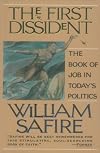
The First Dissident: The Book of Job in Today's Politics
by William Safire
On This Page
Description
William Safire, one of America's most influential political columnists, applies the Book of Job to the politics of today. In The First Dissident he shows how modern heroes have reshaped authority and history - and how individual citizens can, too - by following the courageous example of Job. The Bible's Book of Job is the story of a good man who dares to challenge God's judgment. Job's search for the answer to apparent injustice in God's design has stirred religious controversy and inspired show more readers for 2,500 years. Tennyson called the Book of Job "the greatest poem of ancient and modern times." D.H. Lawrence described it as "the story of your own soul." Safire's provocative exploration interprets Job - the innocent, angry sufferer - as the original dissenter. He shows how the biblical story can serve as inspiration and instruction manual for modern leaders and citizens, a primer on effective protest - when to dissent, how to force authority to listen, what kinds of persuasion work, why it is important for leaders to avoid isolation. He illuminates the timeless role of dissent in shaping power and influencing even the highest authority. And he draws modern-day parallels in the struggles of such human rights leaders as Mustapha Barzani, Martin Luther King, Jr., Natan Sharansky, Vaclav Havel, and others. The First Dissident is written in William Safire's insightful style of informal scholarship and is studded with anecdotes and examples drawn from Safire's wide-ranging political experience in the White House as speechwriter and in covering global politics for The New York Times. The First Dissident reaches across the millennia to show how any person, armed with a sense of righteousness, can engage with higher authority to protest unfair treatment - and thereby change the world. show lessTags
Recommendations


































Member Reviews
I liked his interpretation of Job, but I did not like his applying it to the deeds of conservative politicians.
An insightful look at the book of Job as well as some great political commentary.
“I read the Book of Job last night. I don’t think God comes well out of it.” — Virginia Woolf (1882-1941)
Ratings
Members
- Recently Added By
Author Information

39+ Works 5,072 Members
William Safire was born on Dec. 17, 1929. He attended Syracuse University, but dropped out after two years. He began his career as a reporter for The New York Herald Tribune. He had also been a radio and television producer and a U.S. Army correspondent. From 1955 to 1960, Safire was vice president of a public relations firm in New York City, and show more then became president of his own firm. He was responsible for bringing Nixon and Nikita Khrushchev together in 1959. In 1968, he joined the campaign of Richard Nixon as a senior White House speechwriter for Nixon. Safire joined The New York Times in 1973 as a political columnist. He also writes a Sunday column, On Language, which has appeared in The New York Times Magazine since 1979. This column on grammar, usage, and etymology has led to the publication of 10 books and made him the most widely read writer on the English language. William Safire was the winner of the 1978 Pulitzer Prize for distinguished commentary. He is a trustee for Syracuse University. Since 1995 he has served as a member of the Pulitzer Board. He is the author of Freedom (1987), a novel of Lincoln and the Civil War. His other novels include Full Disclosure (1977), Sleeper Spy (1995) and Scandalmonger (2000). His other titles include a dictionary, a history, anthologies and commentaries. (Bowker Author Biography) show less
Common Knowledge
- Original publication date
- 1992
Classifications
Statistics
- Members
- 243
- Popularity
- 133,078
- Reviews
- 3
- Rating
- (3.75)
- Languages
- English
- Media
- Paper, Ebook
- ISBNs
- 4
- ASINs
- 2