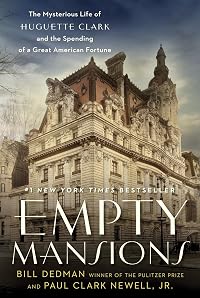
Empty Mansions: The Mysterious Life of Huguette Clark and the Spending of a Great American Fortune
by Bill Dedman, Paul Clark Newell, Jr.
On This Page
Description
"When Pulitzer Prize-winning journalist Bill Dedman noticed a property listing for a grand estate that had been unoccupied for nearly sixty years, he stumbled into one of the most surprising American stories of the nineteenth and twentieth centuries. Empty Mansions is a rich tale of wealth and loss, complete with copper barons, Gilded Age opulence, and backdoor politics. At its heart is a reclusive 104-year-old heiress named Huguette Clark. Dedman has collaborated with Huguette's cousin, show more Paul Clark Newell, Jr., one of the few relatives to have had frequent conversations with her, to tell a fairy tale in reverse: the bright, talented daughter who is born into an almost royal family of amazing wealth and privilege, yet who secrets herself away from the outside world. Empty Mansions reveals a complete picture of the enigmatic Huguette Clark, heiress to one of the greatest fortunes in American history, a woman who had not been photographed in public since the 1920s. Though she owned three palatial homes in California, New York, and Connecticut, they sat vacant while she lived out her final two decades in a New York City hospital room, despite being in excellent health. Her father was self-made copper industrialist W. A. Clark, who at the dawn of the twentieth century was one of the richest men in America. Huguette's inheritance afforded her untold luxury: gorgeous paintings by Degas and Renoir, a world-renowned Stradivarius violin, a vast collection of antique dolls, lavish gifts for her friends, the freedom to pursue her own work as an artist, and, most important, the privacy she valued above all else. The Clark family story takes the reader nearly the entire span of American history in just three generations. The same Huguette who held a ticket for the return trip of the Titanic was touched by the terror attacks of 9/11. In this scrupulously detailed account, we meet Huguette's extravagant father, her publicity-shy mother, her star-crossed sister, her noble French boyfriend, the nurse who received more than $30 million in gifts, and the relatives seeking to inherit Huguette's $300 million fortune. Richly illustrated with more than seventy photographs, some never before seen, Empty Mansions is a touching story of an eccentric of the highest order, a last jewel of the Gilded Age who lived life on her own terms"-- show lessTags
Recommendations









Member Recommendations
akblanchard Both stories illustrate how wealth corrupts and families grow apart.
Member Reviews
One day Dr. Singman was on his way to the opulent apartment of Huguette Clark, an 85-year-old heiress living in seclusion whose untreated ailments meant that she had to be admitted to the hospital. She would regain her health, but she spent the rest of her life (twenty years) living in a hospital room. Her beautifully appointed mansions in California, Connecticut, and New York City would continue to wait for an owner who would never visit.
To understand Huguette Clark, one must learn about her parents. Her father, William A. Clark was one of the wealthiest men in America, making his fortune in copper. The one thing he wanted was a title, and he tried every trick in the book to become the senator from Montana. After his experiences he show more retired from the political arena to build the largest, most impressive mansion on Fifth Avenue. This is where he would bring his second wife (39 years his junior) and his two daughters to live.
The second Mrs. Clark shunned the limelight, and her youngest daughter seems to have inherited that trait and turned it into an art form. After a disastrous marriage that didn't survive the honeymoon, Huguette lived with her mother, the two women dividing their time between their Santa Barbara, California mansion, and their spacious apartments in New York City. After her mother's death, Huguette chose to live alone with her priceless paintings and her exquisite collections of Japanese art. As her servants died one by one, she found herself alone, communicating by letter or telephone. Once in the hospital, she felt safe and cared for, and the hospital administrators decided not to make her leave.
Granted, the part of the book about William A. Clark is the most interesting. The man lived a long life, and he lived large-- so large that several books could easily be written about him. However, this book does belong to Huguette. It's difficult to make someone fascinating who would only communicate by letter or telephone. It's hard to bring a woman to life who hadn't had her photograph taken in decades. It's even more demanding to create a portrait of a woman who loved to paint, to watch The Flintstones and The Smurfs, and to create elaborately detailed dollhouses, without having readers dismiss her as childish or senile. The authors do manage to accomplish this very subtly.
During her later years, Huguette loved to write checks to those she cared for and who cared for her. The nurses who worked with her soon learned to pepper their daily conversations with off-hand mentions of old, worn-out cars, wished-for college educations, or tiny, cramped apartments. Even Huguette's doctors made frequent appearances with their requests, and the administrators had their own pecuniary reasons for allowing her to live in their hospital. After her death at the age of 104, Huguette's relatives, who'd thought nothing of leaving her alone for decades without even cards or telephone calls, began circling to contest her will. $300 million will do that to most people.
It's easy to read this book and dismiss Huguette Clark as a little rich girl who never had to grow up, as an old lady who was taken advantage of by everyone she came in contact with. But that's not what I came away with when I'd finished Empty Mansions. I was left with a mind buzzing with details about priceless art and the most opulent era in America, and that's not all. Not by a long shot. I was also left believing that here was one woman who was given the opportunity to do what made her happy, and she took it. She did as she pleased, she hurt no one, and she helped many people. Was she taken advantage of? Yes, I believe she was. But I also believe that she took more than a few advantages of her own.
The authors set out to present a fair and balanced portrait of a mystifying woman. They did, and in such a discerning manner that I didn't feel coerced into their way of thinking. Empty Mansions is a fascinating portrait of a bygone era and an enigmatic woman. show less
To understand Huguette Clark, one must learn about her parents. Her father, William A. Clark was one of the wealthiest men in America, making his fortune in copper. The one thing he wanted was a title, and he tried every trick in the book to become the senator from Montana. After his experiences he show more retired from the political arena to build the largest, most impressive mansion on Fifth Avenue. This is where he would bring his second wife (39 years his junior) and his two daughters to live.
The second Mrs. Clark shunned the limelight, and her youngest daughter seems to have inherited that trait and turned it into an art form. After a disastrous marriage that didn't survive the honeymoon, Huguette lived with her mother, the two women dividing their time between their Santa Barbara, California mansion, and their spacious apartments in New York City. After her mother's death, Huguette chose to live alone with her priceless paintings and her exquisite collections of Japanese art. As her servants died one by one, she found herself alone, communicating by letter or telephone. Once in the hospital, she felt safe and cared for, and the hospital administrators decided not to make her leave.
Granted, the part of the book about William A. Clark is the most interesting. The man lived a long life, and he lived large-- so large that several books could easily be written about him. However, this book does belong to Huguette. It's difficult to make someone fascinating who would only communicate by letter or telephone. It's hard to bring a woman to life who hadn't had her photograph taken in decades. It's even more demanding to create a portrait of a woman who loved to paint, to watch The Flintstones and The Smurfs, and to create elaborately detailed dollhouses, without having readers dismiss her as childish or senile. The authors do manage to accomplish this very subtly.
During her later years, Huguette loved to write checks to those she cared for and who cared for her. The nurses who worked with her soon learned to pepper their daily conversations with off-hand mentions of old, worn-out cars, wished-for college educations, or tiny, cramped apartments. Even Huguette's doctors made frequent appearances with their requests, and the administrators had their own pecuniary reasons for allowing her to live in their hospital. After her death at the age of 104, Huguette's relatives, who'd thought nothing of leaving her alone for decades without even cards or telephone calls, began circling to contest her will. $300 million will do that to most people.
It's easy to read this book and dismiss Huguette Clark as a little rich girl who never had to grow up, as an old lady who was taken advantage of by everyone she came in contact with. But that's not what I came away with when I'd finished Empty Mansions. I was left with a mind buzzing with details about priceless art and the most opulent era in America, and that's not all. Not by a long shot. I was also left believing that here was one woman who was given the opportunity to do what made her happy, and she took it. She did as she pleased, she hurt no one, and she helped many people. Was she taken advantage of? Yes, I believe she was. But I also believe that she took more than a few advantages of her own.
The authors set out to present a fair and balanced portrait of a mystifying woman. They did, and in such a discerning manner that I didn't feel coerced into their way of thinking. Empty Mansions is a fascinating portrait of a bygone era and an enigmatic woman. show less
Where I got the book: LibraryThing Early Reviewers Program
Journalist Bill Dedman came across one of Huguette Clark's properties when, frustrated by never seeming to find the right house to move to, he decided to look up properties he really couldn't afford on the internet. As you do. This led him to discover that Huguette Clark had spent the last decades of her life in an ordinary room in a New York hospital, despite being in reasonable health and having multi-million-dollar real estate in New York, Connecticut and California.
He discovered that Madame Clark, as she liked to be known, was the daughter of a copper baron, famous in his lifetime but now forgotten, and his very much younger second wife. She'd spent her early years in France show more and still retained a slight French accent and a fondness for all things French. She collected dolls and dollhouses, painted in oils and was obsessed with Japanese culture; and yet after living such a reclusive life in her New York apartment that she had allowed cancer to eat away at her face, she now preferred to look at photos of her collections from her hospital bed.
And she gave away money--lots of it. Despite the concerted efforts of the hospital and various art foundations to milk her for all she was worth, Huguette preferred to give her money to the people in her life; hospital staff, assistants, the people who looked after her properties and, a little sinisterly, her lawyer and accountant. This created some definite potential conflicts of interest for the people in contact with her, not to mention enormous consequences in terms of gift tax and some very bad feeling on the part of her extended family who didn't actually bother to visit her but wanted her money anyway.
There are quite a few levels to this story. There's the history of W.A. Clark, Huguette's father, and how he made his fortune and steamrolled his way into politics, for one. The guy was a player with a foot in US history; the unneeded lots he sold off from his railroad holdings, for example, formed the core of downtown Las Vegas. He did things on a massive scale but once he was dead, nobody carried his legacy forward; they broke up his homes and spent his money instead. As we all know, the entrepreneurial spirit rarely survives a privileged childhood.
Then there's the story of Huguette's great spendathon aka her life. I don't think there's anyone for whom the idea of having a bottomless checkbook doesn't bring a gleam to the eye. Huguette had that checkbook--more money than she could get through in her lifetime. There are lists of gifts, lists of purchases, jaw-dropping figures galore for the breathlessly envious or avidly curious to peruse and sigh over.
Then there's the sad personal story of a woman who must have always wondered if her friends were friends because of her or because of her money. Even the distant cousin who spoke with her three or four times a year on the phone was recording those conversations and co-authored the book; he wasn't in the will, but boy he could still make money from Tante Huguette. It's a great picture of how life as a seriously moneyed person is also a lonely life, and it makes me very happy that my own checkbook has a very solid bottom.
The material is nicely arranged, the writing is lively and there are pictures. An interesting book for the nonfiction lover with a fascination for how the other half live. show less
Journalist Bill Dedman came across one of Huguette Clark's properties when, frustrated by never seeming to find the right house to move to, he decided to look up properties he really couldn't afford on the internet. As you do. This led him to discover that Huguette Clark had spent the last decades of her life in an ordinary room in a New York hospital, despite being in reasonable health and having multi-million-dollar real estate in New York, Connecticut and California.
He discovered that Madame Clark, as she liked to be known, was the daughter of a copper baron, famous in his lifetime but now forgotten, and his very much younger second wife. She'd spent her early years in France show more and still retained a slight French accent and a fondness for all things French. She collected dolls and dollhouses, painted in oils and was obsessed with Japanese culture; and yet after living such a reclusive life in her New York apartment that she had allowed cancer to eat away at her face, she now preferred to look at photos of her collections from her hospital bed.
And she gave away money--lots of it. Despite the concerted efforts of the hospital and various art foundations to milk her for all she was worth, Huguette preferred to give her money to the people in her life; hospital staff, assistants, the people who looked after her properties and, a little sinisterly, her lawyer and accountant. This created some definite potential conflicts of interest for the people in contact with her, not to mention enormous consequences in terms of gift tax and some very bad feeling on the part of her extended family who didn't actually bother to visit her but wanted her money anyway.
There are quite a few levels to this story. There's the history of W.A. Clark, Huguette's father, and how he made his fortune and steamrolled his way into politics, for one. The guy was a player with a foot in US history; the unneeded lots he sold off from his railroad holdings, for example, formed the core of downtown Las Vegas. He did things on a massive scale but once he was dead, nobody carried his legacy forward; they broke up his homes and spent his money instead. As we all know, the entrepreneurial spirit rarely survives a privileged childhood.
Then there's the story of Huguette's great spendathon aka her life. I don't think there's anyone for whom the idea of having a bottomless checkbook doesn't bring a gleam to the eye. Huguette had that checkbook--more money than she could get through in her lifetime. There are lists of gifts, lists of purchases, jaw-dropping figures galore for the breathlessly envious or avidly curious to peruse and sigh over.
Then there's the sad personal story of a woman who must have always wondered if her friends were friends because of her or because of her money. Even the distant cousin who spoke with her three or four times a year on the phone was recording those conversations and co-authored the book; he wasn't in the will, but boy he could still make money from Tante Huguette. It's a great picture of how life as a seriously moneyed person is also a lonely life, and it makes me very happy that my own checkbook has a very solid bottom.
The material is nicely arranged, the writing is lively and there are pictures. An interesting book for the nonfiction lover with a fascination for how the other half live. show less
 This review was written for LibraryThing Early Reviewers.
EMPTY MANSIONS is my first audiobook of 2018. (The plan is to dedicate most of my audiobook listening to nonfiction this year. We’ll see how it goes!) Abandoned places are fascinating to me. While the mansions in this book weren’t abandoned entirely (there were caretakers on-site), the eccentric owner – Huguette Clark – hadn’t lived in them or seen them in decades. In fact, she spent her last 20 years living unnecessarily in hospital rooms, until her death in 2011 at age 104.
The first part of the book was all about Huguette’s father, W. A. Clark, who amassed a great fortune in copper mines and railroads during the late 1800s. Mr. Clark had quite an exciting life, going from a humble Pennsylvania farm boy to an extremely show more wealthy industrialist with a passion for art and the finest things money could buy. When he died in 1925, his fortune was split equally between Huguette and her four older half-siblings.
The rest of the book focused on Huguette and the ways she spent her inheritance. She was an unusual person, private to a fault, and very generous to people and causes close to her heart. She seemed happiest when she was hidden away from the world, among her art and her dollhouses.
As she got older, I think there were some who took advantage of her generosity. She gave away millions and millions, but was she manipulated by those few who were close to her? Conflicting wills written close together bring her mental state into question.
EMPTY MANSIONS is a well-researched blend of American History, biography, and family drama. The audiobook was performed by Kimberly Farr, and she did a fantastic job keeping me engaged in Huguette’s story. It also contained snippets of phone conversations between Huguette and her cousin, Paul Clark Newell, Jr., one of the co-authors of this book.
Overall, I enjoyed EMPTY MANSIONS, though given how insanely private Huguette Clark was during her life, I think she would cringe knowing this book is out there. show less
The first part of the book was all about Huguette’s father, W. A. Clark, who amassed a great fortune in copper mines and railroads during the late 1800s. Mr. Clark had quite an exciting life, going from a humble Pennsylvania farm boy to an extremely show more wealthy industrialist with a passion for art and the finest things money could buy. When he died in 1925, his fortune was split equally between Huguette and her four older half-siblings.
The rest of the book focused on Huguette and the ways she spent her inheritance. She was an unusual person, private to a fault, and very generous to people and causes close to her heart. She seemed happiest when she was hidden away from the world, among her art and her dollhouses.
As she got older, I think there were some who took advantage of her generosity. She gave away millions and millions, but was she manipulated by those few who were close to her? Conflicting wills written close together bring her mental state into question.
EMPTY MANSIONS is a well-researched blend of American History, biography, and family drama. The audiobook was performed by Kimberly Farr, and she did a fantastic job keeping me engaged in Huguette’s story. It also contained snippets of phone conversations between Huguette and her cousin, Paul Clark Newell, Jr., one of the co-authors of this book.
Overall, I enjoyed EMPTY MANSIONS, though given how insanely private Huguette Clark was during her life, I think she would cringe knowing this book is out there. show less
Empty Mansions: The Mysterious Life of Huguette Clark and the Spending of a Great American Fortune by Bill Dedman and Paul Clark Newell Jr. is a 2013 Ballantine publication.
This is one of those books I discovered through a Goodreads friend, and thankfully one of my local libraries to provide me with a digital copy and another one had it on audio, so I listened to parts of the book and read the other parts, which made this a unique experience.
The author describes how he first came across the story of the Clark family’s empty mansions and I can see why this story and mystery surrounding it would appeal to anyone, but for a journalist the urge to investigate was nearly impossible to ignore.
The book got off to a slow start for me, as show more the authors went through the family background explaining how Clarks accumulated their vast fortune.
But then the book began to read like an episode of “American Castles’ and I got caught up the descriptions of opulence, the blueprints of the main properties owned by W.A. Clark. The designs, the furnishings, the grounds and the various collections of art and books, china and countless other investments were mind boggling.
I then found myself wrapped up in W. A. Clark’s rather colorful personal life, his bid for the senate, various scandals he found himself embroiled in, and of course his family life.
All of this is quite interesting, but then the second half of the book begins to focus exclusively on Huguette Clark, W.A.’s daughter, who eventually inherited the family fortune.
Huguette Clark was an odd duck, surely suffering from some form of mental illness, such as agoraphobia.
Which is why she spent the last part of her life in a hospital room instead of living in any of the incredible properties she owned. Still, she insisted that the properties were maintained, although the caretakers never met her in person.
She maintained an incredible collection of dolls, one that kept her rapt attention well into her later years, which added to her eccentric persona.
But, once she shut herself off from the world, allowing people access to her funds, and realizing her penchant for giving away large sums of money to people, namely people who cared for her during her long hospital stay, it made her quite vulnerable. She was taken advantage of by many people and institutions, until her fortune began to dwindle and was put at risk.
Yet, despite her overly generous nature, her oddness, and mental illnesses, she was physically well, and I think maybe she controlled her life the best way she knew how, unable to trust certain people or capable of coping with the demands and pressures of such a large fortune and the obligations typically attached to it. She may very well have done with her money, exactly what she wished to, although some took advantage of her in a terrible way.
Sadly, her family contested her wills, with a three hundred million dollar bounty on the line, but one had to wonder if maybe Huguette’s mind was sound and she left what was left of her fortune to the people and causes she wanted. I was conflicted about the will, but felt that most of it should have been left as it was, although the nurse Huguette seemed so fond of, was not my favorite, but then neither were the relatives who came crawling out of the woodwork after her death.
.
This is a fascinating historical novel, highlighting a family whose wealth rivaled the Rockefellers, but whose name faded into obscurity. It’s a shame the mansions were left unoccupied for so many years, and it’s so sad that Huguette didn’t do more with her life. Her story is a kind of cautionary tale, warning that money does not buy happiness or contentment.
This book has been researched thoroughly and gives us an intimate look at the Clark family and their history. The audio version includes some actual voice mail recordings and the book provides a few interior photos the mansions.
I felt like this book was a nice mix of history and family saga, rich in historical details, sweeping the reader up into the gilded age, which is a period of history I find endlessly fascinating.
Although the book ends before the settlement was reached with the family, you can look up the Clark family on the internet to learn what eventually happened to the long vacant properties.
Despite the rough start, I ended up losing myself in this book and it has wetted my appetite for more information on the family and the amazing collections and homes they built. show less
This is one of those books I discovered through a Goodreads friend, and thankfully one of my local libraries to provide me with a digital copy and another one had it on audio, so I listened to parts of the book and read the other parts, which made this a unique experience.
The author describes how he first came across the story of the Clark family’s empty mansions and I can see why this story and mystery surrounding it would appeal to anyone, but for a journalist the urge to investigate was nearly impossible to ignore.
The book got off to a slow start for me, as show more the authors went through the family background explaining how Clarks accumulated their vast fortune.
But then the book began to read like an episode of “American Castles’ and I got caught up the descriptions of opulence, the blueprints of the main properties owned by W.A. Clark. The designs, the furnishings, the grounds and the various collections of art and books, china and countless other investments were mind boggling.
I then found myself wrapped up in W. A. Clark’s rather colorful personal life, his bid for the senate, various scandals he found himself embroiled in, and of course his family life.
All of this is quite interesting, but then the second half of the book begins to focus exclusively on Huguette Clark, W.A.’s daughter, who eventually inherited the family fortune.
Huguette Clark was an odd duck, surely suffering from some form of mental illness, such as agoraphobia.
Which is why she spent the last part of her life in a hospital room instead of living in any of the incredible properties she owned. Still, she insisted that the properties were maintained, although the caretakers never met her in person.
She maintained an incredible collection of dolls, one that kept her rapt attention well into her later years, which added to her eccentric persona.
But, once she shut herself off from the world, allowing people access to her funds, and realizing her penchant for giving away large sums of money to people, namely people who cared for her during her long hospital stay, it made her quite vulnerable. She was taken advantage of by many people and institutions, until her fortune began to dwindle and was put at risk.
Yet, despite her overly generous nature, her oddness, and mental illnesses, she was physically well, and I think maybe she controlled her life the best way she knew how, unable to trust certain people or capable of coping with the demands and pressures of such a large fortune and the obligations typically attached to it. She may very well have done with her money, exactly what she wished to, although some took advantage of her in a terrible way.
Sadly, her family contested her wills, with a three hundred million dollar bounty on the line, but one had to wonder if maybe Huguette’s mind was sound and she left what was left of her fortune to the people and causes she wanted. I was conflicted about the will, but felt that most of it should have been left as it was, although the nurse Huguette seemed so fond of, was not my favorite, but then neither were the relatives who came crawling out of the woodwork after her death.
.
This is a fascinating historical novel, highlighting a family whose wealth rivaled the Rockefellers, but whose name faded into obscurity. It’s a shame the mansions were left unoccupied for so many years, and it’s so sad that Huguette didn’t do more with her life. Her story is a kind of cautionary tale, warning that money does not buy happiness or contentment.
This book has been researched thoroughly and gives us an intimate look at the Clark family and their history. The audio version includes some actual voice mail recordings and the book provides a few interior photos the mansions.
I felt like this book was a nice mix of history and family saga, rich in historical details, sweeping the reader up into the gilded age, which is a period of history I find endlessly fascinating.
Although the book ends before the settlement was reached with the family, you can look up the Clark family on the internet to learn what eventually happened to the long vacant properties.
Despite the rough start, I ended up losing myself in this book and it has wetted my appetite for more information on the family and the amazing collections and homes they built. show less
I have a friend who calls herself a failed reader. She thinks because it takes her a long time to get through a book, and because she likes non-fiction, her reading "doesn't count". Ha! This book was one she highly recommended.
Fascinating, well written, and in the "life is indeed strange" category. I found the back history of the Clark family as interesting as Huguette Clark's own (long) personal one. The mansions, perfectly maintained, yet unlived in were just one element that tagged my attention. Huguette's artwork and doll collection grabbed another piece. I don't think this is a case of "poor little rich girl" as she seems to have been content with her existence, in fact, she took great effort to maintain her privacy, even if it show more cost her thousands of dollars. Her generosity, while laudable, was a bit over the top at the end, especially. Sad that her family seems so out of touch with her in the last decades.
Excellent writing and research, too. show less
Fascinating, well written, and in the "life is indeed strange" category. I found the back history of the Clark family as interesting as Huguette Clark's own (long) personal one. The mansions, perfectly maintained, yet unlived in were just one element that tagged my attention. Huguette's artwork and doll collection grabbed another piece. I don't think this is a case of "poor little rich girl" as she seems to have been content with her existence, in fact, she took great effort to maintain her privacy, even if it show more cost her thousands of dollars. Her generosity, while laudable, was a bit over the top at the end, especially. Sad that her family seems so out of touch with her in the last decades.
Excellent writing and research, too. show less
Huguette Clark's father made millions in mining and railroad ventures in the Gilded Age, but his daughter Huguette lived out much of her life as a recluse, spending the last decades in a hospital room, even though she was perfectly healthy.
As a peek into the life of the super-rich, it is staggering. From her father's Park Avenue mansion (26 bedrooms, 31 bathrooms and five art galleries for a family of four -- plus staff, of course) to Huguette's determination to reproduce her late mother's bedroom in another apartment while leaving the originals in an unoccupied one -- the curtain is drawn back on people who spend unthinkable sums to gratify their whims. But at the same time, Huguette Clark is shown as a loving and generous patron, not show more only of the arts, but to family and friends. She was lavish in her financial gifts to them, but utterly parsimonious with her time and physical presence.
The book outlines what is known of her life, most drawn from the voluminous correspondence she left behind, but never really speculates as to why she became so reclusive in her later years or why she spent the last 20 years of her life in a hospital room when she was fully recovered from the health emergency that sent her there.
Fascinating reading about an ultimately unknowable character. show less
As a peek into the life of the super-rich, it is staggering. From her father's Park Avenue mansion (26 bedrooms, 31 bathrooms and five art galleries for a family of four -- plus staff, of course) to Huguette's determination to reproduce her late mother's bedroom in another apartment while leaving the originals in an unoccupied one -- the curtain is drawn back on people who spend unthinkable sums to gratify their whims. But at the same time, Huguette Clark is shown as a loving and generous patron, not show more only of the arts, but to family and friends. She was lavish in her financial gifts to them, but utterly parsimonious with her time and physical presence.
The book outlines what is known of her life, most drawn from the voluminous correspondence she left behind, but never really speculates as to why she became so reclusive in her later years or why she spent the last 20 years of her life in a hospital room when she was fully recovered from the health emergency that sent her there.
Fascinating reading about an ultimately unknowable character. show less
Though prominent in his day, mining, banking, and railroad magnate William Andrews Clark (1839-1925) has been all but forgotten. This engrossing book revives his story and that of his daughter Huguette Clark (1906-2011), youngest of the five children who survived him. Huguette emerges as an extraordinary, if somewhat eccentric, woman who inherited a fortune but lived out her last decades in a spartan hospital room--despite no medical or financial necessity--while her five homes (the titular "empty mansions") sat vacant. Carrying out the "mansions" theme, most of the chapters bear the name or address of one of the Clark residences and focus on the period in which one or more of the Clarks occupied or acquired it.
The authors, one an show more award-winning journalist and the other a half-grandnephew of Huguette, engrossingly recount W. A.'s rise to wealth, as well as his daughter's life. For this reader's interests, they describe the houses and furnishings in perhaps too much detail. They abundantly offset it, however, with the final chapters--a riveting chronicle of Huguette's late-in-life reliance on caregivers and other employees who professed their devotion to her while, in some cases, failing to protect her valuable belongings from theft and, in other instances, reporting their monetary woes and shamelessly accepting checks totaling millions of dollars. These chapters serve as a cautionary tale for anyone in comfortable circumstances--not only the wealthiest few--who have no immediate family whom they can trust in old age.
Although the authors emphasize that Huguette made these gifts willingly, that her mind was unimpaired, that she had many friends, and that she long remained in touch (on her terms) with certain of her half-siblings and their descendants, it is difficult to avoid the conclusion that Huguette's life was as empty as her mansions. Although she made generous gifts to certain arts organizations and contributed to memorials to deceased relatives, her wealth would have supported much more meaningful philanthropy.
If I had browsed through this book in a bookstore, I would not have been tempted to buy it. Something about its description in the Early Reviewer list attracted me, however, and I'm very glad that I read Empty Mansions--though I can't quite explain why a book about someone notable only for inheriting great wealth and spending it erratically merited being written. Did it impress me because it is extensively documented? Because it is well structured and engagingly written? Because Huguette is unlike anyone else I've ever heard of? There is something sad and abnormal about this lady, yet she emerges as someone I would like to have known--even if I never saw her brandish her checkbook. show less
The authors, one an show more award-winning journalist and the other a half-grandnephew of Huguette, engrossingly recount W. A.'s rise to wealth, as well as his daughter's life. For this reader's interests, they describe the houses and furnishings in perhaps too much detail. They abundantly offset it, however, with the final chapters--a riveting chronicle of Huguette's late-in-life reliance on caregivers and other employees who professed their devotion to her while, in some cases, failing to protect her valuable belongings from theft and, in other instances, reporting their monetary woes and shamelessly accepting checks totaling millions of dollars. These chapters serve as a cautionary tale for anyone in comfortable circumstances--not only the wealthiest few--who have no immediate family whom they can trust in old age.
Although the authors emphasize that Huguette made these gifts willingly, that her mind was unimpaired, that she had many friends, and that she long remained in touch (on her terms) with certain of her half-siblings and their descendants, it is difficult to avoid the conclusion that Huguette's life was as empty as her mansions. Although she made generous gifts to certain arts organizations and contributed to memorials to deceased relatives, her wealth would have supported much more meaningful philanthropy.
If I had browsed through this book in a bookstore, I would not have been tempted to buy it. Something about its description in the Early Reviewer list attracted me, however, and I'm very glad that I read Empty Mansions--though I can't quite explain why a book about someone notable only for inheriting great wealth and spending it erratically merited being written. Did it impress me because it is extensively documented? Because it is well structured and engagingly written? Because Huguette is unlike anyone else I've ever heard of? There is something sad and abnormal about this lady, yet she emerges as someone I would like to have known--even if I never saw her brandish her checkbook. show less
This review was written for LibraryThing Early Reviewers.Members
- Recently Added By
Lists

Top Five Books of 2013
1,562 works; 715 members

Penguin Random House
458 works; 4 members

Books Read in 2020
4,379 works; 123 members

Best Biographies of Notable Women
277 works; 101 members

Biographies of Little Known People
39 works; 2 members

Books Read in 2025
4,091 works; 97 members
Author Information

2 Works 1,719 Members
1 Work 1,719 Members
Awards and Honors
Awards
Common Knowledge
- Canonical title
- Empty Mansions: The Mysterious Life of Huguette Clark and the Spending of a Great American Fortune
- Original publication date
- 2013-09-10
- People/Characters
- Huguette Marcelle Clark; Dr. Henry Singman; Louise Amelia Andree Clark; William Andrews Clark; Anna Eugenia LaChapelle Clark; Marcus Daly (show all 14); Tadeusz Styka; William MacDonald Gower; Dr. William Gordon Lyle; Leontine Lyle; Ann Ellis Reynolds; Marquis Etienne Allard de Villermont; Hadassah Peri; Chris Sattler
- Important places
- New York, New York, USA; Belloguardo, Santa Barbara, California, USA; Butte, Montana, USA; Connellsville, Pennsylvania, USA; Las Vegas, Nevada, USA
- Important events
- American Civil War (1861 | 1865); Gilded Age (1870 | 1900); California Gold Rush (1848 | 1855); World War I (1914 | 1918); World War II (1939 | 1945); September 11 Attacks (2001-09-11)
- First words
- We came to this story by separate paths, one of us by accident and one by birth.
- Last words
- (Click to show. Warning: May contain spoilers.)To live happily, live hidden.
- Canonical DDC/MDS
- 973.9092
- Canonical LCC
- CT275.C6273
Classifications
Statistics
- Members
- 1,718
- Popularity
- 12,837
- Reviews
- 99
- Rating
- (3.77)
- Languages
- English, Italian
- Media
- Paper, Audiobook, Ebook
- ISBNs
- 10
- ASINs
- 11

