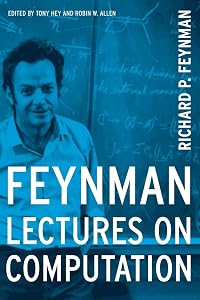
Feynman Lectures on Computation
by Richard Feynman
On This Page
Description
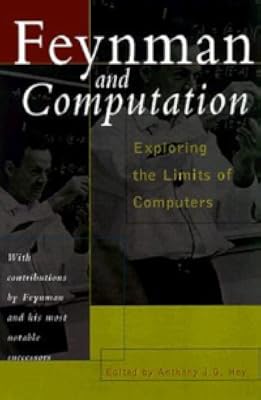
From 1983 to 1986, the legendary physicist and teacher Richard Feynman gave a course at Caltech called "Potentialities and Limitations of Computing Machines.”Although the lectures are over ten years old, most of the material is timeless and presents a "Feynmanesque” overview of many standard and some not-so-standard topics in computer science. These include computability, Turing machines (or as Feynman said, "Mr. Turing’s machines”), information theory, Shannon’s Theorem, show more reversible computation, the thermodynamics of computation, the quantum limits to computation, and the physics of VLSI devices. Taken together, these lectures represent a unique exploration of the fundamental limitations of digital computers.Feynman’s philosophy of learning and discovery comes through strongly in these lectures. He constantly points out the benefits of playing around with concepts and working out solutions to problems on your own-before looking at the back of the book for the answers. As Feynman says in the lectures: "If you keep proving stuff that others have done, getting confidence, increasing complexities of your solutions-for the fun of it-then one day you’ll turn around and discovers that nobody actually did that one! And that’s the way to become a computer scientist.” show lessTags
Recommendations


Member Reviews
There is much that is meritorious here: Feynman's distinctive voice comes through clearly. One gets an insight into both his teaching philosophy and his working methods. The book heavily reflects what Feynman thought was important, interesting and essential to know about the field and makes accessible some really unusual topics as well as some familiar ones (if one has ever done an entry level course on the subject). There is a 10p memoir of Feynman by the book's editor at the end, which contains some delightful anecdotes that are not recorded elsewhere in the Feynman canon.
Feynman's working method, which he encourages others to adopt, was to work out as much as he can on his own first and look up what others had done afterwards. He show more would find that usually he had come up with no original results but quite often would have reached the same conclusions by an alternative route. Occasionally he proved something that was not known before. This technique is fabulous if one has both a wide knowledge (in memory) of physics and maths and a great facility with both, too. For lesser mortals it's completely useless.
The book oscillated from fascinating (reversible computing, quantum computers) to excruciatingly dull (logic circuit design, chip fabrication, semi-conductor device theory) depending on my personal level of interest. Even Feynman can't make engineering interesting to me! But that's not his fault; if you're into these topics it'll be great. If you're not, it's for Feynman completists only. show less
Feynman's working method, which he encourages others to adopt, was to work out as much as he can on his own first and look up what others had done afterwards. He show more would find that usually he had come up with no original results but quite often would have reached the same conclusions by an alternative route. Occasionally he proved something that was not known before. This technique is fabulous if one has both a wide knowledge (in memory) of physics and maths and a great facility with both, too. For lesser mortals it's completely useless.
The book oscillated from fascinating (reversible computing, quantum computers) to excruciatingly dull (logic circuit design, chip fabrication, semi-conductor device theory) depending on my personal level of interest. Even Feynman can't make engineering interesting to me! But that's not his fault; if you're into these topics it'll be great. If you're not, it's for Feynman completists only. show less
Somewhat of a mixed bag. The first half is very interesting, then kind of loses steam towards the end. It seems like some course lecture notes were somewhat quickly tossed together to make a book; this could have benefited from a more in-depth going over by Feynman to smooth out some rough edges. Overall worth reading for a unique physicist's view of computability, but don't expect it to be up to Feynman's usual standard of quality.
A very challenging and very deep book. Feynman at his best and most suprising, anticipating things like quantum computing years in advance. See a genius at work.
Ratings
Members
- Recently Added By
Author Information

153+ Works 41,284 Members
Series
Belongs to Publisher Series
Common Knowledge
- Original publication date
- 1996
- People/Characters
- Alan Turing; Alonzo Church; Stephen C. Kleene; Emil Post; Marvin Minsky; Claude Shannon
- Original language
- English
Classifications
- Genres
- Science & Nature, Technology, Nonfiction, General Nonfiction
- DDC/MDS
- 004.01 — Computer science, information & general works Computer science, knowledge & systems Computer science standard subdivisions Philosophy and theory
- LCC
- QA76 .F45 — Science Mathematics Mathematics Instruments and machines Calculating machines Electronic computers. Computer science Computer software
- BISAC
Statistics
- Members
- 550
- Popularity
- 53,912
- Reviews
- 3
- Rating
- (4.01)
- Languages
- English, French, Spanish
- Media
- Paper, Ebook
- ISBNs
- 13
- ASINs
- 7