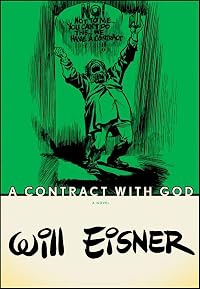
A Contract with God and Other Tenement Stories
by Will Eisner
The Contract with God Trilogy (1), Will Eisner Library
On This Page
Description
Revolutionary novel, A Contract With God re-creates the neighborhood of Will Eisner's youth through a quartet of four interwoven stories. Expressing the joy, exuberance, tragedy, and drama of life on the mythical Dropsie Avenue of the Bronx, A Contract With God is a monumental achievement, a must in the library of any graphic novel fan.Tags
Recommendations





Member Reviews
In his December 2004 introduction to the 2005 reprint of A Contract with God, Will Eisner wrote of the work’s genesis, “In 1978, encouraged by the work of the experimental graphic artists Otto Nückel, Franz Masareel and Lynd Ward, who in the 1930s published serious novels told in art without text, I attempted a major work in a similar form” (pgs. xxiii-xxiv). He described his narrative as “an exercise in personal agony,” his way of dealing with the death of his daughter, Alice, from leukemia in 1970. Eisner wrote, “I exorcised my rage at a deity that I believed violated my faith and deprived my lovely 16-year-old child of her life at the very flowering of it” (pg. xxvi).
The titular story begins with Frimme Hersch show more returning to the tenement at No. 55 Dropsie Avenue, after burying his daughter Rachele. Eisner depicts the scene with long lines of rain striking through Frimme and the background, leaving only the puddles as solid shapes. The reader can feel the rain soaking into Frimme while the lines darken the image to match Eisner’s narration. He writes, “Only the tears of ten thousand weeping angels could cause such a deluge!” (pg. 6). Eisner adds the same lines of rain to the bottom of his letters, giving the appearance of the ink bleeding down the page from the rain. He continues, “Not so unusual, a father brings up a child with care and love only to lose her… plucked, as it were, from his arms by an unseen hand – the hand of God” (pg. 8). This atmospheric narration overlays the open door of the tenement, appearing in the rain seen through the doorway while puddles on the floor show Frimme’s sodden path into the building. One of his neighbors offers him food, but Frimme, appearing to melt as Eisner depicts the water dropping off of him, passes on the offer. Later, as Frimme vents his anger at his god, Eisner uses the medium of comics to capture his anguish and rage in a way realistic illustration would not allow: his eyes bulge, his mouth gapes, and Eisner’s linework captures his fury (pg. 25). Frimme abandons the contract he made with God as a young boy, becoming a real-estate investor. When he acquires sufficient wealth, he asks the synagogue elders to write him a new contract. Reading it, he pledges to rededicate himself to good works and charity, only to die of a heart attack. Eisner’s first short story in this anthology perfectly captures a sense of loss and dramatic irony while evoking the people he knew as a young man growing up in the Bronx. In a way, the work foreshadows elements of Michael Chabon’s novel, The Amazing Adventures of Kavalier & Clay, itself about city life, the comics industry, and the collision of old world and new.
The other stories similarly have a folklorish tone, full of dramatic irony. “The Street Singer” tells of a man singing in alleys to make money. He attracts the attention of a former opera singer, who thinks she can teach him to be a star. After spending her cash advance on alcohol, he realizes he never wrote down her address and so sees his chance of a big break disappear before his eyes. In “The Super,” Eisner examines the antagonistic relationship between the residents and the building supervisor, Mr. Scuggs, while also showcasing the seedy underside of life in the tenements. Eisner portrays the anti-Semitic super fantasizing about an underage girl in a manic panel capturing his frenzied thoughts as he drinks beer and looks at lewd advertisements (pg. 107). The girl arrives, flashes him for a nickel, then poisons his dog and grabs his cashbox while his back is turned. He chases her, only for the building residents to see him about to hit her and call the police. Returning to his basement room, he cradles his dead dog and shoots himself. The story itself and Eisner’s graphic depiction of the super’s fantasizing recall the underground comix of the 1960s and 1970s, though he never shows more than the story requires and remains focused on the complexity of life in the slums rather than indulging his inner Id, as R. Crumb would do. Eisner begins with the narration, “After all, he was the landlord’s man – the enemy” (pg. 100). He gives the super the unflattering name of Scuggs, portrays him as balding and overweight, and portrays his disturbing fantasies. Eisner wants the reader to align with the tenants against this bully, only for him to evoke their sympathy when the littler girl poisons his dog. After Scuggs returns to his basement room, he cradles the dog in a series of textless panels in which Eisner depicts his anguish. Though Eisner never portrays Scuggs as a good man, he does show him as capable of genuine affection for one living creature, thereby depicting a far more complicated morality than appeared in most comics in 1978. The final story, “Cookalein,” examines the class structure of vacations, with the wealthy leaving the city in the summer for fancy Catskills resorts and those in the tenements going to farms with cottages, where a family might share a single room while also doing their own cooking and bringing their own linens. Even in vacation, however, people bring their problems and the traumas of the tenement with them. show less
The titular story begins with Frimme Hersch show more returning to the tenement at No. 55 Dropsie Avenue, after burying his daughter Rachele. Eisner depicts the scene with long lines of rain striking through Frimme and the background, leaving only the puddles as solid shapes. The reader can feel the rain soaking into Frimme while the lines darken the image to match Eisner’s narration. He writes, “Only the tears of ten thousand weeping angels could cause such a deluge!” (pg. 6). Eisner adds the same lines of rain to the bottom of his letters, giving the appearance of the ink bleeding down the page from the rain. He continues, “Not so unusual, a father brings up a child with care and love only to lose her… plucked, as it were, from his arms by an unseen hand – the hand of God” (pg. 8). This atmospheric narration overlays the open door of the tenement, appearing in the rain seen through the doorway while puddles on the floor show Frimme’s sodden path into the building. One of his neighbors offers him food, but Frimme, appearing to melt as Eisner depicts the water dropping off of him, passes on the offer. Later, as Frimme vents his anger at his god, Eisner uses the medium of comics to capture his anguish and rage in a way realistic illustration would not allow: his eyes bulge, his mouth gapes, and Eisner’s linework captures his fury (pg. 25). Frimme abandons the contract he made with God as a young boy, becoming a real-estate investor. When he acquires sufficient wealth, he asks the synagogue elders to write him a new contract. Reading it, he pledges to rededicate himself to good works and charity, only to die of a heart attack. Eisner’s first short story in this anthology perfectly captures a sense of loss and dramatic irony while evoking the people he knew as a young man growing up in the Bronx. In a way, the work foreshadows elements of Michael Chabon’s novel, The Amazing Adventures of Kavalier & Clay, itself about city life, the comics industry, and the collision of old world and new.
The other stories similarly have a folklorish tone, full of dramatic irony. “The Street Singer” tells of a man singing in alleys to make money. He attracts the attention of a former opera singer, who thinks she can teach him to be a star. After spending her cash advance on alcohol, he realizes he never wrote down her address and so sees his chance of a big break disappear before his eyes. In “The Super,” Eisner examines the antagonistic relationship between the residents and the building supervisor, Mr. Scuggs, while also showcasing the seedy underside of life in the tenements. Eisner portrays the anti-Semitic super fantasizing about an underage girl in a manic panel capturing his frenzied thoughts as he drinks beer and looks at lewd advertisements (pg. 107). The girl arrives, flashes him for a nickel, then poisons his dog and grabs his cashbox while his back is turned. He chases her, only for the building residents to see him about to hit her and call the police. Returning to his basement room, he cradles his dead dog and shoots himself. The story itself and Eisner’s graphic depiction of the super’s fantasizing recall the underground comix of the 1960s and 1970s, though he never shows more than the story requires and remains focused on the complexity of life in the slums rather than indulging his inner Id, as R. Crumb would do. Eisner begins with the narration, “After all, he was the landlord’s man – the enemy” (pg. 100). He gives the super the unflattering name of Scuggs, portrays him as balding and overweight, and portrays his disturbing fantasies. Eisner wants the reader to align with the tenants against this bully, only for him to evoke their sympathy when the littler girl poisons his dog. After Scuggs returns to his basement room, he cradles the dog in a series of textless panels in which Eisner depicts his anguish. Though Eisner never portrays Scuggs as a good man, he does show him as capable of genuine affection for one living creature, thereby depicting a far more complicated morality than appeared in most comics in 1978. The final story, “Cookalein,” examines the class structure of vacations, with the wealthy leaving the city in the summer for fancy Catskills resorts and those in the tenements going to farms with cottages, where a family might share a single room while also doing their own cooking and bringing their own linens. Even in vacation, however, people bring their problems and the traumas of the tenement with them. show less
My first Will Eisner. The art is exquisite, but maaaan is this a bleak depiction of the human condition.
In general, I don't love narratives that are framed around whoever is causing the most pain. In these stories, it's often unclear which character earns this superlative - nevertheless, most are organized around broken men and the inscrutable or one-dimensional women who, like the God of the title story, push them toward their tragic ends. From this perspective, "Cookalein" was probably my favorite story - it's heavy, but felt more multidimensional.
I think the best art resonates even when the creator and audience have different worldviews. From that perspective, A Contract With God is a successful book - I found a lot to unpack in show more these stories, despite not sharing their assessment of human nature. show less
In general, I don't love narratives that are framed around whoever is causing the most pain. In these stories, it's often unclear which character earns this superlative - nevertheless, most are organized around broken men and the inscrutable or one-dimensional women who, like the God of the title story, push them toward their tragic ends. From this perspective, "Cookalein" was probably my favorite story - it's heavy, but felt more multidimensional.
I think the best art resonates even when the creator and audience have different worldviews. From that perspective, A Contract With God is a successful book - I found a lot to unpack in show more these stories, despite not sharing their assessment of human nature. show less
Graphic novels or non-fiction was the theme for the January 2022 American Authors Challenge. I was encouraged to try this one by its subject matter---life in a tenement in the Bronx during the early years of the 20th century. The copy I obtained from the library contained all three of Eisner's novels The Contract With God Trilogy and the author himself wrote the introduction, which was excellent, and made me expect a sort of Jewish version of A Tree Grows in Brooklyn. Not so. I found the characters to be more like caricatures; the women all either worn-out, bitter and frumpy or Barbie-doll man-killers; the men brutish and lustful or sly and conniving. The art reflects those qualities, and there is no subtlety in it whatsoever. There is show more also no hope or humor in it that I could detect. All in all, distasteful and not for me. TW for rape and nudity. show less
A powerfully written, powerfully drawn collections of stories set on the mythic "Dropsie Avenue," a Bronx street of Jewish tenements in the 1930s. It has all the sentimental cliches about Jewish immigrants in the Bronx. But this novel, which makes the reasonable claim to be the first graphic novel, is anything but sentimental. It depicts a pious man stealing from a synagogue; a brutal, wife-beating alcoholic street singer who catches a lucky break and then loses it; a sex-obsessed superintendent being taken advantage and driven to suicide by a wily 10-year old girl; and the sexual and matrimonial lies of a set of people as they shuttle back and forth from the Bronx to their summer vacations in the Catskills.
But beneath all of this, show more there is still something sentimental about the community that is being presented, the traditions, and the gritty realities of a collection of people working hard to get ahead in New York--working in everything from the clothing trade to accounting to show business.
The pictures are extremely good, especially the expressiveness on the faces which can--and should--almost be read without the words because what they convey is so much more powerful. show less
But beneath all of this, show more there is still something sentimental about the community that is being presented, the traditions, and the gritty realities of a collection of people working hard to get ahead in New York--working in everything from the clothing trade to accounting to show business.
The pictures are extremely good, especially the expressiveness on the faces which can--and should--almost be read without the words because what they convey is so much more powerful. show less
A powerfully written, powerfully drawn collections of stories set on the mythic "Dropsie Avenue," a Bronx street of Jewish tenements in the 1930s. It has all the sentimental cliches about Jewish immigrants in the Bronx. But this novel, which makes the reasonable claim to be the first graphic novel, is anything but sentimental. It depicts a pious man stealing from a synagogue; a brutal, wife-beating alcoholic street singer who catches a lucky break and then loses it; a sex-obsessed superintendent being taken advantage and driven to suicide by a wily 10-year old girl; and the sexual and matrimonial lies of a set of people as they shuttle back and forth from the Bronx to their summer vacations in the Catskills.
But beneath all of this, show more there is still something sentimental about the community that is being presented, the traditions, and the gritty realities of a collection of people working hard to get ahead in New York--working in everything from the clothing trade to accounting to show business.
The pictures are extremely good, especially the expressiveness on the faces which can--and should--almost be read without the words because what they convey is so much more powerful. show less
But beneath all of this, show more there is still something sentimental about the community that is being presented, the traditions, and the gritty realities of a collection of people working hard to get ahead in New York--working in everything from the clothing trade to accounting to show business.
The pictures are extremely good, especially the expressiveness on the faces which can--and should--almost be read without the words because what they convey is so much more powerful. show less
Will Eisner's Contract with God was arguably the beginning of the graphic novel as an American Art form. No longer confining comics to daily serials starring super heroes or those on other lofty quests, Eisner's stories concentrated on the day-to-day lives of those living in a tenement on Droopsie Avenue in the Bronx. What may at first appear to be simple stories soon become the things that will bind the tenement dwellers together in the one thing that is always in plentiful supply on Droopsie...the long suffering days interspersed with the few fleeting moments of triumph.
These stories will be repeated until the end of time in different skins and will be lauded as new and groundbreaking. But the truth is that it all starts here...and, show more yes, your grandparents and great-grandparents absolutely understood what it was like to have life randomly kick them when they were down for no good reason. And then they found ways to tell life that they were going to sometimes find victory on their own terms. Crazy, but true. Luckily, Eisner got it down for the permanent record. show less
These stories will be repeated until the end of time in different skins and will be lauded as new and groundbreaking. But the truth is that it all starts here...and, show more yes, your grandparents and great-grandparents absolutely understood what it was like to have life randomly kick them when they were down for no good reason. And then they found ways to tell life that they were going to sometimes find victory on their own terms. Crazy, but true. Luckily, Eisner got it down for the permanent record. show less
I LOVE this whole book! It's four short stories, all in graphic novel format, black and white.
I had to pick this up for my "Graphic Novel" class, before which I'd never heard of the book.
The stories here are really amazing. I really connected to it because of the Jewish backgrounds of many of the characters, which is something I'm not used to in comics. The characters were all very unique, mentally and physically (you could tell them all apart very easily, even ignoring their clothing). I loved the art style, and the way Eisner manipulates the story with just three colors (black, white and gray) is really cool.
This is a great read if you're interested in comics. Just be careful where you read it or who you give it to because it does show more deal with "adult" themes and is rather explicit at times. show less
I had to pick this up for my "Graphic Novel" class, before which I'd never heard of the book.
The stories here are really amazing. I really connected to it because of the Jewish backgrounds of many of the characters, which is something I'm not used to in comics. The characters were all very unique, mentally and physically (you could tell them all apart very easily, even ignoring their clothing). I loved the art style, and the way Eisner manipulates the story with just three colors (black, white and gray) is really cool.
This is a great read if you're interested in comics. Just be careful where you read it or who you give it to because it does show more deal with "adult" themes and is rather explicit at times. show less
Members
- Recently Added By
Lists

Recommended Comics / Graphic Novels
595 works; 122 members

Read
293 works; 4 members

The Atlantic's The Great American Novel
136 works; 12 members
Author Information

Will Eisner was born March 6, 1917 in Brooklyn, NY. As a child he worked for printers and sold newspapers. He attended De Witt Clinton High School in the Bronx, where his artwork first appeared in the school newspaper. His first job was at the New York American, but he lost that and found a job with WOW What a Magazine! in 1936. He created two show more features for the magazine, Harry Karry and The Flame. After the magazine went under, for a short time, he freelanced and drew stories for Comic Magazines before he and friend Jerry Iger formed a the Eisner-Iger studio. The two went their separate ways when Eisner joined the Quality Comics Group to produce a syndicated 16-page newspaper supplement. It was there that Eisner created his most well known character, the Spirit. In 1942, Eisner was drafted into the army where he produced posters and strips for the troops. After the war, he continued the Spirit strip until 1952. It was during this time that he created the American Visuals Corporation, a commercial art company that created comics for educational and commercial purposes. Some of the company's clients included RCA Records, the Baltimore Colts, and New York Telephone. Eisner had given up on the Spirit strip, but still produced new material for it from time to time. He chose to focus his efforts on a more mature storyline and so produced A Contract With God, which was published in 1978. It was the beginnings of the graphic novel. Eisner also taught cartooning at the School of Visual Arts in New York, in addition to writing Comics and Sequential Art and Graphic Storytelling. The Eisner Awards, one of only two comics industry awards, are named for Eisner and were established in 1988. Eisner's work was showcased in the Whitney Museum's 1996 "NYNY: City of Ambition" show. Will Eisner passed away on Monday January 3, 2005 at the age of 87 after undergoing quadruple bypass heart surgery. (Bowker Author Biography) show less
Some Editions
Awards and Honors
Series


Belongs to Publisher Series
Colecção Novela Gráfica (série I) (01)
Work Relationships
Is contained in
Common Knowledge
- Canonical title
- A Contract with God and Other Tenement Stories
- Original publication date
- 1978, 1983, 1995
- People/Characters
- Frimmehleh Hersh; Rachele Hersh; Shloime Khreks; Diva Marta Maria (Sylvia Speegel); Ronald Barry (Eddie); Sophie (show all 20); Mr. Scuggs; Mrs. Farfell; Rosie; Goldie; Benny; Will Eisner; Fannie Eisner; Sam Eisner; Herbie; Petey Eisner; Maralyn Minks; Harold Shmutzik; Irving Minks; Ruthie Fein
- Important places
- The Bronx, New York, New York, USA; Catskill Mountains, New York, USA
- Important events
- Great Depression
- First words
- At 55 Dropsie Avenue, the Bronx, new York--not far from the elevated station--stood the tenement.
- Last words
- (Click to show. Warning: May contain spoilers.)Nu...Willie? Vacation's over already! So, start getting ready for school!! This year you're gonna have lotsa responsibility around here ... your father is ... ... gonna be ::AH:: traveling a lot ... so, yizzel. Be the man of the house now! ...y'hear me Willie ...Willie?
- Blurbers
- Vonnegut, Kurt
- Disambiguation notice*
- The Contract with God Trilogy is a different book from A Contract with God and Other Tenement Stories. Please, don't combine them.
*Some information comes from Common Knowledge in other languages. Click "Edit" for more information.
Classifications
- Genre
- Graphic Novels & Comics
- DDC/MDS
- 741.5973 — Arts & recreation Drawing & decorative arts Drawing Comic books, graphic novels, fotonovelas, cartoons, caricatures, comic strips History, geographic treatment, biography North American United States (General)
- LCC
- PN6727 .E4 .C6 — Language and Literature Literature (General) Literature (General) Collections of general literature Comic books, strips, etc.
- BISAC
Statistics
- Members
- 1,138
- Popularity
- 22,158
- Reviews
- 42
- Rating
- (3.97)
- Languages
- 12 — Danish, Dutch, English, Finnish, French, German, Greek, Italian, Norwegian (Bokmål), Portuguese, Spanish, Yiddish
- Media
- Paper, Ebook
- ISBNs
- 39
- ASINs
- 3