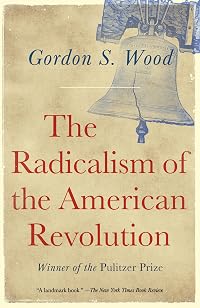
The Radicalism of the American Revolution
by Gordon S. Wood
On This Page
Description
Gordon Wood depicts not just a break with England, but the rejection of an entire way of life. A society with feudal dependencies, a politics of patronage, and a world view in which people were divided between the nobility and 'the Herd.' He shows how the theories of the country's founders became realities that sometimes baffled and disappointed them.Tags
Recommendations
















Member Recommendations


Member Reviews
THAT ENDING. WOW. Wood takes us through an entire description of how radical politicians tore down monarchy... and then adds a sarcastic, bitter, twist ending revealing that every founding father eventually came to hate the America they had created.
Gordon Wood, in a well-researched and well-written book, shows why the American Revolution was so revolutionary. In grad school and academe, there is a tendency to say the French Revolution was a REAL revolution, or so the Russian, etc., but that the American Revolution really wasn't. They say it was a civil war and rebellion, but NOT a revolution. They say it was conservative, reactionary, and all orchestrated by (à la Charles Beard) by the wealthy to help the wealthy. Some will even call it a counter-revolution or "conservative revolution." But historian Gordon Wood wants to show you all the ways it WAS revolutionary. It undermined monarchical, patriarchal society. It put the ideas of equality and democracy out in the open. And there show more was no going back. To prove his thesis, Gordon talks about the lead up to the Revolution, the Revolution, and through the 1700s to the start of the Jacksonian Era to show you all the ways the American Revolution influenced the opening and democratization of society. There were some glaring omissions, like slavery—of course. But, the idea that all white men were EQUAL was radical. And it inevitably led to "aren't black men equal too?" and "aren't women equal too?" and so forth. Lots of examples, lots of primary sources discussed. No pics. Lots of endnotes, some discursive; no separate bibliography. There are some things that Wood might get wrong, and I don't agree with all of his interpretations or all the implications for American history. I think the Founders were not so hateful about the changes to society as he may lead on. And, he seems to praise democracy over republics, but, the Founders chose republic for a reason. And we still operate as such for a reason. show less
The American Revolution was a failure.
That is not the opinion of Wood. It was the opinion of the Revolutionaries. Looking back on what they had wrought, they were despondent over the gap between their ambition and their achievement.
“We are indeed a bebanked, a bewhiskied, and a bedollared nation,” said Benjamin Rush in 1812. Of the Constitution, he said, “I cannot meet a man who loves it.” The government had devolved to the “young and ignorant and needy part of the community.”
George Washington complained character was no longer a factor in politics.
John Adams, in 1813, asked “Where is now, the progress of the human Mind? … When? Where? And How? Is the present Chaos to be arranged into Order?”
Alexander Hamilton looked show more at a country he had helped birth on the battlefield and said “this American world was not made for me”.
Thomas Jefferson was not just speaking of personalities but also of revolutionary principles when he lamented in 1825, “All, all dead, and ourselves left alone amidst a new generation whom we know not, and who knows not us.”
And neither did I know them, not really, before reading this book.
What Wood shows is the aristocratic world the Revolutionaries rebelled against: a world of patronage and connection, the mixing of private and public interests, of dependency being key to advancement and not merit. He then shows the republican world they dreamed of: disinterested men of merit in charge, a natural aristocracy leading a nation of improving minds.
And then he shows the world they produced, the acid of an egalitarianism they unknowingly and unwillingly ushered in which destroyed the old ways families related to each other, created greater inequalities of wealth, substituted party patronage and politics for personal patronage, replaced Christian reason with evangelism, and brought about the beginnings of the modern bureaucratic American state and its ethnic politics.
The American Revolution certainly produced less bodies than the French Revolution or its heirs in Russia and China, but it, Wood convincingly argues, was even more radical in how it changed the way the “people” related to each other, what “commerce” was, what “equality” was. It literally redefined those words.
Wood details this progression in three parts: “Monarchy”, “Republicanism”, and “Democracy”. There is no specific timeline, no specific date the Revolutionary Republican dream dies. It’s hard to plot exactly in time how millions of minds and attitudes changed. However, he presents a surprisingly readable mixture of apt anecdote and quotation and statistics to document that change in the American mind.
For me, if not Wood, the book is another example of the failure of the Blank Slate idea the Enlightenment was so fond of. Even the wise and learned Revolutionaries had their hopes dashed on it. And Wood convincingly shows that the America many conservatives love is not the world the Founding Fathers had in mind even at its most basic social and political workings.
Wood concludes his work noting that, while they failed, the Founders’ revolution did not fail in typical ways but “succeeded only too well”. Wood argues that the price of the democracy the Revolutionaries unleashed on the world was vulgarity, materialism, rootlessness, and anti-intellectualism. But there were “real earthly benefits … to the hitherto neglected and despised masses of common laboring people”.
I will leave it as an exercise to the reader, though, to ponder whether the more than 20 years of American politics since this book was written have not, in a peculiar way, have seen a growing amalgamation of the worst of the aristocratic and democratic worlds. It is to Wood’s great credit that he has produced a history that educates us about the past and yet so pertinent to our world and conversations today. show less
That is not the opinion of Wood. It was the opinion of the Revolutionaries. Looking back on what they had wrought, they were despondent over the gap between their ambition and their achievement.
“We are indeed a bebanked, a bewhiskied, and a bedollared nation,” said Benjamin Rush in 1812. Of the Constitution, he said, “I cannot meet a man who loves it.” The government had devolved to the “young and ignorant and needy part of the community.”
George Washington complained character was no longer a factor in politics.
John Adams, in 1813, asked “Where is now, the progress of the human Mind? … When? Where? And How? Is the present Chaos to be arranged into Order?”
Alexander Hamilton looked show more at a country he had helped birth on the battlefield and said “this American world was not made for me”.
Thomas Jefferson was not just speaking of personalities but also of revolutionary principles when he lamented in 1825, “All, all dead, and ourselves left alone amidst a new generation whom we know not, and who knows not us.”
And neither did I know them, not really, before reading this book.
What Wood shows is the aristocratic world the Revolutionaries rebelled against: a world of patronage and connection, the mixing of private and public interests, of dependency being key to advancement and not merit. He then shows the republican world they dreamed of: disinterested men of merit in charge, a natural aristocracy leading a nation of improving minds.
And then he shows the world they produced, the acid of an egalitarianism they unknowingly and unwillingly ushered in which destroyed the old ways families related to each other, created greater inequalities of wealth, substituted party patronage and politics for personal patronage, replaced Christian reason with evangelism, and brought about the beginnings of the modern bureaucratic American state and its ethnic politics.
The American Revolution certainly produced less bodies than the French Revolution or its heirs in Russia and China, but it, Wood convincingly argues, was even more radical in how it changed the way the “people” related to each other, what “commerce” was, what “equality” was. It literally redefined those words.
Wood details this progression in three parts: “Monarchy”, “Republicanism”, and “Democracy”. There is no specific timeline, no specific date the Revolutionary Republican dream dies. It’s hard to plot exactly in time how millions of minds and attitudes changed. However, he presents a surprisingly readable mixture of apt anecdote and quotation and statistics to document that change in the American mind.
For me, if not Wood, the book is another example of the failure of the Blank Slate idea the Enlightenment was so fond of. Even the wise and learned Revolutionaries had their hopes dashed on it. And Wood convincingly shows that the America many conservatives love is not the world the Founding Fathers had in mind even at its most basic social and political workings.
Wood concludes his work noting that, while they failed, the Founders’ revolution did not fail in typical ways but “succeeded only too well”. Wood argues that the price of the democracy the Revolutionaries unleashed on the world was vulgarity, materialism, rootlessness, and anti-intellectualism. But there were “real earthly benefits … to the hitherto neglected and despised masses of common laboring people”.
I will leave it as an exercise to the reader, though, to ponder whether the more than 20 years of American politics since this book was written have not, in a peculiar way, have seen a growing amalgamation of the worst of the aristocratic and democratic worlds. It is to Wood’s great credit that he has produced a history that educates us about the past and yet so pertinent to our world and conversations today. show less
Gordon Wood is my favorite revolutionary war historian by far, so it was a real priority for me to read his magnum opus, Radicalism of the American Revolution. In this early and influential work, I see the traces and ideas he later expands on in the Americanization of Benjamin Franklin as well as The Idea of America. In particular, the discussion of the concept of the gentleman and courtier culture.
The book is pretty dense, a real academic work that packs a lot of complex and nuanced ideas. It's not really for someone looking for a brief brush up or simple chronological retelling of the revolutionary war. Loosely speaking, Wood is part of the ideological school that opposes the progressive tradition, mostly represented by Charles show more Beard. Beard and the progressive tradition lean quasi-marxist, in that they believe history is explained by material and economic behavior alone, frequently between the haves and have-nots. The ideological school opposes this viewpoint as far too restricting and unsatisfactory. For example, Wood notes that despite the attempts for progressive historians to find an economic crisis that led to the American Revolution, there really isn't one; the revolution was largely caused by a shift in ideas. Wood doesn't go so far as to completely disregard the economic basis behind the revolution. For example, he discusses how the wide availability of land effectively made early america a truncated society. Unlike in Europe, where the landed gentry lived off of rent, there was too much land for there to be a real American entrenched aristocracy. America was also lacking the urban poor of Europe. This truncated society had huge implications, in that Americans were more receptive to republican ideals, and the lack of a stable aristocracy made the early dream of an enlightened disinterested elite impractical. Wood also discusses the often overlooked home manufacturing that eventually grew into the American celebration of commerce.
Wood's point is to show that even though the American Revolution seems conservative compared to the Russian or French Revolution, the changes in society and ideas was indeed both radical and novel for the western world. The book moves through three phases, monarchy, republic and democracy. There's alot that changes through each phase, but I'll mention what I think are the most interesting. Monarchical society was highly hierarchical, familial and patriarchal. During the revolution, these ideas were challenged and replaced with a natural aristocracy, where people rose and fell based on merit not family ties. Offices were no longer seen as rightfully belonging to a few families, and the governmental model moved from the King as patriarch, to government by consent (there's some interesting discussion of the rise of contract culture). Even changing ideas of family structure, from father as head to enlightened paternalism changed the concepts of governance. Government was suppose to be rule by disinterested elites, who had independent wealth and would put the public interest above their own. Work was not seen as a source of wealth or pride, but as a distrusted interest, and the only caused by necessity of starvation. Finally, the revolution unleashed democracy, where the talk of equality broadened from equal capability to equality of all opinions and peoples. The disinterested elites were attacked, as was their main source of distinction, leisure. Work and commence were celebrated, and the rise of popular politics came into play. Interests not only became accepted, they became the model of governance. Office no longer became the monopoly of educated elites, but also representatives of artisans, workers and mechanics. The anti-elitism of American politics was born, as was the nascent belief that people could and did have opinions that were as good as those of elites (which was heavily tied to the idea of freedom of press, even when the opinions might be false or incorrect). Parties, which were distrusted by the founding fathers, were born as permanent institutions and party loyalty became the chief criteria for holding office. These are just a few of the interesting changes that Wood discusses in the book. I have to draw this to a close, I'd probably write a small essay just going over some of the ideas in this dense and nuanced book. A highly recommended read for anyone with a deep interest in the history of our early republic. show less
The book is pretty dense, a real academic work that packs a lot of complex and nuanced ideas. It's not really for someone looking for a brief brush up or simple chronological retelling of the revolutionary war. Loosely speaking, Wood is part of the ideological school that opposes the progressive tradition, mostly represented by Charles show more Beard. Beard and the progressive tradition lean quasi-marxist, in that they believe history is explained by material and economic behavior alone, frequently between the haves and have-nots. The ideological school opposes this viewpoint as far too restricting and unsatisfactory. For example, Wood notes that despite the attempts for progressive historians to find an economic crisis that led to the American Revolution, there really isn't one; the revolution was largely caused by a shift in ideas. Wood doesn't go so far as to completely disregard the economic basis behind the revolution. For example, he discusses how the wide availability of land effectively made early america a truncated society. Unlike in Europe, where the landed gentry lived off of rent, there was too much land for there to be a real American entrenched aristocracy. America was also lacking the urban poor of Europe. This truncated society had huge implications, in that Americans were more receptive to republican ideals, and the lack of a stable aristocracy made the early dream of an enlightened disinterested elite impractical. Wood also discusses the often overlooked home manufacturing that eventually grew into the American celebration of commerce.
Wood's point is to show that even though the American Revolution seems conservative compared to the Russian or French Revolution, the changes in society and ideas was indeed both radical and novel for the western world. The book moves through three phases, monarchy, republic and democracy. There's alot that changes through each phase, but I'll mention what I think are the most interesting. Monarchical society was highly hierarchical, familial and patriarchal. During the revolution, these ideas were challenged and replaced with a natural aristocracy, where people rose and fell based on merit not family ties. Offices were no longer seen as rightfully belonging to a few families, and the governmental model moved from the King as patriarch, to government by consent (there's some interesting discussion of the rise of contract culture). Even changing ideas of family structure, from father as head to enlightened paternalism changed the concepts of governance. Government was suppose to be rule by disinterested elites, who had independent wealth and would put the public interest above their own. Work was not seen as a source of wealth or pride, but as a distrusted interest, and the only caused by necessity of starvation. Finally, the revolution unleashed democracy, where the talk of equality broadened from equal capability to equality of all opinions and peoples. The disinterested elites were attacked, as was their main source of distinction, leisure. Work and commence were celebrated, and the rise of popular politics came into play. Interests not only became accepted, they became the model of governance. Office no longer became the monopoly of educated elites, but also representatives of artisans, workers and mechanics. The anti-elitism of American politics was born, as was the nascent belief that people could and did have opinions that were as good as those of elites (which was heavily tied to the idea of freedom of press, even when the opinions might be false or incorrect). Parties, which were distrusted by the founding fathers, were born as permanent institutions and party loyalty became the chief criteria for holding office. These are just a few of the interesting changes that Wood discusses in the book. I have to draw this to a close, I'd probably write a small essay just going over some of the ideas in this dense and nuanced book. A highly recommended read for anyone with a deep interest in the history of our early republic. show less
A fantastic resource that helped me explore the mindsets of the revolutionary generations better than anything else I've read. It explores ideas I haven't seen expounded elsewhere. The central idea is that of an American democracy that went far beyond what the founders expected - or were comfortable with. It emphasizes the Revolution as more than just a change in government. It changed society, theology, the economy, and the way people thought of themselves and others.
Although the Revolution is never complete, the book helps us realize the importance of those first few decades not just to the future United States, but to modern society throughout the world.
Although the Revolution is never complete, the book helps us realize the importance of those first few decades not just to the future United States, but to modern society throughout the world.
Very interesting account of how traditional colonial America moved through republican ideals to democratisation in the revolutionary era, with the best explanations I've read of these different political cultures. My only gripe is that Wood does not distinguish the different colonial cultures: while he discusses examples from New England, the middle Atlantic and the South, their distinctiveness from each other is not brought out, which is somewhat of a sin in a book that postdates 'Albion's Seed'. It is a problem to discuss the political cultures of Massachusetts and Virginia as if they were roughly equally democratic at the start of the era.
A well-researched and engaging historical work in which the great social revolutions (as opposed to the political one) of the American War for Independence are analyzed. The people of the time made some great lurches forward toward true democracy that in some sense has been lost and remains unrealized to this day. Great book!
Members
- Recently Added By
Lists

Best U.S. History Books (1754-1828)
363 works; 18 members

r/AskHistorians' Recommended Books
1,068 works; 19 members

Chronological 2016
33 works; 1 member

Chronological 2017
30 works; 1 member

Books Read in 2015
3,299 works; 129 members

Books That Changed Our Perspective
423 works; 168 members
Author Information

37+ Works 10,148 Members
History professor and award-winning author Gordon S. Wood was born in Concord, Massachusetts on November 27, 1933. After graduating in 1955 from Tufts University he served in the US Air Force in Japan and earned his master's degree from Harvard University. In 1964, Wood earned his Ph. D. in history from Harvard, and he taught there, as well as at show more the College of William and Mary and the University of Michigan, before joining the Brown University faculty in 1969. Wood has published a number of articles and books, including The Creation of the American Republic, 1776-1787, which won the Bancroft Prize and the John H. Dunning Prize in 1970, and The Radicalism of the American Revolution, winner of the Pulitzer Prize for History and the Ralph Waldo Emerson Prize in 1993. He has won many other awards in the past five decades from organizations such as the American Historical Association, the New York Historical Society, and the Fraunces Tavern Museum. Wood is a fellow of both the American Academy of Arts and Sciences and the American Philosophical Society. In 2014, his book, The American Revolution: A History, was on the New York Times bestseller list. (Bowker Author Biography) show less
Awards and Honors
Common Knowledge
- Canonical title
- The Radicalism of the American Revolution
- Original publication date
- 1992
- Important places
- USA
- Important events
- American Revolution (1775 | 1783)
Classifications
Statistics
- Members
- 1,877
- Popularity
- 11,490
- Reviews
- 24
- Rating
- (4.05)
- Languages
- English
- Media
- Paper, Audiobook, Ebook
- ISBNs
- 9
- ASINs
- 10