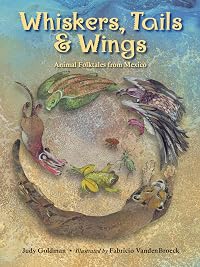
Whiskers, Tails & Wings: Animal Folktales from Mexico
by Judy Goldman
On This Page
Description
Retells animal folktales from five indigenous peoples of Mexico, including the Tarahumara tale in which a puma meets a grasshopper, and provides information on the culture of each indigenous people.Tags
Recommendations











Member Reviews
I should really stop checking out folktales, especially collections, since I have completed my reorganization of the Tales neighborhood and vowed to purchase no more fairy tales or folktales for, well, probably a couple years at least. But I just can't resist them.
This is a collection of five animal folktales from Mexico, but it's much, much more than just a folktale collection. It opens with a brief introduction to Mexico, mainly an explanation of its indigenous peoples and its history of folklore. There is also a map, showing where the five stories come from. The first story, "When Senor Grillo met Senor Puma" pits a clever grillo (cricket) against a hot-tempered Puma. The story has a full-page illustration of a puma and a cricket and show more the story itself is three pages long. It's followed by several pages explaining the culture of the Tarahumara, the indigenous group the folktale comes from, as well as the geography of where they live and how the folktale fits into their lives. The final pages include a glossary for the story and the nonfiction portion.
Each of the folktales follows this pattern. The stories include a Seri tale, "Mosni's Search" a creation myth about a determined turtle, and the following information includes how sea turtles are a part of Seri culture. A Huichol Tale, "Tlacuache's Tail" about the coming of fire, while the cultural information focuses on the significance of opossums and some of the rituals of the Huichol people. The Triqui Tale, "Ouch!" is probably the funniest - it's about how fleas were invented to keep people from being lazy. The following information has a lot of fascinating discussions of the importance of weaving and cloth to the Triqui culture. The last story, "Pokok up high" is a Tseltal tale, and has a familiar ring - it's about a frog who wants to fly, convinces a bird to give him a ride, but it doesn't end so well. The information about the Tseltals covers many different aspects of their culture, from their fiestas to their connection with the land.
There is a brief conclusion celebrating the importance of folktales. Further information for the book includes a detailed bibliography, web resources, multiple sources for each of the tales, and an index.
Verdict: This is an amazing resource. It has to be the best-researched folktale collection I've seen in years, not to mention the stories are retold beautifully, the art is brilliant, and it offers unique stories that are accessible (yes, weird fairy tales are fun, but they're not very easy to circulate). It would be an amazing resource for any kind of cultural of folktale study and a great selection for older kids who like folktales. Unfortunately, I just don't have an audience for it in my library - longer collections like this are almost impossible to circulate and I don't get asked for Mexican folktales at all. I'm happy that it's available in my consortium though!
ISBN: 9781580893725; Published 2013 by Charlesbridge; Borrowed from another library in my consortium show less
This is a collection of five animal folktales from Mexico, but it's much, much more than just a folktale collection. It opens with a brief introduction to Mexico, mainly an explanation of its indigenous peoples and its history of folklore. There is also a map, showing where the five stories come from. The first story, "When Senor Grillo met Senor Puma" pits a clever grillo (cricket) against a hot-tempered Puma. The story has a full-page illustration of a puma and a cricket and show more the story itself is three pages long. It's followed by several pages explaining the culture of the Tarahumara, the indigenous group the folktale comes from, as well as the geography of where they live and how the folktale fits into their lives. The final pages include a glossary for the story and the nonfiction portion.
Each of the folktales follows this pattern. The stories include a Seri tale, "Mosni's Search" a creation myth about a determined turtle, and the following information includes how sea turtles are a part of Seri culture. A Huichol Tale, "Tlacuache's Tail" about the coming of fire, while the cultural information focuses on the significance of opossums and some of the rituals of the Huichol people. The Triqui Tale, "Ouch!" is probably the funniest - it's about how fleas were invented to keep people from being lazy. The following information has a lot of fascinating discussions of the importance of weaving and cloth to the Triqui culture. The last story, "Pokok up high" is a Tseltal tale, and has a familiar ring - it's about a frog who wants to fly, convinces a bird to give him a ride, but it doesn't end so well. The information about the Tseltals covers many different aspects of their culture, from their fiestas to their connection with the land.
There is a brief conclusion celebrating the importance of folktales. Further information for the book includes a detailed bibliography, web resources, multiple sources for each of the tales, and an index.
Verdict: This is an amazing resource. It has to be the best-researched folktale collection I've seen in years, not to mention the stories are retold beautifully, the art is brilliant, and it offers unique stories that are accessible (yes, weird fairy tales are fun, but they're not very easy to circulate). It would be an amazing resource for any kind of cultural of folktale study and a great selection for older kids who like folktales. Unfortunately, I just don't have an audience for it in my library - longer collections like this are almost impossible to circulate and I don't get asked for Mexican folktales at all. I'm happy that it's available in my consortium though!
ISBN: 9781580893725; Published 2013 by Charlesbridge; Borrowed from another library in my consortium show less
This a collection of stories from Mexico. There are 5 stories all from different indigenous people of Mexico, the Tarahumara, Seri, Huichol, Triqui, and Tseltal. Each story is accompanied with gorgeous illustrations, as well as a bit of information about each people and where the folktale came from. The first story is from the Tarahumara people and is the story of a cricket versus a puma. The second story is from the Seri and is about a sea turtle who was the first creature to walk on land.
A series of animal folktales from five indigenous tribes of Mexico also includes facts about their culture. The characters include Senor Grillo, a fearless cricket, Mosni, a humble sea turtle, Pulga, a persistent flea, Tlacuache, a hairless-tailed opossum, and Polok, the frog who flew with the buzzard.
A book of Animal folktales that originated from five indigenous groups in Mexico. Each story has information about the culture in which it came from so the reader can understand more about these diverse groups.
Whiskers, Tails & Wings is a book with animal folktales from Mexico. There is an introduction titled "Welcome to Mexico" that gives background information about Mexico and its history. Each story comes with a glossary of the Mexican words in the story. This book would be a great addition to a library- readers will come to gain a greater understanding of the Mexican culture through its language and vocabulary and through its stories.
This is a collection of folktales from Mexico. It covers a variety of areas around the country and a wide variety of themes.
One day in the forest, grouchy Señor Puma almost squashed a cricket, Señor Grillo. Señor Puma doesn't care and tells him he is good for nothing. Señor Grillo calls him a coward because of his behavior, causing Señor Puma to get so upset that he challenges him to a war the next day. Señor Puma recruits bears, bobcats, foxes, skunks, and snakes to fight with him. But Señor Grillo only seems to gather gourds. When Señor Puma gives the order to attack, Señor Grillo whips off the tops of the gourds, which contain wasps. Señor Puma's army dives into a lake for safety, and the crickets still sing their song every night to remember their victory.
Hant Caai, the god of creation, created the sky and the waters, full of life. He decides show more to create the earth, but needs the sea creatures help in moving the sand. Many creatures hid, too scared to volunteer. Some volunteered, bragging about how strong or fast they were. When Mosni the sea turtle volunteered, the other creatures told her she was too clumsy. The sea snail, triggerfish, and seal all tried and failed in moving the sand. Hant Caai asks Mosni to help and she she did, but only bringing back a few grains. That was all Hant Caai needed as he multiplied it and spread it to form the beaches, deserts, and mountains, allowing Mosni to be the first creature allowed to walk on the sand.
Tlacuache, the opossum, had a bushy tail. And people hadn't discovered fire yet. One night, lightning struck and started a fire, but only the Old Woman managed to keep Bright Thing burning in her hut. She would not share it with anyone. Tlacuache offers to help the people if they promise not to bother or hunt him anymore. They agree and he tricks the Old Woman into letting him sleep by the fire. When she catches him trying to steal Bright Thing, he escapes, but with his tail on fire. He jumps into a pile of branches in the center of the village, giving the people fire, and his tail is put out. He ran away and hid, but found his bald tail to come in handy to hang from tree limbs, and to this day opossums have hairless tails.
When Man and Woman were first created, they were lazy and did nothing all day. The God of Creation wasn't pleased with this and created insects to bother them into getting up and doing something. He sent a bee, spider, lice, wasp, ant, and butterfly, but Man and Woman swatted them all away, returning to sleep. Finally, the littlest insect was sent and bit Man and Woman over and over until they got up and finally built a home, planted crops, and raised a family. That is how the flea came to be.
Pokok the frog could only leap and swim and thought flying would be fun. Xulem the buzzard offers to take him for a ride to see the world. As they flew around, Pokok noticed the bad smell coming from Xulem's head and made a comment about it, which Xulem thought to be rude. So Pokok tries to enjoy the view, but can't stand the smell, and insults Xulem again. Xulem shakes hard, and Pokok slips off his back, falling down, down, down, knocking the wind out of him. His mama and abuela nurse him back to health, but that is why frogs have a flattened shape still today. show less
Hant Caai, the god of creation, created the sky and the waters, full of life. He decides show more to create the earth, but needs the sea creatures help in moving the sand. Many creatures hid, too scared to volunteer. Some volunteered, bragging about how strong or fast they were. When Mosni the sea turtle volunteered, the other creatures told her she was too clumsy. The sea snail, triggerfish, and seal all tried and failed in moving the sand. Hant Caai asks Mosni to help and she she did, but only bringing back a few grains. That was all Hant Caai needed as he multiplied it and spread it to form the beaches, deserts, and mountains, allowing Mosni to be the first creature allowed to walk on the sand.
Tlacuache, the opossum, had a bushy tail. And people hadn't discovered fire yet. One night, lightning struck and started a fire, but only the Old Woman managed to keep Bright Thing burning in her hut. She would not share it with anyone. Tlacuache offers to help the people if they promise not to bother or hunt him anymore. They agree and he tricks the Old Woman into letting him sleep by the fire. When she catches him trying to steal Bright Thing, he escapes, but with his tail on fire. He jumps into a pile of branches in the center of the village, giving the people fire, and his tail is put out. He ran away and hid, but found his bald tail to come in handy to hang from tree limbs, and to this day opossums have hairless tails.
When Man and Woman were first created, they were lazy and did nothing all day. The God of Creation wasn't pleased with this and created insects to bother them into getting up and doing something. He sent a bee, spider, lice, wasp, ant, and butterfly, but Man and Woman swatted them all away, returning to sleep. Finally, the littlest insect was sent and bit Man and Woman over and over until they got up and finally built a home, planted crops, and raised a family. That is how the flea came to be.
Pokok the frog could only leap and swim and thought flying would be fun. Xulem the buzzard offers to take him for a ride to see the world. As they flew around, Pokok noticed the bad smell coming from Xulem's head and made a comment about it, which Xulem thought to be rude. So Pokok tries to enjoy the view, but can't stand the smell, and insults Xulem again. Xulem shakes hard, and Pokok slips off his back, falling down, down, down, knocking the wind out of him. His mama and abuela nurse him back to health, but that is why frogs have a flattened shape still today. show less
Members
- Recently Added By
Lists

4th Grade Books
312 works; 5 members
Author Information

36+ Works 474 Members
Awards and Honors
Awards
Notable Lists
Classifications
- Genres
- Kids, Children's Books
- DDC/MDS
- 398.20972 — Society, government, & culture Customs, etiquette & folklore Folklore & Folktales Folk literature History, geographic treatment, biography North American folktales Mexico, Central America, and the Caribbean
- LCC
- F1219.3 .F6 .G65 — Local History of the United States, Canada and Latin America Latin America. Spanish America Mexico
- BISAC
Statistics
- Members
- 54
- Popularity
- 565,064
- Reviews
- 9
- Rating
- (3.25)
- Languages
- English
- Media
- Paper, Ebook
- ISBNs
- 4
- ASINs
- 1