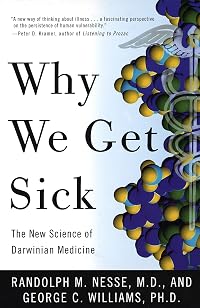
Why We Get Sick: The New Science of Darwinian Medicine
by Randolph M. Nesse, George C. Williams
On This Page
Description
Health & Fitness. Science. Nonfiction. HTML:The next time you get sick, consider this before picking up the aspirin: your body may be doing exactly what it's supposed to. In this ground-breaking book, two pioneers of the science of Darwinian medicine argue that illness as well as the factors that predispose us toward it are subject to the same laws of natural selection that otherwise make our bodies such miracles of design. Among the concerns they raise:When may a fever be beneficial?
show more Why do pregnant women get morning sickness?
How do certain viruses "manipulate" their hosts into infecting others?
What evolutionary factors may be responsible for depression and panic disorder?
Deftly summarizing research on disorders ranging from allergies to Alzheimer's, and form cancer to Huntington's chorea, Why We Get Sick, answers these questions and more. The result is a book that will revolutionize our attitudes toward illness and will intrigue and instruct lay person and medical... show less
Tags
Recommendations


























Member Reviews
Potentially very interesting but somehow fall short. The book shows its age (1996), is ultimately rather speculative, at best a set of proposals for future research, . The surprise is that it’s taken well over 100 years before medicine has even begun to think about the implications of Evolutionary theory. Surprising, given that Darwin‘s own dad was a doctor. The best takeaways for me: that many of the symptoms of illness are actually the body's protection and not the direct effect of the invader. Coughs and fevers are prime examples Treatments that simply repress symptoms may well be misguided.
What is the current state of research in this area ?
What is the current state of research in this area ?
This is a well written book that takes a look at why people get sick from an evolutionary perspective. This book is easy enough to understand without requiring a medical/biology degree, but not so simplified that it assumes the readers are have the attention span of a gnat and the intelligence of an amoeba. This is a meat and potatoes type of book compared to the bowl full of lettuce books that seem to be common in the popular science genre these days.
I do however wish the authors would update this book to include any additional information discovered/hypothesized in the last 20 years, but what they cover is still relevant and very interesting.
I do however wish the authors would update this book to include any additional information discovered/hypothesized in the last 20 years, but what they cover is still relevant and very interesting.
A really excellent, if slightly outdated, resource on the Darwinistic underpinings of our responses to disease. By far the best part of the book was the table categorizing disease responses (protective v. quirks v. secondary purpose). The book may have been made slightly stronger if it stuck more strictly to the topic of disease; however, as an introduction to the rigorous scientific ideas behind Darwinism, it was made richer by the discussions of pregnancy, foodstuffs, kin altruism and selfish gene phenomena. Thoroughly enjoyable, although not much new for the already versed reader.
Excellent introduction to Darwinian medicine, with good examples of how an evolutionary perspective adds to our understanding of the origins of disease. While medicine usually focus on the "proximate causes" of disease (such as viral or bacterial agents, or inflammatory processes), we can learn much from also examining the "ultimate" or evolution-derived causes, which would include our genetic inheritance formed by mutation and natural selection, and especially by mismatches between our current resource-rich environments and the "environment of evolutionary adaptation" of our paleolithic ancestors.
Note that while the Kindle edition is (c) 2012, the book was published in 1996 and has not been revised.
Note that while the Kindle edition is (c) 2012, the book was published in 1996 and has not been revised.
Slightly dated, yet interesting read on approaching medicine with a view based on Darwinian science. Authors do a good job taking topics normally covered in freshman biology and expand on them to make them more readable. Authors frequently mention Margie Profet who is interesting to read about in her own regard.
Ratings
Members
- Recently Added By
Lists

A Good Read (Radio 4)
221 works; 1 member
Author Information
6+ Works 658 Members

14+ Works 891 Members
Common Knowledge
- Original publication date
- 1994
Classifications
Statistics
- Members
- 481
- Popularity
- 63,060
- Reviews
- 5
- Rating
- (3.84)
- Languages
- 6 — Czech, English, French, Italian, Korean, Spanish
- Media
- Paper, Ebook
- ISBNs
- 10
- ASINs
- 4