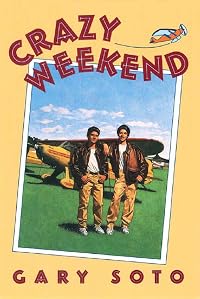
Crazy Weekend
by Gary Soto
On This Page
Description
After their photograph of a robbery is published in the newspaper, Hector and Mando find themselves pursued by two goofy thieves.Tags
Recommendations





Member Reviews
Library Thing Part D Multicultural
Soto, Gary. Crazy Weekend. New York: Persea, 2003. Print.
I’m not sure why I haven’t read any of Gary Soto’s novels; I know he is a much revered Latino writer and his titles are frequently listed in multicultural bibliographies. As a Latina growing up in a border town in South Texas, I couldn’t identify with the Spanish slang, the inner city East Los experience, nor any Bertha Sanchez’ who could beat you up in a heartbeat (12) in Crazy Weekend. Despite all that, I did enjoy every chapter of this quick read novel, first published in 1994. Even though the title is 16 years old, it still speaks to a Latino’s experience in Southern California. But I only came to this conclusion, only after show more living in Orange County for three years and working in Compton for two years. Hector’s memory of Tio Julio was tangible: “Hector hadn’t seen him in two years, since the time Uncle Julio visited and treated him to Disneyland. Later they rented two surfboards to crack the waves at Malibu Beach. Neither of them was any good at surfing, but the crashing waves worked up an appetite that was solved by a huge dinner on Olvera Street” (2).
Crazy Weekend has Uncle Julio Silva, his nephew, Hector, and Mando, Hector’s best friend, as main characters flying in a Cessna 143, riding in a red Ford Escort, developing film in darkrooms, walking around an orange grove and eating oranges, signing their autograph for Dr. Femur, and engaging the two armor car robbers: Huey and Freddie in their Uncle’s apartment. After witnessing and photographing Huey and Freddie robbing an armor car, the boys become the robbers’ obsession. The criminals won’t rest until they teach the boys a lesson about snitching. I don’t believe this part of the plot; the criminals are way too ridiculous and it’s the “let’s get ‘um” scene in the apt. that seems more cartoon like than real time. But the Spanish slang and terms intermittently dispersed the California settings, the boys and Uncle Julio’s perspectives and comments all create an enjoyable plot that a 2nd and 3rd generation Latino could identify and be proud to read. The novel presents the Southern California Latino experience in a comical but positive manner. Julio Silva has served in the Air Force, attended college and is a professional photographer showing familial obligation, concern and love for his sister’s son and Hector’s best friend. A definite must buy for the library collection. Curriculum connection is language arts with elementary and middle school for an audience. show less
Soto, Gary. Crazy Weekend. New York: Persea, 2003. Print.
I’m not sure why I haven’t read any of Gary Soto’s novels; I know he is a much revered Latino writer and his titles are frequently listed in multicultural bibliographies. As a Latina growing up in a border town in South Texas, I couldn’t identify with the Spanish slang, the inner city East Los experience, nor any Bertha Sanchez’ who could beat you up in a heartbeat (12) in Crazy Weekend. Despite all that, I did enjoy every chapter of this quick read novel, first published in 1994. Even though the title is 16 years old, it still speaks to a Latino’s experience in Southern California. But I only came to this conclusion, only after show more living in Orange County for three years and working in Compton for two years. Hector’s memory of Tio Julio was tangible: “Hector hadn’t seen him in two years, since the time Uncle Julio visited and treated him to Disneyland. Later they rented two surfboards to crack the waves at Malibu Beach. Neither of them was any good at surfing, but the crashing waves worked up an appetite that was solved by a huge dinner on Olvera Street” (2).
Crazy Weekend has Uncle Julio Silva, his nephew, Hector, and Mando, Hector’s best friend, as main characters flying in a Cessna 143, riding in a red Ford Escort, developing film in darkrooms, walking around an orange grove and eating oranges, signing their autograph for Dr. Femur, and engaging the two armor car robbers: Huey and Freddie in their Uncle’s apartment. After witnessing and photographing Huey and Freddie robbing an armor car, the boys become the robbers’ obsession. The criminals won’t rest until they teach the boys a lesson about snitching. I don’t believe this part of the plot; the criminals are way too ridiculous and it’s the “let’s get ‘um” scene in the apt. that seems more cartoon like than real time. But the Spanish slang and terms intermittently dispersed the California settings, the boys and Uncle Julio’s perspectives and comments all create an enjoyable plot that a 2nd and 3rd generation Latino could identify and be proud to read. The novel presents the Southern California Latino experience in a comical but positive manner. Julio Silva has served in the Air Force, attended college and is a professional photographer showing familial obligation, concern and love for his sister’s son and Hector’s best friend. A definite must buy for the library collection. Curriculum connection is language arts with elementary and middle school for an audience. show less
Ratings
Members
- Recently Added By
Author Information

103+ Works 14,505 Members
Gary Soto was born April 12, 1952, and raised in Fresno California. He graduated from Roosevelt High School and attended Fresno City College, graduating in 1974 with an English degree. His poems have appeared in many literary magazines, including The Nation, Plouqhshares, The Iowa Review, Ontario Review and Poetry, which has honored him with the show more Bess Hokin Prize and the Levinson Award and by featuring him in Poets in Person. He is one of the youngest poets to appear in The Norton Anthology of Modern Poetry. Soto has received the Discovery-The Nation Prize, the U.S. Award of the International Poetry Forum, The California Library Association's John and Patricia Beatty Award twice, a Recogniton of Merit from the Claremont Graduate School for Baseball in April, the Silver Medal from The Commonwealth Club of California, and the Tomás Rivera Prize, in addition to fellowships from the Guggenheim Foundation, the National Endowment for the Arts twice, and the California Arts Council. For ITVS, he produced the film The Pool Party, which received the 1993 Andrew Carnegie Medal. Soto wrote the libretto for an opera titled Nerd-landia for the The Los Angeles Opera. In 1999 he received the Literature Award from the Hispanic Heritage Foundation, the Author-Illustrator Civil Rights Award from the National Education Association, and the PEN Center West Book Award for Petty Crimes. He serves as Young People's Ambassador for the California Rural Legal Assistance and the United Farm Workers of America. Soto is the author of ten poetry collections for adults, with New and Selected Poems a 1995 finalist for both the Los Angeles Times Book Award and the National Book Award. His recollections Living Up the Street received a Before Columbus Foundation 1985 American Book Award. (Bowker Author Biography) show less
Awards and Honors
Awards
Distinctions
Common Knowledge
- Original publication date
- 1994 Scholastic
- Dedication
- To Jean Montenegro
Classifications
Statistics
- Members
- 129
- Popularity
- 252,558
- Reviews
- 1
- Rating
- (2.83)
- Languages
- English
- Media
- Paper, Audiobook, Ebook
- ISBNs
- 11
- ASINs
- 2