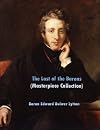
The Last of the Barons
by Edward Bulwer Lytton, Baron Lytton
On This Page
Description
The Last of the Barons is a historical novel by the English author Edward Bulwer-Lytton first published in 1843. Its plot revolves around the power struggle between the English King Edward IV and his powerful minister Earl of Warwick, known as "Warwick the kingmaker".The King is portrayed as effeminate, capricious and licentious, in contrast with the Earl, shown as a distinguished warrior and politician, great patriot and affectionate father. Other historical figures that appear frequently show more in the text are Duke of Clarence, Duke of Gloucester (the future King Richard III), Marquess of Montagu, and Lord Hastings.Romance and science in the Middle Ages are the secondary themes of the novel. They are explored through Sibyll, a beautiful young maiden, and her old father, Adam Warner. Sibyll, who is in love with Lord Hastings, is inseparable from her father throughout the story. Adam is a hypomanic natural philosopher working for many years to complete his invention, a mechanical device that is supposed to carry out functions of a modern steam engine. Persecuted, mistrusted, and misunderstood, he is forced to work as a royal alchemist.The novel ends tragically with the defeat and death of Warwick at the Battle of Barnet. show lessTags
Recommendations
















Member Reviews
2440 The Last of the Barons, by Edward Bulwer-Lytton (Lord Lytton) (read 3 Apr 1992) This 1843 book tells the story of the Earl of Warwick from 1467 to his death at the battle of Barnet on Apr 14, 1471. It sticks very close to historical fact and there are but a few invented characters. I think the book is really good--and since it is truer to history than Sir Walter Scott I like it better. Richard Neville, Earl of Warwick (called the Kingmaker) put Edward IV on the throne in 1461, and Henry VI was in prison thereafter till Warwick switched sides--possibly because of Edward IV's attempted rape of Warwick's daughter Anne (later wife to Henry VI's son, and then to Richard III) and Edward IV fled from England and Henry VI resumed the show more throne. Edward IV returned to England and in a month regained the throne. This book has made the period a lot easier to understand than the turgid histories I have read on the Wars of the Roses. I would like to visit the Barnet battlefield, where an obelisk marks the spot where Warwick fell. This has been an excellent book, and I like it better than Bulwer-Lytton's most famous novel The Last Days of Pompeii, which I read July 4, 1967 and don't remember much about.
. show less
. show less
Ratings
Members
- Recently Added By
Lists

1898 C.K. Shorter List of Best 100 Novels
100 works; 34 members

Fifty Representative Historical Novels
50 works; 2 members
Author Information

289+ Works 5,444 Members
Edward Bulwer-Lytton, Lord of Lytton, was born on May 25, 1803 in London, England. He entered Trinity College, Cambridge in 1822, won the Chancellor's Gold Medal for English verse in 1825, and received a B.A. degree the following year. He was a novelist, poet, playwright, and politician. He coined the phrases the "pursuit of the almighty dollar", show more "the pen is mightier than the sword", and the opening line "It was a dark and stormy night". He wrote in a variety of genres, including historical fiction, mystery, romance, the occult, and science fiction. His works included Falkland, Pelham, Eugene Aram, The Last Days of Pompei, Ernest Maltravers, Zanoni, The Last of the Barons, The Caxtons, and A Strange Story. He also published several volumes of poetry including Ismael and The New Timon. His best known play was The Lady of Lyons. He served as the Secretary of State for the Colonies in from 1858 to 1859 and played a large part in the organization of the new colony of British Columbia. He became Baron Lytton of Knebworth in July 1866 and thereafter took his place in the House of Peers. He died on May 23, 1873, just short of his 70th birthday. The cause of death was not clear but it was thought that an infection he had in his ear had affected his brain. (Bowker Author Biography) show less
Awards and Honors
Series
Belongs to Publisher Series
Os Grandes Romances Históricos (11,12)
Everyman's Library (18)
Work Relationships
Common Knowledge
- Canonical title
- The Last of the Barons
- Original title
- The Last of the Barons
- Original publication date
- 1843
- People/Characters
- Richard Neville, 16th Earl of Warwick (Warwick the Kingmaker); Edward IV, King of England; Anne Neville, Queen Consort of England; Richard III, King of England; Edward of Lancaster, Prince of Wales
- Important places
- England, UK; Warwickshire, England, UK; Warwick Castle, Warwick, Warwickshire, England, UK; London, England, UK
- Important events
- Wars of the Roses (1455 | 1485)
- First words
- Westward, beyond the still pleasant, but, even then, no longer solitary hamlet of Charing, a broad space broken, here and there, by scattered houses and venerable pollards, in the early spring of 1467, presented the rural sce... (show all)ne for the sports and pastimes of the inhabitants of Westminster and London.
- Last words
- (Click to show. Warning: May contain spoilers.)Mechanically Elizabeth turned her moistened eyes from Edward to Edward's bother, and suddenly, as with a mother's prophetic instinct, clasped her infant closer to her bosom, when she caught the glittering and fatal eye of Richard, Duke of Gloucester (York's young hero of the day, Warwick's grim avenger in the future), fixed upon that harmless life--the only life, save the despised and powerless Clarence, whose destiny it needed no wisdom to foresee,--which stood between the ambition of a ruthless intellect and the heritage of the English throne!
- Canonical DDC/MDS
- 823.84
Classifications
- Genres
- Fiction and Literature, General Fiction, Historical Fiction
- DDC/MDS
- 823.84 — Literature & rhetoric English & Old English literatures English fiction 1837-1899 Lytton, Edward George Bulwe, 1st baron 1803–73
- LCC
- PR4913 — Language and Literature English English Literature 19th century , 1770/1800-1890/1900
- BISAC
Statistics
- Members
- 117
- Popularity
- 278,594
- Reviews
- 1
- Rating
- (2.63)
- Languages
- English, Spanish
- Media
- Paper, Ebook
- ISBNs
- 16
- ASINs
- 20