Utz
by Bruce Chatwin
On This Page
Description
An elegant novel set in Prague about the possibility of freedom in an unfree state, from the acclaimed author of The Songlines and In PatagoniaUtz collects Meissen porcelain with a passion. His collection, which he has protected and enlarged through both World War II and Czechoslovakia's years of Stalinism, numbers more than 1,000 pieces, all crammed into his two-room Prague flat. Utz is allowed to leave the country each year, and although he has considered defection, he always returns. He show more cannot take his precious collection with him, but he cannot leave it, either. And so Utz is as much owned by his porcelain as it is owned by him, as much of a prisoner of the collection as of the Communist state.
A fascinating, enigmatic man, Kaspar Utz is one of Bruce Chatwin's finest creations. And his story, as delicately cast as one of Utz's porcelain figures, is unforgettable.
. show less
Tags
Recommendations



















Member Recommendations
Member Reviews
Beautiful, delicate and ambiguous novella about compulsive collecting, authoritarian governments, death, love and Mitteleuropa. With Chatwin's usual talent for parachuting, he somehow managed to extract enough information from a couple of brief visits and some secondhand anecdotes to convince us that he knows Prague better than Klima, Havel, Kundera and Hasek all rolled into one. It's a trick, but it works.
Chatwin wrote this when he was getting over a serious illness, and not very long before his death, so there's a great temptation to read it biographically. That's probably a mistake: the relatively compact form and tight organisation certainly had something to do with this being a project for a period of convalescence, but I don't show more think he was thinking any more about mortality than at other times — in On the black hill, for instance. By all accounts he wasn't someone who was especially conscious of approaching death.
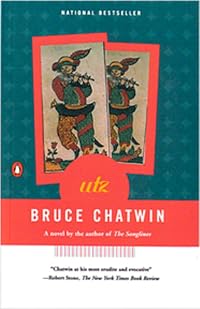
A pity about the horrible Penguin US paperback, set in a Bodoni so smudged and inky it looks as though they've done the whole thing in bold type by mistake. You could wrap chips in it. Who had the bright idea to put playing-cards on the cover of a book dealing with porcelain...? show less
Chatwin wrote this when he was getting over a serious illness, and not very long before his death, so there's a great temptation to read it biographically. That's probably a mistake: the relatively compact form and tight organisation certainly had something to do with this being a project for a period of convalescence, but I don't show more think he was thinking any more about mortality than at other times — in On the black hill, for instance. By all accounts he wasn't someone who was especially conscious of approaching death.
A pity about the horrible Penguin US paperback, set in a Bodoni so smudged and inky it looks as though they've done the whole thing in bold type by mistake. You could wrap chips in it. Who had the bright idea to put playing-cards on the cover of a book dealing with porcelain...? show less
Leggere Chatwin era molto in voga nei primi anni '90, quelli immediatamente successivi alla sua scomparsa. Benché fossi nei miei anni più formativi quanto a letture (e benché qualcuno mi avesse regalato una maglietta con la scritta "what am I doing here"), ho sempre snobbato Chatwin archiviandolo nella categoria della letteratura di viaggio. A lui arrivo oggi grazie a Fredrik Sjöberg che in L'arte di collezionare mosche cita Utz per via dell'enfasi sul collezionismo e di una battuta su un menu di ristorante in cui l'inglese "carp" è reso come "crap", con tutte le conseguenze del caso. Arrivo quindi a questo libro sull'onda di una connessione letteraria (quale miglior modo?) senza aspettative precise e vi trovo un grandissimo show more piacere di lettura (che fa rimpiangere la brevità del libro), una struttura a incastri/digressioni perfetta e una scrittura pregevole. Leggendolo, penso a quanto la storia potrebbe prestarsi a un film; in seguito scopro che il film c'è già, del 1992 (lo cercherò). Scopro anche che questo è l'ultimo libro di Chatwin, scritto durante la malattia che lo avrebbe condotto alla morte, il che rende ancora più eccezionale e sorprendente la vitalità che emana da ogni sua pagina. show less
In this jewel-box of a novella Bruce Chatwin eschews the artifice of his 'non fiction' writing but retains all of its finest features. The unnamed narrator shares Chatwin's authorial voice, his knowledge of art and history, and possesses the same magpie mind. Utz gives Chatwin a framework to discuss Meissen porcelain, the commedia dell'arte, the whims of Hapsburg nobles, the aims of alchemy and the history of Prague, all centred around the eponymous collector Baron Utz. As usual, Chatwin's prose is like Champagne: sparkling, acid and more than a little compulsive. Highly recommended.
“Anything was better than to be loved for one's things.”
Utz, the eponymous main character of this novel is a minor aristocrat and a collector of Meissen porcelain in Czechoslovakia during its period of Soviet rule under Stalin. Although he has multiple opportunities to emigrate, he cannot bear to separate himself for long from his porcelain. So Utz becomes a study into the psychology of obsession and private collecting of art
Utz through various machinations avoids the excesses of both Nazism and Communism yet despite stating that he abhors violence strangely seems to welcome these epochs as they "offer excellent opportunities for the collector." Yet Utz's main enemy are museum curators. He asserts that art trapped behind glass die show more “of suffocation and the public gaze" whereas the private collector, by contrast, “restores to the object the life-giving touch of its maker.”I return for being left alone with his collection Utz agrees that the museum in Prague will have it after his death yet when he supposedly dies, only two people see his dead body or attend his funeral, the porcelain mysteriously disappears which along with earlier talk of alchemy and the elixir of life seems to suggest that porcelain may have super-natural powers. So the reader is left wondering whether or not Utz destroyed the collection before 'his death' to stop it from dying in a museum or because he was so obsessed with it that he was unwilling to share it or conversely he managed to smuggle it out somewhere and then faked his own death. Chatwin leaves this for the reader to decide.
The novel perhaps encourage readers to examine the interrelationships of art, collecting, passion, love, creation, life, and death. That said and done, whilst I enjoyed the author's writing style and tightly controlled prose I struggled to really enjoy it and somehow failed to really engage with it. Perhaps it was just too deep for me. show less
Utz, the eponymous main character of this novel is a minor aristocrat and a collector of Meissen porcelain in Czechoslovakia during its period of Soviet rule under Stalin. Although he has multiple opportunities to emigrate, he cannot bear to separate himself for long from his porcelain. So Utz becomes a study into the psychology of obsession and private collecting of art
Utz through various machinations avoids the excesses of both Nazism and Communism yet despite stating that he abhors violence strangely seems to welcome these epochs as they "offer excellent opportunities for the collector." Yet Utz's main enemy are museum curators. He asserts that art trapped behind glass die show more “of suffocation and the public gaze" whereas the private collector, by contrast, “restores to the object the life-giving touch of its maker.”I return for being left alone with his collection Utz agrees that the museum in Prague will have it after his death yet when he supposedly dies, only two people see his dead body or attend his funeral, the porcelain mysteriously disappears which along with earlier talk of alchemy and the elixir of life seems to suggest that porcelain may have super-natural powers. So the reader is left wondering whether or not Utz destroyed the collection before 'his death' to stop it from dying in a museum or because he was so obsessed with it that he was unwilling to share it or conversely he managed to smuggle it out somewhere and then faked his own death. Chatwin leaves this for the reader to decide.
The novel perhaps encourage readers to examine the interrelationships of art, collecting, passion, love, creation, life, and death. That said and done, whilst I enjoyed the author's writing style and tightly controlled prose I struggled to really enjoy it and somehow failed to really engage with it. Perhaps it was just too deep for me. show less
I read this beautiful small book with the Lincoln Park Book Group and fell in love with the writing of Bruce Chatwin. More recently it was included in a class I took on the literature of Prague. Fundamentally it is the story of Kaspar Utz, who lives in Prague and who is consumed by collecting figurines and living a quiet life under the communist system. Utz is painted as a prisoner to his dolls while he lives under a totalitarian regime, so when he leaves on his annual sabbatical to Vichy in France, he finds capitalist life not to his liking, even though he has an alleged fortune in Swiss banks enabling him to enjoy a nice standard of living abroad, he misses his figurines and wants to return back home.
But really, that isn’t him, he show more was a state collaborator acting on small tasks when he was abroad and he enjoyed living under the Soviet system as he was comfortable with his life there. This is highlighted by the way he keeps his figurines so that only he can enjoy them, not the state, and that in an era where drabness is the norm, he can stand out from the crowd and lure partners with his goods brought overseas and obtained locally on the black market. Chatwin creates a unique and believable world in this small jewel of a story. show less
But really, that isn’t him, he show more was a state collaborator acting on small tasks when he was abroad and he enjoyed living under the Soviet system as he was comfortable with his life there. This is highlighted by the way he keeps his figurines so that only he can enjoy them, not the state, and that in an era where drabness is the norm, he can stand out from the crowd and lure partners with his goods brought overseas and obtained locally on the black market. Chatwin creates a unique and believable world in this small jewel of a story. show less
You appropriate things to make up for a life you eventually must let go. Collecting and travelling are ways to embellish life. Mr Chatwin is a past master.
An unnamed narrator tells the story of Meissen porcelain collector/obsessive Kasper Utz. Set mostly in Prague, the narrator, who has only met Utz once, reveals his own obsession with the eccentric ‘trickster’ and his life, and on the way we learn a lot about the origins of porcelain as well as the tumultuous time in 1960s Prague.
Always with Chatwin one has to be aware that he was a mythologiser (as well as a self-mythologiser), and the complaint many have is that you can never know what element of his novels have some validity/fact/truth in them. It is not something that has ever bothered me. If I become fascinated with a subject he weaves a spell over, I go find a non-fiction book to learn. Like Tolstoy, I don’t think he himself show more called any of his books one thing or another, ie he never described any of them as novels per se. I’d recommend his essays (or some would say short stories).
As with his own life, when he became ill, he said that it was because he had eaten a thousand year old egg in China, when in actual fact he had HIV/AIDS. Even in pending death he wanted to embellish his life. I have never come away from any of his work without being spell bound by something he has written, and I have reread most of it several times. show less
Always with Chatwin one has to be aware that he was a mythologiser (as well as a self-mythologiser), and the complaint many have is that you can never know what element of his novels have some validity/fact/truth in them. It is not something that has ever bothered me. If I become fascinated with a subject he weaves a spell over, I go find a non-fiction book to learn. Like Tolstoy, I don’t think he himself show more called any of his books one thing or another, ie he never described any of them as novels per se. I’d recommend his essays (or some would say short stories).
As with his own life, when he became ill, he said that it was because he had eaten a thousand year old egg in China, when in actual fact he had HIV/AIDS. Even in pending death he wanted to embellish his life. I have never come away from any of his work without being spell bound by something he has written, and I have reread most of it several times. show less
Members
- Recently Added By
Published Reviews
Bruce Chatwin's new novel, ''Utz,'' begins with a funeral in one of Prague's old Baroque churches. Readers of other Chatwin works will understand what I mean when I say that it is a scene only this author could create, alive with shrewd observation, pathos and absurdist humor. Its sense of place is dead-on and its component prose lapidary. It introduces us to the world of the decedent, one show more Kaspar Joachim Utz. show less
added by John_Vaughan
Lists

20th Century Literature
1,161 works; 54 members

Booker Prize
491 works; 62 members

Global Reads: Books Set in Eastern Europe
45 works; 10 members

Backlisted
109 works; 9 members

Books Read in 2014
2,343 works; 89 members

Man Booker Prize Longlist 1988
6 works; 1 member

Books set in Prague
40 works; 1 member

Booker Prize Shortlist: Titles Not Yet Read
161 works; 4 members

Spirit of Place
46 works; 1 member

A Novel Cure
742 works; 23 members
Author Information

55+ Works 14,530 Members
Some Editions
Awards and Honors
Awards
Series
Belongs to Publisher Series
Work Relationships
Is contained in
Common Knowledge
- Canonical title*
- Utz
- Original title
- Utz
- Original publication date
- 1988
- People/Characters
- Kaspar Joachim Utz; Dr Vaclav Orlik; Marta
- Important places
- Prague, Czech Republic
- Related movies
- Utz (1992 | IMDb)
- Dedication
- For Diana Phipps
- First words
- An hour before dawn on March 7th 1974, Kaspar Joachim Utz died of a second and long-expected stroke, in his apartment at No. 5 Siroká Street, overlooking the Old Jewish Cemetery in Prague.
- Quotations
- The Ambras Collection, with its Cellini salt-cellar and Montezuma's headdress of quetzal plumes, had survived intact from the 16th to the 19th centuries when imperial officials, mindful of the revolutionary mob, removed
it... (show all)s more spectacular treasures to Vienna. Rudolf's treasures - his mandragoras, his basilisk, his bezoar stone, his unicorn cup, his gold-mounted coco-de-mer, his homunculus in alcohol, his nails from Noah's
Ark and the phial of dust from which God created Adam - had long ago vanished from Prague.
In any museum the object dies - of suffocation and the public gaze - whereas private ownership confers on the owner the right and the need to touch. As a young child will reach out to handle the thing it names, so the passion... (show all)ate collector, his eye in harmony with his hand, restores to the object the life-giving touch of its maker. - Last words
- (Click to show. Warning: May contain spoilers.)And she raised her eyes to the rainbow and said, 'Ja! Ich bin die Baronin von Utz.'
*Some information comes from Common Knowledge in other languages. Click "Edit" for more information.
Classifications
Statistics
- Members
- 1,422
- Popularity
- 16,567
- Reviews
- 29
- Rating
- (3.60)
- Languages
- 18 — Catalan, Czech, Danish, Dutch, English, Finnish, French, German, Icelandic, Italian, Japanese, Norwegian, Polish, Portuguese, Russian, Spanish, Swedish, Turkish
- Media
- Paper, Ebook
- ISBNs
- 47
- ASINs
- 9