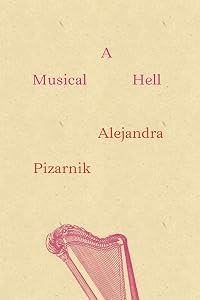
El infierno musical
by Alejandra Pizarnik
On This Page
Description
"An aura of legendary prestige surrounds the work of Alejandra Pizarnik," writes César Aira. Her last collection to be published before her suicide in 1972,A Musical Hell is the first book of poems by Pizarnik to be published in its entirety in the U.S. Pizarnik writes at the edge of poetic impossibility, opening with a blues singer, expanding into silence, and closing into a theater of shadows and songs of the drowned.Tags
Recommendations
































Member Reviews
I'm not a big fan of writing about writing, particularly about oneself writing; nor am I so big on the elemental symbols--water, fire, light, darkness and so on--being used unironically. But if you must do these things, know that Alejandra Pizarnik has done them better than you ever will:
"I cannot speak with my voice, so I speak with my voices."
"Before words can run out, something in the heart must die."
Section IV, 'The Possessed Among the Lilacs,' is truly wonderful.
"I cannot speak with my voice, so I speak with my voices."
"Before words can run out, something in the heart must die."
Section IV, 'The Possessed Among the Lilacs,' is truly wonderful.
Ratings
Members
- Recently Added By
Lists

Literary Witches
86 works; 4 members
Author Information

57+ Works 1,124 Members
The daughter of Polish-Jewish immigrants, Pizarnik suffered throughout her life from severe depression and committed suicide one weekend on leave from the psychiatric hospital where she was institutionalized. Pizarnik spent several years in Paris in contact with the European poetic vanguard and toward the end of her life held a Guggenheim show more Foundation award. Her poetry portrays the life of Latin American women as a bodily dismemberment by a multiply oppressive and repressive patriarchy. It sparked interest alone for the intensity with which it chronicles the obsessions of a feminine poete maudit. Concomitantly, Pizarnik's poetry assumed a clandestine and iconic dimension because the bulk of her mature output coincided with the military regimes in Argentine. For some, her work is a symbol of the destruction of the individual by neo-Fascist tyranny. Although Pizarnik mostly wrote highly charged poetic vignettes, leading her to be compared with Sylvia Plath, she also wrote outstanding prose poems, culminating in The Bloody Countess (1971). This is a chilly recreation of the nefarious Hungarian noblewoman, Erzbet Bathory, who was accused in the seventeenth century of torturing to death 600 maidens; and it is a work whose interest overlaps, if only obliquely, with the significant lesbian dimension of Pizarnik's writing. (Bowker Author Biography) show less
All Editions
Series
Belongs to Publisher Series
Common Knowledge
- Canonical title
- A musical hell; El infierno musical
- Original publication date
- 2013; 1971
Classifications
- Genres
- Poetry, Fiction and Literature
- DDC/MDS
- 861.64 — Literature & rhetoric Spanish Literature Spanish poetry 20th Century 1945-2000
- LCC
- PQ7797 .P576 .I513 — Language and Literature French, Italian, Spanish and Portuguese literatures Spanish literature Provincial, local, colonial, etc. Spanish America
- BISAC
Statistics
- Members
- 55
- Popularity
- 555,361
- Reviews
- 1
- Rating
- (4.22)
- Languages
- English, French, Spanish
- Media
- Paper
- ISBNs
- 3
- ASINs
- 1