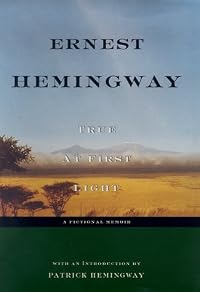
True at First Light: A Fictional Memoir
by Ernest Hemingway 
On This Page
Description
A fictional memoir of an African safari based on a manuscript edited by the author's son. The action centers on wife Mary's desire to kill a lion and her jealousy of a beautiful African woman Hemingway is eyeing.Tags
Recommendations





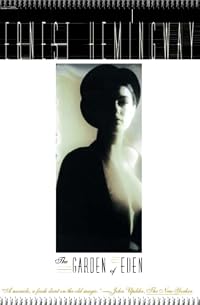
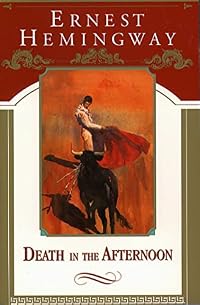


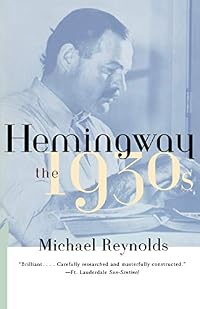




Member Recommendations
Member Reviews
Hemingway, for all his sorrow, was a man who knew he had been lucky in his life and was happy to write about things with affection. At least, that is my humble impression: he writes on page two of True at First Light that his various biographers and commentators "wrote of my life both inner and outer… with an absolute assurance that I had never felt." But as a writer his mode of operation was to experience things – many things – and absorb them and then write about them later as honestly and truthfully as he could. True at First Light might not be as polished as similar late-period books like A Moveable Feast but the nostalgia and the wistfulness and the sense of lost and captured memories do still make themselves very evident.
Any show more review of this book has to mention that it is a posthumously-published manuscript. Hemingway wrote this and then set it aside and there is a reason for that. Any literary effect created by the prose is hard won, only there if the reader is dedicated enough to seek it. Much of it could have been excised and perhaps would have (note that A Moveable Feast is much shorter, and Hemingway thought that he could write about Paris more truly than he could Africa). As his son Patrick says in the Introduction, only Hemingway himself could have really licked this into shape (pg. xi). However, for committed Hemingway aficionados there is still value in seeing a Hemingway work-in-progress, and learning intuitively about his process of honing his books into shape.
There is also much that would have survived a cull. Individual passages are starlight-pure, and there are the usual digressions into writing and literature and other loosely related topics which are always interesting. The part where his wife Mary is writing a poem is a nice moment (pg. 179), the (perhaps semi-fictional) recollection of meeting George Orwell in Paris during the War was fascinating (pp129-30) and the bit where Hemingway recalls shooting an old and faithful horse was heartbreakingly depicted (pp197-8) because of the unassuming way in which it was told. Hemingway writes better about safaris and big-game hunting in Green Hills of Africa and in his short stories, but there is still much to recommend on this in True at First Light, particularly about the politics and group dynamics of the hunt.
But it is the sense of nostalgia and wistfulness the book captures that is its main draw: remarkably, Hemingway manages to write such things without any sentimentality or mawkishness. One must remember that Hemingway was a reporter and a journalist as much as a novelist and whilst he may talk of "the old days" a lot in the book, it is not out of any desire to return so much as to try and understand what makes them so clear and so beloved, so that he can acknowledge them and provide a realistic and truthful snapshot of them as they were. The title of the book has been well-chosen (Hemingway's manuscript was untitled), coming from the passage Hemingway writes on page 179 that "nothing was true and especially not in Africa. In Africa a thing is true at first light and a lie by noon." The assertion that 'nothing is true' is a useful justification for what is a semi-fictional memoir (I don't really see how people classify it as a novel) and the image of light changing by degrees through the day is an exceptional one for Hemingway's purposes; not only does it alter the dynamics of the hunt (it is better to shoot at certain times of day, before the light is gone (pg. 110)) and the appearance of the landscape ("the tents of camp showed under the yellow and green trees which the first light of the sun was now turning to bright dark green and shining gold" (pg. 193)) but it also ties in neatly with Hemingway exploring nostalgia and his past from the insecurities of his advancing age, the evening and the sunset of his days. However unpolished the manuscript may be, it is a bittersweet sentiment for the reader to gorge upon. Hemingway always talks about things with a paradoxically warm detachment, so clean and precise. show less
Any show more review of this book has to mention that it is a posthumously-published manuscript. Hemingway wrote this and then set it aside and there is a reason for that. Any literary effect created by the prose is hard won, only there if the reader is dedicated enough to seek it. Much of it could have been excised and perhaps would have (note that A Moveable Feast is much shorter, and Hemingway thought that he could write about Paris more truly than he could Africa). As his son Patrick says in the Introduction, only Hemingway himself could have really licked this into shape (pg. xi). However, for committed Hemingway aficionados there is still value in seeing a Hemingway work-in-progress, and learning intuitively about his process of honing his books into shape.
There is also much that would have survived a cull. Individual passages are starlight-pure, and there are the usual digressions into writing and literature and other loosely related topics which are always interesting. The part where his wife Mary is writing a poem is a nice moment (pg. 179), the (perhaps semi-fictional) recollection of meeting George Orwell in Paris during the War was fascinating (pp129-30) and the bit where Hemingway recalls shooting an old and faithful horse was heartbreakingly depicted (pp197-8) because of the unassuming way in which it was told. Hemingway writes better about safaris and big-game hunting in Green Hills of Africa and in his short stories, but there is still much to recommend on this in True at First Light, particularly about the politics and group dynamics of the hunt.
But it is the sense of nostalgia and wistfulness the book captures that is its main draw: remarkably, Hemingway manages to write such things without any sentimentality or mawkishness. One must remember that Hemingway was a reporter and a journalist as much as a novelist and whilst he may talk of "the old days" a lot in the book, it is not out of any desire to return so much as to try and understand what makes them so clear and so beloved, so that he can acknowledge them and provide a realistic and truthful snapshot of them as they were. The title of the book has been well-chosen (Hemingway's manuscript was untitled), coming from the passage Hemingway writes on page 179 that "nothing was true and especially not in Africa. In Africa a thing is true at first light and a lie by noon." The assertion that 'nothing is true' is a useful justification for what is a semi-fictional memoir (I don't really see how people classify it as a novel) and the image of light changing by degrees through the day is an exceptional one for Hemingway's purposes; not only does it alter the dynamics of the hunt (it is better to shoot at certain times of day, before the light is gone (pg. 110)) and the appearance of the landscape ("the tents of camp showed under the yellow and green trees which the first light of the sun was now turning to bright dark green and shining gold" (pg. 193)) but it also ties in neatly with Hemingway exploring nostalgia and his past from the insecurities of his advancing age, the evening and the sunset of his days. However unpolished the manuscript may be, it is a bittersweet sentiment for the reader to gorge upon. Hemingway always talks about things with a paradoxically warm detachment, so clean and precise. show less
OK, I tried. This "fictional memoir" was left behind in manuscript form, untouched for nearly a decade when Ernest Hemingway died. Thirty-five years later, his son Patrick, who was with his father and stepmother in Africa for the real-life events portrayed here, edited it for publication. His introduction intrigued me, and I love the title. The book's epigram is this quote from Papa himself: "In Africa, a thing is true at first light, a lie by noon, and you have no more respect for it than for the lovely, perfect wood-fringed lake you see across the sun-baked salt plain. You have walked across that plain in the morning and you know that no such lake is there. But now it is there absolutely true, beautiful and believable." With writing show more like that, he almost had me. But I couldn't bear more than 60 pages or so of his paternalism; Mary's fawning for his approval; the casual acceptance of his relationship with the village woman, Debba (another "child-wife"); and finally the whole insider attitude of the narrator cryptically referring to native tribes, uprisings, and secret doings without enough background or explanation. Granted, Patrick does cover some of the latter in his fine introduction, but the text itself seems to have been written for readers "in the know". Reportedly there is some very fine writing in here, and I am willing to believe that. I'm just not willing to wade through so much muck to get to it.
Reviewed in 2017 show less
Reviewed in 2017 show less
While there are some passages of truly beautiful prose, it is hard to really feel for the characters as they are not very sympathetically rendered. Would definately be worthwhile if you are a big Hemingway fan
Sort of a watered down Hemingway to read. I don't really remember what gave me that impression, but there it is. I guess it's insightful into how much Hemingway edited and punched his works up.
Staged in Africa, Hemingway reflects himself as a hired hunter in the Game Department of the British Administration. The book is set on the African plains, within and out of a hunting camp site established to hunt for an elusive and wanted lion. The book also seems to reflect on the cusp of the change over in Africa from the British (i.e., white man) to the African self-awareness and quest for independence. Though the book does not specifically refer to politics, you get a sense that the story spins on the edge of that change and the reflection of what Africa once was and meant to the likes of someone like the main narrator, Hemingway.
1953-54 East African Safari with Ernest Hemingway and his wife Maty. They were in two plane crashes presumed dead and sparked a controversy.
See What I Have Been Reading, November 2010 at From Word to Word
Members
- Recently Added By
Published Reviews
"The famous style occasionally flares into fineness but is really no more than a pretender to its former royalty . . . [It] serves as a warning to let Hemingway be, both as a literary estate and as a literary influence."
added by GYKM
Author Information

652+ Works 173,074 Members
Ernest Miller Hemingway was born in the family home in Oak Park, Ill., on July 21, 1899. In high school, Hemingway enjoyed working on The Trapeze, his school newspaper, where he wrote his first articles. Upon graduation in the spring of 1917, Hemingway took a job as a cub reporter for the Kansas City Star. After a short stint in the U.S. Army as a show more volunteer Red Cross ambulance driver in Italy, Hemingway moved to Paris, and it was here that Hemingway began his well-documented career as a novelist. Hemingway's first collection of short stories and vignettes, entitled In Our Time, was published in 1925. His first major novel, The Sun Also Rises, the story of American and English expatriates in Paris and on excursion to Pamplona, immediately established him as one of the great prose stylists and preeminent writers of his time. In this book, Hemingway quotes Gertrude Stein, "You are all a lost generation," thereby labeling himself and other expatriate writers, including F. Scott Fitzgerald, T.S. Eliot, and Ford Madox Ford. Other novels written by Hemingway include: A Farewell To Arms, the story, based in part on Hemingway's life, of an American ambulance driver on the Italian front and his passion for a beautiful English nurse; For Whom the Bell Tolls, the story of an American who fought, loved, and died with the guerrillas in the mountains of Spain; and To Have and Have Not, about an honest man forced into running contraband between Cuba and Key West. Non-fiction includes Green Hills of Africa, Hemingway's lyrical journal of a month on safari in East Africa; and A Moveable Feast, his recollections of Paris in the Roaring 20s. In 1954, Hemingway won the Nobel Prize in Literature for his novella, The Old Man and the Sea. A year after being hospitalized for uncontrolled high blood pressure, liver disease, diabetes, and depression, Hemingway committed suicide on July 2, 1961, in Ketchum, Idaho. (Bowker Author Biography) show less
Ernest Hemingway has a Legacy Library. Legacy libraries are the personal libraries of famous readers, entered by LibraryThing members from the Legacy Libraries group.
Some Editions
Awards and Honors
Distinctions
Series
Belongs to Publisher Series
Common Knowledge
- Canonical title
- True at First Light: A Fictional Memoir
- Original title
- True at First Light: A Fictional Memoir
- Original publication date
- 1999
- People/Characters*
- Philip Percival; Miss Mary; Ngui; Mthuka; Arap Meina; Charo (show all 8); Mr Singh; Mw Singh
- Important places*
- Oost-Afrika
- Epigraph
- In Africa a thing is true at first light and a lie by noon and you have no more respect for it than for the lovely, perfect weed-fringed lake you see across the sun-baked salt plain. You have walked across that plain in th... (show all)e morning and you know that no such lake is there. But now it is there absolutely true, beautiful and believable.
-Ernest Hemingway - First words
- Things were not too simple in this safari because things had changed very much in East Africa.
This story opens in a place and at a time which for me, at least, remains highly significant. (Introduction) - Last words
- (Click to show. Warning: May contain spoilers.)I listened as he moved away and then I went back to sleep.
- Original language
- English
*Some information comes from Common Knowledge in other languages. Click "Edit" for more information.
Classifications
Statistics
- Members
- 1,705
- Popularity
- 12,951
- Reviews
- 9
- Rating
- (3.20)
- Languages
- 13 — Catalan, Czech, Danish, Dutch, English, Finnish, French, German, Italian, Norwegian (Bokmål), Portuguese, Spanish, Swedish
- Media
- Paper, Audiobook, Ebook
- ISBNs
- 51
- ASINs
- 21