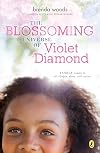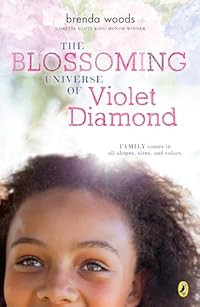
The Blossoming Universe of Violet Diamond
by Brenda Woods
On This Page
Description
"A biracial girl finally gets the chance to meet the African American side of her family"--Tags
Recommendations


Member Reviews
This is one of those books that should be read and discussed not just by kids who can relate to the protagonist, but by all as a way to build empathy for others. It's about a charming, curious, and lively biracial girl who struggles to fit in with her all white family (her father died in a car accident before she was born). Determined to understand her black identity, she arranges a meeting with her African-American grandmother, whom she'd never met. Woods doesn't shy away from the topics of race and racism, which I think can generate lots of discussion among young people. Violet's reflective nature and curiosity make sure this book doesn't get too heavy. Not to mention, the cover features an African American girl!
Ever relatable and bi-racial Violet Diamonds feels singled out and incomplete in the predominantly white town of Moon Lake, Washington. Her family is white. Her best friend is white. The only time she feels she belongs is with her friend's, Yaz's, family. At eleven year's old Violet is still trying to find herself (think pre-teen/teen angst but less whiny) and her journey leads her to her other family. Her black family. With her grandmother, Roxanne Diamond, Violet learns countless things about her deceased father and returns home feeling like not so many pieces are missing. I loved this story. Growing up in a predominantly white neighborhood as an African American definitely has its challenges. You're looked at funny when you're out show more with friends. Whenever someone mentions your parents and you say it's just your mom, their expressions are pitying and also assuming. So even though I'm not bi-racial, I can completely relate to V. She is a smart and curious narrator. I truly enjoyed being inside of her head throughout the book. I adored both sides of her family and bonded with them. Almost every character felt fleshed out and authentic, especially Violet. Top notch. show less
Violet Diamond is eleven years old, has a wonderful family, good friends and a lot of hobbies. Something is missing in her family, her father died a couple months before she was born. She feels disconnected because she never met any of his family before. She struggles because her mom and sister are white but she is black. She feels like the black sheep of the family because everyone is fair skinned with light eyes, but she looks different. She doesn't want to feel like an outcast so she reaches out to her father's mother in hopes to learn about her African American side of the family. As a society, there is still some tension between races and Violet gets it from both sides. She felt like she didn't belong in either world, in the white show more culture she was seen as half- black, but in the black culture she was seen as half-white. This book made me miss my Maw Maw(grandmother) because I can relate to the bond between a grandmother and a granddaughter. I had a great relationship with my Maw Maw before she passed away. The relationship between Violet and Bibi was especially touching and definitely had me wanting more. My Maw Maw and I had a really close relationship, just like Bibi and Violet towards the end of the book. show less
Violet, whose dad died in a car accident before she was born, is starting to wonder about her missing piece. She's growing up in a suburb outside of Seattle. She knows her dark skin and curly hair make her stand out. And she hates the looks she gets from strangers when she is with her mom and her blond, light-skinned sister. V is biracial, and she is curious about her paternal grandma, Roxanne Diamond, an artist she's never met. When she finds her grandma is going to be doing a show in Seattle, she talks her mom into going so she can meet her and try to connect with the African-American side of herself.
A touching book. Things end up to be packaged nice and neat, maybe a little too so.
A touching book. Things end up to be packaged nice and neat, maybe a little too so.
While reading this book I definitely felt like I can relate to the author. I loved her style of writing and her visual wording. This made me really get into the book because I felt like I can visualize everything. I feel like the way she chose to begin the book grasps her audience in a very different way. She says something in which everyone can relate to and chooses to expand on that quote. I enjoyed reading this book because it was very interesting to see how she felt towards her family. I also enjoyed reading the book and relating it to myself as a kid. At times I felt exactly as she felt, the feeling of not belonging somewhere, but then again you feel like you should belong. Therefore, you try to prove that you belong somewhere. show more This book had a very different style than others that I have read in the past but it was definitely a good book interpret. I feel like it's beneficial for children to read this book because it would make them see that if they're dealing with the same difficulties as she is doing , then they won't feel isolated. show less
Violet tells her story of her life as a biracial 11-year-old. Most families around her have what she describes a "real family"; a mom, dad, and their children. This was not the case for Violet. Her dad died when she was young. Violet's dad was black while her mom was white and since her dad died, she was the only one in her family that had dark skin. Along with her family being white, she lived in a city where the majority of people were white, too.
If Violet's life represented a puzzle, she was missing quite a few pieces and she could feel that. All Violet ever wanted was a "real family" (her mom, sister, and dad) so when she was seen with all three, the public would understand, oh she is biracial by looking at her dad and mom. Instead show more of people looking at her funny when she was out with her family due to the skin color issue. When Violet finds her missing puzzle pieces, she also discovers she is unique, beautiful, and proud of her family background of her dad's side. She changes her wish from being a real family (to stop the nasty looks) to herself discovering her dad's side of the family and being proud of what she looks like and why. She needed to discover her missing puzzle pieces in her life and she did not find this out until she hung out with her dad's family during the summer.
I would say the theme of the book is to discover who you are and be proud of it. Everyone is different in each and every way and that is perfectly okay. This does not refer only to race, but to other scenarios that make you different.
Violet had a 500-page journal that she wrote in, daily. In her journal, it included: new words & their definitions, wishes, & dreams to always remember. This journal helped Violet with her thoughts and learning new words. She used her big words and things she research to spark up conversations with people to show them how smart she was. By doing this, it also helped her feel a bit more confident in her self because people focused more on praising how smart she was instead of questioning her looks.
This book can relate to any race (minority or majority).
Readers can also relate to this, other than race, by being different, unique, or feeling out of place. It allows the readers to connect with what Violet Diamond is going through and how she, her family, and the outside world handles the big issue of being/looking different. show less
If Violet's life represented a puzzle, she was missing quite a few pieces and she could feel that. All Violet ever wanted was a "real family" (her mom, sister, and dad) so when she was seen with all three, the public would understand, oh she is biracial by looking at her dad and mom. Instead show more of people looking at her funny when she was out with her family due to the skin color issue. When Violet finds her missing puzzle pieces, she also discovers she is unique, beautiful, and proud of her family background of her dad's side. She changes her wish from being a real family (to stop the nasty looks) to herself discovering her dad's side of the family and being proud of what she looks like and why. She needed to discover her missing puzzle pieces in her life and she did not find this out until she hung out with her dad's family during the summer.
I would say the theme of the book is to discover who you are and be proud of it. Everyone is different in each and every way and that is perfectly okay. This does not refer only to race, but to other scenarios that make you different.
Violet had a 500-page journal that she wrote in, daily. In her journal, it included: new words & their definitions, wishes, & dreams to always remember. This journal helped Violet with her thoughts and learning new words. She used her big words and things she research to spark up conversations with people to show them how smart she was. By doing this, it also helped her feel a bit more confident in her self because people focused more on praising how smart she was instead of questioning her looks.
This book can relate to any race (minority or majority).
Readers can also relate to this, other than race, by being different, unique, or feeling out of place. It allows the readers to connect with what Violet Diamond is going through and how she, her family, and the outside world handles the big issue of being/looking different. show less
This is an uplifting story about a young biracial girl struggling to come to terms with her own identity. This book by Brenda Woods addresses some fairly controversial subjects, including but not limited to, the difficulties faced by females of mixed race. The issues of black hair and skin color are both mentioned multiple times throughout the book, but I think that the most poignant issue addressed in this story is that of beauty.
Violet struggles with the color of her skin-- something that I think many black women and girls have experience with. Very early on in the novel, it becomes apparent that Violet doesn't see herself as being beautiful. Moreover, the way that Violet came across to me, I almost felt that she believed that she show more could never be beautiful because, unlike her white sister, she was "brown haired, brown eyed, brown skinned, biracial" (17). At one point in the story, Violet even notes that she cannot remember ever having been called "beautiful" before. I personally found this to be one of the most heartbreaking scenes in the entire novel, and I am glad that Woods was unafraid to broach this controversial topic. My one main criticism for this book, though, is that while Woods opened this topic for discussion, I don't feel that I received proper closure on it. It is true that by the end of the novel, Violet seems to have come to terms with her race and has gained an appreciation for the ways in which she is different; however, I wish that it would have somehow been suggested that she had dispelled her previously held belief that only tall, blonde-haired women could be "breathtaking."
Despite this, I think that this book could prove itself to be life-changing to young girls of color and/or mixed race. In some ways, I found myself in Violet Diamond, and this book would have been of great value to me had I found it ten years ago. On the other hand, I believe that this book could still be relatable to those children who might not be black or biracial but who still feel that they are ostracized for being different somehow, and it could also be eye-opening to those children who have never experienced these things before. I think that this is a wonderful novel that introduces young readers to the still-complicated issue of race relations in the 21st century-- I would recommend it! show less
Violet struggles with the color of her skin-- something that I think many black women and girls have experience with. Very early on in the novel, it becomes apparent that Violet doesn't see herself as being beautiful. Moreover, the way that Violet came across to me, I almost felt that she believed that she show more could never be beautiful because, unlike her white sister, she was "brown haired, brown eyed, brown skinned, biracial" (17). At one point in the story, Violet even notes that she cannot remember ever having been called "beautiful" before. I personally found this to be one of the most heartbreaking scenes in the entire novel, and I am glad that Woods was unafraid to broach this controversial topic. My one main criticism for this book, though, is that while Woods opened this topic for discussion, I don't feel that I received proper closure on it. It is true that by the end of the novel, Violet seems to have come to terms with her race and has gained an appreciation for the ways in which she is different; however, I wish that it would have somehow been suggested that she had dispelled her previously held belief that only tall, blonde-haired women could be "breathtaking."
Despite this, I think that this book could prove itself to be life-changing to young girls of color and/or mixed race. In some ways, I found myself in Violet Diamond, and this book would have been of great value to me had I found it ten years ago. On the other hand, I believe that this book could still be relatable to those children who might not be black or biracial but who still feel that they are ostracized for being different somehow, and it could also be eye-opening to those children who have never experienced these things before. I think that this is a wonderful novel that introduces young readers to the still-complicated issue of race relations in the 21st century-- I would recommend it! show less
Members
- Recently Added By
Lists

Books Read in 2016
4,666 works; 199 members
Author Information
10+ Works 1,829 Members
Awards and Honors
Awards
Classifications
- Genres
- Kids, Tween, Fiction and Literature, Children's Books
- DDC/MDS
- 813.6 — Literature & rhetoric American literature in English American fiction in English 2000-
- LCC
- PZ7 .W86335 .B — Language and Literature Fiction and juvenile belles lettres Fiction and juvenile belles lettres Juvenile belles lettres
- BISAC
Statistics
- Members
- 351
- Popularity
- 88,853
- Reviews
- 47
- Rating
- (4.31)
- Languages
- English
- Media
- Paper, Audiobook, Ebook
- ISBNs
- 14
- ASINs
- 4