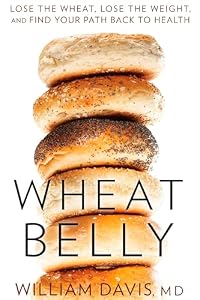
Wheat Belly: Lose the Wheat, Lose the Weight, and Find Your Path Back to Health
by William Davis
On This Page
Description
A renowned cardiologist explains how eliminating wheat from our diets can prevent fat storage, shrink unsightly bulges, and reverse myriad health problems.Tags
Recommendations


Member Recommendations
Member Reviews
When it comes to books on health and nutrition, I'm constitutionally skeptical of any author who makes sweeping claims that a particular regimen can produce miraculous results. I'm particularly dubious when the claims encompass multiple areas.
That's kind of what the author does in this book. His thesis is that wheat isn't wonderful thing it's cracked up to be. While wheat may have provided the foundation for agriculture, which led to the establishment of permanent settlements and, ultimately, civilization, he claims that the substance is responsible for a host of ailments.
To my surprise, I found some of his arguments convincing. For one thing, he demonstrates that modern wheat is a much different plant than the the seed-bearing grass show more that humans began to cultivate thousands of years ago. Even before the gene splicers at Monsanto got their hands on it, the wheat of a century ago had been hybridized so that it bore only a pale resemblance to the plant that produced the flour used to make the loaves that Jesus distributed.
He cites studies that claim that the human digestive system has never been able to properly digest gluten and other components.
I find his arguments persuasive, though I'm taking him at his word that the studies he cites are scientifically valid. My skepticism increases, though, when he makes claims (again supposedly based on legitimate scientific studies) that wheat is also responsible for a wide variety of physical and mental health ills much different from diabetes and beer bellies.
But he really grabbed my attention when he demonstrated how pervasive wheat is in the modern diet. Even if one avoids the bread aisle in the supermarket, wheat or its byproducts are pervasive in all sorts of processed foods.
I'm toying with the idea of trying to go wheat free for several months just to see what kind of change it might make in my health, weight, and energy level. I know that it would require a lot of inconvenience and discipline on my part, and that scares me.
We'll see. show less
That's kind of what the author does in this book. His thesis is that wheat isn't wonderful thing it's cracked up to be. While wheat may have provided the foundation for agriculture, which led to the establishment of permanent settlements and, ultimately, civilization, he claims that the substance is responsible for a host of ailments.
To my surprise, I found some of his arguments convincing. For one thing, he demonstrates that modern wheat is a much different plant than the the seed-bearing grass show more that humans began to cultivate thousands of years ago. Even before the gene splicers at Monsanto got their hands on it, the wheat of a century ago had been hybridized so that it bore only a pale resemblance to the plant that produced the flour used to make the loaves that Jesus distributed.
He cites studies that claim that the human digestive system has never been able to properly digest gluten and other components.
I find his arguments persuasive, though I'm taking him at his word that the studies he cites are scientifically valid. My skepticism increases, though, when he makes claims (again supposedly based on legitimate scientific studies) that wheat is also responsible for a wide variety of physical and mental health ills much different from diabetes and beer bellies.
But he really grabbed my attention when he demonstrated how pervasive wheat is in the modern diet. Even if one avoids the bread aisle in the supermarket, wheat or its byproducts are pervasive in all sorts of processed foods.
I'm toying with the idea of trying to go wheat free for several months just to see what kind of change it might make in my health, weight, and energy level. I know that it would require a lot of inconvenience and discipline on my part, and that scares me.
We'll see. show less
Atkins diet in disguise. Listen, folks, according to this book: you're not ONLY supposed to cut out wheat, nope. You are supposed to cut out all gluten, all gluten-free products (with rice, oat, and all grains basically), most fruits, and anything with carbohydrates (potatoes, corn, beans). Of course you will lose weight, how much meat and fat can you eat in a day?
ASSUMING it's true (it's not, because it's anecdotal and some pseudo science) I will never ever attempt this diet and limit what I love. I rather die prematurely than stop eating fruits and grains just because some author decided it would be cool to go low-carb.
Guess what? No one lives forever. And our ancestors probably died in their 30s and they ate all natural and non-GMO show more products. So there. :)
That is how it is with people, they like to blame food groups on their health problems. Give me a person with absolutely no health problems and I can assure you it is not because of their diet ONLY. Everyone is different, our bodies are different, so having everyone follow the same diet is UTTER. STUPIDITY.
Stay away from any diet that cuts out a major food group or type. It's most likely because the author is biased and personally hates the taste of that food.
Those bagels on the cover do look delicious though. show less
ASSUMING it's true (it's not, because it's anecdotal and some pseudo science) I will never ever attempt this diet and limit what I love. I rather die prematurely than stop eating fruits and grains just because some author decided it would be cool to go low-carb.
Guess what? No one lives forever. And our ancestors probably died in their 30s and they ate all natural and non-GMO show more products. So there. :)
That is how it is with people, they like to blame food groups on their health problems. Give me a person with absolutely no health problems and I can assure you it is not because of their diet ONLY. Everyone is different, our bodies are different, so having everyone follow the same diet is UTTER. STUPIDITY.
Stay away from any diet that cuts out a major food group or type. It's most likely because the author is biased and personally hates the taste of that food.
Those bagels on the cover do look delicious though. show less
This book starts off rather heavy handed in its premise--that wheat is largely respnsible for our nation's epidemics of diabetes, heart disease, and obesity, among other maladies. While I agree that wheat plays a large role, I'm not convinced it's as large as purported by the author. The explanations provided by the author as to how wheat exerts its nefarious influences are sound and logical to a scientifically oriented person like myself, also an MD, and I much appreciated the physiological and biochemical details (though these were presented in a way that I feel would be accessible and interesting to the reader without a science background).
After the introduction, the author does give some more credence to other factors such as show more reduced physical activity, and the ready availability and heavy use of carbohydrates in the diet in the past century as playing a large role in the above problems and others, coming away a bit from the near "wheat is the only villian" assertion. However, the premise still remains that wheat is the biggest baddie, and I'm just not so sure. I do agree, as I've said, that it plays a much misunderstood and enormous role, but there are others players here.
Finally, I appreciated the organization of the chapters into various systems/disease processes affected by wheat. Also, the inclusion, at the end of the book, of guidelines for eating without wheat, as well as recipes that highlight his other reccommedations such as incorporating more nuts, cheese, eggs, some meats and fruits, and vegetables into one's diet are helpful, if one wants to put his recommendations into practice but needs some concrete ideas to begin. The recipes that feature bread like foods made with wheat alternatives, such as coconut or almond flours, instead of other possibly insulin raising wheat alternatives, are also a smart addition. Most people would probably have a very difficult time not eating bread like foods and making these types of foods is not straightforward when you are used to the methods and results that baking with gluten entails. All in all, a very interesting premise that could use closer examination in our own lives as well as further research by the scientific and medical communities. show less
After the introduction, the author does give some more credence to other factors such as show more reduced physical activity, and the ready availability and heavy use of carbohydrates in the diet in the past century as playing a large role in the above problems and others, coming away a bit from the near "wheat is the only villian" assertion. However, the premise still remains that wheat is the biggest baddie, and I'm just not so sure. I do agree, as I've said, that it plays a much misunderstood and enormous role, but there are others players here.
Finally, I appreciated the organization of the chapters into various systems/disease processes affected by wheat. Also, the inclusion, at the end of the book, of guidelines for eating without wheat, as well as recipes that highlight his other reccommedations such as incorporating more nuts, cheese, eggs, some meats and fruits, and vegetables into one's diet are helpful, if one wants to put his recommendations into practice but needs some concrete ideas to begin. The recipes that feature bread like foods made with wheat alternatives, such as coconut or almond flours, instead of other possibly insulin raising wheat alternatives, are also a smart addition. Most people would probably have a very difficult time not eating bread like foods and making these types of foods is not straightforward when you are used to the methods and results that baking with gluten entails. All in all, a very interesting premise that could use closer examination in our own lives as well as further research by the scientific and medical communities. show less
I am on record as not being an advocate of all-or-nothing diets and this one is in that line. I know fully how restrictive gluten-free is, I have to live that life due to a very strenuous gluten allergy and it can be terribly hard. He confirmed my belief that there is too much gluten in things and that the gluten today is stronger and meaner than the gluten many years ago. Personally I belive that with the prevalence of gluten, it has become a serious issue and people are actually hurting because of it.
If you doubt that there is gluten in too many things, take a look at your lunch. You're eating crisps? May contain gluten. Chocolate? May contain gluten. That sandwich? duh. The chicken on it, check it again, can contain gluten. The show more mayonaise? possibly gluten. They even bulk up some coffee with barley or wheat, which contain gluten.
Do I think it's a practical diet? No.
Do I think it's for everyone? No.
Do I think some people might benefit from it? Yes
Do I think it's the panacea for all ills? No
To be honest I'm more in favour of 80/20 diets and think that people could stick to them. Completely excluding wheat/gluten/refined carbohydrate from your diet is a uphill task and while some of what he says makes sense and might be your thing, it might not.
I also have certain issues about the use of artifical sweeteners, I'm not sure about the safety. show less
If you doubt that there is gluten in too many things, take a look at your lunch. You're eating crisps? May contain gluten. Chocolate? May contain gluten. That sandwich? duh. The chicken on it, check it again, can contain gluten. The show more mayonaise? possibly gluten. They even bulk up some coffee with barley or wheat, which contain gluten.
Do I think it's a practical diet? No.
Do I think it's for everyone? No.
Do I think some people might benefit from it? Yes
Do I think it's the panacea for all ills? No
To be honest I'm more in favour of 80/20 diets and think that people could stick to them. Completely excluding wheat/gluten/refined carbohydrate from your diet is a uphill task and while some of what he says makes sense and might be your thing, it might not.
I also have certain issues about the use of artifical sweeteners, I'm not sure about the safety. show less
The beginning of the book was difficult to get through because it's all science. Yes, it's good to know how Davis came to his conclusion that living without wheat will make a person healthier, but twelve chapters seemed long.
He explains the best way to cut wheat out of your diet is cold turkey and goes on to give reasons why some people also cut out cornmeal, rice, nightshades and soda in order to feel healthier. He provides a list of things you should eat. The book includes a one week meal plan.
I do believe the wheat we eat now is different from what was available 50 years ago and no one knows the long-term effects of the genetically modified wheat we're ingesting. One of my best friends feels better on a gluten free diet. I am show more ingesting more fruits and vegetables at meal time and eating less processed items but I'm not certain I'm ready to try a wheat free diet at this time. show less
He explains the best way to cut wheat out of your diet is cold turkey and goes on to give reasons why some people also cut out cornmeal, rice, nightshades and soda in order to feel healthier. He provides a list of things you should eat. The book includes a one week meal plan.
I do believe the wheat we eat now is different from what was available 50 years ago and no one knows the long-term effects of the genetically modified wheat we're ingesting. One of my best friends feels better on a gluten free diet. I am show more ingesting more fruits and vegetables at meal time and eating less processed items but I'm not certain I'm ready to try a wheat free diet at this time. show less
The book presented a lot of scientific evidence that wheat in our diet can cause all sorts of problems we never thought about. Davis discusses all the various diseases that wheat and gluten can cause in some people (eg. Celiac disease) but also has anecdotal stories about his own patients with various complaints - painful joints, high cholesterol, etc. - who he advised to try eliminating wheat totally from their diet, with amazing results. I very much enjoyed reading about those cases, and all of the scientific studies that support the author's premise. All was well until the end of the book when he got down to the nitty-gritty about how to eliminate the wheat, and at that point listed a whole bunch of other foods that you should rarely show more or never eat. I agree with another reviewer that the diet really only left you with unlimited nuts, cheese, eggs, meat, and vegetables. After reading this book, convincing as it was, I think while I will continue to cut back on wheat products, I'm not ready to give them up entirely. I think that extra list of verboten foods at the end shows that the author himself knows that wheat is not the only culprit, and while his diet is likely very healthy, it is not for everyone. show less
2.5 stars.
I'm not necessarily disagreeing with much of what the author writes, but much of his evidence is not scientifically backed-up even though he goes into quite a few scientific explanations in the book. The author often says things like 'research was never done in this area' or 'research needs to be done in this area' in regard to many of his theories. Much of his philosophy seems to be based on his physical observations but w/out the scientific evidence to back it up. I think much of what he says is probably right & is on track (& a few other things are over-simplified), but the extreme dietary changes he advocates & science studies he does quote are weirdly (off)balanced by his repetition that these ideas are based mainly on show more personal observation. Also, his manner of writing is almost provocative -- making it a bit of a stressful read, imo.
Many dietary books recommend cutting out carbs anyway, and Davis does do that (w/ the caveat that all wheat be cut out completely & that wheat is the most-damaging carb for you). I just wish he had presented his info/stance in a somewhat different manner.
Tried/slightly modified version of one of the recipes in the back of the book & liked it. Will try more of the recipes.
Info re: cutting out wheat = probably good.
Theories = various but most stated w/out scientific back-up or research.
Presentation = so-so.
Recipes = good/tasty &/or seem do-able. show less
I'm not necessarily disagreeing with much of what the author writes, but much of his evidence is not scientifically backed-up even though he goes into quite a few scientific explanations in the book. The author often says things like 'research was never done in this area' or 'research needs to be done in this area' in regard to many of his theories. Much of his philosophy seems to be based on his physical observations but w/out the scientific evidence to back it up. I think much of what he says is probably right & is on track (& a few other things are over-simplified), but the extreme dietary changes he advocates & science studies he does quote are weirdly (off)balanced by his repetition that these ideas are based mainly on show more personal observation. Also, his manner of writing is almost provocative -- making it a bit of a stressful read, imo.
Many dietary books recommend cutting out carbs anyway, and Davis does do that (w/ the caveat that all wheat be cut out completely & that wheat is the most-damaging carb for you). I just wish he had presented his info/stance in a somewhat different manner.
Tried/slightly modified version of one of the recipes in the back of the book & liked it. Will try more of the recipes.
Info re: cutting out wheat = probably good.
Theories = various but most stated w/out scientific back-up or research.
Presentation = so-so.
Recipes = good/tasty &/or seem do-able. show less
Members
- Recently Added By
Published Reviews
Davis has an amusingly dramatic and colloquial writing style that most readers will appreciate as making science entertaining, and cites 16 pages of studies to back up his theories.
added by VivienneR — edited by private library
Lists

Books Read in 2025
4,043 works; 97 members
Author Information

20 Works 2,177 Members
William Davis, MD, is the #1 New York Times bestselling author and cardiologist who advocates unique, insightful, cutting-edge strategies to help individuals discover the health hidden within them. His blog, wheatbellyblog.com. has been visited by millions of people. Dr. Davis has also shared his passion for wheat-free living on national show more television shows including The Dr. Oz Show and CBS This Morning. He is the author of four other books: Wheat Belly, Wheat Belly Cookbook. Wheat Belly 30-Minute (or Less!) Cookbook and Wheat Belly 10-Day Grain Detox. His wheat Belly Total Health program has become a nationwide public television special, and he has launched a Wheat Belly 10-Day Grain Detox online course. He lives in Wisconsin. show less
Some Editions
Awards and Honors
Distinctions
Series
Belongs to Publisher Series
Goldmann (17358)
Work Relationships
Has as a reference guide/companion
Common Knowledge
- Canonical title*
- Weizenwampe. Warum Weizen dick und krank macht
- Original title
- Wheat Belly. Lose the Wheat, lose the Weight and Find Your Path Back to Health
- Original publication date
- 2011
- Dedication
- For Dawn, Bill, Laren, and Jacob, my companions on this wheat-free journey
- First words
- Flip through your parents' or grandparents' family albums and you're likely to be struck by how thin everyone looks.
- Last words
- (Click to show. Warning: May contain spoilers.)See you in the fresh-produce aisle.
- Original language
- English
*Some information comes from Common Knowledge in other languages. Click "Edit" for more information.
Classifications
Statistics
- Members
- 1,364
- Popularity
- 17,310
- Reviews
- 55
- Rating
- (3.64)
- Languages
- 8 — Dutch, English, French, German, Polish, Portuguese, Spanish, Swedish
- Media
- Paper, Audiobook, Ebook
- ISBNs
- 35
- UPCs
- 1
- ASINs
- 14